Introduction
Shoppers today don't just want to find a product — they want to feel like the store already knows them. That shift from passive browsing to expectation-driven, conversation-led retail has happened faster than most retailers anticipated.
The numbers reflect real pressure. According to McKinsey, personalization typically drives a 10–15% revenue lift, and fast-growing companies generate 40% more revenue from personalization than slower peers. Meanwhile, Salesforce found that 73% of customers expect better personalization as technology improves — and 68% won't return to a chatbot after a single negative experience.
The gap between what shoppers expect and what most retailers currently deliver is where AI chatbots come in. Unlike static product pages or keyword search bars, AI-powered chat creates something closer to a real conversation — one that adapts in real time based on who the shopper is and what they actually need.
What follows is a practical breakdown of how that personalization actually works — and what it takes to build it.
Key Takeaways
- AI chatbots personalize recommendations using purchase history, browsing behavior, and live session signals
- Personalization extends beyond discovery — covering cart recovery, order support, and loyalty engagement
- AI-influenced chat drove 42% more customer service engagement in the 2024 holiday season vs. 2023
- A working personalization chatbot requires clean, unified customer data before anything else
- SMBs can deploy on AWS without enterprise budgets using pre-configured services and an implementation partner
What Makes AI Retail Chatbots Different from Basic Bots
The chatbot on a retail site and the one inside a modern AI shopping assistant may look identical from the outside. Under the hood, they're solving completely different problems.
Rule-based bots follow scripted decision trees — useful for answering store hours or return policy questions, but unable to handle anything outside their fixed script. When a shopper asks something unexpected, the experience breaks down. As AWS notes, rule-based bots simply cannot manage open-ended conversations or adapt to unknown inputs.
AI-powered chatbots work differently. They use natural language processing (NLP) and machine learning to understand intent and generate responses that fit the specific context of that conversation — not just match keywords to canned replies.
Conversational Context: The Core Difference
The feature that separates AI chatbots from glorified FAQ bots is conversational context. An AI chatbot doesn't treat each message as an isolated query — it understands the full thread.
That means a response to "do you have something similar but in a warmer color?" is shaped by:
- What the shopper browsed in the last 10 minutes
- Which items they've purchased before
- How long they lingered on specific product pages
- Whether they've engaged with promotions previously
Every response is informed by that accumulated context, making it feel less like a search engine and more like a knowledgeable assistant.
The Move Toward Agentic AI
The next step beyond conversational AI is agentic AI — chatbots that don't just respond, but proactively guide. Rather than waiting to be asked, an agentic assistant might notice a shopper has visited the same jacket three times and surface a size guide or trigger a limited-time offer. Salesforce's Agentforce for Retail describes this kind of assistant as purpose-built for retail, connecting discovery, checkout, and post-purchase support without breaking the conversation at each handoff.
How AI Chatbots Actually Personalize the Retail Shopping Experience
Personalization at scale is a data architecture problem — and modern AI chatbots are built to solve it in real time.
Data Inputs That Drive Real-Time Relevance
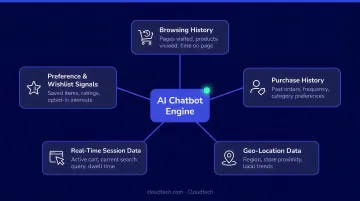
AI chatbots pull from multiple data sources simultaneously to shape every response:
- Purchase history — what the shopper has bought, at what price point, how often
- Browsing behavior — categories explored, time spent on specific pages, products viewed repeatedly
- Wishlist and saved items — signals of intent without commitment
- Loyalty program status — tier, points balance, past redemptions
- Session behavior — what they've clicked, scrolled, or hovered over in the current visit
Amazon Personalize, for example, synthesizes interaction data across users and items in real time, requiring at least 50,000 item interactions from 1,000 users for quality recommendations — a threshold most active retail sites reach quickly.
Dynamic Behavioral Profiling Mid-Session
Shopper profiles aren't static. An AI model continuously updates its understanding of a customer as the conversation unfolds. Someone who starts by browsing minimalist home decor and then asks about "cozy throw blankets" is telling the system something — and the chatbot adjusts its recommendations accordingly, mid-session, without any manual intervention.
Personalized Product Recommendations
Two algorithmic approaches underpin most retail chatbot recommendation engines:
- Collaborative filtering — surfaces products based on patterns from shoppers with similar behavior (what people like you also bought)
- Content-based filtering — matches items based on product attributes that align with a shopper's demonstrated preferences
The result isn't just "popular items" — it's a narrowed, contextually relevant set that matches what that specific shopper is looking for right now.
Contextual Offers and Hesitation Detection
When a shopper has been matched to the right product, the next challenge is converting interest into action. That's where triggered offer delivery comes in. When a chatbot detects hesitation signals — a shopper visiting a product page three times without adding to cart, for instance — it automatically surfaces a personalized discount, bundle suggestion, or urgency prompt.
This differs from blanket promotional emails in three specific ways:
- Trigger: behavioral signal, not a scheduled send
- Timing: immediate, in the same session
- Relevance: tied to a product the shopper already demonstrated interest in
Personalization Beyond Purchase
Personalization doesn't end at checkout. AI chatbots extend the relationship through:
- Post-purchase follow-up — suggesting complementary products after delivery
- Return and exchange support — resolving issues with context from the original order
- Review requests — timed based on product type and delivery date
- Loyalty tier nudges — informing shoppers how close they are to a reward milestone
Top Personalization Use Cases for Retail AI Chatbots
Product Discovery and Guided Selling
For retailers with large catalogs — fashion, beauty, electronics — the discovery problem is real. Shoppers faced with hundreds of options often leave without buying. Accenture found that 74% of consumers walked away from purchases in late 2023 because they felt overwhelmed by choice.
AI chatbots work like a skilled in-store associate, asking about size, style preference, budget, or occasion before narrowing thousands of SKUs to a handful of relevant options. Bloomreach's Loomi Conversational Agent does exactly this, reasoning through multi-factor shopper requests and surfacing recommendations with context pulled from product reviews.
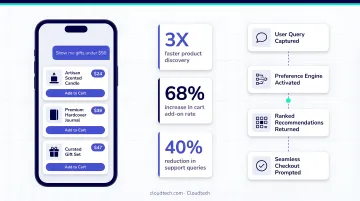
A typical guided-selling exchange looks like:
- Shopper says: "I need a gift for my sister who runs marathons, under $80"
- Chatbot filters by activity type, price range, and gender fit
- Returns 3-4 specific product options with review highlights and size guidance
Abandoned Cart Recovery
Cart abandonment averages 70.22% across e-commerce, according to Baymard's 2025 analysis of 50 studies. Most of those abandoned carts aren't decisions — they're hesitations. A chatbot that identifies the specific product a shopper left behind, references it by name, and addresses the likely sticking point (size availability, shipping cost, return policy) converts hesitation into action more effectively than a generic reminder email.
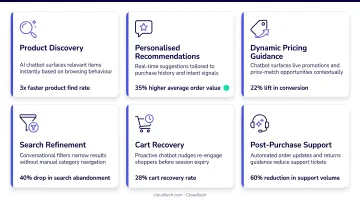
Real-Time Order Support That Doubles as Engagement
A shopper waiting on a delayed shipment is already engaged — they've opened the app or website with intent. AI chatbots connected to order management systems can:
- Proactively deliver shipping updates before the customer asks
- Address delivery concerns without routing to a human agent
- Suggest related products while the customer is already attentive
One interaction handles the concern and opens a selling moment simultaneously.
Loyalty Program Personalization
Most loyalty programs underperform because they're invisible between purchase moments. Salesforce found consumers actively engage with only one-third of the roughly 18 reward programs they belong to — the rest sit dormant. AI chatbots change that by surfacing loyalty relevance mid-conversation: showing a customer their current point balance, how close they are to the next tier, or flagging a member-only offer before they check out.
Omnichannel Continuity
Shoppers move between channels — website, mobile app, WhatsApp, in-store kiosk — and expect the experience to follow them. Salesforce's 2023 State of the Connected Customer found 56% of customers have to repeat information to different representatives. AI chatbots that maintain session continuity across channels fix this directly — customers never have to repeat themselves.
Real-World Examples of AI Chatbot Personalization in Retail
Sephora
Sephora launched a ChatGPT plugin in 2023, enabling U.S. customers to discover and shop beauty products through curated recommendations tied directly to their Beauty Insider profile data. The integration connects personal purchase history and loyalty status to AI-driven product suggestions — a direct application of the kind of data-backed personalization that moves conversion.
Starbucks
Starbucks deployed My Starbucks Barista in 2017, allowing customers to place food and drink orders via voice command or messaging in the mobile app. The personalization hook was remembering a customer's regular order and preferences — reducing friction to near zero for repeat purchases.
Walmart
Walmart's Sparky, launched in 2025, synthesizes product reviews and generates occasion-based recommendations through a conversational interface. Walmart has also partnered with OpenAI to let shoppers purchase directly through ChatGPT — taking personalized retail beyond Walmart's own digital properties.
SMB Scale: Bella Sante
Not every compelling example comes from a Fortune 500. According to Tidio's 2025 e-commerce roundup, Bella Sante — a smaller-scale spa and beauty brand — automated 75% of its FAQ volume using Lyro AI and generated $66,000 in assisted sales. For a business running lean on support staff, that's a direct revenue line tied to AI — and a sign of how accessible these tools have become.
On the broader impact: Salesforce reported that AI and agents influenced 19% of all online holiday orders in 2024, representing $229 billion in global online sales.
How to Build the Cloud Foundation for AI Chatbot Personalization
Personalization chatbots require real infrastructure — good intentions don't process behavioral signals or serve recommendations in milliseconds.
The Technical Foundation
A working retail AI chatbot requires:
- Real-time data pipelines connecting customer data platforms, product catalogs, CRM, and inventory systems
- Low-latency cloud infrastructure capable of processing personalization signals in milliseconds
- Unified customer identity across online and in-store channels
Without these, the chatbot has no material to work with. It can answer questions, but it can't personalize.
Key AWS Services for Retail AI Chatbots
Three AWS services form the backbone of most production retail chatbot architectures:
| Service | Role |
|---|---|
| Amazon Lex | Conversational AI — handles voice and text interfaces with natural language understanding |
| Amazon Personalize | Real-time recommendation engine — collaborative filtering and behavioral signals at scale |
| Amazon Bedrock | Generative AI foundation — builds and runs production-scale AI agents and assistants |
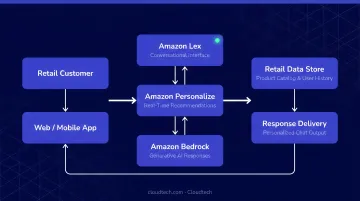
AWS has published a full tutorial for building an e-commerce product recommendation chatbot using Bedrock Agents, and the AWS Solutions Library provides generative AI shopping assistant architecture guidance for retailers building this stack.
Data Readiness: The Make-or-Break Factor
Poor data architecture is the most common reason personalization chatbots underperform — not the AI itself.
Before investing in a chatbot layer, retailers should:
- Audit existing customer data sources — where does customer data live and in what format?
- Unify online and in-store data — a loyalty profile split across systems can't power real-time personalization
- Establish clean data flows — Amazon Personalize recommends at least 50,000 interactions from 1,000 users for reliable recommendations
- Resolve identity across channels — the same customer on mobile and desktop should be recognized as one profile
Implementation Guidance for SMBs
Small and mid-size retailers don't need to build any of this from scratch. Pre-configured AWS solutions reduce the architecture burden , and working with an AWS-certified consulting partner compresses the path from concept to production.
Cloudtech, an AWS Advanced Tier Partner based in New York, specializes in conversational AI and generative AI deployments for SMBs — deployed inside the client's AWS environment, so the retailer owns the data and infrastructure. Their core offerings for retail include:
- Conversational AI Chat — customer-facing agents trained on company-specific knowledge bases, with clean human handoff when needed
- Cloud Foundation package — builds the underlying AWS infrastructure layer for retailers starting from scratch
- Generative AI solutions — production-scale AI agents tailored to specific retail and e-commerce workflows
A well-scoped conversational AI deployment typically takes four to eight weeks, depending on data readiness and integration complexity. Working with a partner who already knows the AWS stack shortens that window considerably.
Frequently Asked Questions
How can I use AI in my retail business?
Retailers can start with AI chatbots to automate customer support, personalize product recommendations, recover abandoned carts, and support loyalty programs. Pre-configured cloud platforms on AWS make this accessible without large internal technical teams — the key is having clean, unified customer data before you start.
Which AI tool is best for retail business?
The right tool depends on your size, existing tech stack, and goals. SMBs often start with platforms like Tidio or Amazon Lex-powered solutions; enterprise retailers with Salesforce infrastructure tend toward Agentforce, while Bloomreach suits mid-market e-commerce. Evaluate on personalization depth, CRM integration, and product intelligence — not just ease of setup.
What is an example of a retail chatbot?
Sephora's Beauty Insider-connected chatbot delivers curated product recommendations tied to a customer's personal profile. Starbucks' My Starbucks Barista allows voice and text ordering within the mobile app, remembering regular preferences.
How do AI chatbots collect customer data for personalization?
AI chatbots pull from browsing history, purchase records, loyalty profiles, and real-time session behavior via CRM, customer data platforms, and e-commerce integrations. That data is assembled at the moment of interaction — not stored in the chatbot itself — which is why clean backend data architecture matters so much.
Can small retail businesses afford AI chatbot personalization?
Yes. Cloud-native solutions on AWS use pay-as-you-go pricing, and pre-packaged configurations significantly reduce the custom build cost. SMBs working with an AWS Advanced Tier Partner can access partner funding programs that further reduce upfront investment compared to building from scratch.
How long does it take to implement an AI chatbot for retail?
A basic rule-based chatbot can be live in days. A full AI-powered personalization chatbot — with CRM integration, product catalog connections, and behavioral data pipelines — typically takes four to eight weeks. Data readiness is the most common delay factor. Partnering with an experienced AWS consulting firm can cut that timeline significantly.