Introduction
Healthcare compliance is expensive — and the numbers make that hard to argue with. According to the American Hospital Association, U.S. hospitals and health systems spend nearly $39 billion annually on administrative compliance activities. An average 161-bed community hospital dedicates 59 full-time employees to regulatory compliance alone — a staggering resource commitment for any organization, let alone a small or mid-sized one.
Generative AI is drawing serious attention as a way to change this math. Unlike earlier automation tools that flagged anomalies or ran rule-based checks, generative AI can:
- Read and summarize dense regulatory text
- Draft policy documents and compliance reports
- Answer staff questions in plain language
- Help teams prepare for audits with targeted gap analysis
Deploying it responsibly in healthcare, however, requires navigating real risks: hallucinated outputs, PHI exposure, bias in training data, and a regulatory environment that's still catching up with the technology.
This guide covers what compliance teams need to know — from core use cases and regulatory frameworks to the specific challenges and best practices that determine whether a generative AI deployment succeeds or creates new liability.
Key Takeaways
- Generative AI interprets regulations, drafts documents, and answers compliance queries — capabilities that go well beyond what traditional AI/ML tools can do
- Core use cases include policy drafting, real-time monitoring, compliance Q&A, audit preparation, and staff training
- HIPAA, FDA SaMD guidance, and the EU AI Act are the three frameworks every healthcare AI strategy must address
- 53% of compliance leaders cite budget and resource constraints as their top implementation barrier
- Human oversight is non-negotiable: generative AI augments compliance judgment, it doesn't replace it
What Makes Generative AI Different for Healthcare Compliance
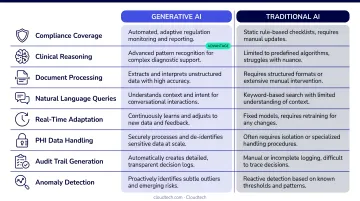
Traditional AI and ML tools excel at pattern recognition — detecting anomalies in billing data, flagging unusual access to patient records, predicting claim denial risk. These are valuable capabilities, but they stop at detection. Generative AI goes further: it produces text, which in a compliance context means drafting policy language, interpreting regulatory requirements, generating audit responses, and answering staff questions in plain English. These are tasks that previously required a compliance officer's time, judgment, and institutional knowledge.
What Generative AI Can Actually Do for Compliance Teams
Generative AI compliance tools can:
- Ingest and summarize dense regulatory frameworks (HIPAA, CMS, Joint Commission standards)
- Draft SOPs, consent forms, and audit responses aligned to specific requirements
- Simulate compliance scenarios for staff training
- Surface relevant policy clauses in response to natural language queries
- Generate alerts in plain language when documentation gaps are detected
The adoption numbers confirm this shift is already underway. Barnes & Thornburg's 2025 Healthcare Compliance Outlook, which surveyed more than 120 U.S. healthcare and life sciences organizations, found that nearly three-quarters are already using or considering AI for internal compliance functions. Yet 58% said building a governance structure for AI compliance is difficult — meaning most organizations are adopting faster than they're governing.
Why Hallucination Is the Central Risk
The same capability that makes generative AI powerful — generating fluent, confident text — is also its primary liability. Peer-reviewed research in the Journal of Legal Analysis found that general-purpose LLMs hallucinated on legal queries 58% to 82% of the time. Even RAG-based legal research tools showed hallucination rates of 17% to 33% in a Stanford/Yale evaluation.
In a compliance context, a confident-sounding but incorrect regulatory interpretation can produce non-compliant documentation — creating exactly the liability organizations are trying to avoid. Avoiding that outcome requires three things working together:
- Human-in-the-loop review at every output stage, not just final sign-off
- Retrieval-augmented generation (RAG) architectures tied to verified regulatory source documents
- Systematic output auditing that catches drift before it reaches documentation
Key Use Cases: Where Generative AI Transforms Compliance Operations
Regulatory Document Generation and Policy Drafting
Compliance teams spend enormous amounts of time drafting and updating policies, SOPs, and consent forms — working from dense source regulations that require careful interpretation. Generative AI models trained on regulatory frameworks can accelerate this process.
A team can prompt the model to draft a HIPAA-compliant breach notification procedure aligned to HHS OCR guidance, then review and refine the output rather than starting from a blank page. Applied Clinical Trials has noted this approach for pharmaceutical regulatory document drafting, noting that professional review remains essential.
The value isn't full automation — it's dramatically reducing the manual writing burden while ensuring regulatory context is properly incorporated from the start.
Real-Time Compliance Monitoring and Anomaly Flagging
Generative AI integrated with EHR and billing systems can continuously scan documentation for inconsistencies, coding errors, and documentation gaps, surfacing findings as plain-language alerts rather than raw data flags.
This matters for revenue cycle compliance specifically. An HFMA/AKASA survey found 80% of health systems were exploring or implementing generative AI tools for revenue cycle management in 2025, with a 38% jump in adoption in under two years. Research cited by a 2025 NIH review suggests generative AI could save revenue cycle professionals 41% to 50% of time across RCM stages.
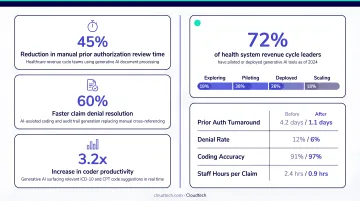
For compliance officers, real-time monitoring means fewer manual audits and earlier detection of issues before they escalate.
Intelligent Compliance Q&A and Staff Guidance
Staff questions are a constant drain on compliance teams. Queries pile up, routing everything through compliance creates delays, and informal answers spread misinformation fast.
Generative AI chatbots trained on approved internal policies can answer staff questions on demand, with responses grounded in the organization's actual policies rather than generic guidance. Mass General Brigham's documented approach to approved internal AI tools illustrates how leading health systems are creating structured, governed pathways for this kind of AI-assisted guidance.
Audit Preparation and Reporting Automation
Audit preparation is one of the most time-intensive compliance activities: aggregating evidence, drafting responses to auditor questions, and mapping documentation to specific regulatory requirements. Generative AI can pre-populate audit packages, draft narrative responses, and cross-reference documentation against HIPAA, SOX, or ACA standards.
The efficiency gains here are real. When content teams can update compliance documents without touching underlying AI logic — as Cloudtech implemented for a healthcare SaaS client using Amazon Bedrock Agents with RAG — engineering bottlenecks decrease and compliance update cycles accelerate.
Personalized Compliance Training
Standard compliance training treats every employee the same. Generative AI can analyze individual knowledge gaps and generate training scenarios tailored to specific roles, regulatory exposures, or recent policy changes.
Role-specific scenarios make a real difference in practice:
- ICU nurses need training focused on patient consent, documentation standards, and privacy protocols
- Billing specialists need coverage of coding accuracy, claim submission rules, and payer requirements
- IT staff need training tied to data access controls and breach notification procedures
AI-generated curricula update automatically as regulations change, so compliance teams aren't rebuilding training from scratch each cycle. That said, rigorous outcome benchmarks for this use case in healthcare compliance are still limited — this remains an area where evidence is accumulating rather than settled.
Regulatory Frameworks Your Generative AI Strategy Must Address
HIPAA and FDA Guidance
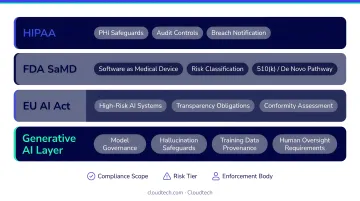
HIPAA remains the foundational U.S. privacy regulation governing how generative AI handles protected health information. Training data, model outputs, storage, and vendor relationships must all comply.
Before using PHI in AI training, organizations must apply de-identification — either Expert Determination or Safe Harbor, per HHS OCR guidance. Any cloud provider handling PHI must also sign a Business Associate Agreement.
The FDA's Total Product Lifecycle (TPLC) approach applies when generative AI is embedded in medical devices or clinical decision support tools classified as Software as a Medical Device. FDA's 2024 Digital Health Advisory Committee materials signal that TPLC will remain central to generative AI-enabled device compliance. That means the following obligations extend beyond pre-deployment validation:
- Continuous performance monitoring post-launch
- Predetermined Change Control Plans for model updates
- Ongoing post-market surveillance requirements
EU AI Act and Global Considerations
U.S. regulations don't operate in isolation. For organizations serving EU patients — or handling EU personal data — international obligations stack on top of domestic ones. The EU AI Act classifies most healthcare AI as high-risk, triggering requirements for risk management, data governance, bias mitigation, technical documentation, human oversight, and conformity assessment. This applies to any organization serving EU patients, not just European companies.
Additional compliance layers include:
- GDPR for any processing of EU personal data
- U.S. state laws in California, Colorado, and New York that impose AI-specific requirements
- HHS Section 1557 nondiscrimination protections, which HHS OCR has explicitly extended to AI-driven clinical tools
- ONC HTI-1 Final Rule, which requires transparency for predictive decision support algorithms in certified health IT
Emerging Frameworks to Monitor
The regulatory landscape is still developing. Organizations should track:
- NIST AI RMF and AI 600-1 (Generative AI Profile) — the most actionable voluntary framework for structured AI risk management in healthcare
- FTC enforcement activity around deceptive AI claims in healthcare
- FDA guidance updates as the agency refines its approach to generative AI-enabled devices
Challenges of Implementing Generative AI in Healthcare Compliance
Hallucination and Output Accuracy Risk
The hallucination risk covered earlier isn't just a technical inconvenience — it's a compliance liability. A RAG architecture that grounds outputs in verified regulatory source documents significantly reduces this risk, but does not eliminate it. Human review workflows must be built into any compliance use case, with clear protocols for when AI-generated content requires legal or clinical review before use.
Data Privacy and PHI Exposure
Generative AI systems operating on healthcare data create real re-identification risks. To manage that exposure, organizations should:
- Apply de-identification or tokenization to training data before use
- Enforce access controls limiting who can query AI systems containing sensitive data
- Confirm the underlying cloud infrastructure meets HIPAA-eligible standards, including encryption at rest and in transit
Bias in Training Data and Outputs
A 2024 peer-reviewed review found medical AI models frequently show bias toward certain patient groups, creating disparities in performance and outcomes. For compliance tools, this means AI-generated guidance or monitoring flags could be applied unevenly across demographic groups — creating regulatory exposure under Section 1557 nondiscrimination rules. NIST SP 1270 recommends identifying and managing bias throughout the AI lifecycle, not just at initial deployment.
Integration with Legacy Systems
Many healthcare SMBs run on older EHR and billing platforms that weren't designed for AI integration. This creates data silos, format incompatibilities, and API gaps that must be resolved before generative AI can function reliably. Middleware solutions or a well-architected cloud environment — with properly structured data lakes and documented data pipelines — are often prerequisites, not afterthoughts.
The SMB Resource Barrier
Barnes & Thornburg's 2025 report found 53% of healthcare organizations cite budget, staffing, and technology constraints as primary barriers, with 56% expecting those limitations to worsen. Cloud-native, pre-built compliance architectures directly address this gap — without requiring enterprise-scale budgets. Cloudtech's work with Klamath Health Partnership demonstrates the model: a HIPAA-compliant AWS data infrastructure built through a structured engagement process. The result was a 77% year-over-year reduction in infrastructure costs, freeing up budget for AI investment without the overhead of a large enterprise deployment.
Best Practices for Deploying Generative AI Compliantly in Healthcare
Establish a Governance Framework Before Deployment
Define roles, accountability structures, and review workflows before any tool goes live. This means:
- Assign output review responsibilities — who reviews AI-generated policy drafts, and who escalates concerns
- Documenting AI's role as a support tool, not a decision-maker, in all compliance workflows
- Build cross-functional governance that includes clinical, legal, IT, and compliance stakeholders from the start
- Mapping to NIST AI RMF functions (Govern, Map, Measure, Manage) as a structural guide
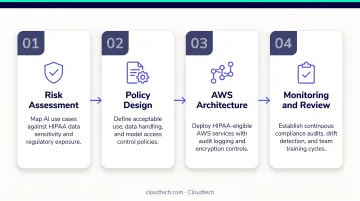
NIST AI 600-1 — the Generative AI Profile — addresses hallucination risk, synthetic content, and misuse controls — all directly applicable to healthcare compliance deployments.
Build on HIPAA-Eligible, Secure Cloud Infrastructure
The cloud architecture hosting generative AI tools must meet HIPAA eligibility requirements:
- Encryption at rest and in transit
- Comprehensive audit logging
- Least-privilege access controls
- BAAs with all cloud providers handling PHI
AWS offers HIPAA-eligible generative AI services — including Amazon Bedrock, Amazon SageMaker, and Amazon Q Business — but eligibility requires proper configuration and a signed AWS Business Associate Addendum.
Organizations working with an AWS Advanced Tier Partner like Cloudtech can accelerate compliant infrastructure setup. That includes configuring the security controls — AWS Security Hub, Amazon Macie, AWS CloudTrail, AWS Config, and AWS KMS — that form the governance backbone for any AI workload handling patient data.
Implement Ongoing Model Monitoring and Validation
Initial validation is not enough. Generative AI models in compliance contexts require:
- Continuous output monitoring for accuracy drift and hallucination patterns
- Periodic bias reviews across demographic groups and use case scenarios
- Documented model recalibration processes with version control
- Audit trails that support FDA post-market surveillance requirements for SaMD applications
Monitoring alone doesn't close the loop — staff need to understand what they're working with.
Prioritize Transparency and Staff Training
Compliance teams and clinical staff must understand what generative AI tools can and cannot do — specifically their limitations around hallucination and context misinterpretation. In Cloudtech's healthcare engagements, staff training is treated as a governance mechanism, not an afterthought. Structured onboarding and clear documentation of AI's role keep human judgment where it belongs: at the center of every AI-assisted decision.
Frequently Asked Questions
What is generative AI in healthcare compliance?
Generative AI refers to AI systems that produce text, documents, or responses based on training data. In healthcare compliance, this means tools that can draft policies, interpret regulations, answer staff queries, and assist with audit documentation.
How is generative AI different from traditional AI in healthcare compliance?
Traditional AI/ML tools primarily detect patterns and flag anomalies. Generative AI can produce human-readable text, draft regulatory documents, and engage in natural language dialogue — enabling compliance support that goes beyond detection into drafting, interpreting, and explaining guidance to staff.
How does generative AI help with HIPAA compliance?
Specific applications include automating PHI access monitoring, generating HIPAA-compliant policy documentation, drafting breach notification responses, and creating scenario-based staff training. The underlying data handling — training data sources, storage, and outputs — must itself comply with HIPAA requirements throughout.
What are the biggest risks of using generative AI for healthcare compliance?
Four risks demand attention:
- Hallucinations — AI-generated regulatory interpretations that are plausible but factually wrong
- PHI exposure — improperly secured AI systems handling protected health information
- Bias — compliance decisions applied unevenly across patient populations
- Regulatory drift — outputs becoming outdated as regulations change
Human oversight and validation workflows are essential controls for all four.
What regulations govern generative AI use in healthcare?
Core frameworks include HIPAA (U.S. data privacy), FDA's SaMD guidance for AI-based medical software, and the EU AI Act's high-risk classification for healthcare AI. State-level laws in California, Colorado, and New York add further requirements, alongside NIST's AI Risk Management Framework. The landscape continues to evolve rapidly.
Can small healthcare organizations afford to implement generative AI for compliance?
More than ever, yes. Cloud-native architectures built on HIPAA-eligible AWS services have significantly lowered the infrastructure barrier. SMBs can deploy targeted generative AI tools without enterprise-scale IT investment — especially when working with an AWS Advanced Tier Partner like Cloudtech, whose pre-packaged solutions and AWS-certified architects compress implementation from months to weeks.