The problem isn't finding a chatbot. Capterra lists 633+ options. The problem is picking the wrong one — a platform that doesn't connect to your CRM, floods agents with escalations it could have handled itself, or locks you into expensive seat pricing before you've tested it properly.
This review cuts through the noise. Each tool was evaluated on AI capability, ease of deployment, integration depth, multichannel support, and scalability across SMB to enterprise use cases.
Key Takeaways
- Free options exist — Tidio, HubSpot, Freshchat, and Zoho SalesIQ all offer usable free tiers
- AWS-native teams get the best ROI from Amazon Lex, which charges as low as $0.00075/text request
- eCommerce brands on Shopify should shortlist Gorgias and Tidio first
- Enterprise compliance needs (HIPAA, SOC2, GDPR) are met by Ada, Netomi, Kommunicate, and Sendbird — each certified across major frameworks
- No single platform wins every use case — match the tool to your tech stack, not the brand name
What Is a Customer Service Chatbot?
A customer service chatbot is AI-powered software that uses natural language processing (NLP) and machine learning to simulate human conversation, handle queries, and automate routine support tasks across websites, apps, and messaging channels — handling the majority of interactions without a human agent involved.
Three generations are relevant in 2026:
| Type | How It Works | Trade-off |
|---|---|---|
| Rule-based | Scripted, keyword-triggered; follows decision trees | Predictable but rigid |
| AI-powered | NLP-driven; understands open-ended input and adapts mid-conversation | Flexible but requires training data |
| Agentic AI | Executes multi-step tasks autonomously — resolves an order issue, updates a record, sends a follow-up — with no human handoff | High capability, higher implementation complexity |
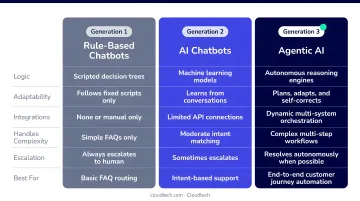
Gartner predicts agentic AI will autonomously resolve 80% of common customer service issues without human intervention by 2029.
Where a platform sits on this spectrum should be your first filter — it determines what the bot can actually do, not just what the vendor claims.
13 Best Customer Service Chatbots for 2026
Tools were evaluated on AI capability, deployment ease, integration depth, multichannel support, scalability, and fit across SMB to enterprise use cases. If you're an SMB on AWS, start with Amazon Lex or Zendesk AI. For eCommerce brands, jump to Tidio, Gorgias, or Chatfuel. Enterprise teams with high ticket volumes should look at Netomi, Ada, or Sendbird.
1. Amazon Lex — Best for AWS-Native Deployments
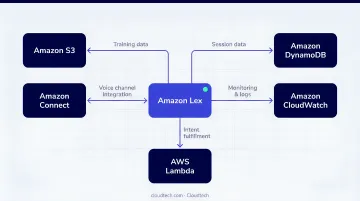
Amazon Lex is AWS's native conversational AI service, built on the same underlying technology as Alexa. Its real advantage isn't the NLP — it's the depth of integration with the AWS ecosystem. Lambda, Amazon Connect, S3, DynamoDB — Lex connects to these natively, which eliminates the middleware overhead that plagues third-party chatbot integrations in AWS environments.
For businesses already running on AWS, that integration depth translates directly into faster deployment, cleaner data flows, and lower maintenance overhead. Cloudtech's AWS-certified architects can deploy and customize Lex implementations without starting from scratch, accelerating time-to-value for SMBs that don't have an in-house engineering team to manage the build.
| Category | Details |
|---|---|
| Key Features | Multi-turn dialogue management, intent recognition, slot filling, AWS Lambda integration, Amazon Connect compatibility, voice and text support |
| Best For | SMBs and enterprises on AWS seeking a deeply integrated, scalable chatbot solution |
| Pricing | Pay-as-you-go: $0.00075/text request, $0.004/speech request; no minimum fees; free tier available for new AWS customers |
2. Zendesk AI — Best for Autonomous, Pre-Trained AI Agents
Zendesk AI ships with pre-trained agent capability built from a massive volume of real support interactions — meaning it can handle complex queries from day one without a lengthy training phase. Its AI Copilot assists human agents in parallel, while built-in QA scoring and sentiment detection give managers visibility without manual auditing.
| Category | Details |
|---|---|
| Key Features | Agentic AI, hybrid flows, intent routing, omnichannel support, QA tools, sentiment detection, no-code builder, AI Copilot |
| Best For | Mid-market to enterprise teams needing scalable, autonomous support with built-in analytics |
| Pricing | Starting at $19/agent/month (billed annually); 14-day free trial available |
3. Intercom Fin — Best for Blending AI Chat with Live Agent Support
Fin is Intercom's GPT-4-powered AI agent that pulls answers from help docs, FAQs, and public URLs in real time. What sets it apart is the escalation experience — when Fin hands off to a human agent, the full conversation context transfers with it, so customers don't have to repeat themselves.
The platform combines inbox, ticketing, and sales workflows in one interface, which reduces tool sprawl for teams managing both support and pipeline.
| Category | Details |
|---|---|
| Key Features | AI-to-human handoff with full context, 45-language support, draft responses, conversation summaries, omnichannel messaging |
| Best For | Support teams needing AI chat alongside live agent capability in a single, unified interface |
| Pricing | Essential plan starts at $29/seat/month; Fin AI Agent charged at $0.99/outcome |
4. Freshchat — Best for Multichannel Inbox Management
Freshchat unifies website chat, WhatsApp, Instagram, email, and more into one inbox, powered by Freddy AI for intent detection and natural-language responses. The no-code bot builder means support managers — not just developers — can build and adjust flows. Live translation is available for teams serving multilingual customer bases.
| Category | Details |
|---|---|
| Key Features | Freddy AI, unified multichannel inbox, co-browsing, canned replies, proactive messaging, GDPR compliance, skills-based routing |
| Best For | Support teams managing conversations across multiple social and messaging channels |
| Pricing | Free plan (up to 10 agents); Growth $19/agent/month; Pro $49/agent/month; Enterprise $79/agent/month (billed annually); Freddy AI Agent includes 500 free sessions initially |
5. Tidio — Best for Small Businesses and eCommerce
Tidio keeps costs accessible without gutting functionality. Its Lyro AI agent — powered by Claude (Anthropic) — handles FAQ resolution, order tracking, and product recommendations, with intelligent handoff to human agents when queries get complex. Shopify integration is native, making it a practical fit for growing DTC brands.
| Category | Details |
|---|---|
| Key Features | Lyro AI agent (Claude-powered), visual flow builder, real-time visitor tracking, Shopify integration, multilingual support, agent permission controls |
| Best For | Small businesses and eCommerce stores needing affordable 24/7 AI support without developer resources |
| Pricing | Free plan (50 billable conversations/month); Starter $24.17/month; Growth from $49.17/month |
6. HubSpot Chatbot — Best for CRM-Powered Automation
HubSpot's chatbot builder is embedded directly in its Smart CRM, which means every conversation can be personalized using contact history, deal stage, and prior purchase data — without any custom integration work. The no-code builder and native WhatsApp and Facebook Messenger support make it easy for marketing and support teams to align on the same toolset.
| Category | Details |
|---|---|
| Key Features | CRM-powered personalization, no-code builder, WhatsApp and Facebook Messenger support, live chat handoff, detailed reporting |
| Best For | Businesses already in the HubSpot ecosystem that want CRM-driven, personalized support automation |
| Pricing | Free chatbot builder available; paid plans vary by HubSpot suite tier |
7. Ada — Best for Multilingual, No-Code Deployments
Ada supports 60 languages with NLP strong enough to interpret slang, informal phrasing, and mixed grammar — a real advantage when serving global customers who communicate informally across regions. Its Coaching feature uses past conversation data to improve future bot performance without requiring manual rule updates. SOC2, HIPAA, and GDPR compliance come standard.
| Category | Details |
|---|---|
| Key Features | 60-language support, advanced NLP and intent detection, smart escalation, Coaching feature, CRM and ticketing integrations, no-code flow builder |
| Best For | Enterprises and global teams needing reliable multilingual customer service automation at scale |
| Pricing | Custom pricing (contact sales); free demo available |
8. Netomi — Best for High-Volume Enterprise Automation
Netomi's platform automatically resolves the majority of routine support queries across email, chat, voice, and social — with a dual-mode setup that lets teams run fully automated agents or AI-assisted human agents depending on the ticket type. Real-time sentiment detection adjusts tone dynamically, and the compliance stack covers GDPR, HIPAA, SOC2, and ISO 27001.
| Category | Details |
|---|---|
| Key Features | Automated and co-pilot modes, 100+ language support, sentiment-adaptive responses, dynamic carousels, CRM integration, enterprise security compliance |
| Best For | Enterprise support teams handling high ticket volumes needing secure, deeply integrated AI automation |
| Pricing | Custom/quote-based; contact Netomi for pricing |
9. Kommunicate — Best for Enterprise-Grade Flexibility
Kommunicate's Kompose builder lets teams upload PDFs, CSVs, and DOCX files to train a bot instantly. It supports GPT-4, Gemini, and Anthropic models, and voice support is available via Twilio. HIPAA and SOC2 compliance are included across plans, which removes a common hidden cost in enterprise deployments.
| Category | Details |
|---|---|
| Key Features | No-code Kompose builder, document-to-bot training (PDF, DOCX, CSV, TXT), entity extraction, voice via Twilio, Salesforce/Zendesk integrations, HIPAA/SOC2 compliance |
| Best For | Teams needing flexible, enterprise-grade AI automation with document-based training and voice support |
| Pricing | Starter $40/month; Professional $200/month; Enterprise custom; 30-day free trial, no credit card required |
10. Sendbird — Best for Scalable, Multilingual Support
Sendbird's AI Agent platform covers web, mobile, email, and SMS channels with specialized agents built for each channel type. Proactive messaging tools let teams trigger outbound conversations based on customer behavior, and the compliance footprint covers GDPR and HIPAA. Pricing is enterprise-tier, so it's best suited for fast-scaling businesses with substantial volume.
| Category | Details |
|---|---|
| Key Features | Specialized email and SMS AI agents, sentiment analysis, proactive messaging, enterprise security compliance, dynamic workflow routing, multilingual support |
| Best For | Fast-growing enterprises needing scalable, compliant, multilingual support across web, mobile, and messaging channels |
| Pricing | Custom enterprise pricing; contact Sendbird for a quote |
11. Gorgias — Best for Shopify and eCommerce Brands
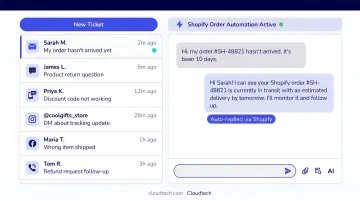
Gorgias was built specifically for eCommerce. The Shopify Actions integration lets agents — and the AI — create orders, issue refunds, edit orders, modify shipping addresses, and reship items directly from within Shopify Admin, without switching tabs. The unified dashboard handles chat, SMS, email, and social in one view.
| Category | Details |
|---|---|
| Key Features | Shopify Actions integration, prebuilt macros, unified multichannel dashboard, checkout chat triggers, AI ticket automation, product suggestions in live chat |
| Best For | Shopify-powered eCommerce stores that need high-volume ticket automation with direct store action capability |
| Pricing | Plans start at $10/month; see Gorgias pricing page for current tier details |
12. Zoho SalesIQ — Best for Zoho Ecosystem Users
Zoho SalesIQ offers three distinct bot modes — rule-based custom bots, an AI Answer Bot connected to Zia or OpenAI, and a hybrid combination of both. The 30-language auto-detection is useful for businesses with multilingual site traffic, and the drag-and-drop codeless builder keeps setup accessible for non-technical teams already working inside Zoho CRM.
| Category | Details |
|---|---|
| Key Features | Codeless and AI chatbot options, 30-language support, Zoho CRM integration, visitor tracking, social media integrations, hybrid bot model |
| Best For | Businesses already using the Zoho ecosystem that want a tightly integrated, multi-mode chatbot solution |
| Pricing | Free plan (3 operator licenses, 10K visitors/month); paid plans available — see Zoho SalesIQ pricing page |
13. Chatfuel — Best for Meta Channel Automation
Chatfuel is purpose-built for Instagram, WhatsApp, and Facebook Messenger. Its Fuely AI — based on OpenAI models — handles smart replies, lead qualification, and order update flows via prebuilt campaign templates. Native integrations with Google Sheets and Stripe make it easy to sync data without custom development.
| Category | Details |
|---|---|
| Key Features | Meta-channel automation, OpenAI-powered smart replies, knowledge base sync, prebuilt campaign templates, Google Sheets and Stripe integrations, campaign analytics |
| Best For | Businesses that primarily sell and support customers through Instagram, WhatsApp, or Facebook Messenger |
| Pricing | Free plan available (Chatfuel Light); paid AI Pro tier available — check Chatfuel's pricing page for current rates |
How We Chose the Best Customer Service Chatbots
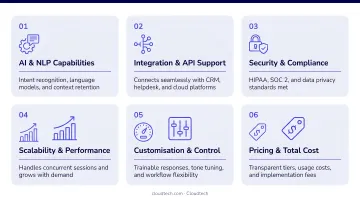
Tools on this list were evaluated across six dimensions:
- AI capability and NLP quality — Can it handle open-ended, real-world queries?
- Deployment accessibility — Is there a no-code or low-code path that doesn't require a developer?
- Integration depth — Does it connect natively to major CRMs, helpdesks, and communication channels?
- Multichannel coverage — Web, mobile, WhatsApp, email, SMS, social?
- Pricing transparency — Is cost predictable, or does it balloon with volume?
- Compliance readiness — GDPR, HIPAA, and SOC2 certifications where industry requires them
The Integration Trap Most Buyers Fall Into
The most common mistake in chatbot selection is picking a platform that doesn't fit the existing tech stack. A chatbot with great NLP scores but poor CRM integration creates data silos. A bot that can't escalate with context frustrates both customers and agents.
For businesses running on AWS, that integration gap compounds quickly. Platforms that don't connect cleanly to Amazon Connect, Lambda, or S3 create maintenance overhead that compounds over time. AWS-certified guidance helps teams identify these conflicts before signing a contract — not just during implementation.
As Forrester has cautioned, AI customer service tools can struggle to integrate with complex ecosystems, causing inconsistent data, broken workflows, and poor customer experiences. And given that 73% of consumers switch to a competitor after multiple bad experiences, getting the integration right matters more than getting the latest AI features.
Conclusion
There's no universal winner here. The right chatbot depends on your business size, tech stack, industry compliance requirements, and which channels your customers actually use. An eCommerce brand on Shopify has different needs than a healthcare provider on AWS — and both have different needs than a B2B SaaS company running a high-volume support inbox.
A practical shortlisting approach: identify your dominant use case, pick 2–3 tools that match it, and run a real test before committing to a contract. If you're deploying on AWS or need help integrating a chatbot into existing cloud infrastructure, Cloudtech's AWS-certified architects can evaluate options, configure Amazon Lex or third-party platforms, and handle end-to-end implementation — typically delivered in weeks. Reach out through Cloudtech's contact page to scope the right approach for your environment.
Frequently Asked Questions
What is an AI chatbot for customer service?
An AI customer service chatbot is software that uses NLP, machine learning, and large language models to simulate human conversation and automate routine support tasks. It operates across websites, apps, and messaging platforms 24/7, handling most queries without human involvement.
What features should I look for in a customer service chatbot?
Prioritize NLP-driven intent recognition, omnichannel deployment, CRM and helpdesk integration, a no-code or low-code builder, human escalation with context handoff, and analytics. Add compliance certifications (GDPR, HIPAA, SOC2) if your industry requires them.
How much does a customer service chatbot cost?
Pricing runs from free tiers (Tidio, HubSpot, Freshchat, Zoho SalesIQ) to pay-as-you-go models like Amazon Lex ($0.00075/text request), monthly plans starting at $10–$49/month, and fully custom enterprise pricing from Ada, Netomi, and Sendbird. Always calculate total cost including expected conversation volume and add-ons.
Can a customer service chatbot replace human agents?
Chatbots are designed to augment human agents, not replace them. They handle repetitive, high-volume queries autonomously and escalate complex or emotionally sensitive conversations to humans with full context intact. Teams that combine both consistently outperform those relying on either alone.
How do I integrate a chatbot with my existing CRM or helpdesk?
Most platforms offer native integrations with Salesforce, HubSpot, Zendesk, and Freshdesk. Businesses running AWS-based infrastructure can also use Amazon Lex, which connects directly to services like Lambda, Connect, and DynamoDB for more flexible, custom workflows.
Which customer service chatbot is best for small businesses?
Tidio and HubSpot are the strongest SMB picks — both offer free or low-cost entry plans with no-code builders and solid CRM integrations. Tidio is particularly strong for eCommerce, while HubSpot suits businesses already using its CRM suite.