Introduction
The modern employee experience doesn't begin on day one — it starts when a candidate first sees a job posting. From that moment through onboarding, performance reviews, and eventual departure, employees move through dozens of touchpoints that demand fast, accurate responses.
Most HR and IT teams can't keep up. According to Gartner's 2023 survey, 47% of digital workers struggle to find the information they need to do their jobs effectively. That's nearly half your workforce hitting friction walls on routine tasks — policy lookups, benefits questions, IT ticket submissions — that should take seconds.
The problem isn't a lack of HR software. Most organizations have invested in platforms like Workday, ServiceNow, or SAP. The gap is the human layer still required to bridge routine interactions: answering the same questions repeatedly, chasing approvals, manually triggering offboarding checklists.
Conversational AI closes that gap. It handles the predictable interactions so HR and IT teams can focus on work that requires judgment — not just queue management.
This guide covers each stage of the employee journey where automation delivers the clearest results, what outcomes to expect, and what to get right before you deploy.
Key Takeaways
- Conversational AI uses NLP and machine learning to handle dynamic, context-aware employee interactions, not static scripted responses
- It automates distinct journey stages: recruitment, onboarding, daily HR/IT support, performance, and offboarding
- IBM's AskHR handled 11.5 million interactions in 2024 with a 94% containment rate — no human routing required
- SMBs can deploy on AWS-native services like Amazon Bedrock and Amazon Q Business alongside existing HRIS and ITSM tools
- Start with one high-volume use case, prove value, then expand — full-journey automation comes later
What Is Conversational AI for Employee Journeys?
Conversational AI combines natural language processing (NLP), machine learning, and dialogue management to engage employees in dynamic, context-aware conversations. Unlike traditional chatbots that match keywords to scripted responses, it interprets intent, retains context throughout an exchange, and improves with use.
That distinction matters most in HR and IT — where employee questions are high-volume, time-sensitive, and rarely phrased the same way twice.
Why It Matters in HR and IT Contexts
HR and IT teams handle enormous volumes of repetitive, time-sensitive interactions. Password resets, PTO balance inquiries, benefits questions, onboarding task completions — these interactions share three traits that make them ideal for conversational AI:
- Follow consistent underlying logic, making them automatable
- Vary in phrasing every time, putting them out of reach for rule-based bots
- Spike dramatically during open enrollment or mass onboarding, overwhelming human teams
Two Functional Categories
Conversational AI for employee journeys operates in two modes, often working together:
- Task automation — triggering backend actions like account provisioning, payroll lookups, or access revocation
- Conversational support — answering questions, guiding workflows, collecting feedback through natural dialogue
Common Deployment Formats
- Standalone chatbots on HR portals or intranets
- Integrations within Slack or Microsoft Teams
- Voice-enabled assistants for hands-free workflows
- Agentic AI systems that execute multi-step actions autonomously — for example, Amazon Bedrock-based architectures that complete full workflows across multiple connected nodes without human handoffs
How Conversational AI Automates Each Stage of the Employee Journey
The employee journey is a lifecycle, not a single event. Each stage carries its own set of repetitive interactions — and conversational AI can systematically take over the predictable ones at every step.
Recruitment and Pre-Boarding
High-volume recruiting creates a communication bottleneck that frustrates candidates and exhausts recruiters. According to SHRM's Talent Board research covering 150 organizations and 240,000 candidates, 36% of US candidates had not heard from employers one to two months after applying — with poor communication cited as a leading reason candidates withdrew.
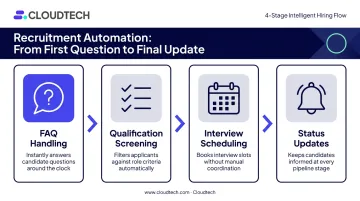
Conversational AI addresses this at the top of the funnel:
- FAQ handling — answers role-specific questions without recruiter involvement
- Basic qualification screening — collects experience, availability, and location through structured dialogue
- Interview scheduling — syncs with recruiter calendars and confirms appointments automatically
- Status updates — keeps candidates informed at each stage, reducing drop-off from silence
Once a candidate accepts an offer, pre-boarding automation kicks in. The AI sends personalized pre-start checklists, collects required documents, answers policy questions, and introduces new hires to tools and team structure — before day one.
Onboarding
The first few weeks are where new hires form lasting impressions. Yet Gallup finds that only 12% of US employees say their organization did a good job onboarding them — a striking gap given how much is at stake.
SHRM reports that new hires who complete standardized onboarding programs are 50% more productive than those who don't. That's a benchmark for structured process, and conversational AI is what makes that structure scalable.
During onboarding, conversational AI:
- Answers "where do I find X?" questions in real time, without making new hires wait for a response
- Surfaces role-specific information based on job title, location, and department
- Guides compliance task completion through structured dialogue
- Reduces the anxiety of not knowing who to ask — a consistent problem for remote or distributed teams
Ongoing HR and IT Support
This is where conversational AI delivers the most immediate, measurable impact. Employees ask the same questions constantly: What's my PTO balance? When does open enrollment close? How do I reset my VPN password?
Each question routed to a human costs time on both sides. The Forrester Consulting study commissioned by ServiceNow found that one organization moved self-service adoption from 4% to 34% within two weeks of deploying HR virtual agent capabilities.
How it works technically:
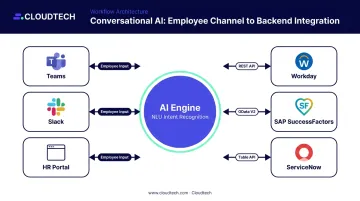
- Employee sends a query via Teams, Slack, or the HR portal
- The AI identifies intent using NLU
- It queries the connected HRIS (Workday, SAP SuccessFactors) or ITSM system (ServiceNow) via API
- It returns a personalized response or executes the action — all within the same conversation thread
The underlying integration infrastructure already supports this. Each major platform exposes the necessary operations:
- Workday — worker, absence, and time-off data via REST APIs
- SAP SuccessFactors — create, read, update, and delete operations via OData V2 APIs
- ServiceNow — case management and CRUD operations via the Table API
Conversational AI connects to these systems directly, making automation a configuration problem rather than a development project.
Performance, Development, and Engagement
Performance management is broken. Deloitte's 2025 survey found that 61% of managers and 72% of workers couldn't say they trusted their organization's performance management process.
Conversational AI reduces the administrative friction that makes performance cycles feel like overhead:
- Check-in automation — scheduled conversational prompts collect manager and peer feedback without requiring form submissions
- Deadline reminders — the AI surfaces review due dates and nudges managers before windows close
- Training recommendations — based on role, skill gaps, or stated career goals surfaced through prior conversations
On the engagement side, AI conducts pulse surveys through natural dialogue rather than formal survey forms. Gallup's Q12 meta-analysis — covering over 3.3 million employees — found that top-quartile engagement units had 51% lower turnover in low-turnover organizations. Catching disengagement signals early, before attrition happens, is where this layer pays off.
Offboarding
Offboarding is the most overlooked automation opportunity, and one of the highest-risk if handled manually. CISA's advisory on insider threats explicitly flags former-employee accounts not properly removed from Active Directory as a common exploitation vector.
Conversational AI automates the offboarding sequence:
- Triggers equipment return checklists and tracks completion
- Initiates system access revocation across connected platforms
- Coordinates benefits termination workflows
- Conducts exit interviews through structured conversational dialogue — collecting feedback HR can act on to improve retention
When access revocation and compliance documentation run through automated workflows, the risk of a departing employee retaining active credentials drops significantly. ServiceNow's documented AI-assisted offboarding workflow illustrates what this looks like in practice: it generates a knowledge-transfer plan and automatically adds transfer tasks to the departing employee's journey — no manual coordination required.
Key Benefits of Automating Employee Journeys with Conversational AI
Conversational AI delivers measurable returns across three dimensions: operational efficiency, employee experience, and the ability to scale without adding headcount.
Operational Efficiency
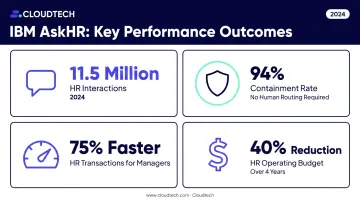
IBM's AskHR handled 11.5 million HR interactions in 2024 with a 94% containment rate — meaning 94% of those interactions resolved without routing to a human agent. Managers completed HR transactions 75% faster. IBM also reports its HR operating budget fell 40% over four years.
The Forrester/ServiceNow commissioned study modeled 5–15 minutes saved per tier-one request and 15–30 minutes for tier-two interactions — with HR processing time falling 45% for tier-one requests in the composite model.
Employee Experience
- 24/7 availability — employees in different time zones or on non-standard shifts get immediate answers without waiting for business hours
- Personalized responses — answers reflect the employee's role, location, and history, not generic policy language
- Reduced frustration — no tickets, no wait times, no "I'll follow up with you" for routine requests
IBM reported employee NPS moving from -35 to +74 during its broader AI-first HR transformation.
That experience improvement only holds if the system can handle demand at scale — which brings us to the third advantage.
Scalability Without Degradation
Human support teams hit capacity limits during peak periods. Conversational AI doesn't. Key scenarios where this matters:
- Open enrollment — thousands of benefit questions arrive simultaneously
- Mass onboarding — new cohorts need the same answers at the same time
- Post-acquisition integration — two workforces with different policies, all asking questions at once
Amazon Lex V2 supports adjustable service quotas for runtime requests and concurrent streaming conversations, so throughput scales with demand rather than headcount.
What to Consider Before Implementing Conversational AI for Employee Journeys
Integration Requirements
Conversational AI is only as good as the data it can access. Without proper integration to authoritative sources — your HRIS, ITSM platform, knowledge base, and policy documents — the AI returns outdated answers or fails mid-workflow.
Before selecting a platform, map your integration landscape:
- Which systems hold authoritative employee data?
- What APIs expose that data for read and write operations?
- Where do authentication and role-based access controls need to enforce data boundaries?
SMBs already on AWS infrastructure have an advantage here. Amazon Bedrock Knowledge Bases implement retrieval-augmented generation over organizational data, and Bedrock Guardrails can apply content filters and sensitive-information controls. Bedrock Agents handle multi-step orchestration natively, which means SMBs can connect conversational AI to existing AWS data infrastructure without rebuilding from scratch.
Data Privacy and Governance
Employee data processed by conversational AI is sensitive. Payroll details, medical leave records, performance documentation — this data requires explicit governance before any AI system touches it.
Key controls to establish:
- Data access boundaries — define what the AI can query, and enforce role-based restrictions so employees only see their own data
- Vendor data handling agreements — require contractual zero-retention policies; the AI must not train on your proprietary employee data
- GDPR — requires transparency disclosures when automated decisions produce significant effects on employees
- CCPA/CPRA — can cover employee and job-applicant data when statutory thresholds apply
- HIPAA — the Privacy Rule does not cover employment records held by an employer, but health-plan records may carry different obligations
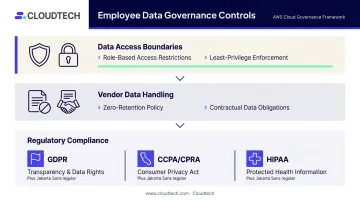
On AWS, the core security controls for these deployments include IAM-based RBAC, KMS encryption, CloudTrail audit logging, and Business Associate Agreement execution for any health-plan data in scope.
Escalation Design and Change Management
No conversational AI should operate without clear escalation paths. Amazon Lex V2's built-in FallbackIntent triggers when input isn't recognized after configured attempts — a fulfillment Lambda can then create a case or route the conversation to a human agent with full context already transferred.
Escalation should trigger on:
- Emotionally charged situations (performance disputes, terminations, accommodation requests)
- Complex, multi-party issues that require judgment
- Any interaction where the AI has failed to resolve after a defined number of attempts
Equally important: HR and IT teams need structured change management to adopt AI as a complement to their roles. The teams most resistant to conversational AI are typically those who weren't involved in defining what it should and shouldn't handle.
Conclusion
Across the employee lifecycle — from the first recruiter touchpoint through exit interviews — conversational AI delivers something HR teams have always struggled to provide at scale: consistent, immediate responses to predictable requests. It doesn't replace the human judgment that matters in sensitive moments. It handles the volume that was simply too high to manage well manually.
That consistency depends on solid infrastructure. Organizations already on AWS are better positioned to move quickly — the integration surface (Workday REST APIs, ServiceNow Table API, SAP OData APIs, Amazon Bedrock Knowledge Bases) already exists. The work is connecting these components correctly and governing the data that flows through them.
For SMBs looking to implement this on AWS without building from scratch, Cloudtech's pre-packaged generative AI implementations on Amazon Bedrock — covering Knowledge Base setup, API integration, and data governance — provide a practical foundation, typically delivered in weeks rather than months.
The organizations that see real returns treat automation as a scoping decision, not a coverage goal. Define which interactions are high-volume and low-variance, build clean escalation paths for everything else, and the technology handles the rest.
Frequently Asked Questions
What is the difference between conversational AI and a traditional HR chatbot?
Traditional chatbots follow rigid keyword-triggered scripts that break when policies change or phrasing varies. Conversational AI understands intent, retains context, and improves through machine learning — handling complex, multi-step interactions that rule-based tools simply can't manage.
Which stages of the employee journey benefit most from conversational AI automation?
Onboarding and ongoing HR/IT support deliver the fastest ROI because they involve the highest volume of repetitive, predictable interactions. Recruitment pre-screening and offboarding also generate significant time savings when automated — particularly around candidate communication and access revocation compliance.
How long does it take to implement conversational AI for employee workflows?
Timelines vary by complexity and integration requirements. Organizations using cloud-native tools like Amazon Bedrock or Amazon Q Business on existing AWS infrastructure can deploy basic employee self-service workflows in a matter of weeks. Multi-system integrations connecting HRIS, ITSM, and collaboration platforms typically take two to four months.
Can conversational AI integrate with existing HR systems like Workday or SAP?
Yes. Modern platforms connect to Workday, SAP SuccessFactors, ServiceNow, and other major HRIS and ITSM tools via standard APIs. These integrations let the AI query live data and execute actions directly inside the systems employees already use.
Is conversational AI secure enough to handle sensitive employee data?
Enterprise-grade platforms include role-based access controls, end-to-end encryption, audit trails, and compliance certifications. The key step is vetting vendor data handling practices and locking in zero-retention policies contractually — your employees' personal and payroll data should never be used to train the model.
Can small and mid-sized businesses realistically deploy conversational AI for employee journeys?
Yes, and the barrier is lower than most expect. Cloud-native platforms — especially for businesses already on AWS — make it practical to start with one high-volume use case like IT self-service or onboarding Q&A. Prove the value with measurable outcomes, then expand from there.