Introduction
Conversational AI product search sits at the intersection of NLP, cloud infrastructure, and product data management. That combination makes implementation genuinely complex — technically and organizationally.
In-house teams with cloud and ML experience can build this. So can e-commerce teams that partner with an AWS-certified consulting firm. Pure marketing or commerce teams attempting this without technical support typically run into serious trouble.
What does "serious trouble" look like in practice?
- Irrelevant results that surface the wrong products
- Persistently high zero-result rates that frustrate shoppers
- Conversation flows that feel robotic and erode trust
- Infrastructure spend that produces nothing useful
Baymard's e-commerce Search UX benchmark found that 56% of sites had mediocre or worse search performance — and that's before adding conversational complexity.
This guide covers the full implementation process: prerequisites, step-by-step configuration, post-launch validation, and the most common problems with their fixes.
Key Takeaways
- Product data quality determines search relevance — get it right before touching any AI configuration.
- Implementation follows a fixed sequence: data audit → enrichment → AI configuration → conversation design → integration → test and deploy.
- Core AWS services for this stack: Amazon Lex, Amazon Bedrock, Amazon OpenSearch Service, and Amazon Kendra (note: Kendra stops accepting new customers July 30, 2026).
- Track zero-result rate, search-to-cart conversion, session duration, and query response latency from day one.
- Working with an AWS-certified partner shortens deployment timelines and prevents the architectural mistakes that derail projects.
Prerequisites and System Readiness
Before configuring any AI component, three areas need honest assessment: cloud infrastructure, product catalog quality, and compatibility with existing commerce systems. Skipping this step is the most common cause of failed implementations.
Infrastructure and Cloud Readiness
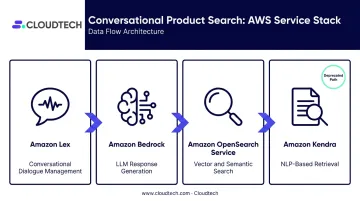
Cloud readiness means having an active AWS environment with relevant services provisioned or accessible. The core AWS services used in a conversational product search stack are:
| AWS Service | Role in the Stack |
|---|---|
| Amazon Lex | Conversational dialogue management |
| Amazon Bedrock | LLM access for response generation |
| Amazon OpenSearch Service | Vector/semantic search over product embeddings |
| Amazon Kendra | Intelligent NLP-based retrieval (note: stops accepting new customers July 2026) |
If there is no structured cloud environment, no API-accessible product catalog, or no defined data governance policy for user query data, implementation should not start until these are resolved.
An AWS readiness assessment before proceeding is worth the time — this is where an AWS-certified consulting partner adds early value.
Product Catalog Data Readiness
With infrastructure confirmed, the next risk area is the catalog itself. The AI retrieves from what exists — if the catalog is incomplete, inconsistently structured, or written in manufacturer language, search results will be irrelevant no matter how well the AI layer is configured.
According to Salsify's 2025 Consumer Research Report, 54% of shoppers abandoned a purchase because product information was inconsistent across websites, and 53% abandoned because information was incorrect. Poor catalog data hurts both search relevance and conversion rates.
Attributes must be structured, consistently labeled, and enriched with buyer-relevant metadata: use cases, compatibility details, and intent-based tags — not just SKUs and technical specs.
System Compatibility Checks
Once the catalog is ready, the third check is integration. The conversational search layer must query the product catalog in real time, which requires working API connections across:
- PIM systems for structured product attributes
- CRM platforms for personalization signals
- E-commerce backends (Shopify, Magento, custom storefronts)
The implementation team needs working knowledge of API integration, NLP configuration, and AWS cloud services — or access to a partner who does.
Step-by-Step Implementation Guide
Each phase builds on the previous one — skipping steps, especially data preparation and flow design, consistently produces poor search quality.
Step 1: Audit Your Current Search Experience
Before building anything, understand what's broken. Assess:
- What percentage of queries currently return zero results or irrelevant products?
- Where do users drop off in the shopping journey?
- Which product categories generate the most complex, multi-attribute queries?
Nearly 50% of sites fail to provide effective recovery paths after a no-results search, according to Baymard's no-results page research — meaning users who hit a dead end mostly leave. This audit defines the scope and rollout priority.
Step 2: Enrich and Structure Product Data
This is the phase most teams underestimate. Semantic search requires products described in the language shoppers use — not the language manufacturers use. That vocabulary gap is the direct cause of most zero-result failures.
Enrichment tasks:
- Standardize attribute names across the catalog
- Add use-case-based tags ("for home office," "works with X system")
- Fill missing attribute values
- Map technical specs to buyer-friendly language
- Add synonyms for common product terms
Step 3: Configure AI Components
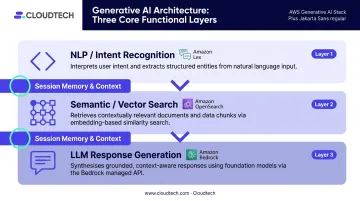
The AI layer has three functional components. Each maps to specific AWS services:
NLP/Intent Recognition Amazon Lex V2 handles conversational dialogue — intents, slots, prompts, and fulfillment logic. It parses what the user is asking and structures it for downstream processing.
Semantic/Vector Search Amazon OpenSearch Service stores and retrieves vector embeddings for similarity-based product discovery. A multi-modal indexing approach works best: keyword indexing for exact matches plus vector search for semantic similarity.
LLM Response Generation Amazon Bedrock provides managed access to foundation models for generating natural conversational responses — without requiring training a model from scratch.
Session Memory System prompt configuration and conversation memory sit across all three components. The assistant must maintain context across follow-up questions within a session — without it, every follow-up feels like starting over, and users disengage fast.
Step 4: Design Conversation Flows and Question Logic
Map customer decision logic into branching question flows:
- Start with high-level intent — "Where will you use this?" "Who is this for?"
- Narrow with attribute-specific questions — compatibility, size, price range
- Confirm and retrieve — surface matching products with brief explanations
Question phrasing must mirror how customers naturally speak, not product attribute field names. "What's your budget range?" works. "Enter maximum price filter value" does not.
Human review of AI-generated question flows before deployment is non-negotiable. Irrelevant or awkward questions erode confidence in the tool — and once users dismiss it, they revert to manual search.
Step 5: Integrate with Your Commerce Stack
The integration sequence:
- Connect the conversational search layer to the product catalog API
- Map extracted user preferences to search filter parameters (JSON output)
- Embed the interface into the e-commerce front end — product pages, category pages, or the site search bar
Every preference captured in conversation must translate cleanly into a query parameter the search API can process. A user saying "I need something under $200 that works with Android" must become structured filter inputs: price_max: 200, compatibility: Android. Any gap in that mapping means wrong results — no exceptions.
Step 6: Test, Iterate, and Deploy
Staged rollout is the right approach:
- Launch in one high-traffic, high-complexity product category (laptops, skincare, industrial equipment)
- Collect real query data — this reveals vocabulary gaps no test set can predict
- Assess result relevance and refine attribute mappings
- Expand to additional categories once the first performs well
A/B test before full deployment. Run two conversation flow variants on a subset of traffic — different question phrasing, different ordering — and measure which produces better search-to-cart conversion. Real conversion data, not intuition, should drive flow design decisions.
Post-Implementation Checks and Validation
Deploying without confirming search quality means real customers encounter a broken experience — and broken experiences erode trust faster than a delayed launch ever would.
Functional and Quality Testing
Submit a range of natural language queries and verify results are relevant:
- Broad queries — "I need a laptop for work"
- Specific queries — "Wireless noise-canceling headphones under $150"
- Multi-attribute queries — "Running shoes for wide feet, size 11, waterproof"
- Vague queries — "Something for my dad's birthday"
Test edge cases specifically:
- Synonyms and colloquial language
- Misspellings ("wireles headphnes")
- Multi-language inputs where applicable
These expose gaps in NLP configuration and data enrichment before they reach real shoppers.
Performance and Business Metrics to Baseline
Track these KPIs from launch day:
| Metric | Target | Why It Matters |
|---|---|---|
| Zero-result rate | Significant reduction from pre-launch baseline | Measures catalog-query vocabulary alignment |
| Search-to-cart conversion | Increase vs. keyword search baseline | Measures search quality and intent matching |
| Average session duration | Increase indicates engaged users | Proxy for conversation quality |
| Query response latency | 200–500 ms ideal; above 4 seconds degrades experience | Directly impacts conversation naturalness |
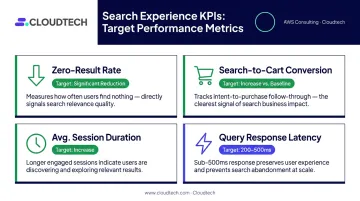
The 200–500 ms latency target comes from AWS guidance on conversational AI response times. A separate ACM study confirmed that delays above 4 seconds degrade quality of experience in LLM conversations.
Set up analytics dashboards — Amazon CloudWatch and AWS X-Ray work well for this — and monitor these metrics continuously. Search quality degrades quietly without ongoing measurement; catching a spike in zero-result rates early is far cheaper than diagnosing it after conversion drops.
Common Implementation Problems and Fixes
Most problems trace back to two sources: insufficient data preparation or misconfigured AI components.
Poor Search Result Relevance
Problem: Users receive irrelevant products even for clear queries.
Fix: Product attributes typically lack buyer-relevant language, so the semantic model has nothing to match against natural user phrasing. Run a targeted data enrichment pass on in-scope categories — add use-case tags, buyer-intent descriptors, and synonyms. Re-index and re-test. This is a catalog problem, not an AI problem.
Persistently High Zero-Result Rates
Problem: Too many natural language queries returns no products.
Fix: The NLP/semantic layer usually isn't configured for query expansion or synonym handling. Enable query expansion in the search configuration, then pull your top zero-result queries from analytics and use them to either enrich the catalog or add synonym mappings.
High Latency and Slow Response Times
Problem: The conversational interface feels sluggish, breaking natural dialogue flow.
Fix: Over-calling the LLM for tasks that don't require it — and unoptimized API chains between the conversational layer and the catalog — are the usual culprits. Address both:
- Implement response caching for common query patterns
- Handle simple attribute extraction with rule-based logic instead of LLM calls
- Audit the full API call sequence for unnecessary round-trips
Pro Tips for Effective Implementation
Most implementation failures trace back to the same handful of avoidable decisions. These tips address the ones that matter most.
- Start narrow. Pilot in one high-traffic product category where decision complexity is highest. This produces the clearest ROI signal and the most useful training data before wider rollout.
- Log queries from day one. Real user queries reveal vocabulary gaps and intent patterns no synthetic test set predicts. Use this data to refine product data enrichment and conversation flow design on a regular cadence.
- Schedule human review of AI-generated flows. Business context, brand tone, and category nuances aren't things models inherently understand. Regular content reviews are how quality stays high over time.
- Engage an AWS-certified partner early. Building conversational AI product search in-house requires simultaneous expertise across NLP, cloud architecture, API integration, and data engineering. Working with a qualified AWS consulting partner can cut deployment timelines significantly and prevent costly architectural mistakes — particularly around infrastructure configuration and data pipeline design.
Frequently Asked Questions
What is conversational AI product search and how does it differ from traditional site search?
Conversational AI product search uses NLP to interpret user intent and guide shoppers through natural language interaction. Unlike traditional search — which requires exact keyword matches and returns static result lists — it asks clarifying questions and progressively narrows results through dialogue.
How long does it take to implement conversational AI product search?
Timelines vary with data readiness and infrastructure maturity. A deployment with an enriched catalog and cloud-ready infrastructure can go live in a few weeks. Starting from raw product data and no cloud foundation may take several months.
What AWS services are best suited for building conversational AI product search?
The core stack includes Amazon Lex for conversational dialogue, Amazon Bedrock for LLM-powered response generation, and Amazon OpenSearch Service for vector/semantic search. Amazon Kendra has historically covered the retrieval layer, but AWS will stop accepting new Kendra customers on July 30, 2026. Amazon Bedrock Knowledge Bases is the recommended replacement.
How much does product data quality impact conversational AI search performance?
Product data quality is the single biggest determinant of search relevance. Poorly structured or incomplete catalogs produce irrelevant results regardless of how well the AI layer is configured — making data enrichment a prerequisite, not an afterthought.
What metrics should I track to measure the success of conversational AI product search?
Track zero-result rate (should drop significantly post-implementation), search-to-cart conversion rate, average session duration, and query response latency. These together indicate both search quality and direct business impact.
Can small or mid-sized businesses realistically implement conversational AI product search?
Yes — cloud-managed AWS services eliminate the need to build models from scratch, making this accessible to SMBs. The key constraints are product data readiness and access to cloud and NLP expertise. Both become manageable with the right AWS consulting partner.