Introduction
Enterprise teams are drowning in repetitive work. Support queues back up. Employees submit the same IT tickets weekly. Sales reps chase leads that went cold hours ago while a web form sat unanswered. Meanwhile, customers expect instant responses — not next-business-day callbacks.
Conversational AI addresses this gap directly. These are AI-powered systems that simulate natural dialogue to automate interactions across customer-facing and internal business functions — handling queries, routing requests, completing workflows, and escalating edge cases without human intervention.
This guide covers the top enterprise use cases, measurable business benefits, and how SMBs can deploy these systems through AWS-native services — without the overhead typically associated with large-scale automation projects.
Key Takeaways
- Conversational AI extends beyond customer chat — covering HR, IT support, sales qualification, and operational workflows
- McKinsey research documents a 40–50% reduction in service interactions and 20%+ cost-to-serve reduction within 12 months
- Healthcare, financial services, retail, and manufacturing each have distinct, high-ROI use cases
- Enterprise-grade conversational AI is now accessible to SMBs — without the enterprise price tag or implementation complexity
Conversational AI vs. Traditional Chatbots: What Enterprises Need to Know
Not all automated dialogue is created equal. The gap between a rule-based chatbot and a conversational AI system is significant — and choosing the wrong approach is one of the most common reasons enterprise automation stalls.
The Core Distinction
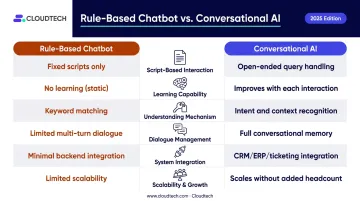
Traditional chatbots follow rigid, pre-scripted decision trees. Ask something outside the script, and the bot either fails or loops you back to a menu. Conversational AI uses natural language processing (NLP), machine learning (ML), and large language models (LLMs) to understand intent, context, and sentiment — then responds dynamically, even across multi-turn conversations.
| Dimension | Rule-Based Chatbot | Conversational AI |
|---|---|---|
| Flexibility | Fixed scripts only | Handles open-ended queries |
| Learning ability | None — static | Improves with each interaction |
| Query handling | Keyword matching | Intent and context recognition |
| Multi-turn dialogue | Limited or none | Full conversational memory |
| Backend integration | Minimal | CRM, ERP, ticketing platforms |
| Scalability | Limited by script complexity | Scales without added headcount |
Conversational AI vs. Generative AI
Conversational AI and generative AI are related but distinct. Conversational AI is optimized for interactive, dialogue-driven engagement — understanding what someone needs and responding or routing accordingly. Generative AI (GenAI) is built for content creation: drafting documents, summarizing text, generating responses from scratch.
Enterprises increasingly combine both. A conversational AI system might handle the dialogue flow and intent recognition, while a generative model drafts the actual response, creating a single automation pipeline where each layer handles what it does best.
Why This Matters for Enterprise
Conversational AI's ability to handle complex, multi-turn conversations, connect to backend systems like Salesforce or ServiceNow in real time, and scale without adding headcount is what sets it apart from simple keyword-matching tools. Humana's conversational voice agent, for example, handles more than 7,000 provider calls per business day — drawing on provider data to answer multi-step pre-service questions autonomously.
Top Enterprise Use Cases for Conversational AI
Conversational AI has expanded well beyond customer service into core enterprise functions. The highest-ROI deployments typically span multiple departments simultaneously.
Customer Service and Support Automation
AI-powered virtual agents handle tier-1 inquiries 24/7, resolve FAQs instantly, and route complex issues to human agents with full context already loaded. Integration with CRM data enables personalized responses — the system knows the customer's history before the conversation starts.
IBM's cross-country virtual agent study (1,005 respondents across 33 countries) shows what this looks like at scale:
- 12% reduction in human-agent handle time
- 8 percentage point increase in CSAT
- 4 point increase in NPS
- 64% average containment rate for in-scope contacts
Camping World's deployment produced 40% higher customer engagement and reduced wait times to 33 seconds, with the assistant resolving roughly 8,000 of 13,999 chat conversations in one reported period.
IT Service Desk and Internal Helpdesk
Password resets. Software access requests. Troubleshooting walkthroughs. These interactions consume substantial IT staff time — and they're exactly the kind of repetitive, high-volume tasks conversational AI handles well.
IBM's internal AskIT deployment demonstrates what's achievable at scale:
- Resolved 86% of queries without human intervention
- Reduced standard support tickets 56% between 2022 and 2024
- Cut calls and chats 74% following its 2023 launch
- Achieved 91.6% CSAT — an 11.6-point improvement from launch
Each deflected ticket is IT staff time recovered for infrastructure work, security projects, and problems that actually require human judgment.
HR Automation and Employee Self-Service
Benefits questions. PTO inquiries. New hire onboarding steps. Policy clarifications. HR teams field the same questions constantly, and most of those questions have definitive, retrievable answers.
IBM's AskHR system shows what mature HR automation looks like in practice: it automates more than 80 HR tasks, handles over 2.1 million employee conversations annually, and resolves 94% of common inquiries — with a 75% reduction in support tickets versus historical levels.
For SMBs without large HR headcounts, that kind of deflection rate means a lean team can support a much larger workforce without proportionally growing staff.
Sales Enablement and Lead Qualification
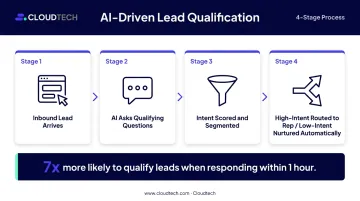
Speed matters more in sales than most teams recognize. Research published in the Harvard Business Review found that companies responding to web leads within one hour were nearly 7 times more likely to qualify a lead than those responding even an hour later — and over 60 times more likely than companies waiting 24 hours.
Conversational AI closes that gap by qualifying inbound leads in real time: asking structured questions, scoring intent, and routing high-priority prospects to sales reps immediately. Lower-intent visitors get nurtured automatically. Post-sale applications include renewal reminders and upsell prompts triggered by user behavior — no rep required to initiate contact.
Operations and Document Workflow Automation
Meeting summarization. Contract query handling. Compliance Q&A. Document classification. These are areas where employees lose hours of time to manual processing — and where conversational AI delivers consistent efficiency gains.
Cloudtech's architecture for this use case combines Amazon Textract for intelligent document processing with Amazon Q Business for natural language interaction. This lets teams query unstructured data using plain-language questions — no SQL, no technical expertise required.
One documented deployment achieved 90% faster retrieval of business-critical data and 99% fewer data errors, though results vary based on deployment scope and data maturity.
Measurable Business Benefits of Conversational AI
Cost Reduction
The per-interaction cost advantage is substantial. Humana's conversational voice agent operates at approximately one-third the cost of its previous automated system, with providers completing inquiries in about two minutes without waiting for a representative.
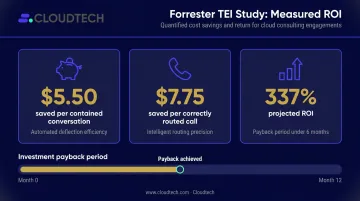
A Forrester TEI study modeled $5.50 saved per contained conversation and $7.75 saved per correctly routed call for a composite organization — with a projected 337% ROI and payback in under six months. At scale, these per-interaction savings compound into significant annual figures.
Operational Efficiency and Workforce Productivity
One retail organization studied by Forrester automated roughly one-third of 57,000 annual service requests — removing human intervention from approximately 20,000 routine tasks. That's not headcount reduction; it's headcount redeployment toward work that actually requires human judgment.
The pattern is consistent across deployments: high-volume, repetitive interactions get automated, and skilled employees shift to complex problem-solving, relationship management, and strategic work.
Customer and Employee Experience
The experience improvements are measurable, not just qualitative:
- 8 percentage point CSAT increase and 4 point NPS gain documented in IBM's virtual agent study
- 33-second wait times at Camping World, down from significantly longer queues
- 91.6% IT helpdesk CSAT at IBM's internal AskIT deployment
Both customer-facing and internal deployments show consistent satisfaction improvements — tied to 24/7 availability, instant responses, and context-aware interactions.
Data Collection and Actionable Insights
Every conversational AI interaction generates structured data on user intent, drop-off patterns, common requests, and pain points. This data feeds directly into product decisions and service improvements — giving operations teams a continuous, structured view of what customers actually need, not just what they report in surveys.
Industry-Specific Applications Across Key Sectors
The underlying conversational AI capabilities are consistent across industries. What changes is which workflows get automated and what compliance requirements must be built into the architecture from day one.
Healthcare
Healthcare conversational AI addresses two simultaneous pressures: administrative burden on clinical staff and patient access friction.
Common applications include:
- Patient intake and triage
- Appointment scheduling and reminders
- Symptom pre-screening and routing
- Insurance verification
- Medication adherence reminders
UC San Diego Health's deployment with Amazon Connect Health saved one minute per call, redirected 630 staff hours per week from patient verification to direct patient assistance, and reduced call abandonment 30% overall — with 60% reductions in selected departments.
HIPAA compliance must be designed into the architecture from the start. Any cloud service processing or storing electronic protected health information (ePHI) is a HIPAA business associate under HHS guidance, requiring a Business Associate Agreement and documented risk analysis covering confidentiality, integrity, and availability.
Financial Services and Banking
Financial services applications span the full customer lifecycle:
- Account balance inquiries and transaction history
- Fraud alerts and behavioral anomaly detection
- Loan application guidance
- KYC and identity verification support
- Financial product recommendations
National Australia Bank achieved 80% IVR containment using Amazon Lex. WaFd Bank reduced agent call volume 30%. TransUnion cut IVR interaction time from two minutes to just 18 seconds — reducing annual costs 40%.

Security and compliance are non-negotiable here. PCI DSS controls apply to any AI system accessing payment data, including requirements for sanitized training data and logged, traceable AI actions.
Manufacturing and Logistics
Conversational AI in manufacturing addresses operational coordination bottlenecks:
- Order status and shipment tracking queries
- Equipment maintenance request routing
- Inventory lookup and availability checks
- Shift scheduling support
For manufacturing SMBs, these applications reduce the manual follow-up burden across shift changes and supply chain handoffs. The practical upside: routine inquiries get handled automatically, with no ERP customization or dedicated support headcount required.
Retail and E-Commerce
Where manufacturing targets internal coordination, retail deployments focus on the full customer purchase journey:
- Real-time product recommendations
- Order tracking and status updates
- Return and exchange processing
- Loyalty program management and redemption support
Conversational AI also reduces cart abandonment by answering product questions — sizing, compatibility, stock availability — at the exact moment a customer hesitates, not after they've already left the session.
How to Implement Conversational AI: A Practical Framework for SMBs
Phase 1 — Define the Use Case and Success Metrics
Start with one high-volume, repetitive workflow where automation delivers clear ROI. The most common starting points for SMBs are customer service tier-1 queries, IT password resets, or HR policy Q&A — all high frequency, low complexity, and well-suited to initial deployment.
Set specific KPIs before building anything:
- Ticket deflection rate (target: 60%+ for mature deployments)
- Average response time (baseline vs. post-deployment)
- CSAT score (measured at conversation end)
- Cost per interaction (AI-handled vs. human-handled)
Without these benchmarks established upfront, success becomes subjective and hard to defend internally.
Phase 2 — Choose the Right Platform and Integration Approach
For SMBs building on AWS, two services form the core of most conversational AI deployments:
- Amazon Lex — provides automatic speech recognition (ASR) and natural language understanding (NLU) for voice and text interfaces, with pay-as-you-go pricing and no upfront commitment. AWS reports that Lex can launch AI chat capabilities in hours; Morrisons delivered a complete self-service contact center in eight weeks.
- Amazon Connect — natively incorporates Lex into a cloud contact center, enabling AI-powered customer conversations without separate integration overhead.
AWS Lambda functions extend both services, connecting conversational interfaces to backend systems — CRMs, ERPs, ticketing platforms — in real time.
Phase 3 — Train, Test, and Continuously Improve
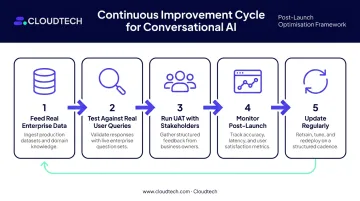
Conversational AI requires ongoing refinement after launch — not just maintenance, but active iteration against real usage data:
- Feed the system with real enterprise data — historical tickets, actual customer queries, policy documents
- Test against real user queries — not just scripted scenarios
- Run UAT with stakeholders — include front-line employees who know where the edge cases live
- Monitor post-launch — track data drift, edge case failure rates, and intent recognition accuracy on a scheduled basis
- Update regularly — as business needs evolve, so must the conversational model
Humana's voice agent illustrates the difference between a pilot and a mature deployment: a three-month proof of concept preceded three years of ongoing development. That ratio — months of build, years of refinement — is typical for conversational AI that actually moves the needle on cost and customer satisfaction.
Frequently Asked Questions
What is the difference between conversational AI and a traditional chatbot in enterprise settings?
Traditional chatbots follow pre-scripted rules and only respond to specific keywords or menu selections. Conversational AI uses NLP and ML to understand intent, handle multi-turn dialogue, and improve over time — making it capable of managing far more complex enterprise workflows beyond what rule-based systems can reach.
Which enterprise departments benefit most from conversational AI automation?
Customer service, IT, HR, and sales have the highest-volume repetitive interactions and therefore the greatest automation ROI. Operations teams also benefit significantly through document processing, compliance Q&A, and workflow automation.
How long does it take to deploy a conversational AI solution for a mid-sized business?
Focused, single-use-case implementations typically take a few weeks. Complex multi-system integrations can take several months. Working with an experienced AWS partner like Cloudtech compresses that timeline by weeks, with pre-built accelerators reducing configuration and testing time.
What is the typical ROI of implementing conversational AI in enterprise operations?
Forrester's Total Economic Impact study projects 337% three-year ROI with payback in under six months — at $5.50 saved per contained conversation. Real-world cases include Humana operating at one-third its previous system's cost.
How does conversational AI integrate with existing enterprise systems like CRMs or ERPs?
Modern platforms use APIs and pre-built connectors to integrate with Salesforce, ServiceNow, SAP, and similar systems. AWS Lambda functions connect Amazon Lex to custom backend logic, enabling the AI to pull and push data in real time for context-aware, personalized responses.
Is conversational AI compliant and secure enough for regulated industries like healthcare and finance?
Yes — when compliance is designed into the architecture from the start, not added afterward. Enterprise-grade deployments can meet HIPAA, SOC 2, PCI DSS, and GDPR requirements using AWS-native controls including IAM, GuardDuty, CloudTrail, and appropriate data handling configurations.