The gap creates real problems. Businesses underbudget, choose the wrong pricing tier, or discover hidden fees only after deployment—when switching costs are high.
This guide breaks down realistic pricing ranges, the five cost components on every bill, what drives costs up or down, and how to build a defensible budget before committing to a platform.
TL;DR
- All-in production cost for most SMB deployments runs $0.07–$0.31/minute, not the $0.05 advertised by some platforms—translating to roughly $150–$900+/month at 3,000 minutes of call volume
- Five billable layers make up every AI voice agent bill: speech-to-text (STT), LLM inference, text-to-speech (TTS), telephony, and platform/orchestration fees
- Lower-cost setups fit startups with simple, scripted workflows under 3,000 minutes/month
- Regulated industries (healthcare, finance) justify higher spend where compliance surcharges and SLA guarantees are non-negotiable; simpler use cases like appointment reminders rarely need the premium tier
How Much Does an AI Voice Agent Cost?
There is no single price for an AI voice agent. Costs vary by platform architecture, call volume, model selection, and whether you use a bundled vs. bring-your-own-key (BYOK) setup.
The gap between advertised and actual cost exists because most platforms publish only their orchestration or hosting fee (the platform's management layer)—not what you'll pay for the underlying speech-to-text (STT), language model (LLM), text-to-speech (TTS), and carrier services on top.
Two common evaluation mistakes to avoid:
- Comparing only platform fees rather than the all-in per-minute rate across all components
- Projecting costs from sandbox testing rather than realistic production call patterns (real calls are longer, messier, and more token-heavy)
With those caveats in mind, here's what each deployment tier actually costs in practice.
Entry-Level / Basic Setup
Volume: Under 2,000–3,000 minutes/month
Typical cost: $0.05–$0.14/minute platform fee; all-in closer to $0.10–$0.20/minute once components are included
Bland AI's free Start plan bills at $0.14/minute with no model pass-throughs, while Vapi's Build plan charges $0.05/minute hosting but passes through all LLM, TTS, and STT costs separately. Both include 10 concurrent calls.
What this covers: basic inbound or outbound call handling, limited concurrency, standard voice quality. What it excludes: compliance certifications, dedicated SLAs, CRM integrations, and premium voice.
Mid-Range / Standard Production
Volume: 3,000–10,000 minutes/month
Typical cost: $0.07–$0.31/minute all-in (Retell's published PAYG range), or $299/month + $0.12/minute on Bland's Build plan
At this tier, you get 20–50 concurrent calls, better voice model options, and more reliable uptime. Retell publishes a stack-level example at $0.115/minute for a specific configuration—a reliable mid-point benchmark for this tier.
High-End / Enterprise Deployment
Volume: 25,000+ minutes/month
Typical cost: $499/month + $0.11/minute (Bland Scale), or custom enterprise contracts starting at $30,000/year (Synthflow)
Enterprise tiers include custom concurrency, priority support SLAs, SSO, data residency options, and compliance certifications. HIPAA on Vapi, for example, is priced at an additional $2,000/month: a line item that surprises many buyers who assumed it came standard.
Quick-Reference: Pricing by Tier
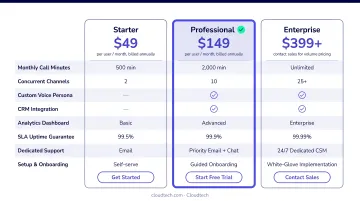
| Tier | Monthly Volume | All-In Cost Estimate | Concurrency | Key Inclusions |
|---|---|---|---|---|
| Entry-Level | Under 3,000 min | $0.10–$0.20/min | ~10 calls | Basic call handling, standard voice |
| Mid-Range | 3,000–10,000 min | $0.07–$0.31/min | 20–50 calls | Better voice models, improved uptime |
| Enterprise | 25,000+ min | $0.11/min + base fee or $30K+/yr contract | Custom | SLAs, SSO, data residency, compliance |
Key Factors That Affect the Cost of AI Voice Agents
AI voice agent pricing is shaped by both technical architecture choices and operational requirements. Each factor below directly controls what you'll pay at scale — get them right and your costs stay predictable.
Pricing Model: Pay-as-You-Go vs. Subscription vs. Enterprise
| Model | Best For | Example Pricing |
|---|---|---|
| Pay-as-you-go | Testing, variable volume | Vapi $0.05/min + pass-throughs |
| Subscription + usage | Consistent 3,000–10,000 min/month | Bland $299/mo + $0.12/min |
| Enterprise annual | 25,000+ min/month, compliance needs | Synthflow from $30,000/year |
Pay-as-you-go works well when call volume is unpredictable or you're still validating the use case. Subscription models lower your per-minute rate but require committing to a monthly base fee—they pay off when call volume is steady and predictable.
Once you've settled on a pricing structure, the next biggest cost variable is the language model powering your agent.
LLM Model Selection
The language model you choose is one of the biggest cost levers in the stack. OpenAI's pricing illustrates the spread clearly:
- GPT-4o mini: $0.15/1M input tokens, $0.60/1M output tokens
- GPT-4o: $2.50/1M input tokens, $10.00/1M output tokens
That's a 16x difference in output token cost. For simple, well-defined tasks—appointment booking, FAQ handling, basic intake—a lightweight model handles the job adequately. Reserve premium models for complex multi-turn conversations or compliance-sensitive workflows where reasoning quality matters. Poorly optimized system prompts compound this further; long prompts with unnecessary context inflate input tokens at scale.
Voice Quality and TTS Provider
TTS is typically the most expensive variable component in a voice agent stack. The price range across providers is wide:
- Amazon Polly Standard: $4/1M characters
- Amazon Polly Neural: $16/1M characters
- ElevenLabs Turbo/Flash: $0.05/1K characters (~$50/1M)
- ElevenLabs Multilingual v2/v3: $0.10/1K characters (~$100/1M)
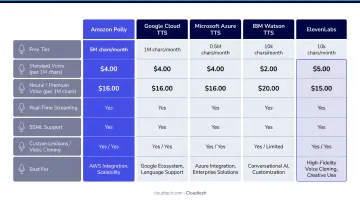
For most SMB use cases—appointment reminders, intake calls, FAQ deflection—dropping from a premium hyper-realistic voice to a mid-tier neural voice doesn't meaningfully degrade caller experience. The cost savings, however, are significant at production volume.
Call Volume and Concurrency Requirements
Volume affects unit pricing (most platforms offer better rates at scale), but concurrency is where surprise costs appear. Retell, for example, includes 20 concurrent calls on its base plan — additional slots run $8/month each, and burst mode adds $0.10/minute on top of standard rates.
For outbound campaigns or healthcare and financial services operations with peak-hour demand, underestimating concurrency needs leads to throttled calls or overage fees. Build in a buffer.
Compliance and Security Requirements
Compliance is a plan-gating or surcharge item on most platforms:
- Vapi: HIPAA costs $2,000/month; Zero Data Retention costs $1,000/month
- Retell: HIPAA/BAA and custom SSO require an Enterprise plan — no public pricing available
- Bland: SOC 2 Type II, HIPAA, GDPR, and PCI DSS listed on their trust page with no public surcharge
Businesses deploying on AWS-native infrastructure—using Amazon Connect, Amazon Transcribe, and Amazon Polly—can consolidate compliance under AWS's existing certifications rather than paying per-platform surcharges. For regulated industries, this architecture decision alone can justify the engineering investment.
Full Cost Breakdown: What Goes Into Every Bill
Most AI voice agent pricing pages show one number. Your actual bill reflects five separate cost layers per call — plus one-time and recurring charges that rarely appear until after you've signed up.
Speech-to-Text (STT)
STT converts spoken audio to text for the LLM to process. Real-time streaming—required for voice agents—costs more than batch transcription.
Current streaming rates:
- Deepgram Flux English: $0.0065/minute
- Google Speech-to-Text V1: ~$0.016/minute after free tier
STT is typically the lowest-cost component, but it adds up at scale and shouldn't be ignored in budget models.
LLM Inference
LLM inference is the "brain" cost, driven by system prompt length, conversation history, and model tier. Costs are token-based, not time-based. A 3-minute call with a verbose prompt and long conversation history costs more than a 3-minute call with a lean one.
Key principle: shorter system prompts + more concise AI responses = meaningfully lower LLM costs at volume.
Text-to-Speech (TTS)
TTS converts the LLM's text response back to audio. It's typically the highest single-component cost, especially when premium or hyper-realistic voices are selected. The tradeoff between voice naturalness and cost is real. For most SMB use cases, mid-tier neural voices deliver sufficient quality at a fraction of the price.
Telephony
Telephony covers the actual carrier cost of the phone connection. Most buyers overlook it entirely:
- SignalWire: $0.0066/minute inbound, $0.0080/minute outbound (US local)
- Twilio: ~$0.0140/minute outbound (US local)
- Retell managed telephony: $0.015/minute (with $0 for SIP/custom carrier)
Platforms that manage telephony on your behalf apply a markup over raw carrier rates. Bring-your-own-carrier (BYOC) options like SIP trunking can reduce this significantly. Retell, for example, charges $0.015/minute for managed telephony but nothing extra when you bring a custom carrier.
Platform / Orchestration Fee + Hidden Charges
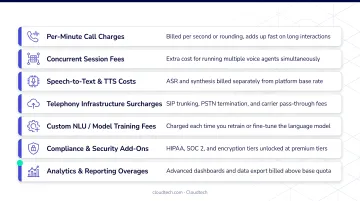
The platform fee covers low-latency orchestration of STT, LLM, and TTS, plus conversation state management. But the line items that surprise buyers most come after:
Common hidden charges to budget for:
- Phone number rental ($2/month per number on Retell)
- Additional concurrency slots ($8/month per slot on Retell; $10/line/month on Vapi)
- Burst mode overages ($0.10/minute on Retell)
- Bland-specific fees: $0.015 per failed outbound attempt, plus $0.03–$0.05/minute for transfers depending on plan
- Add-on features on Retell: Knowledge Base (+$0.005/min), PII Removal (+$0.01/min), AI QA ($0.10/min)
- Compliance surcharges: HIPAA costs $2,000/month on Vapi
- One-time setup and onboarding costs
How to Build the Right AI Voice Agent Budget for Your Business
The right budget matches your call volume, use case complexity, compliance requirements, and expected ROI—not the lowest possible number.
Questions to Answer Before Choosing a Platform
- What is your expected monthly call volume, and how variable is it week-to-week?
- What is your peak concurrency requirement (simultaneous calls at the busiest hour)?
- Is the task simple and scripted, or does it require multi-turn reasoning and CRM lookups?
- Does your industry require HIPAA, SOC 2, or GDPR compliance?
- Do you have in-house engineering capacity to manage a BYOK/BYOC setup, or do you need a fully managed solution?
Common Budgeting Mistakes
- Mistake: Platform fee only — always calculate the all-in per-minute rate across all five cost components
- Ignoring recurring operational costs — telephony markups, compliance surcharges, and concurrency fees recur every month
- Over-specifying for the task — deploying GPT-4o and ElevenLabs Multilingual v3 for an appointment reminder bot burns budget that a lightweight model and standard neural TTS could handle equally well
- Underestimating one-time costs — setup, integration, onboarding, and testing can range from a few hundred to several thousand dollars before the first production call
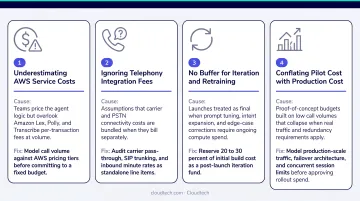
Several of these mistakes point to the same root cause: fragmented tooling with fragmented billing. That's where AWS-native architecture changes the math.
How AWS-Native Architecture Changes the Cost Equation
Businesses deploying on AWS infrastructure—using Amazon Connect, Amazon Transcribe, and Amazon Polly—can consolidate billing under a single AWS account and avoid per-platform compliance surcharges. They also leverage existing AWS certifications rather than paying for them separately on each third-party tool. At production scale, eliminating markups on telephony, TTS, and orchestration can meaningfully reduce your per-minute cost.
The tradeoff is engineering complexity. AWS-native builds require meaningful upfront architecture work, which is where working with an AWS-certified partner makes sense. Cloudtech designs voice AI stacks on AWS for SMBs—scoping the architecture, handling compliance, and often reducing out-of-pocket cost through AWS Partner Funding. If you're evaluating your first deployment or trying to model what a production build would actually cost, reach out to Cloudtech for a consultation tailored to your call volume and use case.
Frequently Asked Questions
What is the actual all-in cost per minute for an AI voice agent?
Advertised rates like $0.05/minute reflect only the platform hosting fee. All-in production costs—including STT, LLM inference, TTS, and telephony—typically land between $0.07 and $0.31/minute for most SMB deployments, with Retell's published stack example sitting at $0.115/minute as a useful mid-point benchmark.
What is the difference between pay-as-you-go and subscription pricing?
Pay-as-you-go suits low or variable call volume—typically under 3,000–5,000 minutes/month—where the flexibility outweighs the higher per-minute rate. Subscription models lower per-minute costs but require a monthly base fee, so they pay off only when volume is consistent. Many platforms now offer hybrid models that combine both.
How does the cost of an AI voice agent compare to a human call center agent?
BLS data puts the median US customer service wage at $20.59/hour—before benefits, software, training, and management overhead. At $0.10–$0.20/minute all-in, an AI voice agent handling 3,000 minutes/month costs roughly $300–$600, compared to a single full-time agent running $3,500–$5,000/month fully loaded.
What hidden fees should I watch for when evaluating AI voice agent platforms?
The most common surprises to watch for:
- Silence and hold-time billed at full per-minute rates
- Concurrency overage fees when peak volume exceeds included slots
- Compliance surcharges (especially HIPAA)
- Failed outbound call minimums
- Telephony markups on managed numbers vs. bring-your-own-carrier rates
Is it cheaper to build on AWS or use a third-party platform?
Custom AWS builds can lower per-minute costs at scale by eliminating platform markups—but require upfront engineering and ongoing maintenance. Third-party platforms offer faster time to value with less technical complexity. Most SMBs find the AWS-native route pays off above roughly 10,000–15,000 minutes/month.
How do I calculate my expected monthly AI voice agent spend?
Multiply your estimated monthly minutes × all-in per-minute rate, then add phone number rental, concurrency slots, compliance add-ons, and one-time setup costs. Example: 5,000 minutes/month × $0.115/minute = $575 in usage, plus $2/month per phone number, $8/month per extra concurrency slot, and any applicable compliance or integration fees.