For SMBs without dedicated AI teams, the stakes are higher. Most of the damage happens before a single conversation takes place — during infrastructure planning, tool selection, and data preparation. Get those decisions wrong, and no amount of prompt engineering will save you.
This article covers five challenges that consistently derail conversational AI deployments in 2026, paired with practical mitigation strategies for businesses building on AWS infrastructure.
Key Takeaways
- Most conversational AI failures trace back to poor NLP design, weak infrastructure, or broken escalation logic — not AI being inherently too complex
- GDPR, HIPAA, CCPA, and EU AI Act compliance demands have grown as LLMs handle more sensitive data
- Backend integration with CRMs, EHRs, and databases is essential for AI that takes real action
- Rigid conversation flows and absent human handoff paths are top drivers of customer abandonment
- Conversational AI requires ongoing governance: retraining, version control, and knowledge base audits after launch
Challenge 1: NLP Accuracy, Intent Recognition, and AI Hallucinations
Even advanced LLMs misfire when conversations involve domain-specific jargon, emotional language, slang, or multi-step requests. The model may return a confident, well-structured answer that is simply wrong.
The Hallucination Problem
AI hallucination occurs when a language model generates a statistically plausible but factually incorrect response. This isn't a fringe edge case. Research from the HalluLens benchmark found hallucination rates of 45.15% for GPT-4o and 26.84% for Llama-3.1-405B-Instruct on factual prompts — and those are controlled benchmark conditions, not the messier reality of enterprise deployments.

In healthcare or financial services, a hallucinated response isn't just unhelpful. It erodes trust and creates liability.
Knowledge Base Rot
A subtler but equally damaging problem: adding more content to a chatbot's knowledge base over time degrades retrieval quality. Conflicting policies, outdated product information, and redundant documents accumulate undetected. Gartner's customer service research found that 61% of leaders reported a backlog of knowledge articles to edit, while more than one-third had no formal process for revising outdated content.
The underlying model isn't the problem — degraded retrieval data is.
Mitigation Approaches
Retrieval-Augmented Generation (RAG) is the current best practice for grounding conversational AI in verified enterprise data. Rather than generating responses from open-ended model knowledge, RAG constrains the model to retrieve answers from trusted internal sources — documents, databases, knowledge bases.
Amazon Bedrock Knowledge Bases supports connections to Amazon S3, SharePoint, Confluence, Google Drive, and OneDrive, making enterprise RAG achievable without custom infrastructure.
RAG alone isn't sufficient, though. Two operational controls keep the system honest over time:
- Confidence thresholds — Route low-confidence responses to a clarifying question or human escalation — never let the model fabricate. Thresholds should be adjustable by non-developer team members to stay practical at SMB scale
- Quarterly knowledge base audits — Assign content ownership, flag outdated articles, and retire documents with a defined expiry date before they contaminate retrieval results
Challenge 2: Data Privacy, Security, and Regulatory Compliance
Conversational AI systems in 2026 ingest far more sensitive data than earlier chatbot generations — patient records, financial transactions, PII — at significantly higher volumes. Compliance obligations have kept pace.
The Regulatory Landscape
Key obligations businesses must address:
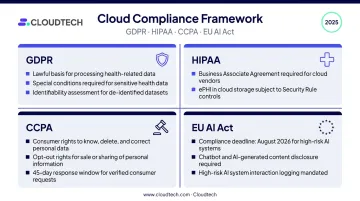
- GDPR: Chatbot logs containing personal data require a valid Article 6(1) lawful basis. Health data requires an additional Article 9(2) condition. AI models are not automatically anonymous — identifiability must be assessed case by case
- HIPAA: Any cloud provider storing or processing electronic Protected Health Information (ePHI) qualifies as a business associate, even if it cannot decrypt the data. A written Business Associate Agreement is required
- CCPA: Chatbot logs containing personal information remain subject to rights to know, delete, and correct. Covered businesses must respond to substantive requests within 45 calendar days
- EU AI Act: Full application scheduled for August 2, 2026. Users must be informed when interacting with a chatbot; high-risk systems face additional logging and documentation requirements
The enforcement environment has hardened. Italy's Garante fined OpenAI €15 million in December 2024 for GDPR violations involving transparency failures, age verification gaps, and failure to notify a data breach.
Mitigation Approaches
For regulated industries — healthcare, financial services — prioritize platforms that support private cloud or on-premises deployment. This keeps conversation data within a controlled security perimeter rather than exposing it to shared public infrastructure.
Automated PII detection and redaction must be built into the pipeline before go-live, not audited after the fact.
Amazon Bedrock Guardrails can block or mask detected PII in both user inputs and model responses — AWS specifically cites PII redaction from call-center transcripts as a supported use case. Set these controls at the infrastructure level so they apply to every request from day one.
Challenge 3: Backend Integration and Cloud Infrastructure Readiness
Most conversational AI systems fail to deliver real business value for one reason: they can't connect to the systems of record that would allow them to act. A chatbot limited to static text responses is, at best, a marginally better search box.
The AI-Ready Data Problem
McKinsey's enterprise AI research found that 70% of AI high performers reported data difficulties, including defining governance processes and integrating data into AI models. Data silos, inconsistent schemas, and legacy systems without APIs are the most common blockers — and they delay deployment by months, not days.
For an AI to function as a business tool, it must:
- Query internal systems in real time (CRMs, EHRs, inventory databases)
- Trigger workflows — creating support tickets, verifying identity, updating account records
- Return personalized, accurate responses based on live data, not cached FAQs
Mitigation Approaches
An API-first architecture is the foundation. The conversation layer must be able to call backend systems, handle responses, and degrade gracefully when those systems are unavailable.
On AWS, this integration layer typically involves:
- Amazon Lex for natural language understanding and intent recognition
- AWS Lambda for fulfillment logic that connects the conversation to backend systems
- Amazon API Gateway for authentication, throttling, and request routing to Bedrock and internal APIs
- Amazon Bedrock for LLM reasoning, RAG orchestration, and agent-based workflows
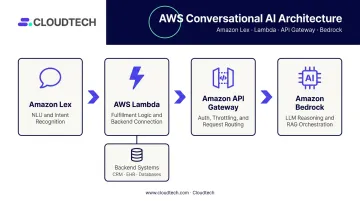
The key is designing this architecture before any AI model is selected. Cloudtech's AWS-certified architects work with SMBs to establish this integration layer before development begins — covering CI/CD pipelines via GitHub Actions and AWS CodePipeline, infrastructure-as-code through Terraform and CloudFormation, and automated data pipelines that prepare Amazon S3 content for AI consumption through Amazon Textract.
That upfront structure matters. Teams that skip the integration design phase routinely discover broken handoffs between the conversation layer and backend systems during production — not during testing, where they're cheaper to fix.
Which is exactly why integration testing deserves its own dedicated phase. Define test cases for edge conditions, error handling, and fallback responses when backend systems are unavailable — well before go-live, while fixes are still straightforward.
Challenge 4: Rigid Conversation Design and Broken Escalation Paths
Decision-tree chatbot design fails in real conversations. Users ask questions out of sequence, change topics mid-flow, and use phrasing no designer anticipated. Force them down a fixed path and they leave.
Forrester predicts that one-third of companies will harm their CX scores in 2026 by deploying AI self-service that doesn't work for the situations it's placed in. The data supports the concern: Gartner found only 14% of customer service issues are fully resolved in self-service, and among self-service failures, 45% said the company didn't understand their intent.
The Escalation Design Problem
The most damaging user experience failure in conversational AI isn't a wrong answer. It's trapping a frustrated customer in a loop with no visible exit.
Escalation logic must be designed before conversation flows — not added as an afterthought when early users start complaining. Conversation context must transfer with the handoff; a customer who has to repeat their entire issue to a human agent after spending five minutes with a bot is worse off than if the bot hadn't existed.
Effective conversation design requires:
- Preserving full session context across topic changes and mid-conversation pivots
- Triggering handoffs automatically on sentiment signals (frustration, repeated failed intents) — not just when the user explicitly asks
- Responding to unresolvable queries with empathetic fallback language, not dead ends or generic error messages
- Passing the full conversation history to the human agent on every transfer

Escalation rate optimization should be treated as an ongoing post-launch deliverable — not a static configuration set at launch. Regular call log reviews and intent-failure analysis are what separate a system that improves over time from one that quietly frustrates users at scale.
Challenge 5: Scalability, Vendor Lock-In, and Knowledge Base Decay
Many conversational AI deployments start as MVPs on proprietary platforms chosen for their drag-and-drop simplicity. They're easy to launch and nearly impossible to scale, customize, or migrate away from as business needs evolve.
Evaluating Platforms Before You're Locked In
Switching costs compound quickly. Proprietary conversation logic, closed model dependencies, and non-portable training data mean that leaving a platform eighteen months in is significantly more expensive than the initial build. Before committing to any platform, evaluate:
- Data portability — Can you export conversation logs, intents, and training data in standard formats?
- Open API access — Does the platform expose APIs for custom integration, or does it require using proprietary connectors?
- Deployment flexibility — Does it support on-premises, private cloud, or hybrid options for regulated industries?
- Model independence — Is the conversation logic tied to a single underlying LLM, or can models be swapped?
AWS-native architectures using Amazon Lex, Bedrock, and API Gateway offer more flexibility than closed SaaS conversation platforms — with no proprietary lock-in on conversation logic or training data.
Knowledge Base Decay as an Operational Reality
Even a well-configured system degrades over time. Product lines change, policies update, terminology shifts — and without a formal governance process, accuracy quietly erodes and customer satisfaction follows. Sustaining performance requires treating the knowledge base as an ongoing operational responsibility, not a one-time deliverable.
Operational requirements to sustain performance:
- Assign a named owner to every knowledge article
- Conduct audits at least quarterly (Salesforce's recommendation) — more frequently for fast-moving product or policy environments
- Use feedback signals from conversation logs to prioritize which articles need revision
- Implement version control so rollbacks are possible when content changes introduce new errors
- Set expiry dates on time-sensitive content so outdated articles are retired automatically
Teams that build governance into their workflows from day one spend far less time firefighting accuracy issues at month six.
Frequently Asked Questions
What are the main challenges of implementing conversational AI?
Five challenges account for most conversational AI failures:
- NLP accuracy and hallucinations
- Data privacy and regulatory compliance
- Backend integration gaps
- Rigid conversation design with broken escalation paths
- Long-term scalability and knowledge base maintenance
Most failures trace back to early infrastructure and design decisions, not AI capability limits.
Why do so many conversational AI projects fail to deliver ROI?
Most failures originate from tools chosen for demos rather than production, skipping data infrastructure preparation, and treating deployment as the endpoint. Sustainable ROI requires an ongoing improvement cycle — continuous retraining, periodic knowledge audits, and integration refinement — not a one-time launch.
What is AI hallucination and why does it matter for business deployments?
Hallucination occurs when a language model generates a confident but factually incorrect response. In healthcare or financial services, this creates real liability. Connecting the model to a verified, domain-specific knowledge base via RAG architecture is the standard technical fix.
How do businesses ensure data privacy and compliance when deploying conversational AI?
Four requirements apply in almost every deployment:
- Explicit consent mechanisms before data collection
- Automated PII redaction within the processing pipeline
- Detailed audit trails with tamper-resistant logging
- Private cloud or on-premises deployment for regulated industries requiring full data sovereignty
How long does it typically take to implement conversational AI for an SMB?
A basic FAQ-style deployment can be live in 2–6 weeks. A fully integrated system connected to backend enterprise systems and configured for compliance typically takes 6–12 weeks. Data readiness and integration complexity drive the timeline far more than AI configuration does.
Can SMBs implement conversational AI without a dedicated AI team?
Yes. Most SMBs use a specialist implementation partner to handle infrastructure and integration, freeing the internal team to focus on conversation design, knowledge base content, and business requirements. Platform selection and partner fit matter more than having in-house AI expertise.