Introduction
Most migration failures aren't technical failures. They're planning failures.
McKinsey research found that poorly coordinated cloud migrations cost organizations an average of 14% more than planned, with 38% of companies experiencing delays of more than one quarter — representing over $100 billion in aggregate overruns globally. The common thread across those overruns isn't bad infrastructure. It's starting migration without an honest readiness evaluation.
An AWS Migration Readiness Assessment (MRA) fixes that. It's a structured, cross-functional evaluation that exposes gaps before they become expensive mid-migration problems: business strategy, people, governance, platform, security, and operations.
This guide delivers a complete MRA checklist: what to assess, how to score results, how to interpret findings, and which mistakes will invalidate the entire exercise.
Key Takeaways
- An MRA evaluates six AWS CAF dimensions — Business, People, Governance, Platform, Security, and Operations — each scored independently.
- Maturity ratings run from 1–5 per dimension; a single blended average obscures the gaps that matter most.
- The MRA output must be an actionable gap-closure plan with owners and deadlines, not just a report.
- Skipping stakeholders — particularly the executive sponsor and workload owners — makes the assessment decorative.
- AWS-certified partners accelerate and deepen MRAs beyond what the self-guided CART tool alone can deliver.
What You Need Before Starting Your AWS Migration Readiness Assessment
A high-quality MRA isn't a solo IT exercise. Without the right people, tools, and baseline data in place, the assessment produces gaps — and gaps in ratings become gaps in your migration plan.
Stakeholders and Roles to Involve
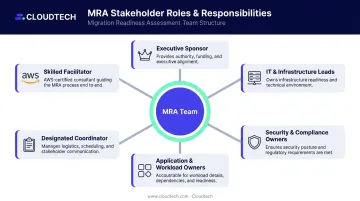
Every role below must participate. Missing any one creates a blind spot that will surface later as a migration risk:
- Executive sponsor — provides business alignment, funding authority, and organizational commitment
- IT and infrastructure leads — own the current environment and dependency knowledge
- Security and compliance owners — ensure regulatory requirements are captured, not assumed
- Application and workload owners — the only people who truly know each system's behavior and criticality
- Designated coordinator — manages scheduling, pre-assessment questionnaire distribution, and information gathering
- Skilled facilitator (an AWS Solutions Architect or certified cloud consultant) — maintains structure, keeps ratings honest, and builds the stakeholder consensus that survives the readout meeting
Tools and Inputs Required
Primary tools:
- AWS Cloud Adoption Readiness Tool (CART) — a 16-question self-guided survey for organizations without a partner
- AWS CAF 3.0 — the framework underpinning all assessment questions and maturity ratings
- Pre-assessment questionnaire — distributed to attendees before the workshop to capture baseline data
Documentation required before the workshop:
- Current application and workload inventory
- Infrastructure diagrams and dependency maps
- Software license records
- Applicable compliance requirements
- Current cost and spend data
- Existing security policies and controls
The Complete AWS Migration Readiness Assessment Checklist
The six areas below come directly from the AWS Cloud Adoption Framework, each rated on a 1–5 maturity scale. All six must be assessed — skipping one area introduces migration risk that will materialize later.
Business Case and Strategic Alignment
Verify each of the following before moving forward:
- A written business case exists with primary migration drivers (cost reduction, scalability, agility, compliance)
- Migration goals are tied to specific, measurable KPIs, not just technical outcomes like "lift and shift complete"
- Executive sponsorship is confirmed and active, not assumed
- Dedicated funding is committed for migration tooling, testing environments, and potential rework
Migrations without a documented business case and a committed executive champion stall. Funding gaps discovered mid-project are far harder to close than those caught during assessment.
People and Organizational Readiness
Skills and organizational gaps to assess:
- Current AWS skills gaps across IT roles (developer, operations, security, architecture)
- Whether a formal training plan or upskilling roadmap exists to close those gaps before go-live
- Whether a Cloud Center of Excellence (CCoE) is established or formally planned
AWS research found that 83% of customers with a Cloud Center of Excellence rated it effective, citing lower security risk, reduced costs, and improved agility. For SMBs without an internal CCoE, a certified AWS partner can serve as that function during the migration period — providing on-demand access to solutions architects and structured knowledge transfer.
Governance and Compliance Readiness
Governance items to confirm:
- Change management processes have a cloud-compatible equivalent defined
- Configuration management, asset tracking, and disaster recovery plans are updated for cloud operations
- All applicable compliance frameworks are identified: HIPAA, SOC 2, GDPR, PCI-DSS, and others
AWS maintains compliance programs for each of these frameworks, but compliance is a shared responsibility. AWS secures the cloud infrastructure; customers are responsible for how they configure and use it. The MRA must confirm that your compliance posture in AWS is explicitly planned, not inherited by assumption.
That distinction matters most in regulated industries. In healthcare engagements, Cloudtech has surfaced gaps like existing logs failing HIPAA audit trail requirements before any production workload moved, giving teams time to preconfigure AWS CloudTrail, KMS encryption, and VPC endpoint policies from day one.
Platform and Infrastructure Assessment
What the inventory must cover:
- A complete workload inventory, including shadow IT and undocumented systems
- Application dependencies and integration points mapped
- Systems nearing or past end-of-support flagged (Windows Server 2012 R2 extended support ended October 2023; SQL Server 2012 extended support ended July 2022)
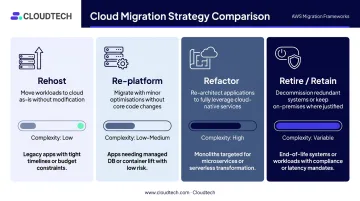
- Each workload classified by migration strategy: rehost, re-platform, or refactor
Also measure current infrastructure for known performance bottlenecks and overprovisioned resources (candidates for right-sizing).
This data drives AWS service selection and instance sizing decisions. Skipping it means guessing at architecture, and that shows up in the bill.
Security Assessment
Security controls to map and verify:
- Existing controls against AWS IAM best practices: least-privilege policies, MFA enforcement, temporary credentials for workloads
- Encryption posture: data at rest and in transit, with AWS KMS for key management
- Logging and monitoring: CloudTrail enabled, centralized logging configured
- Network segmentation: VPC design, endpoint policies, public access restrictions
Build a reference security architecture before migration starts. Factor in third-party risk assessments and compliance-specific controls now, not after go-live.
Operations and Cost Readiness
Cost modeling inputs to calculate:
- Current total cost of ownership (TCO) including hardware, labor, facilities, and licensing
- Projected AWS costs across pricing models: on-demand, Reserved Instances, Savings Plans
Use the AWS Pricing Calculator to validate assumptions and model multiple scenarios before committing to an architecture.
The AWS Optimization and Licensing Assessment (OLA) is a valuable complement here — particularly for organizations running Microsoft SQL Server or Windows Server workloads. AWS reports that customers migrating to AWS reduce Windows Server licensing costs by an average of 77% and SQL Server licensing costs by 45%.
Confirm cloud-native equivalents exist for each of the following before go-live:
- CI/CD pipelines
- Backup and recovery strategies
- VM patching and configuration management
- Service catalog management
- Cost monitoring and alerting (AWS Cost Explorer, AWS Budgets, Trusted Advisor)
How to Interpret Your AWS MRA Results
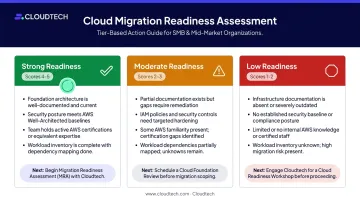
The MRA produces a maturity rating of 1–5 per dimension. Together, these ratings form a readiness profile — but no single average score tells the whole story. A strong average with a score of 1 in Security is not a passing result.
Reading Your Results: Three Outcome Tiers
| Tier | Score Profile | What It Means |
|---|---|---|
| Strong Readiness | 4–5 across most areas | Solid foundations in place. Finalize migration sequencing, identify a pilot workload, establish success metrics. Can move to Mobilize phase quickly. |
| Moderate Readiness | 2–3 in several areas | Gaps exist but are addressable. Prioritize Security, Governance, and People first — these take longer to close than technical gaps. Build a 30–60–90 day remediation roadmap before committing to full migration. |
| Low Readiness | 1–2 across multiple areas | Migration should not proceed. Common indicators: no executive sponsor, undefined compliance posture, unaudited application inventory, no cloud skills in-house. Proceeding carries high risk of cost overruns, security incidents, and failed migrations. |
Turning Results Into an Action Plan
The MRA output is only useful if it drives action. A completed assessment that sits in a shared drive has zero value.
A functional MRA action plan includes three components:
- Order gaps by migration risk and dependency — security before platform, governance before operations
- Assign one named person per gap, not a team or department
- Set closure dates tied to actual resourcing, not aspirational timelines
A readout meeting with the executive sponsor is non-negotiable. Without that meeting, action items lack organizational authority — and they will slip.
Cloudtech's AWS-certified team conducts MRAs as the first step of every migration engagement — converting raw ratings into a prioritized, funded roadmap with named owners and defined timelines. For SMBs without in-house cloud architects, that means walking away with a plan that finance has approved and leadership has committed to, not just a spreadsheet of findings.
Common Mistakes That Undermine AWS Migration Readiness Assessments
Conducting the Assessment Without Key Stakeholders
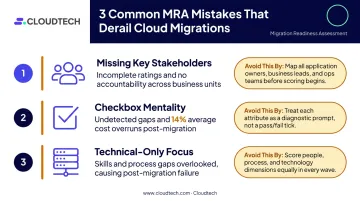
The most damaging mistake is running the MRA without workload owners and the executive sponsor present. Without their input, ratings reflect IT's perspective only — which misses the business alignment, compliance requirements, and accountability that make action items stick. Workload owners fill in the inventory gaps IT can't see. Without an executive sponsor, the resulting action plan has no one to fund or enforce it.
Treating the MRA as a Checkbox Exercise
Organizations that rush through the MRA to produce a "passing" score defeat its entire purpose. The MRA is a diagnostic tool, not a compliance audit. Its value is in surfacing gaps before they become expensive mid-migration problems.
The cost of skipping this work is real. McKinsey's research found that migration coordination problems drive 14% average spending overruns — money that a proper assessment would have redirected into planned, controlled remediation rather than reactive firefighting.
Focusing Only on Technical Dimensions
Platform and Security assessments are measurable and familiar: infrastructure diagrams, firewall rules, instance types. Most organizations assess those thoroughly while giving People and Governance cursory attention.
Cloud migrations routinely fail not because servers can't be moved, but because:
- Teams lack the skills to operate the new environment
- Operational processes weren't adapted for cloud-native workflows
- Change wasn't managed, so adoption stalled post-migration
The technical lift is only half the work. The organizational readiness gaps exposed in these areas are what determine whether the migration delivers lasting value or creates a new set of problems to manage.
Conclusion
A well-executed AWS Migration Readiness Assessment removes the guesswork from cloud migration. Completing all six CAF dimensions with honest ratings and engaged stakeholders gives your team the clarity to move forward with a defined plan — not assumptions.
The MRA output should be a living planning tool, not a report filed after the workshop. Organizations that revisit their assessment as gaps close and use it to sequence migration waves consistently outperform those that treat it as a one-time exercise.
When used correctly, an MRA delivers three things that drive migration success:
- A clear, prioritized gap list across all six CAF dimensions
- A sequenced migration wave plan tied to actual readiness — not arbitrary timelines
- Stakeholder alignment before the first workload moves
If your organization is preparing for an AWS migration, Cloudtech's team of AWS-certified architects (70% former AWS employees) conducts MRAs as the structured first step in every migration engagement. Starting there means your migration plan is grounded in reality from day one.
Frequently Asked Questions
What is an AWS Migration Readiness Assessment (MRA)?
An MRA is a structured evaluation process based on the AWS Cloud Adoption Framework (CAF) that helps organizations understand their current cloud readiness across six dimensions — business, people, governance, platform, security, and operations. The output is an action plan to close identified gaps before migration begins, not just a report.
What are the three phases of the AWS migration process?
The three phases are Assess (evaluate readiness and build a business case), Mobilize (establish cloud foundations, landing zones, and validate with a pilot migration), and Migrate — also called Migrate and Modernize under AWS's Migration Acceleration Program. Each phase builds directly on the one before it.
What is the AWS Cloud Adoption Framework (CAF)?
The AWS CAF is AWS's structured guidance framework that organizes cloud readiness across six perspectives — Business, People, Governance, Platform, Security, and Operations. AWS CAF 3.0, released in November 2021, serves as the backbone of the MRA questionnaire and scoring methodology.
How long does an AWS Migration Readiness Assessment take?
A typical MRA workshop runs one to two days. Pre-assessment preparation — distributing questionnaires, collecting infrastructure data, aligning stakeholders — adds one to two weeks. Working with an experienced AWS Partner can cut that timeline by accelerating both the prep work and the facilitation itself.
Do I need an AWS Partner to complete an MRA?
AWS offers the self-guided Cloud Adoption Readiness Tool (CART) for a DIY approach. An AWS-certified partner brings structured facilitation, deeper gap analysis, and a migration roadmap that a 16-question survey alone cannot produce — a real difference for SMBs that don't have dedicated cloud architects on staff.
What happens after the Migration Readiness Assessment?
MRA results feed directly into the Mobilize phase: gaps are prioritized, owners are assigned, and a migration roadmap is built. High-readiness organizations move to pilot migrations quickly; others close foundational gaps in security, governance, or people readiness before moving production workloads to AWS.