The pressure is building from multiple directions. According to a 2024 J.D. Power study, 53% of first-time auto insurance buyers now start their carrier relationships through digital channels. Meanwhile, a Deloitte survey of 200 US insurance executives found that 76% have already implemented generative AI in at least one business function — meaning conversational AI has moved from pilot project to competitive baseline.
This article covers what conversational AI actually means in an insurance context, which use cases deliver the most value, the measurable benefits carriers can expect, and how to build on AWS infrastructure that scales securely.
Key Takeaways:
- Conversational AI handles multi-intent queries, integrates with live policy systems, and takes real action — not just answers questions
- ID&V, FNOL intake, and routine policy support deliver the fastest, most measurable ROI
- Claims experience is the single highest-risk churn moment — auto claimants switch carriers at a 35% higher rate than non-claimants
- AWS services (Lex, Connect, Bedrock) provide a proven, compliant foundation for insurance deployments
- Starting with one focused use case and expanding is more effective than broad simultaneous rollout
What Is Conversational AI in Insurance?
Conversational AI refers to systems that understand natural language — through NLP and machine learning — and respond intelligently across voice, chat, and messaging channels. In insurance, this means a policyholder can say "I just hit a deer and need to file a claim" and the system understands the intent, asks the right follow-up questions, and initiates the intake process. No menu navigation. No rephrasing required.
How It Differs From Rule-Based Chatbots
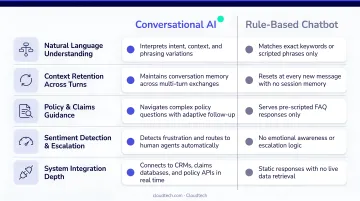
Traditional insurance chatbots operate on decision trees. They work when customers phrase questions exactly right, handle one topic at a time, and fail loudly when queries are ambiguous or compound. Ask about hail damage, your deductible, and your rental coverage in the same message, and most rule-based bots respond with some version of "I didn't understand that."
Conversational AI handles this differently:
- Multi-intent recognition — identifies several questions within a single message
- Context retention — remembers what was said earlier in the conversation
- Live data integration — pulls real-time information from policy administration, claims, and billing systems
- Action capability — initiates a claim, updates a policy, processes a payment, or schedules a callback
- Intelligent escalation — transfers the full conversation history to a human agent when needed, so the customer never repeats themselves
The AWS Infrastructure Layer
For US insurers building these systems, three AWS services form the core stack:
- Amazon Lex — handles intent recognition and dialogue management
- Amazon Connect — provides omnichannel contact center capability across voice and digital channels
- Amazon Bedrock — adds large language model capabilities for complex, open-ended questions
For US insurers building these systems, three AWS services form the core stack:
- Amazon Lex — handles intent recognition and dialogue management
- Amazon Connect — provides omnichannel contact center capability across voice and digital channels
- Amazon Bedrock — adds large language model capabilities for complex, open-ended questions
Together, they form a unified AWS stack where sensitive policyholder data remains under the insurer's control.
Key Use Cases of Conversational AI in Insurance
Identification and Verification (ID&V)
Nearly every insurance interaction starts with identity verification. In practice, this consumes significant agent time before any actual service is delivered — agents confirm policy numbers, verify addresses, answer security questions, and document the result manually.
Conversational AI automates the entire ID&V flow upfront: identity questions, document upload prompts, and verification checks — all before a human agent is ever involved. When escalation is needed, the agent receives a fully verified, context-populated handoff instead of starting from scratch.
The impact is measurable. A Pindrop case study of a large US insurer found that passive call authentication saved 60 seconds per call across 1.8 million annual calls, generating $864,000 in savings. That's from ID&V alone — before any other workflow is automated.
Claims Intake and First Notice of Loss (FNOL)
FNOL is where conversational AI has its most direct impact on customer retention. When a policyholder reports a loss, the AI guides them through capturing incident details, verifying coverage, collecting photos or supporting documents, and confirming next steps — all within the same conversation. The human adjuster receives a fully populated case file rather than a raw call transfer.
The data on why this matters is stark. A LexisNexis study of 1,400 insureds found that:
- Auto claimants switch carriers at a 35% higher rate than non-claimants
- 40% of loyal customers spoke with just one person to settle their claim
- 45% of flight-risk customers dealt with three or more representatives
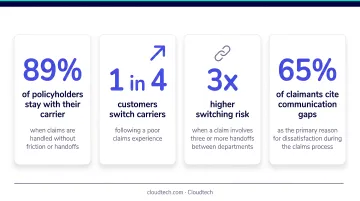
Reducing handoffs and eliminating repeated information requests directly improves retention — every unnecessary transfer is a reason for a policyholder to reconsider at renewal.
There's also the availability problem. Accidents don't happen during business hours. A policyholder who can't reach anyone after an evening collision and has to call back in the morning has already had a poor claims experience — before an adjuster has touched the file.
Policy Quotes, Renewals, and Upsells
Conversational AI can manage the full quoting workflow: gathering customer details, pulling pricing data from backend systems, presenting options, and processing acceptance — all within a single conversation, whether on web chat, WhatsApp, or voice.
For renewals, the proactive outreach use case is especially effective. The AI contacts policyholders near their renewal date, enabling them to confirm or modify coverage in the same channel without navigating to a separate portal. The 2025 J.D. Power Insurance Retention Playbook found that overall satisfaction drops from 712 to 486 when customers don't receive tailored communications — a gap that directly affects renewal rates. The same research identifies P&C attrition as a $100B+ problem for the industry.
Routine Customer Support and Policy FAQs
The highest-volume, lowest-complexity queries in any insurance contact center follow predictable patterns:
- "What's my deductible?"
- "Is this procedure covered?"
- "What's the status of my claim?"
- "When is my payment due?"
Conversational AI resolves these instantly, at any hour, without agent involvement. This isn't about replacing human judgment — it's about protecting it. When agents are freed from repeating the same answers dozens of times per shift, they're available for the cases that actually require expertise, empathy, or discretion.
Fraud Detection Support
Conversational AI plays a supporting role in fraud prevention that's easy to overlook. Rule-based systems and human agents occasionally skip or abbreviate verification steps under volume pressure. AI enforces consistent authentication on every single interaction — no exceptions, no shortcuts.
Every exchange is automatically logged in an auditable trail. That consistency closes the compliance gaps that manual processes leave open — and gives claims teams defensible documentation when contested cases escalate.
Benefits of Conversational AI for Insurance Companies
24/7 Availability and Faster Response Times
Claim acknowledgment speed directly affects satisfaction. The 2025 J.D. Power Property Claims Satisfaction Study found communication ease scores of 777 when very easy vs. 337 when difficult — a gap that correlates directly with retention. Claims completed within 10 days scored 762 in satisfaction, compared to 595 when repairs exceeded 31 days.
Conversational AI eliminates the communication gaps that drive those low scores: missed callbacks, voicemails that go unreturned, and status requests that require hold time during business hours.
Operational Cost Reduction
The cost argument for conversational AI centers on volume displacement. High-frequency, low-complexity interactions — billing questions, coverage lookups, ID&V, status checks — make up a large share of contact center volume.
Automating these doesn't require proportional headcount reduction. It allows existing teams to handle more volume without additional hiring.
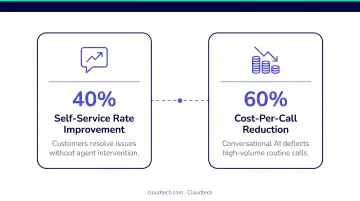
AWS's own customer data offers a concrete reference point: nib Health Insurance achieved a 65% increase in self-service rate after deploying Amazon Lex. More broadly, McKinsey's contact center analysis found AI agents drove a 50% reduction in cost per call in some customer contact center deployments — though results vary by implementation scope and baseline.
Improved Customer Experience and Retention
The claims experience is the single moment that determines whether a policyholder stays or shops. No-repeat-yourself handoffs, instant acknowledgment, and proactive outreach during the renewal window all move the needle on Net Promoter Scores and reduce churn.
Hi Marley's survey of 800 US adults found a stark pattern:
- 86% satisfaction when claim details only had to be reported once
- 7% satisfaction when details had to be repeated six or more times
Closing that gap directly impacts renewal rates — and conversational AI is now the most scalable way to do it.
Human Agent Empowerment
Conversational AI doesn't reduce agent headcount — it changes what agents spend their time on. Pre-verified, context-rich handoffs mean agents receive cases where their skills actually matter: complex coverage disputes, emotionally charged claims situations, or customers who need genuine human judgment.
This also reduces agent burnout. Repetitive, low-stakes calls drive contact center turnover more than most managers expect. Removing them improves job satisfaction and retention outcomes within the team itself — a compounding benefit that's easy to overlook when calculating ROI.
Compliance and Audit Readiness
For US insurers, the NAIC Model Bulletin requires documented AI governance, risk management controls, and oversight across the full insurance lifecycle.
AWS-native deployments address much of this by default — and because every agent interaction is already logged and timestamped, the audit trail builds itself:
- Amazon Lex V2 conversation logs store all bot interactions for review and troubleshooting
- Amazon Connect supports API activity logging through AWS CloudTrail
- Amazon Bedrock is HIPAA eligible, and customer data is not used to train base models
- All interactions are timestamped and auditable by default
This documentation quality often exceeds what manual processes produce — with no additional overhead.
Implementing Conversational AI in Insurance With AWS
Start With One High-Value Use Case
The most common mistake in conversational AI deployment is trying to automate everything at once. A more effective approach:
- Select one high-volume, well-defined use case — ID&V and FNOL intake are the strongest starting points for most insurers
- Map actual conversation flows using real call transcripts and customer interaction data, not theoretical scripts
- Define backend integrations before building — policy administration, claims platforms, billing engines, and CRM must be scoped upfront
- Set clear success metrics — containment rate, average handle time reduction, CSAT scores, so the deployment has measurable benchmarks
The AWS Service Stack
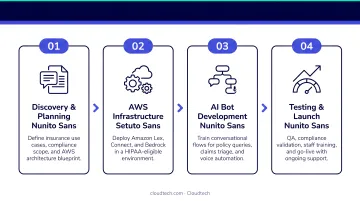
A scalable, secure insurance conversational AI deployment typically uses three AWS services in combination:
- Amazon Lex — intent recognition, entity extraction, and dialogue management across voice and text
- Amazon Connect — omnichannel contact center layer handling voice, chat, and routing, with full compliance support for PCI, HIPAA, and PII handling
- Amazon Bedrock — generative AI capabilities for more nuanced conversations, complex policy language interpretation, and open-ended customer queries
Each service maintains its own compliance posture: Lex V2 is HIPAA eligible, Connect supports CloudTrail logging and encryption controls, and Bedrock keeps customer data isolated from model training. For insurers with data residency requirements, this architecture keeps sensitive policyholder data under their direct control.
Working With an AWS Partner
Small and mid-sized carriers typically don't have the internal AWS expertise to architect these systems securely on a tight timeline. The integration work alone (connecting Lex to a policy administration system, configuring Connect routing logic, building Bedrock prompt chains) can consume months without experienced guidance.
Cloudtech is an AWS Advanced Tier Partner based in New York that works with small and mid-sized businesses to deploy conversational AI and voice solutions on AWS. The team includes former AWS professionals and certified solutions architects who handle compliance requirements, security architecture, and backend integrations as part of every engagement, compressing deployment timelines from months to weeks for focused, single-use-case builds.
Frequently Asked Questions
What are the benefits of conversational AI for insurance customer service?
Conversational AI delivers measurable improvements for both policyholders and carriers:
- 24/7 availability for claims intake and policy inquiries
- No hold times for routine requests
- Reduced agent workload on repetitive tasks
- Auditable interaction logs for compliance
Policyholders get faster responses without repeating information; carriers reduce costs and improve retention.
Are insurance companies using AI for customer service?
Adoption is widespread and accelerating. A Deloitte survey found 76% of US insurers have implemented generative AI in at least one function, with 82% adoption among life and annuity carriers and 70% among P&C insurers. Most deployments include customer-facing use cases: claims intake, policy inquiries, and ID&V.
What is the difference between a chatbot and conversational AI in insurance?
Traditional chatbots follow rigid decision trees, handle single-topic queries, and break when customers ask compound questions. Conversational AI understands natural language, maintains context across a full conversation, integrates with live policy data to give accurate real-time answers, and learns to improve over time.
What is First Notice of Loss (FNOL) and how does AI help?
FNOL is the first report of a claim event (the initial contact when a policyholder reports damage or an accident). Conversational AI automates the intake by capturing incident details, verifying coverage, and collecting documentation, so human adjusters receive a complete case file rather than a raw call transfer.
How long does it take to implement conversational AI in an insurance company?
Typically weeks, not months. A focused single-use-case deployment (such as ID&V or FNOL intake) built on AWS infrastructure can go live quickly with the right implementation partner. Timeline varies based on integration complexity, backend systems involved, and how clearly conversation flows are defined upfront.
What compliance considerations apply to conversational AI in insurance?
AI systems must enforce consistent verification steps, maintain auditable interaction logs, and handle PII securely under state and federal regulations. AWS-native deployments using Lex, Connect, and Bedrock provide built-in HIPAA eligibility, CloudTrail logging, and encryption controls. Insurers also remain responsible for third-party AI governance under NAIC Model Bulletin requirements.