Introduction
Missed appointments cost the U.S. healthcare system more than $150 billion annually, yet front-desk staff still spend hours each week on manual reminder calls. According to MGMA, 30 next-day reminder calls alone consume roughly one hour of staff time per day, not counting rescheduling requests, voicemail callbacks, and follow-ups on top of that.
Legacy tools haven't kept pace with that burden. Static robocalls and rigid IVR menus (the original "automated" fix) can't handle what patients now expect: confirming, rescheduling, or asking questions in real time. Healthcare organizations need AI that holds those conversations naturally, across multiple channels, without adding headcount or creating compliance exposure.
This guide covers what HIPAA actually requires for AI appointment reminders, the five vendor requirements you cannot skip, how modern conversational AI changes the reminder workflow, and how to deploy it on HIPAA-eligible AWS infrastructure.
Key Takeaways
- Missed appointments drain $150B+ from the U.S. healthcare system annually; AI reminders directly cut that loss.
- HIPAA permits appointment reminders without special authorization, but minimum necessary PHI and safeguards still apply.
- A signed Business Associate Agreement (BAA) is legally required before sharing any PHI with a vendor.
- EHR write-back capability separates true automation from a glorified phone tree.
- AWS HIPAA-eligible services (Amazon Connect, Lex, Transcribe Medical, HealthLake) provide a compliant infrastructure foundation.
The Real Cost of Missed Appointments — and Why AI Is the Answer
Quantifying the Problem
A peer-reviewed study of a Texas FQHC with 55 clinics calculated $45,578 per month in recovered revenue from averted missed appointments — and that was a single health system. Scale that across thousands of practices nationwide, and the $150 billion annual system-wide figure holds up.
The damage isn't just financial. Missed appointments waste clinical capacity, leave staff idle, and delay care for patients who needed that slot. Each one is a fixed cost with no recovery path.
What Separates Conversational AI from Older Systems
Traditional automated reminders are one-way broadcasts — they can't respond when a patient says "I need to reschedule." That forces the patient to call back, wait on hold, and hope someone's available, often outside business hours when no one is.
Conversational AI closes that gap:
- Understands natural spoken responses — not just "press 1 to confirm"
- Offers real-time rescheduling by pulling available slots from a live schedule
- Operates across channels — voice, SMS, and email — without adding staff
- Hands off complex cases to a human agent with full conversation context
The Adoption Shift
Those capabilities are driving fast adoption across the industry. ONC data from 2024 shows 67% of non-federal acute care hospitals used AI for scheduling facilitation — up from 51% just one year earlier. That 16-percentage-point jump in 12 months reflects real staffing pressures and measurable ROI, not just hype.
What HIPAA Actually Requires for AI Appointment Reminders
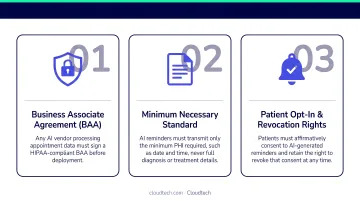
HIPAA explicitly permits appointment reminders as part of treatment under 45 CFR 164.501 — no special patient authorization required. But "permitted" does not mean "unregulated." Three obligations apply regardless:
- Reasonable safeguards — the reminder must be delivered securely
- Patient contact preferences — if a patient specified a preferred channel, honor it
- Minimum necessary PHI — include only what's needed to accomplish the reminder
Defining PHI in the Context of Reminders
Under 45 CFR 160.103, individually identifiable health information that relates to care provision is PHI. Pairing a patient's name with an appointment date and a clinic name qualifies.
What belongs in a reminder message:
- Patient name
- Date and time of appointment
- Clinic or provider name
- Callback number
What does not belong:
- Diagnosis or condition
- Specialty type (for example, "your psychiatry appointment")
- Reason for visit
- Medication instructions
The distinction matters because a specialty name alone can reveal a health condition. Keep templates simple and pre-approved. The system should never pull fields beyond what the template explicitly requires.
The Minimum Necessary Standard
HHS defines the minimum necessary standard as limiting PHI to what the reminder actually requires. Your templates should be locked down before deployment — not adjusted on the fly.
A compliant reminder: "Your appointment with Dr. Smith is Tuesday at 10 AM. Reply C to confirm or R to reschedule."
A non-compliant reminder: "Your oncology appointment with Dr. Smith is Tuesday at 10 AM."
The second version discloses a specialty — and potentially a diagnosis — that wasn't necessary to deliver the reminder.
TCPA Compliance and Opt-Out Requirements
HIPAA compliance isn't the only regulatory layer. The Telephone Consumer Protection Act (TCPA) governs automated calls and texts separately.
Under FCC rulings (FCC 15-72 and FCC 20-186), healthcare providers using automated reminders must:
- Limit frequency to one voice call or text per day, three combined per week per provider
- Exclude non-clinical content — no billing, marketing, or debt collection in the same message
- Provide easy opt-out — texts must include STOP instructions; voice calls must include a toll-free opt-out number
- Log consent status with a full audit trail
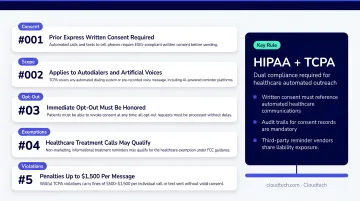
When a patient provides a phone number to a healthcare provider, that constitutes prior express consent under FCC rules. But it's revocable — and systems must honor revocations immediately.
Voicemail Safety Rules
Voicemails are a commonly overlooked risk. When a family member or roommate hears a detailed reminder, PHI reaches an unauthorized person — even unintentionally.
The safer approach: leave a callback request without confirming appointment details. Something like: "This is a message for John from Riverside Clinic. Please call us at [number] at your earliest convenience."
Any compliant AI system should make this behavior configurable. Hardcoding a single template removes the flexibility clinics actually need.
Five Non-Negotiable Requirements Before Choosing a Conversational AI Vendor
When a healthcare organization uses a third-party AI vendor for appointment reminders, it becomes legally responsible for vetting that vendor's compliance posture. These five requirements are baseline — not optional features.
Business Associate Agreement (BAA)
A BAA is a legally required contract between a covered entity and any vendor that handles PHI. It obligates the vendor to:
- Use PHI only for contracted purposes
- Implement appropriate safeguards
- Report breaches and security incidents
- Flow down obligations to subcontractors
- Return or destroy PHI when the engagement ends
A vendor who hesitates to sign a BAA is an immediate disqualifier. North Memorial Health Care paid $1.55 million in a 2016 HHS settlement specifically citing failure to execute a BAA. A separate case — Center for Children's Digestive Health — resulted in a $31,000 fine for the same oversight.
Encryption In Transit and At Rest
All patient data — call transcripts, conversation logs, stored records — must be encrypted both in motion and at rest under 45 CFR 164.312. AES-256 is the current standard for data at rest.
One important caveat: standard SMS is not end-to-end encrypted. PHI should be routed through secure messaging portals for sensitive content, not delivered as plain text messages.
Audit Logging and Data Retention
Every AI interaction must be time-stamped and traceable. HIPAA's Security Rule (45 CFR 164.312(b)) requires audit controls that log who accessed what data, when, and what action was taken. Security Rule documentation must be retained for at least six years under 45 CFR 164.316.
Ask vendors specifically about zero-day data retention agreements with underlying AI model providers — you don't want PHI persisting in a third-party model's training data longer than necessary.
Role-Based Access Controls (RBAC)
Knowing who accessed data is only useful if access was properly restricted in the first place. RBAC is the technical enforcement of the minimum necessary principle: a scheduler sees appointment slots, a biller sees payment data, a clinician sees clinical records. These roles should not overlap by default.
HIPAA's technical safeguards at 45 CFR 164.312(a) require policies that restrict access to only those with granted rights. If a vendor treats RBAC as an add-on tier rather than a standard control, that's a red flag worth acting on.
Independent Security Certifications
A signed BAA establishes legal accountability — it doesn't verify that the vendor's controls actually function as described.
- SOC 2 Type II — an independent CPA audit assessing the design and operating effectiveness of controls over time (not just at a single point)
- HITRUST CSF — a framework that consolidates 70+ standards and regulations, including HIPAA, into a unified control library
Either certification gives procurement teams documented evidence that controls are real and tested. Neither is optional for serious healthcare vendors.
How Conversational AI Transforms the Appointment Reminder Workflow
Modern conversational AI doesn't just send reminders — it conducts conversations. Here's what that looks like across three critical workflow areas.
Omnichannel Reminder Sequences
A well-designed reminder sequence layers channels based on patient behavior, not a single broadcast:
- Email — sent one week before the appointment
- SMS — sent two days before for patients who haven't confirmed
- Voice call — placed the day before for remaining unconfirmed appointments
This approach works because different patients respond to different channels. A 2016 systematic review found SMS contact success rates of 97–99% versus 30–60% for telephone — but telephone reminders produced higher attendance improvement (RR 1.11) than SMS alone (RR 1.14 in a 2026 meta-analysis). The combination outperforms either channel in isolation.
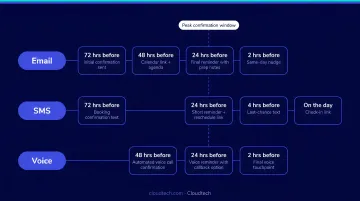
The same research found that reminder systems generated cancellation and rescheduling rates of 17–26%, with 27–40% of cancelled slots successfully reallocated — a direct revenue recovery mechanism that single-channel systems miss.
Natural Language and Low-Latency Architecture
Conversational quality matters clinically. An AI with noticeable lag or robotic phrasing increases patient frustration and call abandonment — which defeats the purpose.
Sub-second response latency is the target for voice interactions. Research on human conversational turn-taking benchmarks delays in the low hundreds of milliseconds — any AI response that feels slower than a human reply registers as unnatural.
Cloudtech's voice AI deployments target 500ms response times, a 67% improvement over typical 1.5-second systems, to maintain a natural conversational feel.
Caller ID authentication via the STIR/SHAKEN framework (mandated by the FCC since 2021) is also critical. Without authenticated caller ID, outbound reminder calls risk being flagged as spam by carrier networks and never reaching patients.
Handling Rescheduling and Escalation
When a patient says "I can't make it Tuesday," the AI should:
- Acknowledge the response naturally
- Query the live schedule for available alternatives
- Offer 2–3 specific slots
- Confirm the new appointment and update the record
When a patient asks a clinical question — about medications, test preparation, or their diagnosis — the AI should recognize the boundary and route to a human agent with a conversation summary already prepared.
Warm transfers pass the full conversation context to the human agent, so patients never have to re-explain their situation from the beginning.
EHR Integration: The Feature That Makes or Breaks the System
EHR integration isn't a nice-to-have. Without it, staff must manually update the schedule after every AI interaction — which eliminates most of the operational benefit of automation.
Write-Back Capability
Write-back means the AI doesn't just read appointment data from the EHR — it writes confirmed, cancelled, or rescheduled statuses directly back. Staff and patients stay on the same synchronized calendar without any manual reconciliation step.
That bidirectional connection is what keeps the schedule accurate in real time — not just notified.
Integration Standards: FHIR and HL7
- FHIR R4 — the interoperability standard at the center of ONC's Cures Act Final Rule, with an Appointment resource that supports booking, rescheduling, no-shows, cancellations, and appointment history
- OAuth 2.0 / SMART on FHIR — enables secure API access without sharing credentials
- HL7 v2 messaging — handles real-time event triggers for legacy EHR environments
Each of these standards maps to specific EHR environments. Epic, athenahealth, Cerner, and NextGen each have established integration patterns — and vendors with pre-built connectors to these platforms cut implementation time and complexity considerably.
Implementation Tip
Before going live:
- Use a sandbox environment to validate appointment type, location, and provider mappings
- Define a single source of truth for scheduling to prevent conflicts between the AI system and any patient portal
- Monitor integration health via dashboards that track throughput, failures, and latency
Deploying HIPAA-Compliant Conversational AI on AWS: The Infrastructure Layer
Choosing the right AI application is half the equation. The infrastructure it runs on must also be HIPAA-eligible.
HIPAA-Eligible AWS Services for Appointment Reminders
AWS offers a suite of HIPAA-eligible services purpose-built for this use case:
| Service | Function |
|---|---|
| Amazon Connect | Cloud contact center for outbound voice calls |
| Amazon Lex | Conversational AI for natural language understanding |
| Amazon Transcribe Medical | Speech recognition optimized for clinical language |
| AWS HealthLake | FHIR-compliant data storage and query |
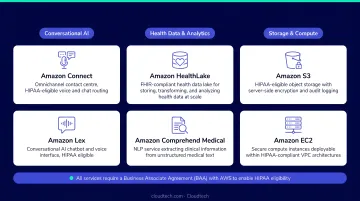
AWS signs BAAs for these services through AWS Artifact — a critical compliance prerequisite before any PHI flows through the infrastructure.
Key Architecture Controls
These AWS-native controls map directly to HIPAA Security Rule requirements:
- AWS KMS — encryption key management with FIPS 140-3 validated hardware security modules
- Amazon VPC — logically isolated network environments that prevent unauthorized lateral access
- AWS IAM — role-based access control enforcement at the infrastructure level
- AWS CloudTrail — complete API activity logging, retainable up to 3,653 days via CloudTrail Lake
Together, these controls cover encryption at rest and in transit, RBAC, audit logging, and network isolation — the same requirements described earlier in the vendor vetting checklist, now enforced at the infrastructure layer.
Cloudtech's Role in Healthcare AI Deployments
As an AWS Advanced Tier Partner, Cloudtech helps healthcare organizations design and deploy HIPAA-compliant conversational AI systems on AWS, from initial architecture review and PHI data flow mapping through to go-live. Healthcare clients including Klamath Health Partnership have benefited from this approach, which delivered a 77% reduction in annual infrastructure costs on a HIPAA-compliant foundation.
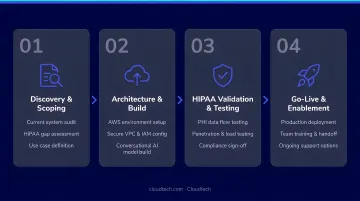
For conversational AI engagements, Cloudtech follows a structured four-phase process:
- Discovery workshop — map PHI data flows and define compliance requirements
- Compliance-first architecture planning — design controls before writing a line of code
- Build and integration — deploy and connect to existing EHR or scheduling systems
- Team enablement — hands-on training so your staff can operate and maintain the solution
Packaged solutions typically go live in weeks, not months. AWS Partner Funding may also be available to offset deployment costs — confirm availability during an initial consultation.
Frequently Asked Questions
Are healthcare appointment reminders allowed under HIPAA?
Yes. HHS explicitly states that appointment reminders are part of treatment and do not require special patient authorization. However, reasonable safeguards, minimum necessary PHI, and patient contact preferences must still be respected.
Can AI be used in a HIPAA-compliant way for healthcare appointment reminders?
Yes, when properly implemented. The vendor must sign a BAA, use encryption and audit logging, adhere to the minimum necessary standard, and run on HIPAA-eligible infrastructure. Compliance is a system-level property — not a feature of any single component.
What is a Business Associate Agreement (BAA) and why is it required?
A BAA is a legally required contract binding any third party that handles PHI to HIPAA standards — covering breach reporting and restricting PHI use to contracted purposes. Operating without one carries serious financial risk: North Memorial Health Care paid $1.55 million for this exact failure.
How does conversational AI actually reduce patient no-shows?
AI reduces no-shows through proactive multi-channel outreach and by making it easy for patients to confirm or reschedule on the spot. When a patient reschedules rather than simply not showing up, the practice can backfill that slot in real time instead of absorbing the full revenue loss.
What AWS services are used to build HIPAA-compliant conversational AI?
The core HIPAA-eligible services are Amazon Connect (contact center), Amazon Lex (conversational AI), Amazon Transcribe Medical (speech recognition), and AWS HealthLake (FHIR data storage). AWS signs BAAs for all of these, making them viable for PHI handling in compliant healthcare workflows.
How long does it take to deploy an AI appointment reminder system?
Timelines depend on EHR complexity and integration scope, but modern platforms using FHIR-based APIs and pre-built EHR connectors go live in a few weeks. Working with an experienced AWS partner — who has already mapped the compliance controls and integration patterns — can compress that timeline further.