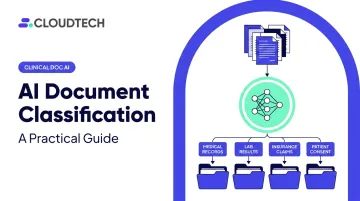
This guide covers what AI document classification actually is, how the pipeline works end-to-end, what determines whether a deployment succeeds or fails, and where the approach genuinely falls short.
Key Takeaways
- AI document classification uses machine learning, NLP, and OCR to sort documents into predefined categories automatically
- The pipeline follows a clear sequence: preprocessing → feature extraction → model training → evaluation → deployment
- Production accuracy hinges on training data quality more than any other factor
- Supervised learning delivers the highest accuracy but requires labeled training data to get there
- Amazon Textract and Amazon Comprehend eliminate most of the custom ML pipeline work
What Is AI Document Classification?
AI document classification is the automated process of assigning incoming documents to predefined categories using machine learning, NLP, and computer vision — without requiring a human reviewer to sort each file.
Faster, more consistent document organization that scales with volume is the core payoff. When a company processes 500 invoices a day versus 5,000, the headcount required for manual sorting grows linearly. AI classification does not.
How It Differs from Rule-Based Sorting
Traditional keyword-matching systems work fine when documents follow predictable formats. Feed them an invoice with an unusual layout, a vendor-specific template, or a scanned form with handwritten fields — and they break.
AI classification learns patterns from labeled examples instead of relying on rigid structural rules. It can handle:
- Variable document layouts from different vendors
- Mixed formats (PDFs, scanned images, digital files)
- Multiple languages and document types in the same workflow
- Semi-structured content that doesn't map to a template
Rule-based sorting is cheaper to set up and easier to maintain in stable, narrow document environments. AI classification earns its complexity when document variety is high and volume makes manual handling impractical.
Why Businesses Are Turning to AI Document Classification
The operational trigger is volume. The same 2025 AIIM survey found that 61% of document processing workflows still involve paper, with fax still present in 37% of cases. That's not a born-digital document landscape — it's a messy, mixed-format reality that manual teams struggle to handle consistently.
What Document-Heavy Industries Actually Need
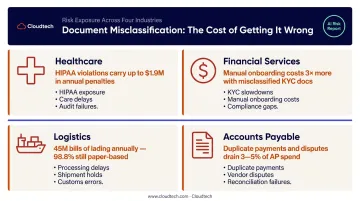
Different sectors have different stakes when classification fails:
- Healthcare: Misclassified patient records delay care decisions, create HIPAA exposure, and must be routed correctly for audit logging
- Financial services: KYC documents routed to the wrong queue slow onboarding; McKinsey identifies KYC as highly manual, expensive, and error-prone
- Logistics: Ocean carriers issue roughly 45 million bills of lading annually. As of 2021, only 1.2% were electronic — meaning the vast majority still require physical handling and manual classification
- Accounts payable: Invoice misrouting creates duplicate payments, approval delays, and vendor disputes
What Goes Wrong Without It
The failure modes are predictable but costly:
- Misrouted documents that sit in the wrong queue for days
- Compliance violations from PHI or PII landing in unprotected workflows
- Duplicate data entry when documents can't be matched to existing records
- Delayed processing for time-sensitive items like insurance claims or loan applications
Each of these failures carries a real cost: wasted staff hours, compliance risk, and slower customer outcomes. For SMBs, AWS-managed services like Amazon Textract and Amazon Comprehend now make AI classification accessible without requiring an internal ML team to build or maintain custom pipelines.
How AI Document Classification Works
Every classification pipeline follows the same basic flow: raw documents enter the system, get cleaned and parsed, have their content transformed into something a model can evaluate, and then receive a category label. The label triggers a downstream action — routing, archiving, flagging for review.
Two recognition pathways drive this process: text-based classification (OCR extracts text, NLP interprets it) and visual classification (computer vision analyzes layout and structure when text alone is insufficient).
Step 1: Preprocessing and Text Extraction
Before classification can occur, documents must be made machine-readable. For scanned images and PDFs, that means OCR — specifically, Amazon Textract, which extracts typed and handwritten text while returning words, lines, bounding boxes, reading order, tables, and section headers.
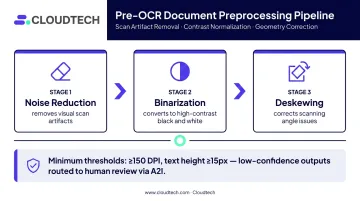
OCR accuracy depends heavily on input quality. Cloudtech's IDP pipeline applies a dedicated pre-Textract preprocessing stage that includes:
- Noise reduction — removing visual artifacts from scanned documents
- Binarization — converting to high-contrast black-and-white for clearer text
- Deskewing — correcting alignment issues from scanning angle
Documents are validated against minimum quality thresholds (≥150 DPI, minimum text height ~15 pixels) before entering the OCR stage. Low-confidence Textract outputs are flagged and routed to human review via Amazon Augmented AI (A2I), rather than passed silently downstream.
Step 2: Feature Extraction and Model Training
Extracted text can't go directly into a model — it first needs to be converted into numerical representations. Three approaches are common:
- TF-IDF — weights terms by frequency in the document versus frequency across the corpus; sparse features, works well with linear classifiers like SVM
- Word embeddings — dense vector representations where related terms cluster together
- Transformer encodings — context-dependent representations via attention mechanisms; fine-tuned transformers (like BERT) lead most modern classification benchmarks
The training approach determines how much labeled data you need upfront:
| Approach | Label Requirement | Accuracy | Setup Effort |
|---|---|---|---|
| Supervised | Labeled samples per class | Highest | High |
| Unsupervised | None | Lower | Low |
| Semi-supervised | Some labels + unlabeled data | Middle | Moderate |
Amazon Comprehend's minimum quota is 50 training documents per class for CSV multi-class training — treat this as a service floor, not a target for production accuracy.
Cloudtech uses Amazon Comprehend as the NLP classification layer for entity recognition, document routing, and PII detection — including Comprehend Medical for clinical records. For document types that fall outside Comprehend's general-purpose capabilities, Amazon SageMaker custom models handle domain-specific classification and continuous retraining.
Step 3: Classification, Evaluation, and Deployment
A trained model assigns category labels to new documents in real time or batch mode. Before production deployment, models should be evaluated using:
- Accuracy — overall correct predictions
- Precision — of all documents labeled X, how many actually were X
- Recall — of all actual X documents, how many were correctly labeled
- F1-score — harmonic mean of precision and recall (the most reliable single metric)
AWS Comprehend reports these metrics from training-job test data — but they approximate performance on similar data, not all future inputs. Benchmark accuracy on held-out training data is not the same as production accuracy on shifted document formats. Plan for drift.
Continuous learning addresses this directly. In Cloudtech's deployments, human corrections to classification errors are fed back into SageMaker retraining jobs — so the model gets sharper on new document layouts, edge cases, and format variations that weren't present in the original training set.
Key Factors That Affect Performance
Getting classification into production is one thing; keeping it accurate is another. These are the variables that actually determine outcomes:
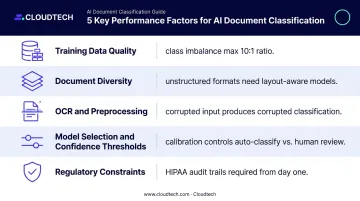
- Training data quality and volume: The model cannot outperform its training data. Insufficient labeled samples, inconsistent labeling, or a dataset that doesn't reflect real-world document variety are the most common causes of poor production accuracy. AWS recommends keeping class imbalance to no more than a 10:1 ratio between the largest and smallest class
- Document diversity and format variability: Unstructured documents (free-text contracts, invoices from dozens of vendors) require significantly more labeled examples than standard forms — and often need layout-aware models rather than text-only classifiers
- OCR quality and preprocessing: If Textract receives a low-resolution scan and returns corrupted text, the NLP model classifies corrupted input. OCR accuracy is a direct prerequisite — and it's frequently underestimated during planning
- Model selection and confidence thresholds: Naive Bayes, SVM, and transformer-based models each have different performance profiles. Confidence thresholds control when the system auto-classifies versus escalates to human review — calibrate them wrong and you get either bottlenecks or unchecked errors
- Regulatory constraints: HIPAA (45 CFR 164.312(b)) requires audit mechanisms for any system touching ePHI. Healthcare and finance pipelines must address audit trails, PII handling, and access controls from day one — not as an afterthought
Common Misconceptions and When AI Classification May Not Fit
Two assumptions consistently derail AI classification projects before they reach production.
The first: that a general-purpose model will handle industry-specific documents accurately out of the box. It won't. A model trained on generic text will underperform on clinical records, mortgage packages, or customs forms without fine-tuning on representative labeled examples from that domain.
The second: that a model trained on invoices will reliably classify contracts. Different document types carry different linguistic and structural patterns. Treating all document classes as interchangeable produces a system that passes testing and breaks in production.
Where AI classification is the wrong tool entirely:
- Low-volume environments where manual sorting takes fewer resources than model maintenance
- Highly specialized document formats with too few training examples — fewer than 50 labeled samples per class is a hard minimum, and real production accuracy typically requires several times that
- Organizations lacking the data infrastructure (cloud storage, tagging pipelines, metadata schemas) needed to act on classification outputs
In these cases, deterministic rule-based routing or a lightweight RPA approach is often more cost-effective. A 2025 systematic review of mental-health EHR classification found that rule-based methods outperformed ML in direct comparisons when stable vocabulary and metadata reliably resolved the document class. In narrow, stable domains with consistent vocabulary, rules are simply the right tool for the job.
Conclusion
AI document classification is a pipeline with real dependencies at every stage:
- Preprocessing quality determines OCR accuracy
- OCR accuracy shapes what features can be extracted
- Feature extraction directly drives model performance
- Model performance depends on labeled training data that takes genuine effort to assemble
Organizations that invest in deliberate setup — making the right calls on training data, classification method, and confidence thresholds — see compounding returns in operational efficiency and compliance reliability. Those that skip the setup work get a system that appears to function but degrades when it encounters document types it wasn't prepared for.
For SMBs looking to deploy on AWS without building from scratch, Cloudtech offers a packaged IDP solution at a fixed price of $7,999, delivered in approximately two weeks. The implementation includes a custom pipeline using Amazon Textract, Amazon Comprehend, and AWS Step Functions, configured for the client's specific document types, volume, and compliance requirements. Book a free demo or email connect@cloudtech.com to discuss your use case.
Frequently Asked Questions
What is the difference between supervised and unsupervised AI document classification?
Supervised classification uses labeled training data to learn mappings from document features to predefined categories — it delivers higher accuracy for defined document types but requires upfront labeling effort. Unsupervised classification groups documents by content similarity without predefined labels, making it faster to set up but less reliable for precise, production-grade categorization.
How does OCR fit into an AI document classification workflow?
OCR is the first processing step for scanned or image-based documents — it converts non-machine-readable content into text that NLP models can analyze and classify. OCR quality directly determines downstream classification accuracy; corrupted or incomplete text extraction leads to misclassification regardless of how well the model is trained.
What types of documents can AI classification handle?
AI systems can classify invoices, contracts, medical records, tax forms, insurance claims, identity documents, shipping documents, and more. Performance varies based on document structure (structured vs. semi-structured vs. unstructured) and the quality and volume of training data available for each category.
How accurate is AI document classification compared to manual review?
Well-trained models on consistent document types can achieve high accuracy, but there is no universal benchmark. Accuracy depends on training data quality, document variability, and whether human-in-the-loop review handles low-confidence outputs. Metrics like precision and recall on realistic test data tell you more than a single accuracy number.
Can AI document classification be customized for specific industry needs?
Yes. Classification systems can be fine-tuned on domain-specific document types, configured with industry-relevant categories (for example, HIPAA-aligned labels for healthcare or KYC categories for financial services), and integrated with existing workflow systems via API.
What are the most common implementation challenges?
The most frequent issues are insufficient or inconsistently labeled training data, degraded OCR output from low-quality scans, document format variability across vendors or departments, and the absence of a confidence threshold strategy that determines when to auto-classify versus route to human review.