Key Takeaways
- Conversational AI reduces operational costs by automating routine queries and cutting average handle times for human agents
- Efficiency gains scale with query volume: infrastructure costs stay flat while throughput increases
- Implementation costs vary widely, but pre-packaged AWS-native solutions cut time-to-value from months to weeks
- Most businesses see measurable ROI within 6–12 months of deployment
Key Financial Benefits of Conversational AI for Business Operations
Customer support is expensive. For SMBs running lean teams, every repetitive query handled by a human agent represents a real cost — in time, in labor, and in opportunity.
Conversational AI addresses this directly, and the financial benefits show up across several operational dimensions.
Reduced Handle Times and Higher Throughput
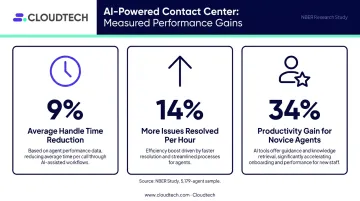
A 2023 NBER field study tracking 5,179 agents across 3 million customer service chats found that AI assistance reduced Average Handle Time by 9% — roughly 3.8 minutes per interaction — and increased issues resolved per hour by 14%. For novice agents, that productivity gain reached 34%.
Across hundreds of daily interactions, the cumulative time savings translate directly into reduced overtime, fewer hires needed to meet volume growth, and more capacity for agents to handle complex cases.
Task Deflection and Resolution Quality
When conversational AI resolves routine queries end-to-end — account status, order tracking, appointment scheduling — those interactions never reach a human agent at all. This self-service deflection rate is one of the clearest cost levers available.
McKinsey's 2023 generative AI research models that AI could reduce human-serviced contacts by up to 50% in customer operations — representing 30–45% of current function costs as modeled potential, though realized savings depend heavily on deployment quality and use case scope.
Labor and Infrastructure Cost Avoidance
Cloud-based conversational AI delivers 24/7 availability without the staffing model that would otherwise require it:
- No shift premiums for after-hours coverage
- No physical call center infrastructure, facilities, or equipment
- No proportional headcount scaling as query volumes grow
- Consistent output quality regardless of time of day or agent fatigue
AWS-hosted deployments built on multi-Availability Zone architectures further reduce maintenance overhead — eliminating the downtime risk associated with on-premises systems and freeing engineering capacity for higher-priority work.
Consistency and Error Reduction
Human agents make mistakes — particularly during high-volume periods or toward the end of long shifts. Bradesco's internal virtual assistant, documented in an IBM case study, reached 95–96% accuracy handling 283,000 questions monthly, with only 5% requiring human follow-up. Response times dropped from 10 minutes to seconds.
Fewer errors translate directly into fewer costly escalations, refunds, and repeat contacts — each representing additional labor cost that compounds quickly at scale.
Revenue Growth and Efficiency Gains with Conversational AI
Cost reduction is the easier story to tell. But conversational AI also drives revenue — through faster engagement, better lead qualification, and the kind of real-time data that makes business decisions sharper.
Revenue Impact
IBM's Institute for Business Value research found that businesses deploying conversational AI in external customer interactions saw 23.5% lower cost per contact alongside 4% higher annual revenue. The revenue connection comes from several mechanisms:
- Faster response times reduce abandonment during purchase decisions
- 24/7 availability captures leads that would otherwise go unanswered
- Personalized, intent-based responses improve conversion rates across sales and support touchpoints
McKinsey estimates that AI-enabled sales and commercial functions could add value equivalent to 3–5% of current global sales expenditures — though this covers broader AI adoption, not conversational AI specifically.
Efficiency That Compounds Over Time
The financial case for conversational AI strengthens as volume grows. Unlike human staffing — where costs scale linearly with interaction volume — AI-based systems handle increased demand without proportional cost increases. A business that deploys conversational AI to handle 1,000 queries per month faces essentially the same infrastructure cost when that volume reaches 5,000.
This compounding efficiency is particularly relevant for SMBs in growth phases, where scaling support capacity traditionally meant scaling headcount.
Actionable Data as a Business Asset
Every customer interaction generates data — sentiment patterns, recurring questions, product gaps, and friction points. Conversational AI captures this systematically and at scale.
Cloudtech's Amazon Q Business implementations give SMB leaders the ability to query their own operational data through natural language — no SQL required, no data analyst as a go-between. Raw interaction logs become searchable intelligence, surfacing what customers actually need before those signals get buried in spreadsheets.
Internal Efficiency Gains
Conversational AI isn't limited to customer-facing applications. Internally deployed AI assistants give employees faster access to HR policies, operational reports, and company knowledge bases — reducing the time spent chasing information across departments. For SMBs especially, where information silos tend to be informal and persistent, this is one of the quieter wins that adds up fast.
What Does It Cost to Implement Conversational AI?
Implementation costs vary considerably based on the platform, deployment model, and scope of integration. SMBs should plan for four primary cost categories:
| Cost Category | What It Includes |
|---|---|
| Platform / Licensing | Monthly SaaS fees or consumption-based model pricing |
| Hosting & Infrastructure | Cloud compute, storage, and LLM inference costs |
| Integration & Setup | API connections, workflow mapping, testing |
| Ongoing Maintenance | Model retraining, compliance audits, performance monitoring |
Understanding Consumption-Based Pricing
LLM-powered conversational AI is typically priced per token — not per conversation — which makes per-interaction costs difficult to state without knowing the specific model, conversation length, and number of turns.
Published reference points from major providers include:
- Anthropic Claude Haiku: $1 per million input tokens / $5 per million output tokens
- Anthropic Claude Sonnet: $3 per million input tokens / $15 per million output tokens
- Google Conversational Agents (Flows): $0.007 per request (one user input + agent response)
- Intercom Fin: $0.99 per resolved outcome
- AWS Bedrock Guardrails: $0.10–$0.17 per 1,000 text units for safety checks
For a realistic per-conversation estimate, SMBs should profile their average conversation length, expected turn count, and whether voice, retrieval, or safety services are required, then calculate costs against those specific inputs.
Build vs. Buy vs. Partner
Each sourcing path carries different tradeoffs on cost, speed, and flexibility:
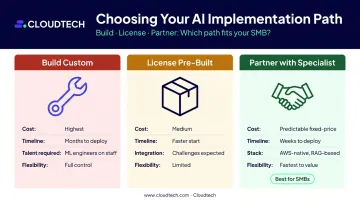
- Build custom: Highest cost and longest timeline. Requires ML engineering talent, dedicated model infrastructure, and months of testing before any production deployment.
- License pre-built: Faster to start, but platforms can be inflexible and may not integrate cleanly with existing business systems.
- Partner with a specialist: A middle path for most SMBs. AWS-certified consulting firms like Cloudtech deliver pre-packaged, AWS-native implementations in weeks, built on Amazon Bedrock. Using RAG (Retrieval-Augmented Generation) with Amazon Bedrock Agents instead of full model fine-tuning keeps both inference costs and deployment timelines down.
Hidden Costs SMBs Often Underestimate
These four categories are frequently underfunded in initial budgets:
- Employee training and change management — adoption rates drop sharply without structured onboarding
- Compliance setup — HIPAA, GDPR, and CCPA configuration requires deliberate architecture, not a checkbox
- Data preparation and cleaning — AI is only as accurate as the data it's trained on
- Ongoing model retraining — accuracy degrades over time without periodic updates
Cloudtech's healthcare AI voice deployments, for instance, treat HIPAA compliance as a foundational design requirement, with encrypted PHI processing, strict access controls, and full audit trails built into the architecture from day one rather than retrofitted later.
How to Measure ROI from Conversational AI
The Core Calculation
ROI = (Net Financial Benefits − Total Costs) ÷ Total Costs
Net financial benefits include both cost savings (labor, infrastructure, error reduction) and revenue gains (conversions, retention, sales productivity). Run both a conservative and an optimistic scenario — the range will be more useful than a single point estimate.
KPIs Worth Tracking
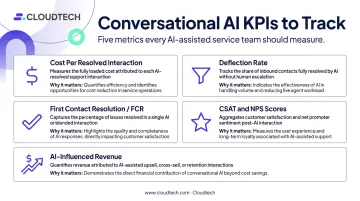
- Compare cost per resolved interaction between AI-handled and human-handled queries — this gap drives most of the labor savings case
- Track deflection rate: the percentage of queries resolved without agent involvement
- First Contact Resolution (FCR) — how often queries are fully resolved on the first try, without escalation
- CSAT and NPS scores as a proxy for retention risk and lifetime value trends
- Revenue influenced by AI-assisted interactions: conversions, upsells, and leads touched before handoff to sales
ROI Timelines
Vendor-commissioned Forrester studies put payback periods at under 6 months for Google's Customer Engagement Suite (with 207% three-year ROI) and under 13 months for Rasa (181% ROI). These are enterprise-scale composites, not SMB averages.
For SMBs, those numbers set a ceiling — not a baseline. Most see initial measurable returns within 6–12 months, with payback shortening when:
- The AI is well-trained before launch (Bradesco's assistant took 5–10 months of pre-launch training to reach 95%+ accuracy)
- Integration depth is high — AI connected to CRM, ticketing, and scheduling systems outperforms standalone deployments
- Use case scope is focused — narrower, well-defined use cases reach ROI faster than broad general-purpose deployments
Industry-Specific Financial Impact for SMBs
Healthcare
Healthcare is one of the clearest ROI cases for conversational AI. High call volumes, repetitive scheduling and FAQ queries, and significant administrative burden on clinical staff make the automation opportunity large.
Intermountain Health's deployment of conversational AI resulted in 85% lower call abandonment and 91% successful routing, according to a Hyro vendor case study — though this represents a large health system rather than an SMB. For smaller healthcare providers, the same principles apply at a different scale.
For smaller providers pursuing similar results, the underlying AWS infrastructure matters as much as the AI layer itself. HIPAA-compliant architecture — built in from the start, not bolted on afterward — determines whether a deployment can scale safely and pass audit. That's where the technical foundation separates functional pilots from production-ready systems.
Financial Services
Banks and credit unions field enormous volumes of repetitive inquiries — account balances, transaction history, loan status, fraud alerts. Bank of America's Erica handled more than 2 billion interactions for 42 million clients since 2018 — roughly 2 million interactions per day. That's an enterprise-scale example, but the use case is identical for smaller institutions.
For financial services SMBs, the compliance dimension is particularly important. Conversational AI handling regulated customer data must maintain:
- Consistent audit trails across every interaction
- Access controls that restrict data exposure by role
- Disclosure practices that satisfy regulatory requirements at the point of conversation
These requirements are far easier to meet when compliance is designed into the system architecture from day one.
Manufacturing and Logistics
Internally deployed conversational AI has expanded in manufacturing and logistics — giving floor operators, dispatchers, and logistics coordinators faster access to process documentation, equipment specs, and operational data without navigating complex systems.
Georgia-Pacific's deployment of a generative AI chatbot for operator knowledge access, built on AWS, shows what's possible: institutional knowledge that previously lived in experienced workers' heads becomes queryable through natural language. The result is faster problem resolution and fewer information bottlenecks across shifts — financial gains that compound with every hour of reduced downtime.
For SMBs in these sectors, the same pattern scales down cleanly. Smaller teams benefit disproportionately when operators can self-serve answers rather than waiting on supervisors or hunting through manuals.
Financial Risks and Compliance Considerations
Regulatory Exposure
The cost of getting AI compliance wrong is not hypothetical:
| Regulation | Maximum Penalty |
|---|---|
| GDPR (upper tier) | €20M or 4% of worldwide annual turnover |
| CCPA (intentional violation) | $7,988 per violation (2025) |
| HIPAA (willful neglect, uncorrected) | $73,011 per violation |
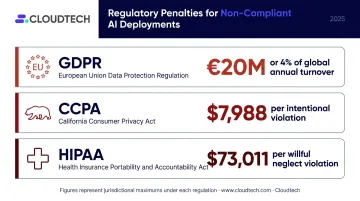
These are jurisdictional maximums, not predicted outcomes. They establish the scale of risk for businesses handling sensitive customer or patient data through AI systems.
The EU AI Act adds another layer. Article 50 (effective August 2026) requires businesses to disclose when customers are interacting with AI, unless that fact is already obvious. Most conversational AI deployments will need to meet this standard for any EU-facing interactions.
Real Liability from AI Failures
Air Canada learned this directly: a chatbot provided incorrect bereavement fare information, and the British Columbia Civil Resolution Tribunal held Air Canada liable. The financial damages were modest (CAD $650), but the precedent matters — AI output is treated as a company-controlled representation, not a disclaimer.
DoNotPay faced $193,000 in FTC-ordered relief for AI capability claims that couldn't be substantiated.
Mitigation Strategies
These cases point to the same conclusion: prevention is cheaper than remediation. Practical steps to reduce exposure include:
- Select an implementation partner with built-in compliance capabilities, not one that treats compliance as a post-launch checklist
- Establish data governance policies before deployment, not after
- Schedule regular AI output audits covering accuracy, bias, and regulatory alignment
- Use AWS-native tools (CloudTrail, Config, IAM, Security Hub) for continuous infrastructure-level monitoring
- Build feedback loops and human escalation paths that catch AI errors before they become customer complaints
- Work with an AWS Advanced Tier Partner (such as Cloudtech) to enforce infrastructure-level security defaults — pod-level IAM roles, VPC configuration, and IaC-enforced consistency — from day one
Frequently Asked Questions
What is the impact of conversational AI on business operations?
Conversational AI reduces operational costs through task automation, improves customer response times and satisfaction, and generates data-driven insights that support faster decisions. Both effects — cost reduction and revenue performance — typically become measurable within a 6–12 month window.
How long does it take to see ROI from conversational AI?
Most businesses begin seeing measurable returns within 6–12 months. Payback accelerates when the AI is well-trained before launch, deeply integrated with existing workflows, and scoped to specific use cases rather than deployed across the board.
What are the main costs SMBs should budget for when implementing conversational AI?
Plan for four categories: platform licensing, cloud hosting and LLM inference costs, integration and setup, and ongoing maintenance including compliance audits and model retraining. Pre-packaged cloud solutions can reduce upfront costs significantly compared to custom builds.
How does conversational AI reduce customer service costs?
AI deflects routine queries from human agents, lowers Average Handle Time, enables 24/7 availability without staffing premiums, and reduces the errors that generate costly follow-up work.
What industries benefit most from conversational AI financially?
Healthcare, financial services, retail, and manufacturing show the strongest documented ROI, driven by high volumes of repetitive interactions that automate well. Healthcare and financial services gain an additional edge: AI applies compliance rules consistently across every interaction, reducing regulatory risk.
What compliance risks should businesses consider before deploying conversational AI?
GDPR, CCPA, and HIPAA all carry significant penalties for non-compliant data handling. Businesses should select an implementation partner with built-in security and regulatory expertise, establish data governance policies before deployment, and audit AI outputs regularly for accuracy and bias.