The challenge isn't awareness anymore. It's selection. The market now includes dozens of AI virtual assistant platforms spanning free tools, per-seat subscriptions, per-resolution pricing, and pay-per-use models — and choosing the wrong one means paying for capabilities you don't use while missing the ones you actually need.
This guide cuts through the noise with a direct comparison of the five best AI virtual assistants for small businesses in 2026, including verified pricing, key features, and a practical framework for choosing the right fit.
Key Takeaways
- AI VA pricing spans free tiers to $500+/month — matching the model to your usage pattern matters as much as the headline cost
- General productivity needs point toward ChatGPT or Microsoft 365 Copilot; customer-facing support calls for Intercom Fin or Tidio Lyro
- No-code tools like Tidio go live in hours; AWS-native builds like Amazon Lex take 2–8 weeks and require technical expertise
- SMBs in regulated industries — healthcare, financial services — should prioritize platforms with HIPAA, SOC, and ISO compliance built in
- Integration depth with your CRM, calendar, and support tools often determines whether a tool gets used or abandoned
What Are AI Virtual Assistants for Small Businesses?
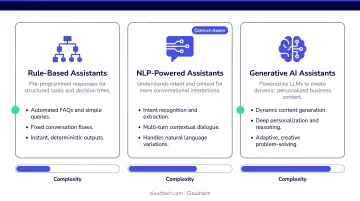
AI virtual assistants are software systems that use natural language processing (NLP) and machine learning to handle tasks — answering customer questions, scheduling appointments, qualifying leads, and processing routine requests — without human intervention.
Unlike basic rule-based chatbots, AI VAs understand context, handle multi-turn conversations, and improve over time. Rule-based systems follow fixed decision trees; AI assistants adapt.
For small businesses, three categories are most relevant:
- Handle inbound queries across chat, email, and social channels (customer-facing support)
- Assist with writing, analysis, and communication via tools like Microsoft 365 or API access (productivity)
- Run voice and text workflows for specific business processes, built on platforms like Amazon Lex (custom conversational agents)
As these platforms have matured, enterprise-grade capabilities have become accessible at SMB-friendly price points. For businesses deploying AWS-native AI tools, having the right cloud foundation in place from the start reduces deployment time and infrastructure risk — something Cloudtech's AWS-certified architects help small businesses address before the first bot goes live.
Best AI Virtual Assistants for Small Businesses in 2026
These tools were evaluated across six criteria:
- Pricing transparency — clear, predictable cost structures
- Ease of deployment — time and technical skill required to go live
- Integration capabilities — compatibility with existing tools and platforms
- Channel support — web, email, voice, social, and messaging coverage
- Scalability — ability to grow with the business
- SMB fit — suitability for customer support, scheduling, and lead qualification
ChatGPT by OpenAI
ChatGPT is the most widely adopted general-purpose AI tool globally. It requires zero technical setup, covers an enormous range of tasks, and offers a free tier that many SMB owners find genuinely useful from day one. Unlike dedicated support bots, it functions as a productivity tool for the business owner or team — not a customer-facing channel.
It handles drafting marketing emails, creating customer FAQs, summarizing documents, generating internal SOPs, and even basic data analysis. Custom GPTs and API access extend its capabilities significantly for businesses ready to go deeper.
| Attribute | Details |
|---|---|
| Pricing | Free tier available; Business plan at $20/user/month (billed annually) or $25/user/month (billed monthly), minimum 2 users; Enterprise pricing on request. Verify current tiers at OpenAI's pricing page before purchasing. |
| Key Features | Natural language content generation, customer email drafting, FAQ creation, brainstorming, coding assistance, basic data analysis; integrates with Slack, Google Drive, Microsoft 365, and external APIs via Custom GPTs |
| Best Use Case | General-purpose productivity: drafting communications, creating internal documentation, supporting non-technical owners with writing and research |
Intercom Fin
Intercom Fin is built specifically for businesses handling significant inbound support volume. Unlike general-purpose AI tools, Fin is designed to resolve customer tickets. The pricing reflects that focus: $0.99 per resolved conversation, so you only pay when it actually helps a customer.
Fin handles over 2 million weekly resolutions across Intercom's customer base, supports 45+ languages, and works across live chat, email, phone, WhatsApp, SMS, Slack, and Discord. Crucially, it integrates with existing helpdesks like Zendesk, HubSpot, Freshdesk, and Salesforce — no platform migration required.
| Attribute | Details |
|---|---|
| Pricing | Seat plans from $29/seat/month (Essential); Fin AI Agent at $0.99 per resolved outcome (minimum 50 outcomes/month for external helpdesk use). Verify current pricing at Intercom's pricing page. |
| Key Features | AI-powered ticket resolution, multi-channel support (chat, email, voice, WhatsApp, Slack, Discord), CRM and helpdesk integrations, 45+ language support, proactive customer messaging |
| Best Use Case | SMBs and SaaS companies with high inbound support ticket volume looking to reduce human escalations across multiple channels |
Microsoft 365 Copilot
For small businesses already running on Microsoft's ecosystem, Copilot is the most friction-free AI upgrade available. It lives inside Word, Excel, Outlook, Teams, PowerPoint, OneNote, and SharePoint, so there's no new app to learn and no integration to configure.
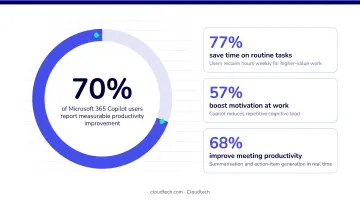
Microsoft's early-user research found that 70% of Copilot users reported being more productive, 73% completed tasks faster, and users caught up on missed meetings nearly 4x faster. For a team spending hours each week on email and meeting follow-ups, those numbers translate directly to recovered time.
| Attribute | Details |
|---|---|
| Pricing | Microsoft 365 Business Standard with Copilot: ~$23.50/user/month (yearly). Business Premium with Copilot: ~$32/user/month (yearly). A Copilot add-on is also available for qualifying plans. Pricing includes time-sensitive promotions — verify current rates at Microsoft's Copilot pricing page. |
| Key Features | Email drafting and summarization in Outlook, formula generation and data analysis in Excel, meeting transcription and summaries in Teams, presentation generation in PowerPoint, natural language search across Microsoft 365 data |
| Best Use Case | Small businesses already on Microsoft 365 that want to boost team productivity across writing, analysis, and communication without adopting a separate AI platform |
Tidio (Lyro AI)
Tidio targets the SMB owner who doesn't have an IT team and needs a chat solution up and running fast. Lyro AI, Tidio's AI agent, trains on your existing FAQ and help center content and can automate up to 67% of customer inquiries on average, with a 50% resolution-rate guarantee.
G2 rates Tidio at 4.6/5 from nearly 2,000 reviews, and Capterra reports that 93% of reviewers are small-business users — a meaningful signal about who actually uses it day to day.
| Attribute | Details |
|---|---|
| Pricing | Free plan (50 AI conversations/month); Starter at ~$24.17/month; Growth from ~$49.17/month; Lyro AI Agent starts at $32.50/month for 50 conversations. Verify current tiers at Tidio's pricing page. |
| Key Features | Lyro AI agent trained on your support content, multichannel inbox (web chat, email, Messenger, Instagram, WhatsApp), no-code chatbot builder, visitor behavior tracking, mobile apps for iOS and Android |
| Best Use Case | Budget-conscious small businesses and solo operators needing an affordable, fast-to-deploy AI chat solution for customer FAQs and basic support across their website and social channels |
Amazon Lex
Amazon Lex is AWS's fully managed service for building conversational interfaces — voice and text — and it powers Amazon Alexa. For small businesses with specific workflows, compliance requirements, or the need for a deeply customized experience, Lex offers capabilities that off-the-shelf tools simply can't match.
It connects natively to AWS Lambda for custom business logic, Amazon Connect for contact center AI, and S3 for conversation logging. Lex V2 is HIPAA eligible and PCI, SOC, and ISO compliant — making it a strong fit for healthcare practices, financial services firms, and other regulated businesses.
The tradeoff is deployment complexity. Lex requires technical expertise to configure well, and most SMBs benefit from working with an AWS consulting partner to architect the solution efficiently. Cloudtech, for example, has deployed HIPAA-compliant AI voice agents for healthcare clients handling 2,500–5,000 monthly calls, with warm transfers to human agents in under 2 seconds.
| Attribute | Details |
|---|---|
| Pricing | Pay-per-use: $0.00075 per text request; $0.004 per speech request. No monthly minimum or seat fee. Verify current rates at AWS Lex pricing. |
| Key Features | Natural language understanding for voice and text, AWS Lambda integration for custom fulfillment logic, Amazon Connect for contact center AI, multi-turn conversation support, enterprise-grade security with HIPAA eligibility and PCI/SOC/ISO compliance |
| Best Use Case | SMBs and growing businesses wanting a fully customizable, scalable AI assistant on AWS — especially in regulated industries like healthcare or financial services with unique workflows |
How to Choose the Right AI Virtual Assistant for Your Business
Most SMB owners evaluate AI VAs by brand name or headline price. That approach leads to tools that sit underused six months later. The right framework starts with use case, not product.
Match the Pricing Model to Your Usage Pattern
There are four primary billing models in this space:
- Flat subscription (ChatGPT, Microsoft 365 Copilot): predictable monthly cost regardless of usage; best for teams using the tool daily
- Per-seat (Intercom base plans): cost scales with team size; watch for unused seats eating into ROI
- Per-resolution/outcome (Intercom Fin): you pay only when the AI resolves something, which aligns cost directly with value delivered
- Per-request/usage-based (Amazon Lex): true pay-as-you-go with the lowest risk for variable or seasonal volume
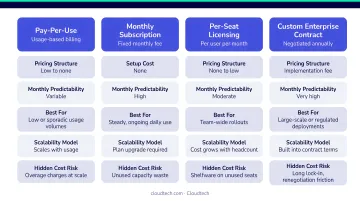
For businesses with inconsistent or seasonal support volume, per-resolution or per-request models typically deliver better cost efficiency than flat subscriptions.
Prioritize Integration Depth
The best AI VA is the one that connects to your existing tools without requiring custom development. Before committing to any platform, confirm it integrates with:
- Your CRM (HubSpot, Salesforce, Zoho)
- Your helpdesk or ticketing system (Zendesk, Freshdesk)
- Your scheduling or ecommerce platform (Google Calendar, Shopify)
- Your communication channels (email, chat, social)
AWS-native tools like Amazon Lex connect directly to the broader AWS ecosystem through Lambda-based integrations (custom serverless functions) — flexible, but requiring technical configuration.
Integration depth directly affects compliance readiness. If your business operates in a regulated industry, how your AI VA connects to existing systems matters just as much as which platform you choose.
Account for Compliance Requirements Early
SMBs in regulated industries cannot treat compliance as an afterthought. If your business handles protected health information, financial data, or European customer data, your AI VA selection must include:
- HIPAA eligibility: required for healthcare; Amazon Lex V2 meets this bar
- SOC and ISO compliance: relevant for financial services and SaaS businesses
- GDPR considerations: AWS provides compliance resources and Artifact reports for data processing agreements
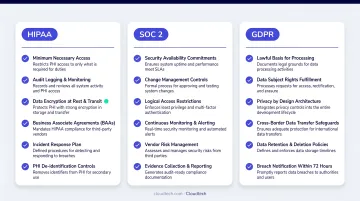
Selecting a compliant platform is only half the equation. Proper compliance architecture requires qualified implementation — a misconfigured HIPAA-eligible deployment carries the same legal exposure as using a non-compliant tool from the start.
Conclusion
The right AI virtual assistant for your small business isn't the one with the most features — it's the one that fits your use case, works with your existing stack, and delivers measurable value at a price point that makes sense for your volume. General productivity needs point toward ChatGPT or Microsoft 365 Copilot. High-volume customer support calls for Intercom Fin or Tidio. Custom, compliant, scalable workflows built on AWS infrastructure point toward Amazon Lex.
Start with a phased approach: run one or two shortlisted tools against real customer scenarios for 30–60 days, measure performance, and expand automation gradually. Rushing full deployment on day one is the fastest way to abandon a tool before it's had a fair trial.
For SMBs looking to build or scale AI-powered solutions on a secure, compliant AWS infrastructure (including Amazon Lex or Amazon Connect), Cloudtech's AWS-certified solutions architects can help you design and deploy the right solution for your industry. Connect with the Cloudtech team to start the conversation.
Frequently Asked Questions
How much does an AI virtual assistant cost for a small business?
Costs range from $0 (free tiers on ChatGPT and Tidio) to $500+/month for higher-volume subscription plans. Per-use models like Amazon Lex charge as little as $0.00075 per text request, while Intercom Fin charges $0.99 per resolved conversation. Total first-year costs including setup typically run from under $2,000 for no-code tools to $6,000+ for custom implementations.
What is the difference between an AI chatbot and an AI virtual assistant?
Traditional chatbots follow pre-programmed decision trees; AI virtual assistants use NLP and machine learning to understand context, handle multi-turn conversations, and improve over time. The practical difference: AI VAs handle open-ended questions that would send a rule-based bot in circles.
Which AI virtual assistant is best for small businesses in 2026?
There's no single answer; it depends on your use case. ChatGPT suits content creation and general productivity. Intercom Fin and Tidio Lyro are better for customer-facing support. Microsoft 365 Copilot fits teams already in the Microsoft ecosystem. Amazon Lex is the right choice for businesses needing custom, compliance-grade conversational workflows on AWS.
Can AI virtual assistants integrate with existing CRM and business tools?
Most modern platforms offer pre-built integrations with HubSpot, Salesforce, Shopify, Google Calendar, and Slack. Intercom Fin works directly on top of Zendesk and Freshdesk without a platform switch, while Amazon Lex connects natively to AWS services like Lambda and Amazon Connect.
How long does it take to deploy an AI virtual assistant?
No-code platforms like Tidio can be live in hours; Intercom Fin's helpdesk integration takes under an hour. Custom-built solutions on Amazon Lex typically require 2–8 weeks depending on workflow complexity, integration requirements, and available technical resources.
Do AI virtual assistants work for regulated industries like healthcare or financial services?
Yes. Amazon Lex V2 is HIPAA eligible and PCI, SOC, ISO, and GDPR compliant, making it well-suited for healthcare and financial services. Keep in mind that selecting a compliant platform and deploying it correctly are two separate steps — proper architecture matters as much as the platform itself.