Introduction
Growing SMBs are caught between two competing pressures: customers who expect instant, 24/7 support, and finance teams who can't justify proportionally scaling headcount to meet that demand.
Two solutions dominate the conversation: outsourcing to a third-party BPO team, or deploying conversational AI to handle interactions automatically. The stakes are concrete. According to Qualtrics XM Institute, bad customer experiences put $3.7 trillion in annual revenue at risk globally — and consumers reduce or stop spending 51% of the time after a negative interaction.
At the same time, Gartner predicts that by 2028, 70% of customers will start their service journey through a conversational AI interface. The technology has matured, and the choice between outsourcing and AI directly shapes your cost structure, customer satisfaction, and capacity to scale.
This guide breaks down both options across cost, quality, scalability, and fit — so you can decide which path, or which combination, fits your business right now.
Key Takeaways
- Outsourcing offers immediate human capacity but costs scale linearly with volume
- Conversational AI requires upfront investment and pays off at scale through flat operational costs
- Quality consistency favors AI; nuanced, emotional interactions still favor humans
- Neither option is universally superior — the right fit depends on your query mix and growth stage
- Most growing SMBs land on a hybrid model: AI for volume, humans for complexity
Outsourcing vs. Conversational AI: Quick Comparison
Here's how outsourced customer service and conversational AI compare across the five dimensions that most affect your decision.
| Dimension | Outsourced Customer Service | Conversational AI |
|---|---|---|
| Cost Structure | Per-agent or per-seat labor; costs scale with volume | Higher setup cost; flat operational cost at scale |
| Scalability | Requires recruiting, training, ramp time | Handles thousands of simultaneous sessions instantly |
| Availability | Limited to staffed hours; after-hours gaps common | 24/7 across all time zones, no added cost |
| Quality Consistency | Varies by agent, training depth, and vendor | Uniform responses; quality tied to design and training data |
| Complexity Handling | Excels at nuanced, emotionally sensitive queries | Best for structured, repeatable interactions; escalates edge cases |
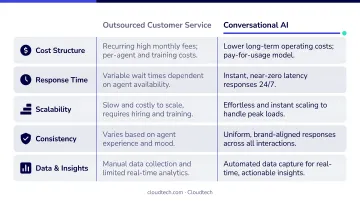
The sections below unpack each dimension so you can assess which model — or which combination — fits your operation.
What Is Outsourced Customer Service?
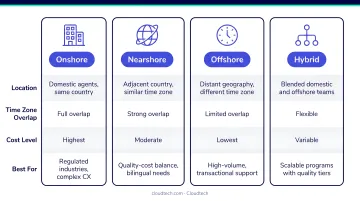
Outsourced customer service means contracting a third-party provider — typically a Business Process Outsourcing (BPO) firm — to handle some or all customer-facing support. Four primary delivery models exist:
- Onshore — agents based in the same country as your business
- Nearshore — agents in a neighboring or time-zone-adjacent country
- Offshore — agents in lower-cost regions (India, the Philippines, Eastern Europe)
- Hybrid — a mix of locations, often pairing offshore volume support with onshore escalation handling
Within each model, you'll typically choose between shared agents (your account shares capacity with other clients) and dedicated agents (exclusively assigned to your business).
Why Businesses Choose Outsourcing
Most businesses turn to outsourcing for four core reasons:
- Immediate capacity — trained agents can be operational within days or weeks
- Multilingual coverage — BPOs often offer agents fluent in multiple languages without recruiting overhead
- Reduced HR burden — recruiting, onboarding, and benefits management stays with the provider
- Specialized knowledge — some BPOs build vertical expertise in healthcare, financial services, or legal support
Where Outsourcing Falls Short
Despite these advantages, the same structural issues surface repeatedly:
- Quality inconsistency — agent performance varies by individual, training depth, and location
- Brand voice misalignment — external teams rarely represent your tone as naturally as internal staff
- Data security exposure — third-party access to customer records creates real risk. In 2025, overseas Coinbase support contractors were bribed to steal customer data — remediation costs ran $180M–$400M.
- Turnover costs — according to ICMI, 54% of contact centers see attrition rates between 21% and 50%, and replacing a single agent costs over $35,000
When Outsourcing Is the Right Move
Outsourcing is the stronger choice when:
- High-touch B2B account support requiring relationship continuity
- Regulated industries where compliance-aware human judgment is non-negotiable
- Complex product troubleshooting that doesn't follow predictable patterns
- Entering new markets where local time zone coverage or language fluency is immediately required
- Seasonal volume spikes too large to staff for internally but too infrequent to build AI around
What Is Conversational AI for Customer Service?
Conversational AI uses Natural Language Processing (NLP), Natural Language Understanding (NLU), and machine learning to automate customer interactions across voice, chat, email, and messaging channels. The key distinction from older rule-based chatbots: it understands context, detects sentiment, retains session memory, and improves over time.
As IBM defines it, conversational AI goes well beyond scripted responses — it uses feedback loops to continuously refine how it interprets and responds to customer intent.
Core Operational Advantages
- Runs 24/7 with no shift scheduling, after-hours gaps, or staffing overhead
- Handles thousands of concurrent sessions without performance degradation
- Delivers consistent responses that reflect the same logic and brand standards every time
- Captures intent data, pain points, and escalation triggers from every interaction
How It Gets Built
AWS offers purpose-built services that make enterprise-grade conversational AI accessible without building from scratch:
- Amazon Lex — natural language understanding
- Amazon Connect — AI-powered contact center workflows
- Amazon Transcribe / Polly — voice input and output
These services integrate into an existing AWS environment with pay-as-you-go pricing and no upfront commitment — making the cost barrier lower than most SMBs expect. For teams without internal cloud expertise, an AWS-certified implementation partner can move from concept to live deployment in weeks rather than months.
Where Conversational AI Performs Best
High-return use cases include:
- Order status, billing questions, password resets, and appointment scheduling — resolved without a human agent
- After-hours volume that would otherwise go unanswered
- Lead qualification that routes prospects by intent before they hit a sales rep
- Proactive outreach: appointment reminders, renewal alerts, follow-up notifications
- High-frequency FAQ deflection that keeps repetitive queries off agent queues
Industries with the clearest ROI include healthcare (appointment scheduling, patient inquiry automation), financial services (account queries, compliance-safe FAQ handling), and retail/eCommerce (order tracking, returns management). National Australia Bank, for example, routes 69% of its 18 million annual inbound calls to self-service, completing 95% within the automated channel — results reported by AWS.
Outsourcing vs. Conversational AI: Which Is Right for Your Business?
The right choice depends on your query mix, budget structure, growth trajectory, and how complex your typical support interaction is. For most SMBs, the answer isn't one or the other — it's knowing where each model breaks down.
Cost: The True Comparison
Outsourcing has a lower barrier to entry — you can launch within weeks with no infrastructure investment. But costs scale directly with volume. Add 500 more daily interactions, and you add headcount, training time, and management overhead.
Conversational AI requires upfront investment in design, integration, and testing. Once deployed, the per-interaction cost drops sharply as volume grows. Gartner predicted conversational AI deployments would reduce contact center agent labor costs by $80 billion in 2026.
McKinsey documented a case where AI-enabled service transformation reduced cost-to-serve by over 20% and cut total service interactions by 40–50%.
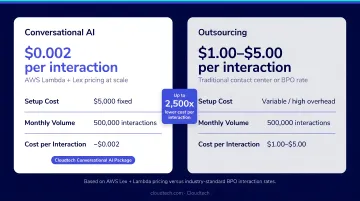
Gartner also forecasts that by 2030, GenAI cost per resolution may exceed offshore human agent costs for some interaction types — which argues for a targeted deployment strategy rather than AI-everywhere thinking.
Quality and Control
Conversational AI delivers consistent output — but only as good as its underlying design and training data. Poorly designed flows produce consistently bad experiences. The quality floor is higher; the ceiling depends on implementation quality.
Outsourcing, by contrast, introduces variability. Agent performance depends on individual capability, training consistency, and turnover rates. BPOs with high attrition — common in the industry — create recurring quality risk.
For emotionally sensitive or high-stakes interactions, human judgment still wins. AI should escalate these cases, not attempt to resolve them.
Decision Framework
| Outsourcing | Conversational AI | |
|---|---|---|
| Best for | Complex, compliance-heavy, irregular volume | High-volume, structured, repeatable queries |
| Cost model | Scales with headcount | Scales with infrastructure |
| Setup time | Weeks | Weeks to months |
| 24/7 coverage | Costly | Built-in |
| Quality control | Variable (turnover-dependent) | Consistent (design-dependent) |
Choose outsourcing when:
- You're early-stage and can't yet invest in AI infrastructure
- Your query mix is heavily complex or compliance-sensitive
- You need multilingual coverage or local market expertise quickly
- Volume is irregular or unpredictable
Choose conversational AI when:
- You handle high volumes of structured, repeatable queries
- You have 24/7 coverage gaps or rising per-contact costs
- You want interaction data for continuous improvement
- You're scaling and need support costs to grow at a fraction of revenue growth
- You have access to implementation expertise to reduce setup time and risk
For most growing SMBs: a hybrid model. AI handles Tier-1 volume automatically; human agents focus on escalations and complex cases. Overall cost drops while service quality is preserved at the moments that matter.
Real-World Application: How SMBs Are Making the Switch
Healthcare: AI Handling Volume at Scale
Cloudtech's work in the healthcare sector shows what conversational AI looks like under real operational pressure. A small support team fielding high patient query volumes — appointment scheduling, intake workflows, insurance verification — faces a familiar bottleneck: agents tied up on routine interactions, with little capacity left for complex patient needs.
Cloudtech deploys AWS-powered voice and chat agents — built on Amazon Connect, Amazon Bedrock, Amazon Transcribe, and Amazon Polly — directly within the client's AWS environment. The four-week implementation covers architecture setup and API integration with patient management and scheduling systems.
A full HIPAA compliance audit runs before any production traffic is handled.
The design includes human escalation with context fully preserved — callers never repeat information already shared with the AI. This is the hybrid model in practice: automation handling volume, humans handling complexity.
Financial Services: The Hybrid Model in Action
AWS-documented outcomes from financial services deployments show what's achievable when conversational AI layers on top of existing human support infrastructure. Documented results include:
- TransUnion: IVR handle time dropped from 2 minutes to 18 seconds; transfer rates fell 50%
- WaFd Bank: Account balance check time cut 90% (from 4.5 minutes to 28 seconds); agent call volume projected down 30%
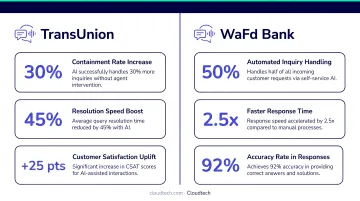
In these deployments, human agents didn't disappear — they shifted focus. Routine queries (balance checks, account status, basic navigation) moved to AI. Complex account management, disputes, and compliance-sensitive conversations remained with trained staff. The result: lower cost-per-interaction across the board, without sacrificing quality where it matters.
The Practical Takeaway
The pattern across both sectors is consistent. Businesses that transition to conversational AI redirect their human staff toward work that actually requires human judgment — and let automation absorb the volume. The result, in both healthcare and financial services, is lower cost-per-interaction alongside higher customer satisfaction. Those two outcomes tend to move together when the model is set up correctly.
For SMBs looking to deploy conversational AI on AWS without the complexity of building it from scratch, Cloudtech offers pre-packaged implementations that go from kickoff to go-live in four weeks. Connect with the Cloudtech team to explore what's feasible for your specific workflows and volume.
Conclusion
Outsourcing remains the right choice for businesses that need immediate human capacity, handle highly complex queries, or are entering new markets where local knowledge matters. Conversational AI is the right investment for businesses scaling volume-heavy, repeatable interactions who want support costs to grow far slower than revenue does.
The choice rarely has to be binary. For most growing SMBs, the most practical path is a hybrid model that evolves as the business does. A common starting point:
- Deploy conversational AI for Tier-1 volume (order status, FAQs, account lookups)
- Keep human agents — outsourced or in-house — for escalations and complex cases
- Expand automation gradually as query patterns become clearer and confidence in the system builds
The decision affects customer satisfaction, operational costs, and competitive positioning. Start by auditing your actual query mix — if 60–70% of tickets are repetitive and low-complexity, conversational AI likely pays for itself within the first year. If your volume is low or queries are consistently nuanced, outsourcing gives you flexibility without the implementation overhead.
Frequently Asked Questions
Can you outsource customer service?
Yes — outsourcing customer service is a widely used practice where businesses contract third-party BPOs to manage support interactions. Models range from offshore and nearshore to onshore and hybrid arrangements. It works best when query complexity is high, specialized expertise is needed, or rapid multilingual coverage is required.
What is conversational AI in customer service?
Conversational AI uses NLP, NLU, and machine learning to automate customer interactions across voice, chat, and messaging channels. Unlike scripted chatbots, it understands context, detects intent and sentiment, and improves over time, enabling more natural and effective automated support.
Is conversational AI cheaper than outsourcing customer service?
Conversational AI carries higher upfront implementation costs but delivers significantly lower per-interaction costs at scale. Outsourcing tends to be more economical for low-volume or highly complex support needs where AI escalation rates would remain high.
What are the biggest risks of outsourcing customer service?
The main risks include quality inconsistency across agents, language and cultural barriers, data security exposure when sharing customer records with third parties, and reduced oversight of brand voice — all compounded by high BPO attrition rates.
Can small businesses afford conversational AI for customer service?
Cloud-native services like Amazon Lex and Amazon Connect use pay-as-you-go pricing with no upfront commitment. AWS Advanced Tier Partners like Cloudtech offer pre-packaged implementations that let SMBs go live in weeks, without large internal teams or infrastructure costs.
Should I replace my outsourced team with conversational AI?
For most businesses, a hybrid approach works best. AI handles high-volume, repeatable interactions while human agents manage complex escalations — delivering cost savings without sacrificing the empathy and judgment needed for high-stakes moments.