Introduction
Picking the wrong conversational AI platform wastes budget, disrupts your sales workflow, and frustrates prospects at critical touchpoints. For SMBs and growing sales teams, that cost hits harder than most vendors will admit.
Conversational AI can qualify leads instantly, book meetings automatically, and free reps to focus on closing. Yet according to Gartner, at least 30% of generative AI projects will be abandoned after proof of concept by end of 2025 — largely due to poor data quality, unclear value, and underestimated implementation complexity.
This guide walks through the criteria that actually matter when evaluating these platforms: integration fit, conversation quality, compliance requirements, and total cost of ownership. Each section is designed to move you from vendor demos to a defensible buying decision.
TL;DR
- Conversational AI for sales uses NLP and machine learning to engage prospects, qualify leads, and book meetings across voice, chat, email, and SMS
- Six criteria determine fit: NLP quality, CRM integration, omnichannel coverage, cloud infrastructure, compliance posture, and total cost of ownership
- Skipping a structured pilot is the most common and costly SMB mistake
- How a vendor supports you during the pilot predicts how they'll treat you after the contract is signed
- An experienced cloud implementation partner reduces deployment risk and speeds time-to-value
What Is Conversational AI for Sales Automation?
Conversational AI for sales is software that uses natural language processing (NLP), machine learning, and AI to engage prospects in real-time — qualifying leads, booking meetings, and routing to human reps across voice, chat, email, and SMS.
How It Differs From Traditional Chatbots
Traditional bots follow scripted rules. When a prospect asks something unexpected, they break. Conversational AI understands intent, maintains context across multiple conversation turns, and adapts dynamically — which matters most during actual sales qualification.
When evaluating vendors, ask for a live demo with off-script questions — that's where the difference becomes obvious.
Core Use Cases in a Sales Workflow
Conversational AI plugs into sales at multiple stages:
- Inbound lead capture — engages website visitors instantly, before interest fades
- Lead qualification — asks discovery questions, scores intent, filters unqualified prospects
- Outbound follow-up — runs nurture sequences via SMS or email without rep involvement
- Appointment scheduling — books meetings directly into rep calendars
- CRM updates — logs conversation summaries and updates deal stages automatically
- Rep coaching — surfaces real-time prompts and post-call insights
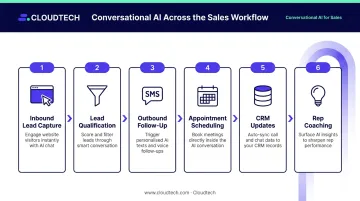
Not every platform handles all six. The gaps matter — they determine which parts of your sales process still require manual oversight, and where you'll need workarounds or additional tools.
Key Criteria for Selecting Conversational AI for Sales Automation
Choosing based on a demo or monthly price is how teams end up with tools that don't fit. The following six criteria connect platform capabilities to real sales outcomes: lead conversion rates, response times, meeting booking rates, rep time saved, and sales cycle length.
NLP and AI Quality
NLP sophistication is the foundational criterion. A platform that misunderstands buyer intent misroutes leads, sends wrong follow-ups, and creates friction at the exact moment a prospect engages.
What to evaluate:
- Does the platform handle multi-turn conversations, or does each message reset context?
- Does it recognize intent, or just match keywords?
- Does it improve from conversation data over time?
How to test it: During a demo or trial, give the bot open-ended, context-dependent questions that real prospects actually ask — not the scripted scenarios vendors prepare. A strong platform maintains context between exchanges. A weak one gives generic responses or restarts the thread.
Speed matters here too. InsideSales research across more than 55 million sales activities found conversion rates were 8x greater when the first response occurred within five minutes. A platform with slow NLP processing or high latency erases that advantage entirely.
CRM and Tech Stack Integration
Native CRM integration — not third-party connectors — determines whether conversation data actually flows into your system of record without manual intervention.
Ask vendors these specific questions:
- Does it offer native connectors for your CRM (Salesforce, HubSpot, Microsoft Dynamics)?
- Does it support custom field mapping?
- Can it trigger workflow automations based on conversation outcomes?
- Is the sync bidirectional — meaning the AI uses CRM context to personalize responses AND updates deal stages in real time?
Salesforce data shows that sales reps already spend 60% of their time on non-selling tasks, including manually entering customer notes. Weak CRM integration doesn't solve that problem — it adds to it. Every hour reps spend reconciling disconnected data is an hour not spent closing.
Omnichannel Coverage
B2B buyers now use an average of 10 interaction channels, up from five in 2016. A platform that only covers web chat misses a significant share of inbound and outbound interactions.
Key questions to ask:
- Does the platform maintain conversation context when a prospect switches from chat to email?
- Can it handle inbound voice, not just text?
- Does it support outbound SMS and email sequences?
If a prospect starts on your website and continues via email, losing that thread creates a disjointed experience — and drops a qualification signal your team needed.
Scalability and Cloud Infrastructure Readiness
SMBs often underestimate infrastructure requirements. As conversation volume grows, so do compute demands, data storage needs, and latency risks. Platforms built on cloud infrastructure built for scale handle growth without performance degradation.
Vendor questions to ask:
- Where is conversation data stored?
- How is compute scaled during peak usage?
- What is the documented uptime SLA?
The stakes are concrete: more than 60% of digital-infrastructure failures caused at least $100,000 in total losses, according to Uptime Institute's 2022 analysis. For a platform handling first contact with new leads, downtime translates directly to lost pipeline.
AWS services like Amazon Lex (with a 99.9% monthly uptime SLA) and Amazon Connect (with 99.99% uptime under eligible conditions) set a useful benchmark when comparing vendor infrastructure commitments. Note that some uptime credits have conditions — verify eligibility criteria, not just the headline percentage.
Compliance, Security, and Data Governance
Sales conversations involve sensitive prospect and customer data. Platforms must comply with relevant regulations and hold the appropriate certifications.
| Requirement | When It Applies |
|---|---|
| SOC 2 Type II | Baseline for most B2B deployments |
| GDPR | Any prospect or customer data from EU residents |
| CCPA | California-based buyers or businesses |
| HIPAA | Healthcare organizations handling PHI |
| ISO/IEC 27001 | Enterprise-grade security assurance |
Governance controls to verify:
- Data retention policies and deletion schedules
- Audit trails of AI interactions
- Consent management for outbound outreach
- Clear escalation paths ensuring human oversight for sensitive conversations
GDPR violations can reach €20 million or 4% of worldwide annual turnover, whichever is higher. For healthcare companies, HIPAA non-compliance carries its own significant penalties. Non-compliant platforms expose your organization to regulatory risk that far exceeds any efficiency gains.
Total Cost of Ownership and Implementation Complexity
Subscription pricing is one line item. The real cost includes:
- Integration development and custom workflow configuration
- Staff training (hours per rep × average hourly rate)
- Ongoing platform administration
- Internal time spent optimizing the system post-launch
A simple TCO framework:
- Add subscription fees + implementation services + integration costs + training time costs + monthly admin overhead
- Project against revenue impact: meetings booked, leads qualified, rep hours freed
- Calculate your breakeven timeline — not just the license cost
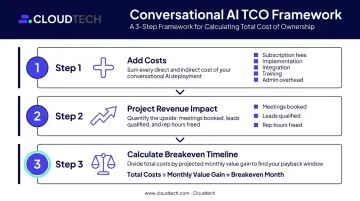
For SMBs, these hidden costs often exceed the license fee. A platform that looks affordable at $500/month can cost $30,000+ in implementation when integration complexity is factored in. Build the full picture before committing.
How to Shortlist and Test Conversational AI Options
Start With Your Bottlenecks, Not Features
Map your specific sales workflow pain points first:
- Slow lead response times?
- Unqualified prospects reaching reps?
- Inconsistent follow-up between touches?
Evaluate only platforms that directly address those bottlenecks. A narrower, better-fit platform consistently outperforms a feature-rich one requiring heavy customization.
Run a Structured Pilot
A structured pilot — not an open-ended trial — is how you distinguish real performance from a polished demo.
Pilot setup:
- Define 3–5 measurable success metrics upfront: meetings booked per week, lead-to-qualified rate, rep hours saved
- Run the pilot for 60–90 days with a representative team
- Compare AI-assisted results against your pre-AI baseline with the same lead volume
Gartner found that organizations mastering AI implementation fundamentals moved pilots into production at twice the rate of those that didn't. The pilot also surfaces something equally valuable: how the vendor actually behaves when things don't go smoothly.
Use Vendor Behavior as a Signal
Watch how quickly the vendor responds to configuration issues during the pilot, and whether they share optimization guidance unprompted or go quiet after contract signing.
Vendors who disengage post-sale create a real liability for SMBs without dedicated internal AI operations staff. Support responsiveness during the pilot is one of the most reliable indicators of long-term partnership quality.
How Cloudtech Can Help You Deploy Conversational AI on AWS
Selecting the right conversational AI platform is only half the challenge. Deploying it on reliable, scalable, and secure cloud infrastructure is what determines whether it actually performs when conversation volume hits.
Cloudtech, an AWS Advanced Tier Partner with a team that is 70% former AWS employees, helps SMBs architect, integrate, and deploy conversational AI solutions on AWS.
Their AWS-certified architects configure services like Amazon Lex for conversational interfaces and Amazon Connect for AI-powered contact center capabilities, then integrate these with existing CRMs and sales tools. That integration work is where most SMB deployments stall — Cloudtech's team has worked through it across healthcare, financial services, and manufacturing.
Key differentiators for this use case:
- Former AWS employees with deep platform expertise across Lex, Connect, and Bedrock
- Pre-packaged cloud solutions deployed in 2–8 weeks using purpose-built accelerators
- AWS Partner Funding programs that may reduce or eliminate out-of-pocket implementation costs
- A structured discovery process (including initial workshops) before any deployment begins
- Compliance guardrails built in by default — HIPAA, SOC 2, CCPA — not added as afterthoughts
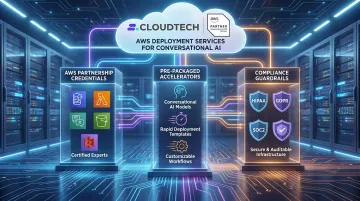
For SMBs without internal cloud or AI operations resources, a partner who knows both the AWS infrastructure and your business workflows is often the difference between a deployment that scales and one that stalls at the pilot stage.
Conclusion
Choosing conversational AI for sales comes down to fit, not popularity or feature count. The platform that works is the one that matches your specific workflow, integrates cleanly with your existing stack, runs on auditable and compliant infrastructure, and delivers measurable outcomes within a realistic total cost of ownership.
That fit is also not static. As your sales process evolves, prospect behavior shifts, and conversation volume grows, your platform requirements will change too. Build periodic reviews of performance metrics and vendor fit into your operating rhythm — and work with partners who can adapt your implementation as conditions shift, rather than starting over when they do.
Frequently Asked Questions
What are the key features of effective AI sales automation software?
The most effective platforms combine NLP-based intent recognition, multi-channel engagement, bidirectional CRM sync, lead scoring, automated meeting scheduling, and conversation analytics in one integrated system. Platforms that require multiple point tools for these functions create unnecessary complexity and data fragmentation.
How does conversational AI for sales differ from a traditional chatbot?
Traditional chatbots rely on scripted rules and keyword matching — they break when prospects ask unexpected questions. Conversational AI uses NLP and machine learning to understand intent, maintain context across multi-turn exchanges, and adapt dynamically, making it far more effective for real qualification scenarios.
What CRM integrations should I look for in a conversational AI platform?
Prioritize native connectors over third-party middleware for your primary CRM — Salesforce, HubSpot, or Microsoft Dynamics. Bidirectional sync, custom field mapping, and conversation-triggered workflow automations are the capabilities that eliminate manual data entry and keep your pipeline data accurate.
How long does it take to implement conversational AI for sales?
Timelines range from days for simple template-based deployments to several weeks or months for integrations requiring custom routing logic and team training. SMBs working with an experienced implementation partner typically deploy faster than self-service approaches — often within 2–4 weeks for straightforward configurations.
What compliance certifications should I require from a conversational AI vendor?
SOC 2 Type II and GDPR are baseline requirements for most businesses; healthcare organizations should also require HIPAA compliance and a Business Associate Agreement, while financial services firms should verify CCPA adherence. Always request audit trails and data retention documentation before signing.
Can small and mid-sized businesses realistically benefit from conversational AI for sales?
SMBs often see outsized gains because conversational AI allows a small team to engage and qualify a volume of leads that would otherwise require significantly more headcount. The key is selecting a platform sized for SMB budgets and workflow complexity — one that can scale as your pipeline grows without requiring a full re-implementation.