Pick the wrong one, and you're not just wasting budget. A healthcare practice that deploys a rigid rule-based bot for patient intake will frustrate callers and lose trust. A small logistics company that over-invests in enterprise-grade conversational AI for basic order tracking will burn money it doesn't need to spend.
This article breaks down what each technology actually is, where each genuinely fits, and how to make the right call for your business.
Key Takeaways
- Chatbots follow predefined rules — fast and cheap to deploy, but rigid and easily broken by unexpected inputs
- Conversational AI uses NLP and machine learning to understand intent, hold context, and respond dynamically
- Chatbots suit high-volume, predictable queries (FAQs, order status, business hours)
- Conversational AI pays off when interactions are varied, multi-step, or need backend system access
- Deploying the wrong tool costs more in customer frustration than it saves in deployment speed
Conversational AI vs. Chatbots: Quick Comparison
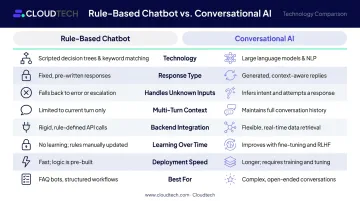
The table below maps eight key dimensions side by side — from underlying technology to deployment timelines — so you can quickly identify which solution fits your use case.
| Dimension | Rule-Based Chatbot | Conversational AI |
|---|---|---|
| Technology | Decision trees, keyword matching | NLP, NLU, machine learning, LLMs |
| Response type | Fixed, pre-scripted | Dynamic, context-aware |
| Handles unknown inputs | Fails or loops | Classifies intent, generates response |
| Multi-turn context | None — each message is isolated | Retained across the full conversation |
| Backend integration | Limited | CRM, EHR, transaction systems |
| Learning over time | Static — requires manual updates | Improves with usage |
| Deployment speed | Days to weeks | Weeks to months |
| Best for | Defined, repeatable queries | Varied, complex, personalized interactions |
What Are Chatbots — and Where Do They Actually Work?
A chatbot is software that simulates conversation by matching user input to predefined responses. The logic is essentially if/then: if someone types "store hours," the bot returns the hours. If nobody programmed that trigger, the bot fails.
AWS defines rule-based chatbots as systems that cannot reliably handle complex questions involving unknown factors. That's not a flaw — it's a design constraint. These tools are built for bounded, predictable problems.
The Two Types Worth Knowing
- Rule-based chatbots — pure scripted logic, decision trees, button menus. Zero language understanding. Reliable within their programmed scope, completely helpless outside it.
- Hybrid chatbots — combine rule-based flows with basic ML to improve keyword matching. Better at handling phrasing variation, but still lack true contextual understanding. Many products marketed as "AI chatbots" are actually hybrid systems.
Where Chatbots Deliver Real Value
For high-volume, repetitive queries with predictable phrasing, chatbots work well:
- FAQ responses — business hours, return policies, pricing tiers
- Order status lookups tied to a tracking number
- Appointment reminders (outbound, not conversational)
- Basic lead capture forms
- Tier-1 support triage and routing
These use cases land naturally in retail, e-commerce, and basic customer service. Even regulated industries like healthcare use them for scheduling reminders and intake form collection — as long as the workflow is linear and the questions are predictable.
The operational appeal is straightforward: fast to build, inexpensive to maintain, and no specialized engineering team required. For SMBs that need a low-risk entry into automation, a well-configured chatbot is a reasonable starting point.
What Is Conversational AI — and What Can It Actually Do?
Conversational AI is a broader technology category that combines natural language processing (NLP), natural language understanding (NLU), natural language generation (NLG), and machine learning. Rather than matching keywords to canned replies, it interprets user intent and generates context-aware responses.
The key difference in practice: the system retains context across a full conversation. If a user says "I need to reschedule my appointment" and then adds "actually, make it Thursday instead" — a conversational AI system handles the follow-up without requiring the user to start over. A chatbot cannot.
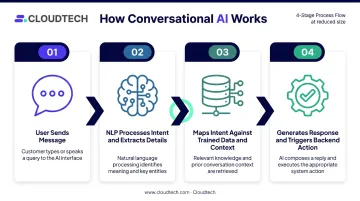
How It Works Without the Jargon
- User sends a message (text or voice)
- The system processes input through NLP to identify intent and extract relevant details
- It maps that intent against trained data and prior conversation context
- It generates a relevant, personalized response — and can trigger backend actions (booking, account lookup, status update)
Amazon Lex is an enterprise-grade example of this — a fully managed service for building voice and text conversational interfaces, powered by the same underlying technology as Alexa. It's accessible to SMBs through AWS cloud infrastructure without requiring an enterprise budget.
Conversational AI vs. Generative AI — a Distinction That Matters
Generative AI (like ChatGPT) creates original content — text, code, images — in response to open-ended prompts. Conversational AI is designed to understand and respond within a structured conversational flow, often integrated with business systems to take action. Many modern tools combine both — so when evaluating vendors, pin down which capability you're actually paying for.
Where Conversational AI Delivers Outsized Impact
This technology fits best when interactions are unpredictable, multi-step, or require pulling data from backend systems:
- Healthcare: Patient intake, symptom triage, appointment scheduling with eligibility checks — Humana's Watson-based voice agent handles provider inquiries in about 2 minutes at roughly one-third the cost of the prior system, according to IBM's case study
- Financial services: Account queries, fraud flagging, dynamic follow-up questions tied to transaction history
- Logistics: Shipment tracking with dynamic re-routing and status updates
- Internal helpdesks: IT and HR support where questions vary widely across employees
The Salesforce 2025 State of Service report found that 88% of service professionals say conversational AI speeds resolution and 87% say it frees their teams for more complex work. Those numbers hold when the technology is deployed against the right use cases — which is exactly what the next section breaks down.
Which One Does Your Business Actually Need?
The honest answer depends on four things:
- Query complexity — How varied are the questions? Can you map 80% of them to fewer than 100 scripted intents?
- Backend integration — Does the system need to pull or update data (CRM, EHR, booking system)?
- Volume and growth — Is support load growing faster than your team can handle?
- Budget and timeline — How quickly do you need results, and what's the acceptable investment?
Choose a Chatbot If:
- Your use cases fit within a defined, bounded set of questions
- Queries are high-volume and repetitive — FAQs, status checks, reminders
- You have limited technical resources and need to deploy fast
- You're testing automation for the first time and want low risk
Choose Conversational AI If:
- Customers phrase questions in unpredictable ways
- Interactions require context from earlier in the same conversation
- The system needs to access or update backend data (booking, accounts, eligibility)
- Your support volume is scaling faster than headcount
- You're in a regulated industry where failed interactions carry real consequences
The Upgrade Path Reality
Many businesses start with a chatbot for quick wins and layer in conversational AI as complexity grows. These aren't always either/or decisions — but the underlying architecture is different enough that migrating typically requires a redesign, not just a configuration change. Planning for that transition from the start saves significant rework later.
If you're unsure where your business falls, an AWS architecture assessment can clarify which approach fits your current interaction patterns and where your infrastructure needs to go as you scale. Cloudtech works with SMBs to evaluate their AWS environment and identify the right path forward — without requiring an enterprise-scale budget to get started.
Real-World Application: Seeing the Difference
Where a Chatbot Handles It Well
A regional logistics company receiving 500+ daily inquiries about shipment status and delivery windows is a strong chatbot use case. The questions are repetitive, the answers are data-lookups, and the interaction doesn't require context. A well-configured rule-based or hybrid bot reduces tier-1 ticket volume without overcomplicating the tech stack — and frees support staff for exceptions that actually need human judgment.
Where Conversational AI Changes the Outcome
Healthcare is where the gap becomes most visible. Consider a healthcare business process outsourcer managing thousands of monthly appointment scheduling calls — a scenario where the stakes of getting automation wrong are immediate.
Patient calls involve identity verification, insurance confirmation, slot availability, and booking confirmation. Questions arrive unpredictably. Callers give wrong insurance numbers or request changes mid-conversation. A rule-based chatbot breaks on the first unexpected input.
A HIPAA-compliant AI voice agent built on AWS — using Amazon Bedrock, Amazon Transcribe, and Amazon Polly — can handle this workflow end to end. In practice, that looks like:
- Average call resolution under 5 minutes
- Warm human handoff in under 2 seconds when needed
- Full call context retained so patients never repeat themselves
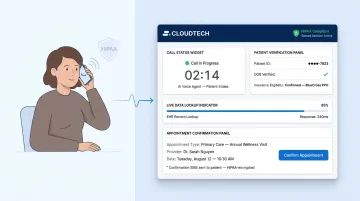
That operational profile is only achievable with conversational AI. A chatbot exits the workflow at the first unexpected input.
The principle is straightforward: match the technology to the complexity of the problem. A chatbot solving a chatbot-sized problem is the right call. Forcing a chatbot into a conversational AI problem is what creates the frustrated customers who research shows are already skeptical of automated service.
If you're unsure where your interactions fall on that complexity spectrum, Cloudtech's team can map your customer interaction patterns against the right AWS-based automation approach.
Conclusion
Neither chatbots nor conversational AI is universally better. A chatbot handles routine, predictable volume efficiently and affordably. Conversational AI earns its investment when flexibility, personalization, and the ability to take action matter — Conversational AI earns its investment when flexibility, personalization, and the ability to take action matter. A wrong answer or a dead-end conversation carries real consequences for customer trust.
For SMBs in healthcare, financial services, logistics, and retail, those costs are tangible. The wrong tool costs more in eroded customer trust than it saves in faster deployment. Start with an honest audit of what your customers actually ask — and how predictable those questions really are. That answer tells you which tool belongs in your stack.
Frequently Asked Questions
What is the main difference between a chatbot and conversational AI?
Chatbots use predefined rules and scripts to match user inputs to fixed responses — they work within a programmed boundary. Conversational AI uses NLP and machine learning to interpret intent, maintain context across multi-turn conversations, and generate dynamic, personalized replies that adapt to what users actually say.
Can a basic chatbot be upgraded to conversational AI?
Many businesses start with rule-based chatbots and layer in conversational AI over time, often through platforms like Amazon Lex. The underlying architectures are fundamentally different, though — a full redesign is almost always required, not a simple configuration upgrade.
Is ChatGPT a chatbot or conversational AI?
ChatGPT is a generative AI tool built on large language models — it falls under the conversational AI umbrella, but goes further by generating original content rather than responding within a constrained flow. Most business automation tools operate well below that level of open-ended capability.
Which is better for customer service: a chatbot or conversational AI?
It depends on query complexity. Chatbots handle high-volume, predictable FAQs efficiently. Conversational AI is the better fit when customers ask questions in varied ways, need multi-step support, or expect responses tied to their account history or prior interactions.
What are the biggest limitations of traditional chatbots?
Rule-based chatbots break down when users phrase questions unexpectedly, when context from earlier in the conversation matters, or when the system needs to take action — like updating an account or booking an appointment. These dead-ends drive most customer frustration with bot-first support.
How much does it cost to implement conversational AI compared to a chatbot?
Chatbots cost less upfront. Conversational AI requires more investment in setup, training data, and integration — but cloud-managed services like Amazon Lex have lowered the barrier considerably. AWS charges $0.00075 per text request with no upfront commitment, putting it within reach for SMBs without an enterprise budget.