Why Healthcare Employee Onboarding Demands a Smarter Approach
Healthcare HR teams operate under a pressure that most industries never experience: a new hire must absorb HIPAA requirements, credentialing workflows, department-specific clinical protocols, and organizational culture — often simultaneously, often before they see a single patient.
The cost of getting this wrong is measurable. National hospital staff turnover reached 18.3% in 2024, and 30.2% of all newly hired hospital employees left within their first year. When replacing one staff RN costs an average of $61,110, a disorganized onboarding process becomes a direct financial liability, not just an HR problem.
AI-driven chatbots offer a purpose-built response to this complexity. Built specifically for healthcare environments, these role-aware, 24/7 assistants can guide a travel nurse, an ER physician, and a medical billing specialist through entirely different onboarding journeys simultaneously, without adding headcount.
This guide covers what these chatbots actually do, where they deliver the most impact, how to deploy them in a HIPAA-compliant environment, and how to get started.
Key Takeaways
- 30.2% first-year turnover among new hospital hires makes onboarding quality a direct retention lever
- Healthcare chatbots are trained on clinical protocols and credentialing workflows — not just general HR policy
- HIPAA compliance, BAA coverage, and EHR integration are baseline requirements that govern every healthcare chatbot deployment
- Structured, technology-enabled onboarding makes organizations 103% more likely to see improvements in new-hire retention
- Amazon Lex, Bedrock, and Lambda deliver HIPAA-eligible infrastructure — giving healthcare teams a compliant foundation to build on
Why Healthcare Employee Onboarding Is Uniquely Challenging
The Volume and Velocity Problem
The BLS projects approximately 189,100 registered nurse job openings annually through 2034, and the AHA expects a shortage of roughly 100,000 critical healthcare workers by 2028. Healthcare HR teams are not onboarding occasionally — they're doing it constantly, under staffing pressure, with no margin to slow down.
Yet the research tells a conflicting story about speed: a 2024 systematic review found that a new graduate nurse requires approximately 8.32 months (1,198 hours) of work to reach the productivity level that offsets orientation costs. Nurse residency programs with at least a 12-month transitional period consistently show better retention than shorter programs.
Healthcare organizations can't compress compliance timelines — but the administrative work surrounding it is a different story. The parts that don't require human judgment are exactly where automation creates room to breathe.
The Role-Specificity Gap
A single all-staff handbook doesn't work in healthcare. The knowledge requirements diverge dramatically:
- An ICU nurse needs ventilator protocols, code procedures, and department-specific escalation paths
- A medical coder needs ICD-10 documentation standards and billing workflow compliance
- A travel nurse needs facility-specific policies that may differ across three locations they'll rotate through
Generic onboarding processes leave these gaps unfilled. New hires either escalate to HR — creating ticket volume — or proceed without the information they need, creating clinical and compliance risk.
The Compliance Clock Is Always Running
Healthcare organizations can't let credentialing slip. Before staff can work independently, several requirements must be cleared:
- Background checks and license verification
- DEA registration (where applicable)
- Mandatory HIPAA training completion
- Joint Commission documentation requirements
Manual tracking across spreadsheets introduces exactly the kind of inconsistency that HIPAA audits are designed to catch. Every gap is a liability.
What AI-Driven Chatbots Actually Do in Healthcare Onboarding
Beyond FAQ Bots: Context-Aware Assistance
Healthcare onboarding chatbots use natural language processing (NLP) to understand employee questions and retrieve accurate answers from a verified knowledge base. Unlike basic FAQ bots, they handle multi-turn conversations — so a new hire can ask a follow-up question and get a response that accounts for what was already discussed.
That distinction matters in practice.
Practical examples of what they handle:
- Benefits enrollment deadlines and instructions
- HIPAA training module status and reminders
- Badge access and IT setup procedures
- Department-specific protocol questions
- Shift scheduling and PTO policy
- Credentialing document submission requirements
Role-Based Personalization at Scale
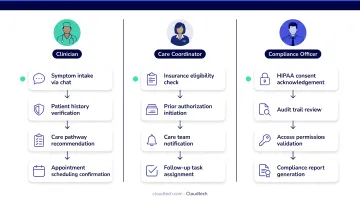
Effective healthcare chatbots are configured to serve different onboarding journeys depending on the new hire's role. Each persona gets a tailored experience:
- Clinical staff receive checklists covering license verification, clinical competency modules, and department orientation
- Administrative personnel get workflows focused on billing systems, coding standards, and compliance training relevant to their function
- Contract and travel workers are routed to facility-specific content without HR manually managing each site
This level of differentiation is only sustainable through automation — no HR team can manually manage role-specific content across hundreds of simultaneous onboarding journeys.
Automated Compliance Tracking and Escalation
Chatbots monitor onboarding task completion in real time and trigger alerts when required steps are missing or overdue — before a new hire is cleared for patient-facing duties.
Chatbots can flag:
- Background check clearance pending beyond a defined window
- Professional licenses not yet uploaded or verified
- Mandatory HIPAA training modules incomplete at day 5, 10, or 30
- Credentialing documents approaching expiration
Integration With Existing Healthcare Systems
Static scripts become outdated the moment a policy changes. Effective chatbots stay current by connecting to:
- HRIS platforms (Workday, BambooHR) for employee data and onboarding status
- EHR systems (Epic, Cerner) for role-specific clinical context
- LMS tools for real-time training completion tracking
This removes duplicate data entry and creates a single, accurate view of where each new hire stands, which is essential for compliance documentation.
24/7 Availability Across All Shifts
Healthcare doesn't operate 9-to-5, and neither can onboarding support. A night-shift nurse who starts a new role at 11 PM shouldn't wait until morning to get answers about badge access or their first mandatory training module. Chatbots cover that gap directly, which makes them particularly useful for multi-site health systems and travel nurse programs.
Key Benefits of AI Chatbots for Healthcare Employee Onboarding
Faster Time-to-Productivity
Organizations with technology-enabled onboarding are 33% more likely to see improvements in time-to-proficiency, according to Brandon Hall Group's 2024 research. Organizations with mature onboarding practices are 103% more likely to see better time-to-proficiency rates.
Chatbots accelerate this by eliminating the most common delay: waiting for information. New hires stop chasing HR contacts and start completing onboarding tasks.
Reduced Administrative Burden on HR Teams
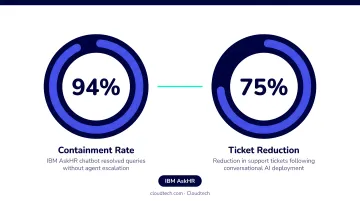
IBM's AskHR platform offers the clearest benchmark available: a 94% containment rate for common employee questions and a 75% reduction in HR support tickets, handling 11.5 million employee interactions in 2024 across approximately 80 automated HR tasks.
Healthcare HR teams face the same pattern of repetitive inquiries. Chatbots can absorb them entirely:
- Payroll and PTO policy questions
- IT setup and access requests
- Credentialing status updates
- Benefits enrollment guidance
That frees HR professionals for work that requires judgment: resolving credentialing discrepancies, supporting staff through orientation challenges, and managing complex compliance situations.
Improved New Hire Satisfaction and Retention
A 2024 systematic review of nurse residency programs found first-year retention rates of 85% to 96% for participants — compared to 14% turnover in control groups receiving standard orientation (versus 3.5% in residency participants). Structured onboarding has a measurable effect on whether nurses stay.
A separate study of personalized onboarding for new graduate nurses found improvements in 16 of 24 satisfaction metrics, along with significantly higher critical-thinking scores assessed around day 70. New hires who get fast, accurate answers in their first weeks arrive on the floor more confident — and more likely to stay past year one.
Consistent Compliance and Audit Readiness
Every chatbot interaction creates a documented, time-stamped record: questions asked, training acknowledged, documents submitted. This audit trail directly supports:
- Joint Commission accreditation reviews
- CMS compliance documentation
- Internal quality audits
- HIPAA enforcement response (where training records are often part of corrective action requirements)
Manual tracking spreadsheets introduce gaps — missing acknowledgments, undated completions, inconsistent records across facilities. A chatbot eliminates those gaps by default, producing documentation that survives scrutiny at any audit point.
Scalability Across Multi-Site Networks
Once built, a healthcare chatbot onboards hundreds of employees simultaneously with zero incremental cost per interaction. A human HR team scales linearly — more hires requires more staff. A chatbot doesn't. For health systems managing multiple facilities or rapid hiring cycles, the difference shows up directly in HR headcount and onboarding costs.
Healthcare-Specific Use Cases: Where Chatbots Make the Biggest Impact
Clinical Staff Credentialing and License Verification
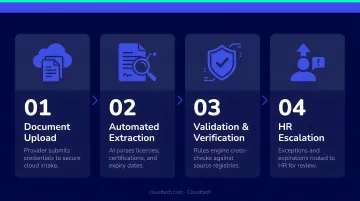
Credentialing is notoriously paper-heavy and error-prone. Chatbots replace this with a structured digital workflow:
- Prompt new hires to upload required documents (state licenses, DEA numbers, malpractice insurance)
- Confirm receipt and flag missing items immediately
- Track expiration dates and alert HR before documents lapse
- Escalate to credentialing staff when verification is pending beyond defined thresholds
Hospitals that have moved to automated credentialing workflows report cutting average time-to-start by days — a meaningful difference when a unit is short-staffed.
HIPAA and Compliance Training Facilitation
HIPAA's Security Rule requires security awareness and training as an administrative safeguard — this is a compliance obligation, not optional. Enforcement consequences reinforce this: Montefiore Medical Center paid $4.75 million to settle HIPAA violations, with corrective action requiring workforce training within 60 days and new hire training within 30 days of starting service.
Chatbots handle the operational side of compliance training by:
- Tracking which modules each employee has completed
- Answering HIPAA obligation questions in plain language
- Sending automated reminders before certification deadlines
Department-Specific Orientation for Clinical Roles
The personalization gap in healthcare onboarding is most visible here. Consider two new hires starting the same week:
- An ICU nurse's chatbot interaction covers ventilator protocols, code blue procedures, and critical care escalation paths
- A medical coder's chatbot covers ICD-10 standards, documentation requirements, and payer-specific billing workflows
Both get relevant, accurate information. Neither gets the other's irrelevant content. Manual onboarding can't maintain this level of role-specific detail across dozens of simultaneous new hires without significant coordinator overhead.
Multi-Site and Travel Nurse Onboarding
Travel nurses and per diem staff present a unique challenge: policies, credentialing requirements, and EHR systems may differ meaningfully across facilities. AI chatbots can be configured with facility-specific knowledge bases, so the same platform serves staff at different locations without requiring dedicated HR coordinators at each site.
Overcoming Implementation Challenges in Healthcare Settings
HIPAA Compliance and Data Security
This is the first question healthcare leaders ask — and it should be. Key requirements for any compliant healthcare chatbot deployment:
- End-to-end encryption for data at rest and in transit
- Role-based access controls limiting what each user can access
- Business Associate Agreement (BAA) coverage with the cloud provider
- HIPAA-eligible cloud infrastructure as the foundation
AWS addresses this directly: Amazon Lex V2, Amazon Bedrock, and AWS Lambda are all HIPAA-eligible services, and AWS offers a Business Associate Addendum to covered entities and their business associates. Building on this infrastructure means the compliance foundation is already in place before any chatbot logic is written.
Integration Complexity
Connecting a chatbot to legacy HRIS platforms, EHR systems like Epic or Cerner, and LMS tools requires experienced cloud architecture — not out-of-the-box configuration. This is where many healthcare chatbot deployments stall.
Common integration failure points include:
- Incomplete connections leaving the chatbot reliant on stale or inaccurate data
- HRIS and EHR systems with limited or undocumented APIs
- LMS platforms that require custom middleware to surface training status
- Security misconfigurations introduced during point-to-point data handoffs
Cloudtech, an AWS Advanced Tier Partner, has handled these integration challenges in healthcare settings — including work with Klamath Health Partnership and data lake implementations supporting EHR migration. The team designs these connections at the architecture level, so data accuracy and security are built in from the start.
Getting the integrations right is half the battle. The other half is getting clinical staff to actually use the tool.
Staff Trust and Adoption
Clinical staff are often skeptical of AI tools, particularly around the accuracy of clinical information. This skepticism is appropriate and should be accommodated, not overridden:
- Ground all chatbot responses in verified, locally approved content — not generic web sources
- Establish clear escalation paths to human HR contacts when questions fall outside the chatbot's scope
- Maintain human-in-the-loop oversight during the first 90 days of deployment, reviewing flagged interactions and refining responses
A chatbot that tells a nurse "I don't have that information — here's who to contact" is more trustworthy than one that guesses.
Getting Started: Building an AI Onboarding Chatbot for Your Healthcare Organization
Step 1: Define Scope Before Building
The most common deployment mistake is building before scoping. Before writing a single line of chatbot logic:
- Identify which onboarding workflows generate the highest HR inquiry volume (compliance questions, scheduling, credentialing)
- Map the knowledge sources the chatbot will pull from (employee handbook, policy documents, LMS content)
- Define the employee personas the chatbot must serve and their distinct requirements
A clear scope prevents the chatbot from becoming a sprawling, unreliable system that staff don't trust.
Step 2: Choose the Right Infrastructure
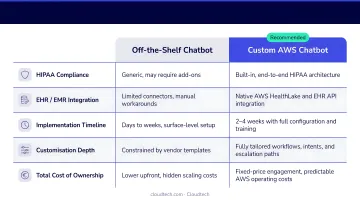
Healthcare organizations face a meaningful decision between off-the-shelf chatbot platforms and custom-built solutions on AWS. The tradeoffs are real:
| Factor | Off-the-Shelf | Custom AWS Build |
|---|---|---|
| HIPAA compliance control | Limited | Full |
| EHR integration depth | Shallow | Deep |
| Organization-specific content | Restricted | Unlimited |
| Speed to first deployment | Fast | Moderate |
| Long-term flexibility | Low | High |
For healthcare specifically, AWS provides the compliance depth and integration control that off-the-shelf platforms can't match:
- Amazon Lex handles conversation management and intent recognition
- Amazon Bedrock powers generative AI capabilities for dynamic responses
- AWS Lambda manages backend logic and EHR integrations
That infrastructure foundation is what allows Cloudtech's AWS-certified team to scope and build production-ready solutions in weeks for a defined use case — not the months that broader enterprise rollouts typically require.
Step 3: Start Narrow, Then Expand
A phased rollout reduces implementation risk and builds internal credibility:
- Pick one high-volume use case first. Compliance training FAQs for new nursing hires is a strong starting point — high inquiry volume, low clinical risk.
- Track what actually moves. Ticket deflection rate, new hire satisfaction scores, and training completion rates tell you whether the chatbot is working.
- Let the data drive expansion. Early results give internal stakeholders the proof they need to approve broader rollout across departments.
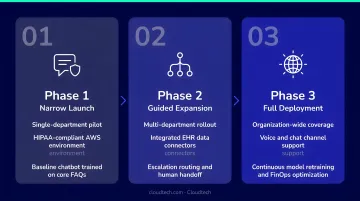
Starting narrow also gives the implementation team room to refine responses before the chatbot faces the full range of questions across the organization.
Frequently Asked Questions
What makes AI chatbots for healthcare onboarding different from standard HR chatbots?
Healthcare onboarding chatbots are configured with clinical knowledge bases, credentialing workflows, and HIPAA compliance requirements that general HR bots don't include. They're role-aware — serving an ICU nurse differently than a billing specialist — and regulation-ready in ways that generic tools are not.
How do AI chatbots handle HIPAA compliance during healthcare employee onboarding?
Compliant healthcare chatbots operate on HIPAA-eligible cloud infrastructure (such as AWS), use encrypted data transmission, enforce role-based access controls, and are covered under a Business Associate Agreement with the cloud provider. Compliance is built into the infrastructure from the start, not added as an afterthought.
Can AI chatbots assist with clinical credentialing and license verification?
Yes. Chatbots can prompt new hires to submit required credentials, confirm receipt, track expiration dates, and alert HR when documentation is missing or needs renewal — replacing a manual, error-prone process with one that is trackable and audit-ready.
How long does it take to implement an AI chatbot for healthcare employee onboarding?
Timelines depend on scope and integration complexity. A defined, single-use-case deployment built by an experienced AWS partner can be operational in weeks. Full multi-role deployments with deep EHR and HRIS integration typically take a few months depending on the systems involved.
What systems can healthcare onboarding chatbots integrate with?
Common integrations include HRIS platforms (Workday, BambooHR), EHR systems (Epic, Cerner), LMS tools, and communication platforms (Microsoft Teams, Slack). Deep integration with legacy healthcare systems requires proper API architecture and hands-on cloud expertise — it's not a configuration task.
How do AI chatbots help reduce early turnover among healthcare staff?
New hires who get fast, consistent answers in their first weeks are less likely to disengage — or leave. Structured onboarding programs have been associated with first-year retention rates as high as 96%. Chatbots deliver that level of support at scale, across all shifts, without adding HR headcount.