That math doesn't work without help.
Generative AI is frequently cited as the solution, but most coverage focuses on speed and skips the operational specifics. What actually changes when your team uses AI in the RFP process? What do you risk by staying manual? And how do you make it work in practice?
This article covers all three — with data where it exists and honest caveats where it doesn't.
Key Takeaways
- Generative AI drafts RFP responses by pulling from your existing proposals, messaging, and content library
- SMB teams averaging 4 people now handle 79+ submissions per year — AI is how lean teams keep pace
- Over 79% of proposal teams now use generative AI tools, up from 68% the prior year
- The biggest competitive risk isn't using AI poorly — it's not using it while your competitors do
- AI accelerates the draft; human review, relationships, and customization close the deal
What Is Generative AI in the RFP Process?
Generative AI refers to a category of AI that produces new text by learning patterns from large datasets. In the RFP context, it takes your prompt — or an uploaded RFP document — and generates structured draft responses, summaries, and narratives matched to the buyer's priorities based on your company's knowledge base and public information about the buyer.
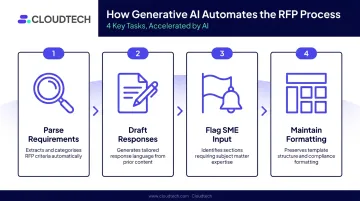
It doesn't replace your proposal process. It automates the parts that eat the most time:
- Parsing RFP requirements and mapping them to relevant content
- Drafting responses to standard and technical questions
- Flagging sections that need human SME input
- Maintaining consistent formatting and tone across a full submission
The real payoff is capacity. A 4-person team can pursue more bids, at higher quality, without burning out — which means more contract opportunities without adding headcount.
Key Advantages of Using Generative AI for RFPs
The advantages below reflect operational impact, not theoretical efficiency. Each maps to the metrics that determine whether an RFP effort pays off.
Advantage 1: Dramatically Faster First Drafts
The gap between receiving an RFP and having a reviewable draft used to be measured in days of manual coordination. Generative AI collapses it.
With generative AI, the process looks different. The tool ingests the RFP document, identifies requirements, and auto-populates responses by pulling from your content library, past proposals, and approved messaging. A structured first draft that once took days can be ready in minutes.
The Loopio 2026 report found that completing a full RFP response takes an average of 27 hours at SMBs. Platform-reported case studies from vendors like Inventive AI suggest AI assistance can dramatically compress first-draft creation — one documented example describes a 100-question RFP dropping from 4–5 hours to 20–30 minutes — though these are individual cases, not independently verified averages.
Why this matters for SMBs specifically:
- Time spent drafting proposals is time pulled from billable work or client delivery
- Faster submissions signal responsiveness to buyers — a meaningful soft signal in competitive bids
- Teams can pursue more opportunities in parallel without adding headcount
KPIs impacted: Time-to-first-draft, total RFP cycle time, bids submitted per quarter, cost-per-proposal
When it matters most: Teams managing concurrent bids, organizations where the same staff handle proposals and delivery work, and businesses competing against larger firms with dedicated proposal departments.
Advantage 2: Reduced Reliance on SMEs for Every Response
Traditional RFP workflows require pulling technical experts, legal reviewers, and department leads into every submission. That coordination creates bottlenecks, delays, and real frustration — especially when the same people are also responsible for client delivery.
According to Loopio's research, 51% of RFP responders identify collaboration with SMEs and internal stakeholders as their top challenge. In specialized industries like insurance, that figure rises to 72%.
Generative AI reduces this dependency by training on your existing documentation, case studies, compliance materials, and past RFP responses. The AI generates accurate draft answers to technical and company-specific questions, reserving SME review for only the most nuanced or novel requirements — rather than every question in the deck.
For firms covering highly technical domains — HIPAA-compliant infrastructure, cloud migration, generative AI on Bedrock — SME knowledge is both the core asset and the most constrained resource. Reducing bottlenecks in proposal work means that expertise stays focused on delivery while proposals still reflect it accurately.
When SME involvement drops from "required for every question" to "review on flagged items," a small team can handle a significantly larger bid pipeline without proportionally increasing coordination overhead.
KPIs impacted: SME hours per proposal, cross-department coordination time, proposal team bandwidth
When it matters most: Companies with deep technical offerings where expertise is concentrated in a few people; organizations responding to compliance-heavy RFPs in healthcare, financial services, or regulated sectors.
Advantage 3: Higher-Quality, More Consistent Proposals
Speed gets you to the table. Quality is what wins the bid.
Generative AI improves quality in two concrete ways. First, it maintains a unified voice throughout the entire submission — eliminating the tonal inconsistencies that emerge when five different contributors write five different sections. Second, it can analyze the issuing organization's language, stated priorities, and public documents to tailor responses that reflect genuine understanding of the buyer's goals.
Disjointed proposals — where the executive summary contradicts the technical section, or the tone shifts mid-document — are a common reason bids get downgraded. AI doesn't solve strategy, but it does prevent the kind of inconsistency that signals a disorganized response team.
Responsive's 2026 SRM report found that SRM Leaders — organizations with mature strategic response practices who also use AI more frequently — reported revenue growth from RFPs at 73% versus 60% for Novices. That's a correlation, not a proven causal link, but it points in a consistent direction.
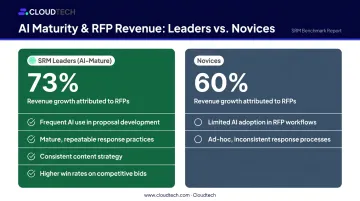
For SMBs competing against larger firms with dedicated proposal departments, a well-tailored, consistent proposal tells evaluators you're organized and serious — which matters when they're comparing dozens of submissions in a single procurement cycle.
KPIs impacted: Proposal win rate, compliance rate, brand consistency across submissions
When it matters most: Open RFPs with many competing vendors where first impressions carry weight; complex proposals requiring input from multiple departments that historically produce disjointed submissions.
What Happens When You Ignore Generative AI in Your RFP Process
The RFP landscape has quietly split into two camps. Loopio's 2026 data shows 79% of proposal teams now use generative AI — up from 68% the prior year, and from just 34% two years ago. Staying manual means competing against AI-augmented teams with no extra hours to close the gap.
The practical fallout compounds quickly:
- Deadlines slip or submissions get rushed, underselling what your team actually delivers
- Copy-paste workflows across multiple contributors drive up error rates and version control headaches
- SMEs get pulled into every proposal cycle — Loopio found 75% of proposal professionals report burnout, with 1 in 10 teams calling their stress unmanageable
- Every hour spent manually drafting content is an hour not spent on strategy, differentiation, or client relationships
Organizations currently respond to just 55% of the RFPs they receive — the industry average — leaving the rest on the table. AI is one of the few levers that increases bid volume without adding headcount.
How to Get the Most Value from Generative AI in Your RFP Workflow
Getting value from generative AI for RFPs requires more than deploying a tool. Three things determine whether it actually improves outcomes:
1. Start with a clean, well-organized content library. Generative AI draws its answers from the information you give it. An outdated or disorganized repository produces generic, inaccurate drafts. A well-maintained knowledge base — past proposals, technical documentation, compliance answers, case studies, approved messaging — produces precise drafts that require minimal editing. AWS recommends clear headings, self-contained passages, explicit context, and consistent terminology for documents used in AI retrieval systems. The better your inputs, the less editing your team does after every draft.
2. Track what wins after every submission. Track which AI-generated responses received the highest evaluation scores and which were flagged for revision. Teams that do this consistently build a compounding advantage — the AI gets smarter inputs, and the team learns what winning looks like in their specific category.
3. Make sure your infrastructure can support it. For AI-powered RFP tools to perform reliably at scale, the underlying cloud environment needs to be secure, scalable, and properly integrated with your data sources. That means:
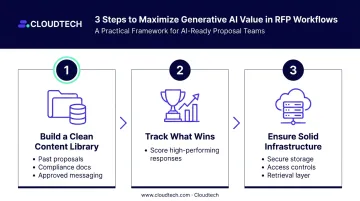
- Solid storage architecture for your knowledge base
- Access controls over sensitive proposal data
- A retrieval layer that connects your content to the AI tool
For SMBs building or modernizing this foundation, Cloudtech's structured five-phase AWS implementation delivers GenAI-ready infrastructure — using Amazon S3, Amazon Bedrock, and Amazon OpenSearch — without requiring an internal team to manage it.
The results translate across use cases. In one healthcare SaaS engagement, Cloudtech's RAG architecture on Amazon Bedrock cut support ticket volume by 45% within two months and resolved complex queries in seconds that previously required manual triage. The same infrastructure patterns apply directly to RFP knowledge base retrieval systems.
Conclusion
The case for generative AI in RFPs comes down to competitive math. Proposal teams are leaner than the workload requires, bid volumes are rising, and over three-quarters of your competitors are already using AI in some form. Faster first drafts, lower SME dependency, and stronger submissions each address a real constraint that limits how many bids a small team can pursue and win.
Those gains compound when AI is treated as an ongoing practice rather than a one-time shortcut. Teams that continuously update their content library, review AI output against win/loss data, and refine their approach will see increasing returns from each proposal cycle. Teams that wait face a widening gap — their competitors' content libraries, feedback loops, and institutional knowledge keep growing while theirs stand still.
Frequently Asked Questions
What is AI in the RFP process?
AI in the RFP process refers to generative AI tools that automate the most time-consuming parts of proposal creation : parsing requirements, drafting responses, and managing review cycles. These tools draw from your company's knowledge base to help you respond to more bids, more accurately, in less time.
Can generative AI write an entire RFP response on its own?
AI can generate a strong, structured first draft quickly, but human review remains essential. Verifying factual accuracy, adjusting tone for the specific buyer, and catching compliance or legal language issues all require judgment AI cannot reliably provide yet.
How much time can generative AI save on an RFP response?
Time savings vary by tool and content library quality. Loopio's 2026 data puts average SMB response time at 27 hours per submission. Vendor-reported cases suggest significant reductions are achievable — one 100-question RFP went from hours to under 30 minutes — though individual results vary and haven't been independently verified at scale.
What are the risks of relying on AI for RFP writing?
The two primary risks are AI hallucinations (inaccurate or fabricated information) and overreliance on unreviewed first drafts. Both are manageable with a human-in-the-loop review process and a well-maintained content library that gives the AI verified source material to draw from.
How should a small business get started with AI-assisted RFPs?
Start by organizing existing proposal content into a centralized, searchable library. Then pilot a generative AI tool on a low-stakes RFP to test output quality and identify gaps before scaling to higher-value bids. Getting the content foundation right before adding AI saves significant rework later.
Why does a strong content library matter for AI-generated RFP responses?
Generative AI draws answers from the information you provide. An outdated or disorganized content library produces generic, unreliable responses. A well-maintained knowledge base of past proposals, technical specs, and approved messaging gives the AI accurate source material — which means drafts that require far less editing before submission.