Introduction
Every time someone asks Siri a question, types a search query, or resolves an issue through a chatbot, Natural Language Understanding is working behind the scenes. Most business leaders, though, have only a vague sense of what NLU actually does — and that gap is costly.
Many companies deploy AI-powered tools without understanding the NLU layer underneath them. The result: chatbots that misfire on unexpected phrasing and automation workflows that fail routine requests — problems that compound quietly until users stop engaging entirely.
Research from a 2026 peer-reviewed study analyzing over 108,000 chatbot conversations found that 62% of users abandoned interactions after a misunderstanding, and 75% abandoned after a complete failure to recognize intent. Those numbers make a strong case for getting the NLU layer right before deployment.
This guide explains what NLU is, how it works, how it differs from NLP and NLG, where it's applied across industries, and how SMBs can implement it through AWS.
Key Takeaways:
- NLU is the AI layer that extracts meaning, intent, and context — not just individual words
- It handles ambiguity, slang, sarcasm, and multi-part questions that break rule-based systems
- Within the broader NLP field, NLU works alongside NLG in conversational AI pipelines
- Amazon Lex and Amazon Comprehend give SMBs production-ready NLU without building from scratch
- Weak NLU is the primary reason chatbot deployments fail users at scale
What Is Natural Language Understanding (NLU)?
Natural Language Understanding is a subset of AI that enables computers to extract meaning, intent, context, and sentiment from human language — not by matching patterns, but by interpreting what someone actually means.
The difference shows up immediately in practice. A system without NLU can recognize that a customer typed the word "broken." A system with NLU understands they're reporting a defective product and needs a support workflow triggered — not a keyword match, but a reasoned interpretation of what the person actually wants.
What NLU Handles That Standard Text Processing Cannot
Rule-based text processing collapses the moment real humans show up. Real communication includes:
- Ambiguity — "I need help with my account" could mean billing, login, or cancellation
- Slang and informal phrasing — "My app keeps crashing lol fix it" still needs routing to engineering
- Misspellings — "cancle my subscrption" should trigger a cancellation workflow
- Implied requests — "This is taking forever" implies frustration, not a literal time inquiry
- Sarcasm — "Great, another outage" is negative feedback, not a compliment
- Multi-part questions — "Can I change my plan and get a refund for last month?" requires two separate workflows
Each of these failures was, historically, a real limitation — which is why the evolution of NLU matters as much as its current capabilities.
How NLU Evolved
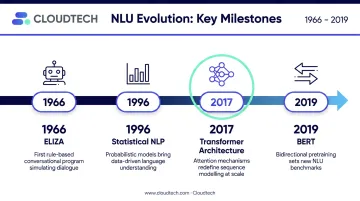
The progression from early systems to modern NLU reflects decades of foundational research:
- 1966 — ELIZA: Keyword-triggered rule matching; no semantic understanding whatsoever
- 1996 — Statistical NLP: Maximum entropy models applied to sense disambiguation
- 2017 — Transformer architecture: Attention mechanisms replaced recurrence, enabling contextual relationships across long text sequences
- 2019 — BERT: Bidirectional pretraining let models condition on both left and right context simultaneously, reaching state-of-the-art results across 11 NLP tasks
Today's transformer-based and LLM-enabled NLU can interpret inputs it has never seen before — which means your users no longer need to phrase requests perfectly for the system to respond correctly.
How NLU Works: The Core Mechanisms
Understanding how NLU operates under the hood helps explain why some deployments succeed and others produce the abandonment rates cited above.
Tokenization and Embeddings
NLU systems start by breaking input text into tokens — the basic units a model works with. Tokenizers use algorithms like Byte Pair Encoding (BPE) or WordPiece to balance vocabulary size against meaningful text representation. Each token is then converted into a numerical vector called an embedding, which encodes semantic relationships among words.
Transformer self-attention drives this capability. It connects every token to contextual information across the full input sequence, so the model distinguishes "bank" in "river bank" from "bank" in "bank account" — no explicit rules required.
Named Entity Recognition (NER)
NER is how NLU identifies and classifies real-world objects within text. Amazon Comprehend's entity model, for example, classifies references like "John" as PERSON, "1313 Mockingbird Lane" as LOCATION, and "2012" as DATE. In a document processing context, this means a system can automatically extract "invoice from March 15" as both a document type and a specific date entity — enabling automatic extraction without manual review.
Intent Recognition
Intent recognition tells the system what a user is actually trying to accomplish. "Chicken tikka masala" implies someone wants a recipe; "chicken tikka masala near me" implies they want a restaurant. Same keywords, completely different intent — and a keyword-matching system gets it wrong every time.
A 2021 ACM study reported BERT intent accuracy of 94% with just 25 training examples per intent, rising to 98% with full datasets. Rule-based systems have no equivalent baseline to compare against.
Sentiment and Context Analysis
NLU reads emotional tone — positive, negative, urgent, frustrated — and maintains conversational state across multiple turns. This means a user who said "my budget is under $500" two messages ago doesn't have to repeat themselves — the system carries that context forward.
How NLU Models Are Trained
Modern NLU models typically combine two approaches:
- Supervised learning on labeled datasets — teaching specific linguistic nuances explicitly
- Unsupervised pretraining on massive unlabeled text corpora — discovering underlying language patterns at scale
BERT separates these phases explicitly: pretraining on unlabeled text first, then fine-tuning on labeled tasks. That combination is what allows the model to generalize to inputs it has never seen before.
NLU vs. NLP vs. NLG: Understanding the Difference
These three terms are frequently conflated — but they're distinct layers of the same pipeline.
| Component | Role | Function |
|---|---|---|
| NLP | The umbrella discipline | Covers all computational language tasks: syntax, grammar, morphology, structure |
| NLU | The comprehension layer | Interprets meaning, intent, entities, and context from input |
| NLG | The output layer | Generates human-readable responses from structured data or intent outputs |
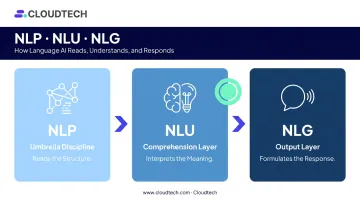
The pipeline works like this: NLP reads the structure → NLU interprets the meaning → NLG formulates the response.
AWS documents this sequence in its conversational AI architecture: language input flows into NLP processing, NLU handles intent and context recognition, dialogue management maintains state, and NLG constructs the response. Remove NLU from that chain and the system loses its ability to determine what a response should say, or whether any action should trigger at all.
In practical terms, this distinction matters most at the design stage. A chatbot built without a dedicated NLU layer can parse words but cannot resolve intent — which means it will fail the moment a user phrases a request in an unexpected way.
Key Applications of NLU Across Industries
NLU is not a single product. It's a capability embedded across a wide range of business applications.
Virtual Assistants and Customer Support
Siri, Alexa, and modern customer support bots all rely on NLU to interpret free-form questions and route users correctly, without requiring exact keyword matches. If users have to phrase requests perfectly to get a useful response, the system fails constantly. That's the business case for NLU in plain terms.
Sentiment Analysis and Business Intelligence
Organizations use NLU-driven sentiment analysis to process unstructured data from customer reviews, support tickets, and social media at scale. Doing this manually across thousands of data points is impossible — NLU turns that volume into a manageable, automated workflow. AWS reports that Vision Creative achieved over 90% sentiment analysis accuracy using Amazon Comprehend. Separately, Siemens cut survey processing time by 75% while reducing cost to under one euro per interview.
Contact Centers and IVR Systems
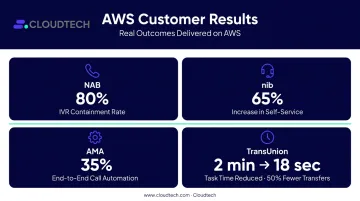
NLU enables callers to interact with phone systems using natural speech ("I need to update my payment method") instead of navigating rigid touch-tone menus. AWS customer results include:
- NAB: 80% IVR containment rate
- nib: 65% increase in self-service interactions
- AMA: 35% end-to-end call automation
- TransUnion: IVR task completion time dropped from 2 minutes to 18 seconds, with 50% fewer transfers
Healthcare and Financial Services
In healthcare, NLU processes clinical notes and patient intake forms at a scale no human team can match. A University of Pennsylvania study processed 55,630 clinical notes for seizure outcome classification, achieving an 0.88 F1 score, demonstrating practical viability for real clinical workflows.
Financial services firms face a similar volume problem. FINRA reports that firms use NLP applications to screen, classify, and route incoming client communications based on key features. Document classification pipelines using Amazon Comprehend automatically categorize invoices, contracts, and compliance documents, sending each to the right team without manual sorting.
Cloudtech builds these kinds of solutions for SMBs in healthcare and financial services — including HIPAA-compliant architectures and intelligent document pipelines using Amazon Textract and Amazon Comprehend.
Search and Intelligent Information Retrieval
NLU improves internal search tools and knowledge bases by matching queries to intent rather than exact keywords. An employee searching "what's our policy on remote work expenses" should find the right HR document even if that exact phrase doesn't appear in it. Semantic search, powered by NLU, makes this work.
How Businesses Can Implement NLU with AWS
AWS's Core NLU Services
Three AWS services form the foundation for most SMB NLU implementations:
- Amazon Lex — Conversational AI with built-in NLU for chatbots and IVR systems, handling intent classification and slot resolution. Amazon Lex V2 now uses LLMs to improve intent classification beyond traditional training phrase matching.
- Amazon Comprehend — NLU-powered text analysis for sentiment detection, entity recognition, key phrase extraction, and custom document classification. Custom entity recognizers return precision, recall, and F1 scores so teams can measure performance against specific business datasets.
- Amazon Bedrock — Managed access to foundation models for more complex text understanding tasks, including question answering, document summarization, and conversational understanding at scale.
Implementation Priorities for SMBs
Start with the highest-volume, most repetitive language-based tasks. The strongest candidates:
- Customer query routing — classifying support tickets by topic and urgency before human review
- Document classification — automatically sorting invoices, contracts, or intake forms into the right workflows
- Sentiment monitoring — processing customer reviews or support interactions to surface emerging issues
- IVR modernization — replacing touch-tone menus with natural speech interfaces
Integration with existing CRM, ERP, or data systems is where NLU investments deliver compounding value. The output of NLU analysis feeds directly into workflows that already exist, rather than creating a parallel process.
Getting that integration right requires scoping the right use case from the start. Cloudtech, an AWS Advanced Tier Partner with AWS-certified cloud architects and a team that is 70% former AWS employees, helps SMBs deploy NLU services across healthcare, financial services, and manufacturing. Each engagement begins with a structured discovery workshop to identify the right use case before any implementation starts, reducing the risk of building against the wrong problem.
AWS Partner Funding programs are available to offset costs for qualifying engagements.
Frequently Asked Questions
What does NLU do in conversational AI?
NLU is the first step in the conversational AI pipeline — it interprets the user's message by identifying intent, extracting relevant entities, and understanding conversational context. Without it, the system has no basis for choosing what action to take.
What is the difference between NLU and NLP?
NLP is the broader field covering all computational language tasks — syntax, grammar, and structure. NLU is the specific subset focused on meaning, intent, and semantics. NLU is what lets a system go beyond recognizing words to understanding what a person wants.
Is conversational AI part of NLP?
Yes. Conversational AI is built on NLP technology, relying specifically on NLU to interpret user input and NLG to generate responses.
What are common examples of NLU in everyday life?
Voice assistants (Siri, Alexa, Google Assistant), search engines interpreting query intent, customer support chatbots, and email spam filters all rely on NLU to interpret what users mean rather than just matching keywords.
Which LLM is best for conversational AI?
There's no single answer. The right choice depends on task complexity, latency requirements, cost, data privacy needs, and compliance constraints. AWS offers several integrated LLM options through Amazon Bedrock that can be evaluated against your specific requirements.
How does NLU handle ambiguous or complex language?
Modern NLU systems use transformer-based models to analyze surrounding context, conversational history, and semantic relationships. This lets them resolve ambiguity that rigid rule-based systems can't handle — reading the same phrase differently based on what came before it.