Introduction
Document backlogs don't wait. For operations teams in healthcare, financial services, manufacturing, and logistics, the volume of incoming documents — invoices, patient records, contracts, freight manifests — keeps climbing while the headcount processing them stays flat.
Generative AI is changing that equation. Intelligent document processing (IDP) automates the extraction, classification, and structuring of data from business documents, and GenAI is its most powerful upgrade yet. Where traditional IDP stopped at pulling text from a form, GenAI IDP reads context, reasons across content, and produces structured outputs ready for downstream systems.
The cost of manual processing is measurable. Invoices keyed by hand, patient records reviewed one at a time, contracts stalled in review queues — each one represents hours and dollars that automation can reclaim.
This guide explains what GenAI IDP is, how the pipeline works end-to-end, where it delivers the most value by industry, and what to consider before implementation — so you can evaluate it against your own document workflows before committing to a direction.
Key Takeaways
- GenAI IDP moves beyond text extraction to contextual classification, summarization, and reasoning across document types
- Three pipeline stages drive the process: document classification, data extraction and normalization, then enrichment and analysis
- Financial services, healthcare, legal, logistics, and manufacturing see the highest ROI — often cutting processing costs by 50% or more
- Unlike rule-based tools, GenAI IDP handles unstructured documents without template training
- Implementation success hinges on model selection, human-in-the-loop design, and compliance readiness
What Is Generative AI for Intelligent Document Processing?
GenAI-powered IDP applies large language models (LLMs) and foundation models to automate how organizations read, classify, extract, validate, and synthesize data from business documents. The goal is straightforward: convert unstructured, semi-structured, and structured documents — invoices, contracts, patient records, shipping manifests, regulatory filings — into accurate, structured, actionable data at scale, without requiring manual intervention for each document.
How It Differs from Traditional IDP
Traditional IDP tools rely on rigid templates, pattern matching, and predefined rules. When a vendor changes their invoice layout or a new form type enters the workflow, those rules break — and someone has to rewrite them manually.
GenAI IDP takes a different approach. Rather than matching fields by position, it understands what a document means, not just where specific fields are positioned on the page. That makes it:
- Adaptable to format variation without re-templating
- Capable of handling ambiguous language and complex document structures
- Faster to onboard new document types with little or no labeled training data
For a healthcare practice processing referral forms from dozens of different clinics, or a logistics company handling shipping manifests across carriers, that adaptability isn't a nice-to-have — it's what makes automation actually work.
Why GenAI IDP Matters for Modern Businesses
The Cost of Manual Document Handling
Manual document processing is slow, but the error problem is what makes it costly. A 2023 systematic review in clinical research found single-data-entry error rates ranging from 4 to 650 errors per 10,000 fields. Even in well-controlled environments, errors slip through consistently. In healthcare, those errors affect patient outcomes. In financial services, they create audit exposure.
The scale of the problem in healthcare alone is stark: CAQH's 2024 Index found that routine administrative tasks cost the industry $90 billion annually, with $20 billion in savings available by shifting from manual to automated workflows. Fully automated administrative processes can save providers an average of 70 minutes per patient visit.
What GenAI Adds Over Prior-Generation IDP Tools
Earlier ML-based IDP tools were an improvement over pure OCR, but they still required training data, fixed schemas, and ongoing rule maintenance. GenAI IDP adds:
- Zero-shot document classification — no labeled examples required to categorize a new document type
- Natural language Q&A over document content, without custom query builders
- Automated summarization of long-form documents like contracts or clinical notes
- Error flagging — missing digits, inconsistent addresses, mismatched totals — that previously required human review
The Productivity Multiplier
Those capability gains translate directly into measurable productivity gains. A Harvard Business School study (conducted with BCG consultants) found that professionals using AI completed 12.2% more tasks, finished them 25.1% faster, and produced higher-quality outputs than the control group. GenAI IDP delivers the same effect for document workers: it doesn't replace expert judgment, it expands the output of the people who provide it.
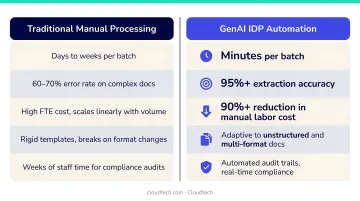
For regulated industries, the case extends beyond productivity. Automated document workflows reduce compliance risk through:
- Consistent rule application across every document, every time
- Automated audit trails that replace manual logging
- Exception flagging that surfaces discrepancies before they reach reviewers
In healthcare and financial services, where a single compliance gap can trigger an audit, that consistency matters as much as the speed.
How GenAI IDP Works: The Three-Stage Pipeline
A document enters the pipeline and passes through three stages: classification, extraction and normalization, and enrichment and analysis. The output is structured data ready for ERP, CRM, or downstream reporting systems.
Accepted inputs include a wide range of formats:
- PDFs and scanned images (PNG, JPEG, TIFF)
- DOCX files and Excel spreadsheets
- Audio transcripts
Amazon Textract handles initial conversion of non-text formats into machine-readable content before passing to foundation models.
Stage 1: Document Classification
Foundation models classify documents into categories (invoice, contract, medical record, shipping manifest) without pre-labeled training examples. Traditional ML classifiers needed hundreds of labeled samples per category. A GenAI classifier can handle a new document type from day one, which means faster onboarding when workflows change or new document sources are added.
Real-world performance supports this. Associa's GenAI-powered classification system using Amazon Nova Pro on Amazon Bedrock achieved 95% document classification accuracy at an average cost of 0.55 cents per document — across approximately 48 million documents.
Stage 2: Data Extraction and Normalization
Amazon Textract pulls structured and semi-structured data from documents (text, tables, form fields, key-value pairs, signatures, and layout elements). That raw text then passes to foundation models via Amazon Bedrock or SageMaker-hosted models for normalization:
- Standardizing date formats across sources
- Verifying phone numbers, addresses, and postal codes
- Flagging missing required fields
- Converting varied input formats into a consistent output schema
This normalization step is where a lot of the downstream value is created. Clean, consistent data means fewer exceptions in the systems that receive it.
Stage 3: Enrichment and Analysis
With clean, structured data in place, foundation models apply inference, reasoning, and summarization in the enrichment stage. Practical outputs include:
- Concise document summaries of long contracts, reports, or clinical notes
- Query responses — answering specific questions from document content on demand
- Cross-referencing against business rules, reference data, or prior records
- Structured JSON outputs ready for ERP, CRM, or analytics pipelines
Prior document automation tools could extract fields. This stage reasons across content — flagging a contract clause that conflicts with company policy, or surfacing a clinical note that meets a specific diagnostic criterion. That distinction is what makes GenAI IDP fundamentally different from OCR-based workflows.
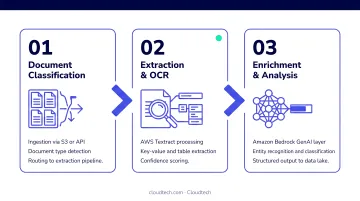
As an AWS Advanced Tier Partner, Cloudtech implements this full three-stage pipeline for SMBs using Amazon Textract for ingestion, Amazon Bedrock for foundation model access, and serverless orchestration through AWS Lambda and Step Functions — at pricing built for businesses without enterprise IT budgets.
Key Use Cases Across Industries
Financial Services
Banks and financial institutions process enormous volumes of semi-structured documents: bank statements, SEC filings, loan applications, invoices, KYC packets. GenAI IDP enables faster credit decisions, automated reconciliation, and reduced review time for regulatory documents.
The business case is significant. McKinsey estimates generative AI could add $200–$340 billion in annual value to banking — equivalent to 9–15% of operating profits. One example they cite: investment brief production reduced from nine hours to 30 minutes.
Healthcare and Life Sciences
Administrative complexity accounts for roughly $400 billion of National Healthcare Expenditures, according to CAQH. GenAI IDP can automate processing of:
- Patient discharge summaries and clinical notes
- Insurance claims and prior authorization forms
- Referral letters and care coordination documents
The system extracts diagnoses, medications, and care instructions into structured records, reducing administrative burden and the documentation errors that affect patient care. Cloudtech has implemented HIPAA-compliant data infrastructure for healthcare organizations including Klamath Health Partnership — the kind of regulated-environment work this use case requires.
Legal and Compliance
Thomson Reuters research found that AI could free up approximately 240 hours per year per legal professional. Currently, 77% of legal professionals use AI for document review and 50% use it to extract contract data.
GenAI IDP speeds contract review by identifying specific clauses, flagging anomalies, and generating redline summaries — turning a multi-day process into hours.
Logistics and Supply Chain
Air waybills, shipping manifests, purchase orders, and customs forms all contain structured shipping data buried in varied formats. GenAI IDP extracts key fields, validates against reference systems, and triggers downstream actions, cutting manual data entry and the errors that delay shipments or trigger customs holds.
Manufacturing and Operations
Quality inspection reports, supplier invoices, compliance certifications, and maintenance logs resist standard database formats. GenAI IDP converts them into structured data that feeds ERP and analytics systems, making operational intelligence genuinely accessible.
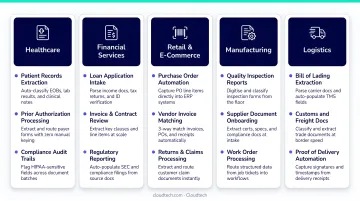
Key document types this covers:
- Quality inspection and compliance reports
- Supplier invoices and purchase records
- Maintenance logs and equipment certifications
What to Consider Before Implementing GenAI IDP
Document Complexity and Model Fit
GenAI IDP delivers the most value on semi-structured and unstructured documents where format varies and context matters. For highly structured, fixed-template documents — think standardized government forms processed at high volume — simpler OCR or RPA tools may be faster and cheaper. Assess your document portfolio before selecting an approach.
Human-in-the-Loop Design
No GenAI IDP system should operate fully autonomously for high-stakes documents. Financial, medical, and legal documents carry consequences when errors occur. Successful implementations build:
- Confidence scoring to flag low-certainty extractions for human review
- Review queues for exceptions and edge cases
- Exception-handling workflows that keep expert reviewers in control
Removing humans from the loop entirely is one of the most common — and costly — mistakes in IDP deployment. The goal is to reduce human workload, not eliminate human judgment.
Data Security and Compliance
Organizations in regulated industries must verify compliance before any documents touch a GenAI pipeline. Key questions to resolve:
- Is the platform HIPAA, SOC 2, or GDPR compliant for your use case?
- Will your data be used to train public models? (AWS Bedrock's policy: customer content is not used to improve base models and is not shared with model providers)
- Are audit logging, access controls, and vendor SLAs clearly defined?
Amazon Bedrock and Amazon Textract are both listed as HIPAA-eligible services under AWS's compliance reference — relevant for healthcare clients and any organization handling protected health information.
Cost and Implementation Realism
GenAI IDP is not plug-and-play. Without the right architecture design, prompt engineering, and integration work, teams encounter poor accuracy and slow ROI. The Oldcastle APG case illustrates the gap between a prior system and a well-designed one: their previous OCR solution accurately read only 30–40% of documents; the AWS Textract and Bedrock solution processed documents at less than $0.04 per page with substantially higher accuracy.
A well-designed pipeline requires the right choices at every layer. Key decisions include:
- Selecting models suited to your specific document types
- Engineering prompts for your extraction and classification tasks
- Integrating outputs with downstream workflows and validation logic
- Building review queues before go-live, not after
Working with an experienced AWS implementation partner on these decisions is what separates a successful deployment from an expensive experiment.
Frequently Asked Questions
What is the difference between traditional IDP and generative AI IDP?
Traditional IDP relies on fixed templates, rules, and OCR pattern matching. When document formats change, rules break and require manual updates. GenAI IDP uses large language models to understand context, adapt to format variation, and reason across content — without pre-defined rules for each document type.
Which AWS services are used for intelligent document processing?
The core stack includes Amazon Textract (extraction), Amazon Bedrock (foundation models), Amazon Comprehend (NLP), and AWS Lambda with Step Functions (pipeline orchestration). Amazon Bedrock Data Automation can also automate IDP workflows end-to-end without manual orchestration.
What types of documents can generative AI process?
GenAI IDP handles structured (forms, invoices), semi-structured (contracts, reports), and unstructured documents (emails, clinical notes, free-text filings). Supported formats include PDFs, scanned images (PNG, JPEG, TIFF), and DOCX files.
How accurate is generative AI for document data extraction?
Accuracy depends on document complexity, model selection, and prompt design — Associa's AWS-based classification system reached 95% at scale. Human-in-the-loop review catches edge cases for high-stakes or ambiguous documents.
Can small and mid-sized businesses afford to implement generative AI IDP?
AWS's serverless and pay-per-use model makes GenAI IDP accessible without large upfront infrastructure investment. Working with an AWS Partner like Cloudtech can further reduce costs through AWS Partner Funding and shorten deployment timelines with pre-built accelerators.
How long does it take to implement a generative AI IDP solution?
Implementation timelines vary by document complexity and integration requirements. Pre-packaged AWS-based IDP solutions designed by experienced AWS-certified architects can be deployed in weeks rather than months — significantly faster than custom-built alternatives without partner support.