Introduction
E-commerce stores face a structural problem: shoppers expect instant answers at 2 a.m. on a Sunday, personalized product guidance mid-browse, and frictionless returns after the fact. Most support operations can't deliver that without proportionally growing headcount — which erodes margins fast.
AI chatbots are the obvious candidate to close that gap. But the vendor landscape doesn't help decision-makers think clearly. Claims of 80% ticket deflection and 30% conversion lifts are everywhere, and most lack the methodology to back them up.
This article takes a different approach. Using verified research from Gartner, Salesforce, IBM, and Forrester, it presents a realistic, framework-driven look at chatbot ROI — what drives it, how to calculate it, which features move the needle, and what honest timelines look like.
If you're an e-commerce operator evaluating this investment, what follows gives you the numbers and frameworks to build a defensible business case.
Key Takeaways
- AI chatbots generate ROI from three sources: support cost reduction, incremental revenue, and customer retention
- Realistic support deflection runs 40–60% for most implementations — not the 80%+ vendors advertise
- Use this formula: ROI (%) = (Total Benefits – Total Costs) ÷ Total Costs × 100
- Proactive cart recovery and deep system integration drive the highest returns
- Most stores reach positive ROI within 3–6 months, assuming sufficient support volume or product complexity
Why E-Commerce Businesses Are Investing in AI Chatbots
Adoption pressure is real. A 2024 Gartner survey of 187 customer service leaders found 85% planned to explore or pilot customer-facing conversational GenAI in 2025 — a signal that reflects broad investment intent, not just a retail trend. Separately, Salesforce's Connected Shoppers research found 75% of retailers believe AI agents will be essential to their operations by 2026.
Two operational pressures are driving this:
- Support volume scales with transactions. Every new customer, seasonal promotion, or product launch generates more shipping inquiries, return requests, and product questions. Human teams don't scale linearly without proportional cost increases.
- Customer expectations have hardened. Round-the-clock response availability isn't a differentiator anymore — it's table stakes. Shoppers who can't get answers move on.
Modern AI vs. Rule-Based Bots
The gap between legacy rule-based chatbots and modern AI-powered systems is worth understanding before evaluating any ROI claim.
Rule-based bots follow decision trees. They break when a question falls outside the script. Modern AI chatbots use natural language processing (NLP) and machine learning to recognize intent, maintain conversational context, and improve over time with more interaction data. That architectural difference shows up in resolution rates.
Solo Brands deployed a generative AI chatbot that resolved 75% of customer interactions, up from 40% with their previous bot. That 35-percentage-point jump in resolution rate is where the ROI math starts.
The Three ROI Pillars: How AI Chatbots Generate Financial Value
Pillar 1: Cost Savings Through Support Automation
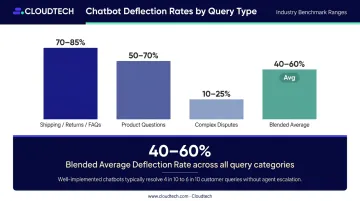
The most immediately measurable ROI component is ticket deflection — the share of support inquiries the chatbot resolves without human intervention. But deflection rates vary significantly by query type:
| Query Type | Realistic Deflection Rate |
|---|---|
| Shipping status, return policy, FAQs | 70–85% |
| Product questions and comparisons | 50–70% |
| Complex disputes or account issues | 10–25% |
| Blended average (typical query mix) | 40–60% |
IBM's cross-industry research attributes a 23.5% average reduction in cost per contact to customer-facing conversational AI. Forrester's composite model — built from seven organizations including e-commerce companies — found that automating 30% of inquiries generated $6.5 million in present value over three years for a large enterprise. These are directional benchmarks, not plug-and-play figures for an SMB.
The critical caveat: Cost savings only materialize if deflection actually reduces headcount or prevents new hiring. If your team still handles the same number of human interactions, deflected tickets just free up time — a real benefit, but not a direct cost reduction on the P&L.
Pillar 2: Revenue Generation
Conversion rate lift is where the most inflated claims live. Here's the distinction that matters for your business case:
- Assisted session conversion rate (8–15% of chatbot-using sessions result in a purchase) looks impressive but reflects self-selection: shoppers who engage with a chatbot are already higher-intent
- True incremental lift — the improvement in overall conversion rate after accounting for that selection bias — runs 3–10% for most implementations
Build your internal case on the conservative end. If your store converts at 2.5% and a chatbot produces a 3% incremental lift, your new rate is 2.575%. That's meaningful at volume; it's not a transformation by itself.
Beyond conversion rate, two more revenue levers are worth modeling:
- AOV lift: Chatbots with personalization and recommendation engines drive cross-sells and guided discovery. Products that require explanation — electronics, supplements, specialized equipment — see larger gains than commodity items. Use 5–10% AOV lift on assisted orders as your baseline; anything higher needs store-specific data to back it up.
- Cart recovery and after-hours availability: Proactive exit-intent messaging re-engages shoppers at the moment of abandonment. After-hours coverage captures sales that would simply be lost to unanswered questions — especially valuable for stores with international customers across time zones.
Pillar 3: Customer Satisfaction and Long-Term Retention
This pillar is harder to quantify but contributes meaningfully to lifetime value (LTV). Salesforce research across 5,038 consumers found 72% said faster service would keep them loyal, while 52% cited poor service as the primary reason not to repurchase.
Faster response times, consistent answers, and frictionless post-purchase support — order tracking, return initiations — reduce churn and increase repeat purchase rates. Value this through retained contribution margin, not just CSAT scores.
One counterweight worth acknowledging: a separate Gartner survey found 64% of customers would prefer companies not use AI for customer service, with difficulty reaching a human as a leading concern. Speed creates value only when paired with accurate answers and a visible escalation path.
How to Calculate Chatbot ROI: A Practical Step-by-Step Framework
The core formula:
ROI (%) = ((Total Benefits – Total Costs) ÷ Total Costs) × 100
- Total Benefits = cost savings from deflected tickets + incremental revenue from conversion lift + AOV increase on assisted orders + retained contribution margin from improved satisfaction
- Total Costs = platform subscription or development + integration and setup + ongoing maintenance and optimization
Step 1: Establish Your Baseline Metrics
Before any deployment, document:
- Monthly site visitors and current conversion rate
- Average order value
- Monthly support inquiry volume
- Average cost per support interaction (fully loaded: agent time, tools, management)
- Current support hours (24/7 or limited)
Step 2: Estimate Cost Savings
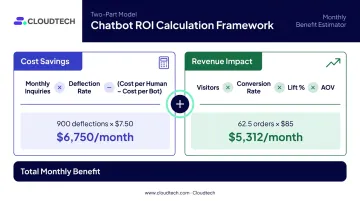
Formula: (Monthly support inquiries × deflection rate) × (cost per human interaction – cost per chatbot interaction)
Use 40–50% deflection, not vendor-claimed figures. If your team handles 2,000 inquiries per month at $8 per interaction, and a chatbot deflects 45% of those at $0.50 per interaction:
- 900 deflected interactions × ($8.00 – $0.50) = $6,750/month in potential savings
Note that these savings only reach the bottom line if deflection actually reduces headcount costs or prevents new hiring — not just ticket volume.
Step 3: Project Revenue Impact
Incremental conversion revenue:
- Additional orders = Monthly visitors × baseline conversion rate × lift percentage
- Additional revenue = Additional orders × AOV
Example: 50,000 monthly visitors, 2.5% conversion, 5% incremental lift, $85 AOV
- Additional orders = 50,000 × 0.025 × 0.05 = 62.5 orders/month
- Additional revenue = 62.5 × $85 = $5,312/month
Add AOV lift on chatbot-assisted orders separately, and apply your gross margin — don't treat gross revenue as profit.
Once you have both savings and revenue projections, the final input is cost. Getting this wrong is the most common reason ROI models look better on paper than in practice.
Step 4: Factor In Total Costs
Cost categories to include:
- Monthly platform fees (SaaS options start around $24/month; enterprise platforms vary widely)
- One-time development, integration, and testing costs
- AWS infrastructure, if building custom (text-based chatbots run approximately $40–$200/month depending on volume; scaled deployments for 8,000 daily queries can reach $1,500/month in infrastructure alone)
- Staff time for ongoing optimization and escalation management
With all four inputs in place, calculate monthly ROI for operational decisions and annual ROI for investment decisions. Seasonal variation makes monthly figures unreliable on their own, so use both timeframes before drawing conclusions.
Key Chatbot Features That Deliver the Highest ROI
Real-Time Personalization and Recommendation Engines
Chatbots that analyze browsing behavior, purchase history, and stated preferences can surface relevant product suggestions at the moment of highest intent. This drives both AOV lift and conversion improvement.
One constraint that's consistently underestimated: recommendation quality is only as good as your product data. Thin descriptions, missing attributes, and inconsistent categorization produce irrelevant suggestions — which frustrate shoppers rather than converting them. Before investing in a chatbot with personalization capabilities, audit your product catalog first.
Proactive Cart Recovery and Exit-Intent Triggers
This is one of the highest-impact, fastest-payback features available. Chatbots can detect abandonment signals — idle time, cursor movement toward close, exit behavior — and deliver targeted prompts addressing shipping concerns or offering assistance.
The calibration matters. Chatbots that interrupt active browsing sessions too aggressively damage conversion rather than help it. The goal is to intervene at the right moment with the right message, not to be maximally persistent.
Deep Integration With E-Commerce Systems
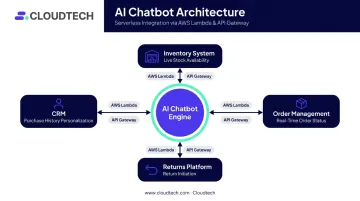
Both personalization and cart recovery only perform as well as the data behind them. A chatbot disconnected from real-time inventory, order management, and CRM data will deliver inaccurate answers — breaking trust at exactly the moments that matter most: when a customer is deciding whether to buy, or checking on a recent order.
Integrated chatbots can:
- Confirm live stock availability
- Provide real-time order status
- Initiate return requests
- Personalize conversations based on purchase history
This integration layer is what separates a genuinely useful sales and support asset from a frustrating dead end. It's also where architecture decisions have long-term consequences. Building on an event-driven, serverless architecture using services like AWS Lambda and Amazon API Gateway — ensures the chatbot performs reliably during traffic spikes like Black Friday, not just on a quiet Tuesday.
For e-commerce operators building on AWS rather than a subscription platform, scoping the integration layer carefully before committing to a build avoids costly rework — and determines whether the chatbot becomes a revenue asset or an operational liability.
Realistic Benchmarks and What Can Undermine Your ROI
Timeline to Positive ROI
| Period | What to Expect |
|---|---|
| Month 1 | Setup, integration, training — minimal measurable impact |
| Months 2–3 | Support deflection begins showing in ticket volume metrics |
| Months 3–6 | Conversion lift becomes statistically visible as interaction data accumulates |
| Month 6+ | Full optimization potential; reliable basis for performance evaluation |
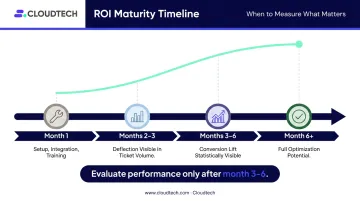
Plan for a 3–6 month evaluation window. Businesses that expect week-one returns draw premature conclusions and make poor investment decisions.
Common Implementation Failures
Poor product data is the most frequent ROI killer. According to Gartner, only 14% of service issues are fully resolved through self-service — and 45% of users say the company never understood what they were actually trying to do. Incomplete product catalogs and missing intent coverage force repeat contacts, erasing whatever deflection gains the chatbot delivers.
Other failure modes that consistently erode returns:
- No clear path to a human agent — customers with complex issues hit a dead end, damaging trust
- Poor placement or trigger timing — a buried widget or premature prompt either goes unnoticed or interrupts the wrong moment
- No measurement infrastructure — without tying chatbot interactions to conversion and support data, optimization stalls and ROI becomes impossible to verify
Who Should and Shouldn't Invest
Knowing the common failure modes matters — but so does knowing whether your business is positioned to benefit in the first place.
Strong ROI candidates:
- Stores with 1,500+ support inquiries per month
- Products requiring explanation or customization guidance (electronics, supplements, specialized equipment)
- International customer bases across multiple time zones
- Operations without 24/7 human coverage
Weak ROI candidates:
- Stores with under 10,000 monthly visitors
- Pure commodity sellers where price is the only variable
- Businesses with already negligible support costs
Be honest about where you fall. The numbers only work when the underlying volume and complexity are there to support them.
Frequently Asked Questions
What is a typical engagement rate for e-commerce AI chatbots?
Engagement rates vary based on chatbot placement, product complexity, and trigger behavior. Commonly cited figures reference 35–40% of chatbot sessions resulting in meaningful interaction — though these use sessions, not total site visitors, as the denominator. Track your own store's data separately for an accurate baseline.
How does an AI chatbot improve the e-commerce customer experience?
The three primary improvements are instant 24/7 response availability, personalized product guidance that reduces browsing friction, and faster post-purchase support for order tracking and returns. Each addresses a distinct friction point in the buyer journey — pre-purchase uncertainty, decision hesitation, and post-sale anxiety.
What personal or business information should I avoid sharing with AI chatbots?
Retail chatbots should never request payment data, full account passwords, or sensitive personal details. Any implementation should include explicit data handling policies and GDPR/CCPA compliance controls to protect customer information.
How long does it take to see ROI from an e-commerce AI chatbot?
Most e-commerce businesses see measurable cost savings from support deflection within 2–3 months. Conversion lift becomes statistically visible after 3–6 months of accumulated interaction data — evaluate performance only after that window for reliable results.
What does it cost to implement an AI chatbot for an e-commerce store?
Subscription-based platforms start around $24/month for entry tiers. Custom-built chatbots with full OMS, CRM, and inventory integration range from a few thousand dollars for basic deployments to substantially more for production-grade builds with complex infrastructure requirements.
Which types of e-commerce businesses benefit most from AI chatbots?
Stores with high support volumes, products that require explanation, international customers across time zones, and limited current support coverage see the strongest returns. Commodity sellers and very low-traffic stores — where the cost of implementation exceeds realistic savings or revenue gains — typically see the weakest ROI.