Introduction
Primary care physicians spend a median of 36.2 minutes on EHR work per visit — including 6.2 minutes after their scheduled hours end, according to a 2024 AMA summary of a 307-physician study. Add inbox management, care coordination, and documentation backlogs, and clinicians are spending more time navigating software than treating patients.
Conversational AI changes that equation. Instead of clicking through EHR menus to retrieve a lab result or draft a note, clinicians ask a question in plain language — by voice or text — and get a structured, sourced answer pulled directly from the patient record.
What follows is a practical guide for healthcare organizations evaluating this technology: what it is, how it connects to clinical systems, where it delivers the most value, and what HIPAA-compliant deployment actually requires.
Key Takeaways
- Clinicians spend 36+ minutes on EHR work per visit — conversational AI targets that burden directly
- FHIR R4 APIs and HL7 v2 messaging are the primary integration pathways; data quality must be validated first
- Start with ambient scribing, patient intake, and scheduling — these deliver the clearest, fastest ROI
- HIPAA compliance must be architected from day one, not retrofitted after deployment
- Four HIPAA-eligible AWS services form the core infrastructure stack for EHR-integrated conversational AI
What Is Conversational AI for EHR Integration?
Conversational AI in healthcare refers to digital systems that use natural language — voice or text — to engage in real-time, multi-turn dialogue with healthcare data and workflows. A 2023 peer-reviewed expert framework published in JMIR defines these systems as "digital interfaces that use natural language to engage in a synchronous dialogue using one or more communication modality, such as text, voice, images, or video."
The key distinction from general healthcare AI is the dialogue layer. Standard automation might flag a drug interaction or auto-populate a billing code. Conversational AI enables a clinician to ask, "What were this patient's last three A1C readings, and are any current medications flagged for interaction?" — and receive a structured, sourced response without opening a single menu.
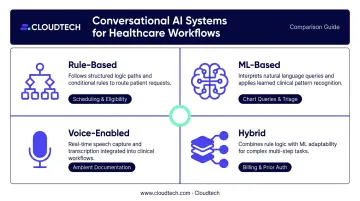
The Four System Types Relevant to EHR Environments
| System Type | How It Works | Best-Fit Workflows |
|---|---|---|
| Rule-based | Scripted decision trees for predictable inputs | Scheduling, eligibility checks |
| ML-based | Statistical models that handle varied phrasing | Chart queries, symptom triage |
| Voice-enabled | Hands-free speech recognition for clinical settings | Ambient documentation, exam rooms |
| Hybrid | Rules + ML for compliance-sensitive tasks | Billing queries, prior auth support |
Most production EHR deployments use hybrid architectures: rule-based logic handles compliance-critical paths, while ML models manage the unpredictability of real clinical language. That combination matters because it's what makes these systems viable in regulated environments — not just technically capable, but audit-ready.
How Conversational AI Systems Connect with EHR Platforms
Getting conversational AI to work reliably with EHR data requires four distinct layers, each of which must be designed intentionally.
Layer 1: Input Capture and Intent Recognition
When a clinician speaks or types a query, the system captures that input, transcribes any speech using medical-grade recognition, and applies natural language processing to extract clinical intent — identifying the patient, the question type, and relevant entities like medications, diagnoses, or lab names. This happens before any EHR data is touched.
Layer 2: EHR Data Access
The system accesses patient records through one of three pathways:
- FHIR R4 APIs — the ONC-certified standard for modern EHR interoperability. As of 2022, 9 in 10 U.S. hospitals used APIs for patient data access, though 1 in 6 still lacked FHIR-based app access
- HL7 v2 messaging — for legacy clinical systems that predate FHIR adoption
- Vendor-approved connectors — for EHR-specific integrations where open APIs are limited
Clean, permissioned API access is a prerequisite, not an afterthought. Organizations with fragmented or inconsistent data structures need to address data quality before any conversational AI layer is built on top.
Layer 3: Response Generation and Workflow Execution
Once intent is recognized and data is retrieved, the system generates a response and surfaces it inside the clinician's existing workflow. That output might be:
- A summarized chart view or lab results snapshot
- A drafted SOAP note ready for review
- A scheduled appointment or routed message
Tools that require clinicians to leave their workflow to retrieve a response see significantly lower adoption — integration into the primary interface isn't optional.
Layer 4: Security, Access Control, and Continuous Learning
Every query involving protected health information (PHI) must pass through a defined set of controls. Per HHS HIPAA guidance, covered entities must limit PHI use to the minimum necessary for the intended purpose — meaning access controls must map to specific clinical roles, not blanket permissions. Required safeguards include:
- Role-based access controls tied to clinical function
- Minimum-necessary-use policy enforcement
- Encryption in transit and at rest
- Full audit logging for every PHI query
Security infrastructure alone isn't enough to sustain a production deployment. Conversational AI models in EHR environments require periodic retraining as clinical terminology, payer rules, and workflows evolve — model drift and accuracy degradation are real operational risks that governance programs must address proactively.
Top Use Cases for Conversational AI in EHR Workflows
Ambient Clinical Documentation
Voice-enabled AI scribes listen to patient encounters and generate structured SOAP notes for clinician review. The Permanente Medical Group deployed this capability for 10,000 physicians in October 2023 — within 10 weeks, 3,442 physicians used it across 303,266 encounters, with clinicians reporting reduced documentation burden and less after-hours EHR time. A 2025 JAMA Network Open study found 30% lower after-hours EHR work per workday during ambient scribe use compared to baseline.

Patient Intake and Eligibility Verification
Conversational AI can conduct structured pre-visit intake through a patient-facing chat or voice interface — collecting symptoms, demographics, and insurance details — then auto-populate the EHR record before the appointment begins. This reduces front-desk workload and shortens the time clinicians spend on chart prep.
Appointment Scheduling, Reminders, and Outreach
Two-way conversational AI manages appointment confirmation, rescheduling, and post-visit follow-up while syncing directly with the EHR schedule. MGMA benchmarks median no-show rates at 5%–7% — targeted automated outreach has shown meaningful reductions in missed visits. Cloudtech implements the HIPAA-compliant AWS infrastructure — Amazon Bedrock, Amazon Transcribe, and Amazon Polly — that powers these scheduling workflows for healthcare clients, enabling full scheduling completion in under five minutes per call with sub-two-second handoffs to staff when needed.
Chart Summarization and Clinical Decision Support
Rather than navigating multiple EHR screens, clinicians can query the conversational AI for a synthesized patient view: recent labs, active medications, diagnoses, pending referrals. The system can also surface guideline-based care suggestions when the data warrants it, cutting the time clinicians spend on protocol lookups before making decisions.
Post-Visit Care Coordination and Billing Queries
After discharge or a visit, conversational AI handles ongoing patient touchpoints and back-office queries without adding staff workload. Key capabilities include:
- Medication adherence reminders and symptom check-ins that reduce care gaps post-visit
- Follow-up prompts triggered by EHR data without manual staff intervention
- Natural language queries for billing status, claim eligibility, and payer-specific documentation requirements — eliminating toggling between billing and EHR interfaces
Key Benefits of Conversational AI EHR Integration
Reduced Administrative Burden
With physicians averaging more than 5 EHR hours for every 8 hours of scheduled patient time, and 48.2% reporting at least one burnout symptom in 2023, the case for offloading repetitive EHR tasks is direct. Ambient scribing alone shows a 30% reduction in after-hours documentation work — time that returns to clinicians, not systems.
Improved Patient Access and Engagement
24/7 conversational interfaces for scheduling, intake, and follow-up give patients faster access to care communication without requiring staff availability at all hours. The result is fewer missed appointments and stronger continuity of care — particularly for patients managing chronic conditions who need consistent, low-friction touchpoints.
Operational Efficiency and Cost Reduction
Replacing manual, queue-driven workflows with always-on automation reduces per-encounter costs and lets existing staff handle higher patient volumes without adding headcount. High-volume tasks that benefit most include:
- Scheduling calls and appointment reminders
- Intake data collection and eligibility verification
- Post-visit outreach and care gap follow-up
Healthcare organizations implementing these AWS-powered automation workflows consistently target outcomes like 50% reductions in patient wait times and 30% improvements in operational efficiency — benchmarks that Cloudtech's healthcare AWS implementations are designed to reach.
Implementation Challenges and How to Address Them
Legacy EHR Integration and Data Quality
Only 70% of U.S. nonfederal acute-care hospitals performed all four measured interoperability functions in 2023, per ONC data. For smaller hospitals, frequent interoperable exchange drops to 38%. Organizations running older EHR platforms face limited API access, inconsistent data structures, and duplicate or incomplete patient records.
What to do:
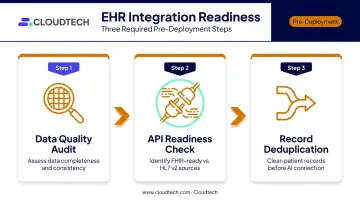
- Conduct a data quality audit and integration readiness assessment before any conversational AI build begins
- Identify which data sources are FHIR-ready and which require HL7 v2 adapters
- Prioritize record deduplication before connecting AI layers to patient data
PHI Protection and HIPAA Compliance
Every conversational AI system that touches EHR data is subject to HIPAA. This covers:
- Business Associate Agreements with every vendor processing PHI
- Encrypted data transmission and storage
- Role-based access controls tied to specific workforce roles
- Audit logging with minimum seven-year retention
- Minimum-necessary-use policies for all PHI access
These requirements shape architecture choices — authentication models, data routing, logging infrastructure — so they need to be defined before a single integration is built, not retrofitted once the system is live.
Clinician Adoption and Change Management
Even a technically sound system fails if clinicians don't use it. Front-office staff and providers who perceive a new tool as adding steps — rather than removing them — will route around it. Override rates and abandonment rates in the first 60 days are the most reliable adoption signals.
What to do:
- Co-design with end users from the start — not after the build is complete
- Pilot in one workflow with willing early adopters before scaling
- Treat high override rates as a design problem, not a training problem
Building a HIPAA-Compliant Conversational AI System on AWS
Why Cloud-Native Infrastructure Fits Healthcare AI
Cloud infrastructure addresses several of the hard problems in healthcare AI simultaneously: scalability for variable patient volumes, managed encryption, built-in audit logging, and access to HIPAA-eligible services that meet the technical safeguard requirements under 45 CFR 164.312. AWS provides a HIPAA-eligible services framework specifically designed for healthcare workloads — but eligibility requires a signed Business Associate Agreement and compliant configuration. AWS service status alone does not create a compliant workload.
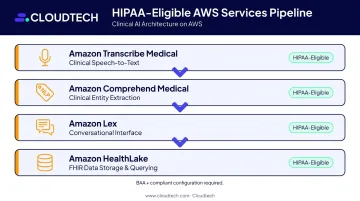
The Core AWS Services for Conversational AI in EHR Environments
| AWS Service | Function | HIPAA Status |
|---|---|---|
| Amazon Transcribe Medical | Clinical speech-to-text | HIPAA-eligible |
| Amazon Comprehend Medical | NLP-based clinical entity extraction | HIPAA-eligible |
| Amazon Lex | Conversational interface builder | HIPAA-eligible |
| Amazon HealthLake | FHIR-based health data storage and querying | HIPAA-eligible |
These four services form a compliant, scalable conversational AI stack. Each must be correctly configured and covered under an AWS BAA before handling any PHI — being listed as HIPAA-eligible does not make a workload compliant by default.
Cloudtech's Role in Healthcare AI Deployments
As an AWS Advanced Tier Partner, Cloudtech helps healthcare organizations architect and deploy conversational AI systems that are FHIR-ready, HIPAA-compliant, and built to integrate with existing EHR platforms. Prior work with Klamath Health Partnership established the HIPAA-compliant cloud infrastructure and EHR data lake on Amazon S3 that these systems depend on.
Cloudtech applies the same compliance-first approach to every conversational AI build:
- RBAC architecture via AWS IAM
- Audit logging through AWS CloudTrail with seven-year retention
- Encryption via AWS KMS with customer-managed keys
Phased Deployment Approach
Starting with a high-volume, low-clinical-risk workflow is the right entry point for most organizations:
- Phase 1 — Deploy patient appointment reminders or intake automation; validate accuracy, HIPAA compliance, and user acceptance in a controlled pilot
- Phase 2 — Expand to ambient documentation or chart summarization once the integration layer and governance model are proven
- Phase 3 — Add clinical decision support or billing query automation after clinical trust is established
Ongoing Governance
Before go-live, organizations need documented governance covering:
- Model accuracy monitoring and drift detection
- PHI access anomaly alerts
- Response quality review processes
- Incident response procedures
- Audit log retention and review schedules
HIPAA mandates each of these controls. Treating them as optional is the fastest way to create compliance exposure after deployment.
Frequently Asked Questions
What is conversational AI in healthcare?
Conversational AI in healthcare refers to AI systems that understand and respond to natural language — voice or text — to support clinical, administrative, and patient-facing workflows. These systems handle dynamic, multi-turn interactions with healthcare data, so clinicians and patients can ask questions and receive structured, contextual responses in real time.
How is AI used in electronic health records?
AI supports EHR workflows across clinical documentation, chart summarization, order validation, patient communication, coding, billing, and risk prediction. Conversational AI acts as the interaction layer for these capabilities — translating natural language queries into data retrieval and workflow actions.
What is one of the primary benefits of integrating AI into EHR systems?
Reduced administrative burden is the most widely documented benefit. When conversational AI handles note drafting, chart lookups, and routine patient communication, clinicians reclaim meaningful time from EHR navigation — directly addressing the documentation overload that contributes to burnout among nearly half of U.S. physicians.
What are the key challenges of integrating conversational AI with EHR systems?
The most common challenges are legacy EHR API limitations and poor data quality, HIPAA compliance requirements for any system handling PHI, and clinician resistance when a new tool adds complexity rather than reducing it.
Is conversational AI in healthcare HIPAA compliant?
It can be, when built correctly. HIPAA compliance requires BAAs with all vendors, encrypted data transmission and storage, role-based access controls, audit logging, and minimum-necessary PHI access policies. These safeguards must be designed in from the start — not added after deployment.
What AWS services support conversational AI in EHR integration?
The four core HIPAA-eligible services are Amazon Transcribe Medical (speech recognition), Amazon Comprehend Medical (clinical NLP), Amazon Lex (conversational interface builder), and Amazon HealthLake (FHIR-compliant data storage). Together they form a compliant conversational AI pipeline — though a signed AWS BAA and proper configuration are required for HIPAA eligibility to apply.