Much of that delay isn't about customers who can't pay — it's about communication failures. A Wakefield Research survey of 300 CFOs found that 27% of AR teams spend half or more of their workday handling invoice disputes. That's not a collections problem; it's a communication capacity problem.
Most AR automation tools don't solve this. They send pre-written reminders on fixed schedules, with no ability to interpret a customer's reply or adjust based on relationship context. Conversational AI is built specifically for that gap — automating the two-way communication layer of collections, not just the outbound triggers.
This guide breaks down how conversational AI works across the AR collections workflow, where it creates the most measurable DSO impact, and what it takes to implement it on cloud infrastructure.
Key Takeaways
- Conversational AI in AR uses NLP to automate two-way customer dialogue — not just scheduled reminders
- Unlike static dunning tools, it reads customer replies, extracts payment intent, and reschedules follow-up automatically
- The biggest DSO gains come from proactive engagement, real-time dispute triage, and promise-to-pay follow-through
- Context-aware outreach replaces aggressive collections tactics, cutting the risk of losing customers during the collections process
- AWS-native services like Amazon Bedrock and Amazon Connect provide the infrastructure for deploying this at SMB scale
What Is Conversational AI in Accounts Receivable?
Conversational AI in AR is the application of natural language processing (NLP) and machine learning to automate two-way communications between a business and its customers across the collections lifecycle — via email, SMS, chat, or voice.
Traditional AR communication was batch-based: static templates sent on fixed schedules, regardless of what customers said or did. Conversational AI makes collections responsive. It interprets what a customer writes or says and acts on it in real time — no human needed to parse the reply and update a task queue.
What Conversational AI Is Not
"AI" gets attached to a lot of tools in this space. Conversational AI is a specific capability — distinct from:
- General analytics platforms and reporting dashboards
- Payment processors or invoicing systems
- Basic email automation with time-based triggers
- Rule-based dunning software
The defining characteristic is the ability to understand unstructured human language and respond meaningfully — classifying intent, extracting commitments, and adjusting actions accordingly.
Two Primary Modes
| Mode | Function |
|---|---|
| Outbound | Proactive reminders, escalation sequences, promise-to-pay capture |
| Inbound | Customer-facing chatbots for balance queries, dispute submissions, payment plan requests |
Both modes work together in a mature AR deployment. Outbound shrinks the overdue account pool; inbound handles customers who respond with questions, disputes, or payment plan requests.
How Conversational AI Reduces A/R Days
The core logic is straightforward: most delayed payments aren't caused by customers who refuse to pay. They're caused by the absence of timely, relevant, actionable communication. Conversational AI targets each stage of the collections cycle where that communication gap costs you days.
Stage 1: Initiation — Detecting the Payment Event
Conversational AI monitors invoice status within your connected ERP or AR system. It activates communication workflows based on conditions, not schedules:
- Invoice sent but not opened after X hours
- Due date approaching within a defined window
- Payment overdue with no customer engagement
- Customer accessed the payment portal but didn't complete payment
This is the first DSO lever. With rule-based tools, there's often a lag between an invoice becoming overdue and the first human-initiated outreach. Condition-based triggering eliminates that delay: the system acts the moment the condition is met.
Stage 2: Core Operation — Dynamic Customer Engagement
The central function of conversational AI is personalizing outreach based on customer context: payment history, preferred communication channel, past dispute behavior, and account value. A long-standing customer with one late payment gets a different message than a newer account with a pattern of delays.
When a customer replies, the NLP layer does the work that would otherwise land in a collections agent's inbox:
- Reads the response — identifies whether it's a confirmation, a dispute, a partial payment notice, or a request for more time
- Extracts payment intent — captures specific dates or conditions ("We'll process this next Friday")
- Reschedules follow-up — automatically updates the task queue based on the promised date
- Flags exceptions — routes ambiguous or complex replies to a human agent with full context attached
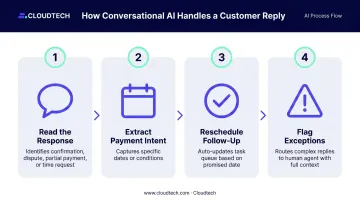
The result: zero manual parsing and no follow-up steps left to chance.
Stage 3: Dispute and Exception Handling
Disputes are where manual AR processes lose the most time. Conversational AI compresses the resolution cycle by classifying disputes directly from customer email or chat content. Common dispute types include:
- Wrong invoice amount
- Missing purchase order
- Duplicate billing
Each case is routed to the correct internal team automatically, without a collections agent manually triaging inbound replies.
The escalation mechanism is where complex cases get resolved faster. If a customer doesn't respond after a defined number of contact attempts, or misses a promised payment date, the AI triggers an escalation workflow. A human agent receives a full conversation summary and context — not a blank slate — which is where the real productivity gain happens in high-stakes accounts.
Stage 4: Output — Faster Collections, Better Cash Visibility
The measurable results of this communication layer improvement include:
- Reduced DSO through faster payment cycle completion
- Lower bad debt exposure from earlier dispute identification
- Complete audit trail of all customer commitments and communications
- Improved cash flow forecast accuracy — when promises-to-pay are systematically tracked against actual payment dates, finance teams gain a cleaner weekly view of working capital
Predictable cash visibility changes how finance leaders make short-term decisions around payables, credit, and investment — and that's the outcome that justifies the system, not just the speed.
Key Use Cases Where Conversational AI Drives A/R Results
Automated Payment Reminders with Two-Way Dialogue
AI sends invoice reminders and handles customer replies — confirming simple acknowledgments automatically and routing complex responses to a human. This keeps the collections queue clean and response rates high without adding headcount.
Promise-to-Pay (PTP) Capture and Follow-Through
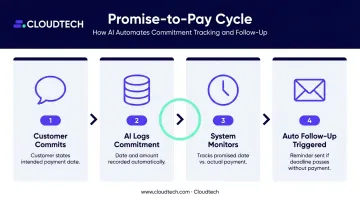
This is one of the most common manual oversight failures in collections. A customer commits to paying by a specific date, that commitment gets noted somewhere — or doesn't, and the date passes with no follow-up.
Conversational AI logs written and verbal payment commitments, tracks them against actual payment dates, and auto-triggers a follow-up if the deadline passes without payment. Collection becomes a system, not a function of any one person's availability.
Dispute Triage and Resolution Acceleration
A Wakefield Research survey found that 78% of finance executives believed payment conflicts could have been avoided with better communication — and 65% agreed that greater transparency would reduce invoice disputes outright. Conversational AI addresses this directly: it reads dispute emails, classifies them by type, routes them to the right team, and generates draft responses — cutting multi-day resolution cycles down to same-day turnaround in many cases.
Early Churn Risk Identification
When customers consistently delay payments, reduce portal engagement, or change communication patterns, conversational AI flags those behavioral shifts before they escalate into bad debt. That flag allows AR teams to intervene with relationship-preservation outreach rather than aggressive collections — a meaningful difference for accounts worth retaining.
Self-Service Payment Portals
Inbound AI chatbots let customers check invoice status, request extensions, file disputes, or initiate payments without calling an AR agent. This reduces inbound contact volume to the AR team while accelerating resolution, particularly for customers in different time zones or with after-hours billing questions.
Implementing Conversational AI for A/R on the Cloud
Conversational AI for AR runs on cloud-native infrastructure. Three AWS services provide the functional building blocks:
| AWS Service | Role in AR Collections |
|---|---|
| Amazon Lex | Builds voice and text conversational interfaces; handles intent recognition, utterances, and dialogue flows for invoice queries, dispute intake, and PTP capture |
| Amazon Connect | Powers voice-based outreach and inbound contact center flows; manages call routing, warm transfers to human agents, and NLP-based conversation analytics via Contact Lens |
| Amazon Bedrock | Provides the reasoning layer; interprets customer responses, determines next steps in a collections dialogue, and generates contextually appropriate follow-up content |
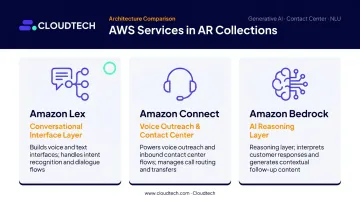
Each service handles a distinct layer. Lex manages the dialogue structure, Connect manages the communication channels, and Bedrock handles the intelligence: interpreting what customers actually mean and deciding what happens next.
Integration and Selection Criteria
Before deploying, businesses should evaluate:
- ERP/AR compatibility: The system must read invoice status and write back commitment data in real time. Common integration targets include accounting platforms via API connectors or tools like Amazon AppFlow
- Workflow customization: A SaaS business on net-30 terms runs a different collections sequence than a manufacturer on net-60. The system should reflect your process, not a generic template
- Compliance requirements: Healthcare organizations face HIPAA constraints around PHI in communications data; financial services firms need audit trails and access controls. Both require encryption at rest and in transit, role-based access, and automated monitoring via AWS Config and AWS Security Hub
- Go-live timeline: Cloud-native deployments on AWS move from discovery to production faster than on-premise alternatives, especially when working with pre-configured service components
Working with an AWS Consulting Partner
If evaluating these criteria feels like a lot to navigate without a dedicated IT team, that's where a consulting partner comes in. Cloudtech, an AWS Advanced Tier Partner, works with SMB clients to design and deploy conversational AI components on AWS, connecting them to existing ERP or AR systems without disrupting current workflows.
The team's approach follows a structured process: discovery and compliance scoping, deployment and integration, and hands-on training so internal teams can manage the system after go-live.
Conclusion
Conversational AI reduces A/R days by fixing the communication layer — not the back-office paperwork. It interprets customer intent, responds in context, captures commitments, and follows through on them systematically. Every stage where a delayed or mishandled communication would otherwise add days to your DSO gets handled automatically before it can.
Businesses that understand how conversational AI works across the collections cycle can more accurately evaluate tools, set realistic expectations, and measure the right outcomes after deployment. Three metrics tell you whether it's actually working: DSO reduction, dispute resolution time, and PTP capture rate. Track those, and the picture becomes clear fast.
Frequently Asked Questions
How can conversational AI services reduce days in accounts receivable?
Conversational AI reduces A/R days by automating personalized outreach at every stage of the collections cycle, interpreting customer replies to extract payment intent, and automatically following up on unmet promises. This compresses the time between invoice issuance and cash receipt by eliminating the communication delays that cause most payment holdups.
Do conversational AI services reduce early churn?
Yes. Conversational AI replaces impersonal collections outreach with context-aware communication tailored to each customer's history. It also flags behavioral changes — delayed responses, reduced portal activity — before accounts disengage, enabling proactive intervention rather than reactive collections.
What are the 5 C's of accounts receivable management?
The 5 C's are Character (payment reliability), Capacity (ability to pay), Capital (financial strength), Conditions (market context), and Collateral (assets backing credit). Conversational AI strengthens Character and Capacity assessment by capturing real-time signals like response patterns, promise-to-pay history, and engagement shifts.
What is the difference between conversational AI and traditional AR automation?
Traditional AR automation sends pre-written messages on fixed schedules with no ability to interpret responses. Conversational AI uses NLP to understand what customers actually say and adjusts follow-up actions accordingly — making it effective for unstructured, two-way communication rather than one-directional reminders.
How long does it take to see DSO improvement after deploying conversational AI for AR?
Most businesses see initial DSO improvement within 60–90 days of deployment, with faster gains in organizations that previously carried high manual collections overhead. Organizations with significant dispute volume or inconsistent PTP follow-through tend to see the earliest measurable impact.
Can small and mid-sized businesses implement conversational AI for AR without a large IT team?
Cloud-native deployments on AWS allow SMBs to implement conversational AI through pre-configured services and consulting partners, without requiring in-house AI expertise. AWS partners like Cloudtech handle the underlying cloud architecture and integration work, making enterprise-grade automation accessible at SMB scale.