According to an IDC survey of 376 small and midmarket organizations, 27% reported reduced manual processes or improved productivity after transforming their document workflows, while 20% were able to redirect staff to higher-value work. The opportunity is clear. The question is how to get there.
Intelligent process automation (IPA) provides a concrete answer. By combining AI, machine learning, and workflow orchestration, IPA turns document chaos into governed, high-speed pipelines — without requiring an enterprise budget or team.
This guide covers what IPA is, how it works across the document lifecycle, the business benefits, industry use cases, and a practical path to getting started.
Key Takeaways
- IPA combines AI, ML, NLP, and RPA to automate end-to-end document workflows — far beyond what rules-based tools can handle
- The biggest gains come in capture, classification, extraction, validation, and routing — the exact stages where manual work creates bottlenecks
- SMBs in healthcare, financial services, and logistics can achieve measurable ROI without large IT budgets
- Starting with a phased, cloud-native approach means faster results — and the system scales as your document volume grows
What Is Intelligent Process Automation for Document Workflows?
Intelligent Process Automation (IPA) combines robotic process automation (RPA) with AI and business process management to handle work that rule-based tools simply can't. For document workflows specifically, that means processing invoices, patient forms, contracts, and other variable documents — not just moving data between fields.
As UiPath's documentation explains, Document Understanding combines RPA and AI to process structured, semi-structured, and unstructured documents — including handwriting, checkboxes, signatures, and tables. That scope covers most of what makes document processing hard in practice.
IPA vs. RPA: A Practical Distinction
Here's how Cloudtech frames this distinction for clients:
"RPA handles the doing — copying, pasting, clicking through screens. IDP handles the thinking — reading unstructured documents, extracting meaning, and passing clean data downstream."
In practical terms:
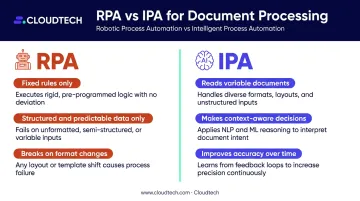
- RPA follows fixed rules on structured, predictable data. It breaks the moment a field moves or a format changes.
- IPA uses AI to read variable documents, make decisions, and improve accuracy over time.
Documents are inherently messy. An invoice from one vendor looks nothing like an invoice from another. A patient intake form filled out by hand is fundamentally different from one completed online. Rules-only automation fails in exactly these conditions. The AI layer is what lets the system adapt instead of breaking.
How IPA Transforms Document Workflows: The Core AI Components
A well-built IPA system for documents layers several AI capabilities together, each handling a different part of the problem.
OCR and Layout Understanding
Optical Character Recognition converts scanned or image-based documents into machine-readable text. Modern OCR, like Amazon Textract, goes further than character detection. It understands document structure: tables, form fields, line items, and key-value pairs extracted in context. That layout awareness is what makes reliable data extraction from complex documents possible.
Machine Learning Classification and Extraction
ML models enable the system to identify what kind of document it's looking at (invoice, purchase order, claim, contract, onboarding form) and extract the right fields for each type. These models also improve over time. When human reviewers correct an extraction, that feedback trains the model to avoid repeating the same mistake.
Natural Language Processing
NLP handles the parts of a document that don't fit neatly into fields. Think contract clauses, free-form notes in patient charts, or email bodies. NLP reads meaning and context from unstructured text, so the system can pull out what a document is actually saying, not just parse its characters.
A few examples of what NLP enables in practice:
- Identifying obligation language in contract clauses without manual review
- Flagging clinical notes that reference specific diagnoses or medications
- Reading intent from email bodies to route documents to the right queue
Confidence Scoring and Exception Handling
Amazon Textract returns a 0–100 confidence score for each extracted element, representing the estimated probability that the extraction is correct. That score becomes the decision point for everything downstream.
When extracted data falls below a configured threshold, the system flags it for human review rather than passing a potential error forward. Cloudtech implements this using Amazon Augmented AI (Amazon A2I), which batches low-confidence items for human reviewers, keeping the workload manageable for lean SMB teams while protecting data accuracy.
High-confidence extractions move through automatically. Only genuinely uncertain cases surface for human attention.
The AWS Infrastructure Backbone
Cloudtech builds IPA solutions for SMBs on a stack of purpose-built AWS services:
- Amazon Textract — document data extraction and layout analysis
- AWS Step Functions — end-to-end workflow orchestration, sequencing, branching, and retries
- AWS Lambda — serverless, event-driven processing triggered by document uploads
- Amazon S3 — secure document storage and pipeline foundation
This architecture scales without adding infrastructure overhead, which matters when processing volumes spike unpredictably.
The Document Workflow Automation Lifecycle: From Capture to Action
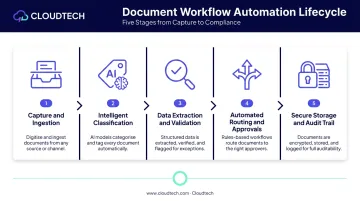
Cloudtech's IDP engagements follow a consistent five-stage framework — standardized in structure, customized in configuration.
Stage 1 — Capture and Ingestion
Documents arrive from multiple sources: email inboxes, web portals, scanners, cloud storage. The system ingests them all and converts them into a consistent format for processing.
Stage 2 — Intelligent Classification
AI automatically categorizes each document — an invoice, a patient intake form, a supplier contract — so it follows the correct workflow path from the start. Amazon Comprehend handles natural language understanding in this layer, routing documents to the right team or process without manual triage.
Stage 3 — Data Extraction and Validation
ML and NLP extract specific fields: vendor name and invoice totals for AP workflows, or patient ID and policy number for healthcare claims. Those extracted values are then cross-referenced against business rules, ERP master data, or external databases before the document moves forward. Errors caught here don't propagate downstream.
Stage 4 — Automated Routing and Approvals
Validated documents are routed based on content — dollar thresholds, risk level, document type, or policy rules. Approvals that previously required manual hand-offs now happen automatically, with exceptions surfaced only when they genuinely require human judgment.
Stage 5 — Secure Storage and Audit Trail
Documents are archived with full traceability: what was extracted, who approved it, when, and what changed. In regulated industries like healthcare and financial services, that audit trail is a compliance requirement, not an afterthought.
Amazon S3 (and Glacier for long-term retention) handles the storage layer, with Amazon Macie and AWS KMS supporting security and governance.
Business Benefits of IPA for Document-Heavy Operations
Efficiency and Speed
Manual document cycles that span days compress to hours — or minutes. In healthcare alone, CAQH benchmark data shows that eligibility verification drops from 20 minutes manually to 4 minutes electronically, at a labor cost reduction from $10.46 to $3.45 per transaction. Prior authorization processing is cut nearly in half. The same compression pattern plays out in financial services, logistics, and manufacturing — anywhere documents bottleneck operations.
Cost Reduction
Fewer manual touchpoints mean lower operating costs. Cloudtech's IDP implementations benchmark at 50%+ lower processing costs compared to traditional manual methods — driven by fewer manual review cycles and less rework from data entry errors. For logistics SMBs specifically, clients have seen 25–40% average cost reductions through automated document processing.
Accuracy and Compliance
Cloudtech's IDP solutions target 99%+ accuracy in document processing. Manual entry error rates, even modest ones, create compounding problems: rework, failed audits, and regulatory penalties. AI-assisted extraction eliminates that variability by enforcing the same validation rules on every document — whether it's the first of the day or the ten-thousandth.
Key compliance benefits:
- Consistent field validation applied to every document, every time
- Audit-ready extraction logs with full traceability
- Reduced exposure in regulated industries like healthcare and financial services
Scalability Without Proportional Headcount Growth
Month-end close, open enrollment, seasonal order spikes — these volume surges no longer require temporary staff. Cloud-native IPA absorbs the increase without adding headcount or infrastructure — a direct advantage for SMBs running lean operations.
IPA in Action: Industry Use Cases for SMBs
Healthcare
Cloudtech's Clinical Document AI service automates chart abstraction, PHI detection and redaction, prior authorization processing, and patient intake forms using Amazon Textract and Amazon Comprehend Medical.
The results are measurable: manual chart abstraction costs of $8–$15 per chart drop to cents per page at scale. Claims turnaround compresses from 4–6 weeks to 24–48 hours, and documentation accuracy climbs from 75% to 99.8%.
For healthcare SMBs like community health centers and specialty practices, this directly reduces administrative burden — freeing clinical staff to focus on patient care rather than paperwork.
Financial Services and Accounting
Accounts payable is the canonical use case. Ardent Partners' 2024 AP benchmark found that top-performing AP teams outperformed their peers across every key metric:
- 78% lower processing costs
- 82% shorter cycle times
- 59% lower exception rates
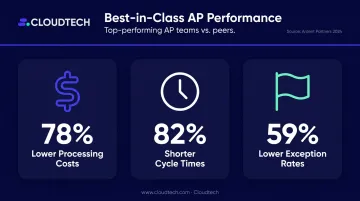
IPA drives this gap. AI extracts line items, matches POs, routes for approval, and posts to ERP systems with minimal manual intervention.
For SMB accounting teams processing hundreds of invoices monthly, the compounding effect is significant: faster cycle times reduce late-payment penalties, lower error rates shrink exception queues, and the whole operation runs leaner without adding headcount.
Manufacturing, Logistics, and Retail
Cloudtech's IDP capabilities for logistics include automated extraction from bills of lading, packing slips, customs documentation, and shipping labels — with direct integration into ERP and TMS systems. Clients in logistics have seen 50–70% reductions in document processing times, accelerating shipment handling and improving delivery schedule accuracy.
Purchase orders work the same way: AI classifies them on ingestion, extracts the relevant fields, and routes them to procurement or AP teams — no manual sorting required.
How to Get Started with IPA for Document Workflows
Step 1 — Identify Your Highest-Friction Process
Don't try to automate everything at once. Pick the one workflow that is highest volume, most error-prone, or creating the biggest operational bottleneck. For most SMBs, that's AP invoice processing, patient intake, or order document handling. Starting focused produces faster, cleaner results and a clear ROI story to justify further investment.
Step 2 — Choose the Right Technology Stack and Partner
The most effective IPA implementations use a unified platform rather than a patchwork of disconnected tools. Cloudtech builds on AWS-native services — Amazon Textract, AWS Lambda, Step Functions, and S3 — combined into a pre-packaged IDP solution deployable in weeks.
As an AWS Advanced Tier Partner with SMB Competency and a team that is 70% former AWS employees, Cloudtech brings direct expertise in how these services behave together in production. That matters when you're configuring confidence thresholds, building human-in-the-loop review flows, or integrating outputs into an existing ERP.
Step 3 — Pilot, Measure, and Scale
Run a focused pilot on your chosen process. Define clear KPIs upfront:
- Cycle time — how long does a document take to process end-to-end?
- Error rate — how often does extracted data require correction?
- Cost per document — what does processing one document cost before and after?
- Straight-through processing rate — what percentage of documents clear without human review?
Once the pilot demonstrates ROI, expand to adjacent document workflows using the same governed framework. As the AI models process more documents, extraction accuracy improves — which directly shrinks your human review queue and lowers per-document cost.
Frequently Asked Questions
What is intelligent process automation for document workflows?
IPA combines AI, ML, NLP, and RPA to automate end-to-end document handling — capture, classification, extraction, validation, routing, and archiving — with minimal manual intervention. Unlike basic digitization, IPA can read unstructured documents, make context-aware decisions, and handle exceptions on its own.
How is IPA different from traditional RPA for document processing?
RPA follows fixed rules on structured data and fails when document formats change. IPA uses AI to interpret variable, unstructured documents, handle exceptions, and adapt over time — making it far better suited for real-world document variability where no two vendor invoices look the same.
What types of documents can be automated with IPA?
Invoices, purchase orders, contracts, claims forms, patient intake records, bills of lading, customs documents, and onboarding paperwork — essentially any high-volume, data-heavy document that currently requires manual reading and data entry.
What AWS services are used to build IPA for document workflows?
The core stack includes Amazon Textract (extraction), AWS Step Functions (workflow orchestration), AWS Lambda (serverless event-driven processing), and Amazon S3 (secure storage). Amazon Comprehend and Amazon A2I support classification and human-in-the-loop review respectively.
How long does it take to implement document workflow automation?
With pre-packaged cloud solutions and an experienced AWS partner, a focused pilot on a single document process can go live in weeks. More complex multi-workflow implementations vary by scope, but Cloudtech's typical packaged engagement runs 2–8 weeks.
What ROI can SMBs expect from intelligent process automation?
Cloudtech's IDP implementations consistently deliver:
- 90%+ reduction in manual work
- 99%+ document processing accuracy
- 50%+ lower processing costs vs. traditional methods
Most clients realize ROI within the first year. Results vary by document volume, workflow complexity, and starting baseline.