Introduction
Most customers don't pick one channel and stick with it. They start a support chat, follow up by phone, and maybe send an email in between. According to Zendesk's CX Trends 2026 report, 74% of customers find it frustrating to repeat their story to different agents — a frustration that drives customers to competitors.
Legacy chatbots make this worse. Rule-based bots match keywords to scripted responses. They don't remember what happened on a different channel, can't handle anything outside their decision tree, and force customers to start over every time. Agents lose context, customers lose patience, and service teams spend their time fielding the same contacts on loop.
This article covers:
- What conversational AI for omnichannel customer service actually means
- How the underlying technology works
- The measurable business benefits
- Where it delivers the most value by industry
- How AWS-powered infrastructure makes enterprise-grade deployment accessible for SMBs
Key Takeaways
- 74% of customers hate repeating themselves across channels — omnichannel AI eliminates this by keeping a unified customer profile across every touchpoint
- Conversational AI cuts cost per contact by up to 23.5% and average handle time by up to 35%
- McKinsey reports AI agents have driven a 50% reduction in cost per call in contact centers
- US contact center agent attrition hit 30% in 2024 — AI absorbs the repetitive work driving burnout
- Amazon Lex, Amazon Connect, and Amazon Bedrock give SMBs full-featured AI infrastructure at SMB-friendly costs
What Is Conversational AI for Omnichannel Customer Service?
Conversational AI vs. Rule-Based Chatbots
A traditional chatbot follows a script. It matches keywords to pre-written responses and fails the moment a customer phrases something unexpected. Conversational AI is categorically different.
Three core technologies power this difference:
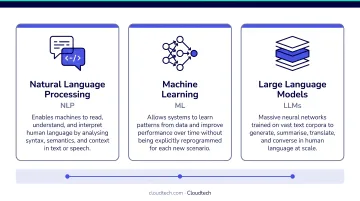
- Natural Language Processing (NLP) — interprets what a customer actually means, not just the words they used
- Machine Learning (ML) — improves response accuracy with every interaction
- Large Language Models (LLMs) — handle follow-up questions and maintain context across a full conversation
The distinction matters because real customer conversations are messy. Customers ramble, change topics, and express frustration in ways no keyword list can anticipate. That's where the channel layer comes in.
What "Omnichannel" Actually Means Here
Being on multiple channels — chat, phone, email, SMS — is multichannel. Omnichannel means something more specific: a unified customer profile that travels with the customer across every channel.
When a customer chats about a billing issue on Tuesday and calls back on Wednesday, the AI (and any human agent) already knows the full context. No re-explaining. No re-verifying. No frustration.
The Adoption Curve Is Moving Fast
Gartner projects that by 2028, at least 70% of customers will use a conversational AI interface to start their service journey. Right now, only 15% of US contact centers currently use voicebots — with 35% planning implementation within two years, according to ContactBabel's 2025 guide.
For SMBs, the window to deploy before competitors do is narrowing.
How Conversational AI Works Across Channels
The Core Technology Stack
Three layers work together:
- NLP/NLU — Identifies what the customer wants (intent) and extracts key details like order numbers or account IDs (entities)
- LLMs — Generate natural, contextually accurate responses instead of canned text
- ML — Improves the system continuously using every conversation as training data
Context Persistence and Integration
The system builds and continuously updates a unified customer profile by mining:
- Call transcripts and chat logs
- Email history
- CRM records
- Behavioral signals from web and app interactions
Every channel interaction is informed by everything that came before it. When a customer calls, the system already knows they started a return via chat two days ago.
The integration layer connects this intelligence to your existing tools via APIs: CRMs, ticketing platforms, calendars, and knowledge bases. The AI doesn't just retrieve data — it takes real actions without agent involvement:
- Schedules appointments directly on connected calendars
- Updates CRM records in real time
- Triggers follow-up emails after resolution
- Logs interaction data across every connected platform
Intelligent Routing and Post-Interaction Automation
When a conversation exceeds what the AI should handle — high complexity, strong negative sentiment, sensitive topics — it routes to a human agent. The agent receives the full conversation history, customer profile, and detected intent before they join — no cold transfer.
After each interaction, the AI handles wrap-up automatically:
- Auto-generates conversation summaries
- Classifies the contact type for reporting
- Updates CRM records without manual input
- Triggers any required follow-up actions
No manual wrap-up time.
Key Benefits of Conversational AI for Omnichannel Customer Service
24/7 Availability Without the Staffing Cost
74% of consumers now expect 24/7 availability because of AI, per Zendesk's CX Trends 2026 report. Conversational AI delivers this without overnight shift premiums or holiday surcharges — every channel, every time zone, any volume of simultaneous inquiries.
Personalization That Doesn't Require Extra Work
Because the system unifies data from every touchpoint, interactions feel tailored from the first message. The AI knows the customer's history, their open issues, and their preferences — before the conversation starts. That context is what turns a routine interaction into a reason to stay.
Cost Reduction at Scale
The cost impact is measurable across multiple data sources:
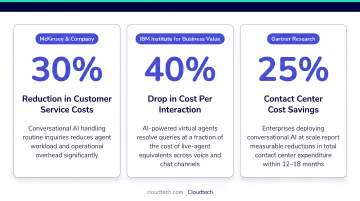
- McKinsey reports AI agents in contact centers have driven a 50% reduction in cost per call
- IBM reports conversational AI reduces cost per contact by 23.5% on average
- Gartner predicts agentic AI will resolve 80% of common customer service issues autonomously by 2029, driving a 30% reduction in operational costs
AI handles peak demand surges — holiday seasons, product launches, outage events — without requiring emergency headcount. Capacity expands on demand, and costs don't follow.
Reduced Agent Burnout
US contact center agent attrition was 30% in 2024, with 40% of contact centers reporting that 6–10% of agents leave within their first three months (ContactBabel, 2025). The primary driver: repetitive, low-complexity work that offers no challenge and generates consistent stress.
Conversational AI absorbs order status checks, password resets, FAQ responses, and appointment confirmations. Human agents handle the complex, empathy-requiring interactions that actually require human judgment — and are more likely to stay in roles that feel meaningful.
Measurable Efficiency Gains
Specific, verified outcomes from AI-assisted contact center operations:
- Up to 35% reduction in average handle time — Genpact solutions built on Amazon Connect (AWS, 2025)
- Up to 60 seconds saved per call from AI-generated post-contact summaries — Forrester's Amazon Connect TEI
- CSAT scores up 25% in deployments where AI handled tier-1 routing and resolution, freeing agents for higher-complexity cases — Salesforce State of Service, 2024
These aren't theoretical projections. They're documented outcomes SMBs can realistically target.
Where Conversational AI Delivers the Most Value
Intent Detection and Intelligent Routing
IVR menus ("press 1 for billing, press 2 for technical support") train customers to hate calling. Conversational AI replaces that friction with a natural question: "What can I help you with today?"
The system identifies real intent, classifies urgency and complexity, and routes the customer to the right destination — an AI agent for routine tasks, a specific human specialist for complex issues — without forcing anyone through a rigid menu.
Self-Service for High-Volume Queries
McKinsey reports that 50–60% of customer interactions remain transactional. These are exactly the queries conversational AI handles best:
- Order tracking and delivery status
- Appointment booking and rescheduling
- Account balance checks
- Password resets and subscription changes
- FAQ responses
Automating these queries frees human agents for work that actually needs a human. McKinsey estimates AI-driven automation could allow companies to handle 20–30% more calls while reducing the volume of routine work landing on human agents.
Human Handoff with Full Context Transfer
When AI reaches its appropriate limits, the handoff model matters. Poorly executed transfers force customers to repeat themselves — which is exactly what erodes trust.
The better model: the AI packages the full conversation history, customer profile, and detected intent, then delivers it to the human agent before they even join the call. The agent starts informed. The customer never has to explain themselves again.
Cloudtech's conversational AI voice deployments on AWS are built with this model in mind, targeting human handoff in under two seconds with full context transfer.
Proactive Outreach and Notifications
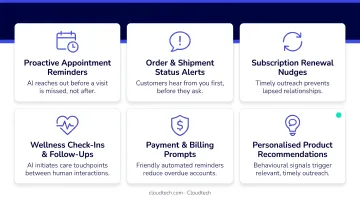
The most underused capability in conversational AI: going first. Instead of waiting for customers to contact you about a problem, the AI initiates:
- Appointment reminders before no-shows happen
- Payment due alerts before late fees trigger
- Shipping delay notifications before complaints arrive
- Service disruption updates before frustration builds
This shifts customer service from reactive to anticipatory. Satisfaction scores improve not because complaints were resolved well, but because fewer complaints reached the queue at all.
Industry Spotlight: Healthcare, Financial Services, and Retail
Healthcare
Conversational AI addresses the administrative volume that bogs down healthcare operations: appointment scheduling, patient intake and pre-registration, prescription refill requests, post-visit follow-ups, and insurance query resolution.
The compliance requirements are strict. Any HIPAA-compliant deployment must include data encryption for all Protected Health Information, role-based access controls, regular security audits, and privacy-by-design architecture. EHR and scheduling system integration via well-documented APIs is non-negotiable. Stale patient data in an AI interaction creates real downstream harm.
Cloudtech has served healthcare clients including Klamath Health Partnership, where the engagement involved HIPAA-compliant AWS infrastructure and data management. This work spanned AWS Control Tower governance, secure data lakes, and audit trail implementation.
That hands-on experience with healthcare compliance architecture translates directly into the rigor required for conversational AI deployments in clinical settings.
Financial Services
Financial institutions are moving quickly. According to an ABA Banking Journal survey citing Hanover Research for Temenos, 11% of financial institutions have already implemented generative AI, with 43% actively in the process of doing so.
The use cases are high-stakes: account inquiries, transaction dispute intake, fraud alert escalation, and loan application status checks. All require the audit trails, identity verification, and compliance guardrails that regulated industries demand. McKinsey notes that a modular AI approach for banking customer care can reduce implementation investment by more than 50% and accelerate delivery times by up to 70%.
Retail and E-Commerce
Where financial services AI is driven by compliance, retail AI is driven by volume. Holiday peaks demand temporary staffing, extended hours, and still produce customer backlogs. Conversational AI solves this directly. Across chat, SMS, and voice, AI handles:
- Order tracking and delivery status at scale
- Returns and refund processing without queue wait times
- Product recommendations based on purchase history
- Cart abandonment recovery via proactive outreach
The result is consistent, personalized service during the highest-volume periods, without the staffing math that traditionally makes peak season a crisis.
Deploying Conversational AI on AWS: What SMBs Need to Know
The AWS Service Stack
Three managed services form the backbone of an enterprise-grade conversational AI deployment accessible to SMBs:
- Amazon Lex — NLP and intent recognition, the conversational interface layer
- Amazon Connect — Omnichannel contact center capabilities covering voice, chat, and task management
- Amazon Bedrock — Access to foundation models and generative AI for natural, contextually rich responses
AWS manages the underlying complexity across all three. The implementation work focuses on configuration, integration, and training on your specific knowledge base and workflows — not on building AI infrastructure from scratch.
The Practical Deployment Path
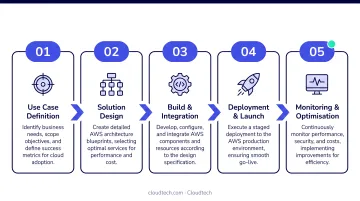
A structured implementation follows these phases:
- Define use cases and target channels — Identify which queries to automate first and which channels your customers actually use
- Configure and train the AI agent — Build on your knowledge base, FAQs, and documented workflows
- Integrate with existing systems — Connect to your CRM, ticketing platform, scheduling tools, or ERP via APIs
- Test with real-world scenarios — Stress test edge cases, sentiment detection, and escalation logic before go-live
- Deploy and monitor with clear KPIs — Track handle time, containment rate, cost per contact, and customer satisfaction
Cloudtech's team — including AWS-certified architects and engineers with former AWS backgrounds — has executed this deployment model in the healthcare sector within a four-week timeline, from architecture design through HIPAA-compliant go-live. Working with an experienced AWS Partner compresses that timeline significantly — and eliminates the trial-and-error of building from scratch.
Addressing the Complexity and Cost Concern
SMBs consistently raise two objections: this is too complex for our team, and it's too expensive for our budget.
On complexity, Amazon Lex, Connect, and Bedrock remove the infrastructure build burden entirely — your team doesn't need to become AI engineers. Configuration and integration is where an experienced AWS Partner adds value.
On cost, Cloudtech's status as an AWS Advanced Tier Partner — and its participation in the AWS Small Business Acceleration Initiative — means eligible SMB clients can access AWS Partner Funding to reduce or eliminate out-of-pocket implementation costs. The same conversational AI capabilities large enterprises use are available to SMBs, without the enterprise deployment timeline or price tag.
Frequently Asked Questions
What does Fin AI do?
Fin AI is Intercom's AI-powered customer service agent built on large language models including GPT-4. It ingests a company's support content to autonomously resolve customer queries, escalates to human agents when needed, and operates across chat, SMS, and WhatsApp. It's designed to handle support volume without requiring additional human headcount.
How much does Fin AI cost?
Intercom's Fin AI is priced at $0.99 per resolved outcome — counted when a customer confirms their issue is resolved or stops asking follow-up questions. Bundled seat plans (Essential, Advanced, or Expert) combine a base seat cost with per-outcome Fin charges. Check Intercom's pricing page for current details.
What is the difference between conversational AI and a traditional chatbot?
Traditional chatbots follow rigid decision trees and keyword matching, breaking down the moment a customer goes off-script. Conversational AI understands intent, maintains context across a full conversation, and improves over time — so it handles real exchanges, not just scripted ones.
Can conversational AI maintain context across different channels?
True omnichannel conversational AI does this by building a unified customer profile from all interaction history. A customer who chats about a return and then calls in doesn't need to restart the conversation — the AI (and any human agent) already has the full context from the prior chat session.
How long does it take to implement conversational AI for customer service?
With cloud-native managed services like Amazon Lex and Amazon Connect, and an experienced AWS Partner managing the implementation, SMBs can typically reach production deployment in a matter of weeks. Cloudtech has executed healthcare conversational AI deployments from architecture through compliant go-live in four weeks.
Does conversational AI replace human customer service agents?
No. Conversational AI handles routine queries autonomously — order status, FAQs, appointment booking, password resets — and routes complex or emotionally sensitive issues to human agents with full context already in hand. Agents stay focused on work that requires human judgment; the AI handles everything else.