Introduction
Most businesses discover that implementing an AI customer service chatbot is far more involved than purchasing a software subscription and flipping a switch. The actual process — planning, building, integrating, and deploying a conversational AI assistant that handles real customer inquiries — takes careful coordination across multiple phases.
This guide is written for SMBs, startups, and growing businesses in healthcare, retail, financial services, and SaaS that want to automate customer support without an enterprise budget or a dedicated internal engineering team.
That window is closing fast. Gartner predicts that by 2028, at least 70% of customers will use a conversational AI interface to start their customer service journey — shifting the question from whether to implement to how to do it right.
This guide covers a realistic, phase-by-phase implementation timeline — including the factors that accelerate or stall deployment and the most common mistakes to avoid before you select a platform or sign a contract.
Key Takeaways
- A typical SMB chatbot implementation spans 8–12 weeks across five structured phases
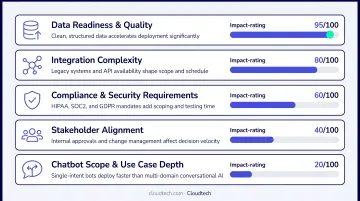
- Integration complexity and internal data readiness are the two biggest drivers of timeline variance
- AI-powered chatbots (NLP/LLM-based) differ fundamentally from rule-based bots, which directly shapes scope and cost
- Most implementation failures stem from poor requirements definition and weak knowledge base preparation, not the technology
- Post-launch success depends on ongoing monitoring, retraining, and knowledge base updates
What Is an AI Customer Service Chatbot and Why Does It Matter?
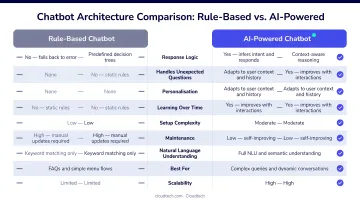
An AI customer service chatbot is an automated application that uses natural language processing (NLP), machine learning, and large language models (LLMs) to understand customer queries and respond intelligently. This is meaningfully different from rule-based systems that follow fixed, keyword-triggered scripts.
Rule-Based vs. AI-Powered: Why the Distinction Matters
| Feature | Rule-Based Chatbot | AI-Powered Chatbot |
|---|---|---|
| Response logic | Fixed scripts, button menus | Contextual NLP understanding |
| Flexibility | Breaks outside predefined paths | Handles varied natural language |
| Conversation depth | Single-turn, transactional | Multi-turn, adaptive |
| Implementation complexity | Lower | Higher |
| Training requirement | Minimal | Significant |
As AWS describes it, rule-based bots guide users through predetermined menus, while modern AI chatbots use NLP to understand users and answer complex questions. That architectural difference has direct consequences for implementation timeline, cost, and the customer experience you ultimately deliver — which is why understanding it upfront shapes every decision that follows.
The Business Case
McKinsey reports that 50–60% of customer interactions remain transactional — the category most suited to chatbot automation. For businesses handling high volumes of repetitive inquiries, the ROI case is clear: McKinsey also cites AI contact center deployments achieving a 50% reduction in cost per call.
Practical use cases vary by industry, but the pattern is consistent — high-frequency, low-complexity interactions are where AI chatbots pay off fastest:
- Appointment scheduling, patient FAQs, and medication reminders (healthcare)
- Account inquiries, fraud alert routing, and compliance-safe FAQ handling (financial services)
- Order tracking, returns processing, and product lookups (retail/e-commerce)
- Support triage, onboarding guidance, and subscription management (SaaS)
The AI Customer Service Chatbot Implementation Process: Phases and Timeline
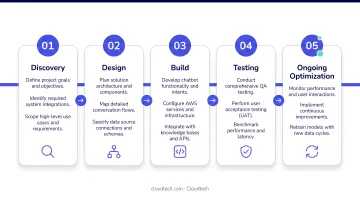
A properly scoped SMB chatbot implementation runs 8–12 weeks across five phases. Enterprise deployments with complex integrations or regulated data environments routinely extend to 16–20+ weeks. The range is driven by three variables: integration depth, data readiness, and compliance requirements.
Here's how each phase breaks down.
Phase 1: Discovery and Requirements Planning (Weeks 1–2)
This phase defines everything the chatbot will — and won't — do. Shortcutting it is the leading cause of failed implementations.
Key activities:
- Audit existing support data — review ticket history to identify the highest-volume, most repetitive query types
- Define escalation rules — document exactly when the bot hands off to a human and what context it transfers
- Set measurable success metrics — deflection rate, CSAT, average handle time
- Define channel scope — website widget, mobile app, WhatsApp, SMS
The deliverable is a written chatbot brief covering the bot's persona, tone, supported channels, languages, and explicitly out-of-scope topics. Every hour spent here prevents days of rework later.
Phase 2: Platform Selection and Infrastructure Setup (Weeks 2–4)
The core decision: build on cloud-native AI services or use a pre-built SaaS chatbot platform?
AWS-native build (Amazon Lex, Amazon Bedrock, Amazon Connect) offers higher customization and deeper integration capability, and scales with your existing AWS infrastructure. It's the better fit for businesses that need the chatbot connected to proprietary systems. Working with an AWS-certified partner like Cloudtech can compress this phase by eliminating early trial-and-error through pre-built accelerators and pre-configured compliance guardrails.
Pre-built SaaS platforms get you to a first deployment faster, but come with less flexibility and are constrained by the vendor's integration ecosystem.
Technical tasks in this phase:
- Provisioning cloud infrastructure
- Configuring APIs and authentication
- Connecting to CRM or helpdesk systems (Salesforce, Zendesk, HubSpot)
- Establishing data pipelines
Integration complexity is the single biggest driver of timeline variance in this phase. Each connected system requires API configuration, error handling, and testing.
Phase 3: Bot Design, Knowledge Base Training, and Integration (Weeks 4–8)
This is the most labor-intensive phase. It's also where chatbot quality is actually determined.
Knowledge base training involves:
- Uploading FAQs, product documentation, policy documents, and support transcripts
- Defining conversational flows and fallback handling for unrecognized queries
- Writing system prompts that specify the bot's behavior, tone, and topic boundaries
- Explicitly instructing the bot on what not to discuss — this prevents off-topic or hallucinated responses
Gartner (2024) found that 61% of customer service leaders have a backlog of knowledge articles to edit, and more than one-third lack any formal process for revising outdated content. Businesses in that situation will spend a significant portion of this phase cleaning and organizing content before training can begin.
Integration work connects the chatbot to live systems so it can retrieve real-time data — not just serve static answers. For AWS-native implementations, this typically involves Lambda functions for backend logic, API Gateway for request routing, and DynamoDB for session or state management.
A healthcare SaaS implementation Cloudtech completed, for example, used Amazon Bedrock Agents connected to Amazon S3 and Amazon Redshift datasets. The result: a 45% reduction in support tickets within two months of launch.
Phase 4: Testing and Quality Assurance (Weeks 8–10)
Testing is where you find the problems before your customers do.
A thorough QA process includes:
- Internal QA — simulated conversation scenarios covering expected query types
- Edge case testing — unusual phrasing, multilingual inputs, escalation triggers
- Integration testing — verify real-time data retrieval accuracy from connected systems
- Security and compliance review — mandatory for healthcare (HIPAA) and financial services (SOC 2, GDPR)
- User acceptance testing (UAT) — limited rollout to internal staff or beta users to collect real interaction data
Skipping UAT is one of the most expensive mistakes in chatbot deployment. The Amazon Lex V2 Test Workbench allows teams to build structured test sets from existing transcription data and evaluate bot performance at scale before any public launch — a step that should be non-negotiable.
Phase 5: Launch, Monitoring, and Continuous Optimization (Weeks 10–12 and Ongoing)
A phased go-live — starting with a single channel or limited query scope, then expanding — reduces risk and allows rapid adjustment based on live traffic patterns. A full "big bang" launch across all channels at once amplifies any misconfiguration.
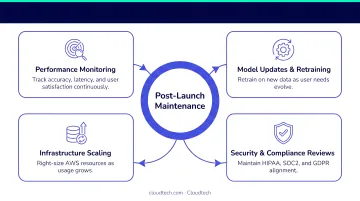
Post-launch operational requirements:
- Monitor key metrics weekly: deflection rate, containment rate, escalation frequency, CSAT
- Update the knowledge base whenever products, policies, or pricing change
- Retrain on real conversation logs to improve accuracy over time
- Set a quarterly performance review cadence with defined improvement targets
Teams that treat launch as the finish line typically see performance plateau within 60–90 days. The ones that don't keep improving it.
Key Factors That Affect Your Chatbot Implementation Timeline
Several variables routinely extend — or compress — implementation timelines beyond the baseline 8–12 week range.
Integration complexity: Every system the chatbot connects to adds API configuration, authentication, error handling, and testing. Legacy systems without modern REST APIs can add weeks. Plan integrations explicitly in your requirements phase.
Data readiness and knowledge base quality: Businesses with well-organized FAQs, clean policy documentation, and accessible support transcripts train chatbots far faster than those starting with fragmented content. Given that 61% of customer service leaders already have a knowledge backlog, content readiness is often the longest hidden phase.
Internal team availability: Implementations stall most often when subject matter experts — customer service leads, compliance teams, product managers — are unavailable to review flows, approve responses, or sign off on scope. A dedicated internal project owner is the most underrated accelerator.
Implementation partner expertise: Cloudtech's pre-built AWS infrastructure frameworks include pre-configured IAM roles, compliance guardrails, and automation templates that compress SMB deployment timelines from months to weeks.
Compliance and security requirements: Healthcare clients must account for HIPAA Security Rule safeguards. Financial services firms face SOC 2 and GDPR obligations. Scope these review stages into your timeline from the start — they cannot be bolted on after build.
Common Mistakes and Misconceptions in AI Chatbot Implementation
"We Can Just Turn It On and It Will Work"
Out-of-the-box AI models have no knowledge of your business. Without a structured knowledge base, defined conversational flows, and proper system prompting, the bot will hallucinate answers or return generic responses that erode customer trust. Training and configuration are what determine quality — the underlying model is just the engine.
Skipping Human Escalation Design
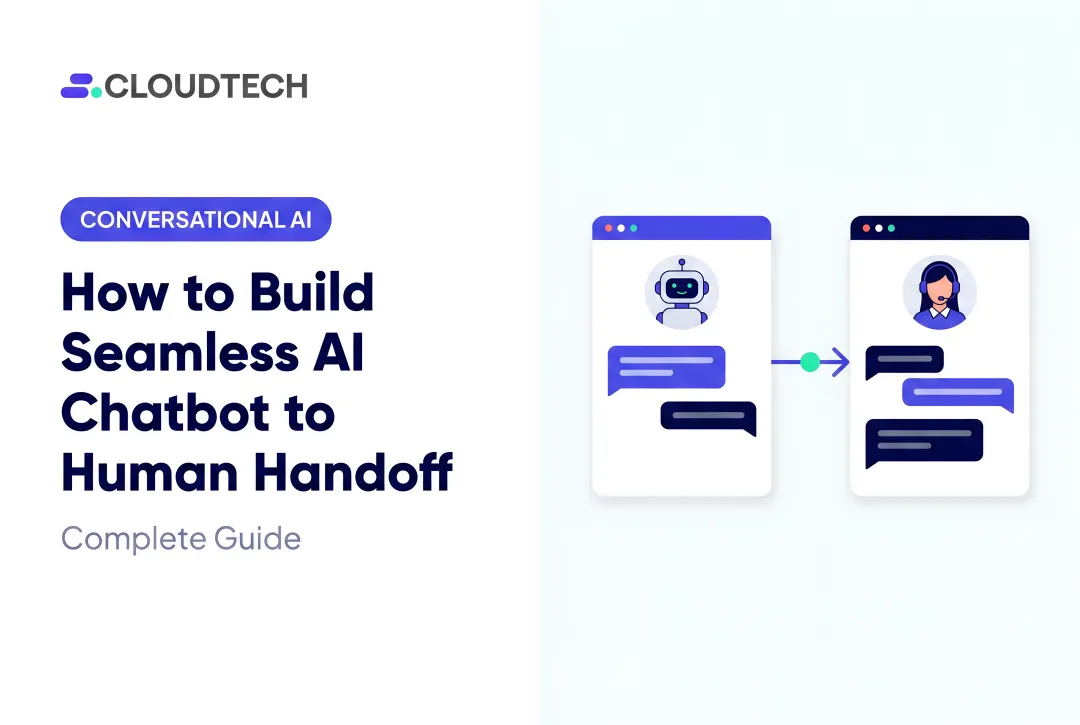
Many businesses focus entirely on what the chatbot handles and give no thought to the handoff. When should it escalate? What context does it pass to the human agent? How does the transition feel to the customer? A poorly designed escalation experience frequently frustrates customers more than the chatbot's limitations themselves.
This matters: Gartner (2024) found that 64% of customers would prefer companies not use AI in customer service, with top concerns including difficulty reaching a human and receiving wrong answers. That means escalation design isn't a nice-to-have — it's the single highest-leverage factor in customer acceptance of AI service.
"Once It's Live, We're Done"
Without ongoing knowledge base updates and model retraining based on real conversations, chatbot accuracy degrades as your products, policies, and customer language evolve. Gartner reports that more than one-third of customer service leaders have no formal process for revising outdated knowledge articles. That same gap is what causes chatbot quality to erode quietly after launch, often without anyone noticing until customers start complaining.
A sustainable chatbot program includes:
- Scheduled knowledge base reviews (monthly or after major product changes)
- Conversation log analysis to catch unanswered or mishandled queries
- Periodic retraining or prompt updates based on real user language
- A defined owner responsible for post-launch quality
When an AI Customer Service Chatbot May Not Be the Right Fit
A chatbot is a poor investment in specific situations:
- Low support volume: If your team handles a few dozen inquiries per month, the implementation investment won't generate meaningful ROI
- Overwhelmingly complex queries: If nearly every customer interaction requires nuanced judgment with no significant volume of repetitive FAQs, a chatbot adds friction without reducing load
- No resources to maintain it: A chatbot with no dedicated owner to update the knowledge base quickly becomes a liability
Watch for these warning signals in the decision process:
- The chatbot is being chosen to follow a trend rather than solve a specific pain point (long wait times, high volume, after-hours gaps)
- The goal is to replace human agents entirely rather than augment them
That second signal is worth taking seriously. Gartner (2026) reports that 85% of customer service and support leaders are expanding human-agent responsibilities despite AI adoption. If your business case depends on eliminating your support team, the data — and most real-world deployments — suggest you're building on a flawed premise.
Conclusion
AI customer service chatbot implementation is a structured, phased process — not a product purchase. Businesses that invest properly in discovery, knowledge base preparation, integration, and testing see better outcomes than those who rush to launch and iterate under live customer pressure.
Timeline realism, internal alignment, and a genuine commitment to ongoing optimization separate successful deployments from the ones that frustrate customers and get quietly shut down. Before selecting any platform or vendor, define your requirements clearly — that work determines the quality of every decision that follows, from vendor selection to go-live.
If your business is at the planning stage, Cloudtech's conversational AI implementation service helps SMBs navigate this process with AWS-native tooling, a structured timeline, and hands-on support from certified architects who have done it before.
Frequently Asked Questions
How long does it take to implement an AI customer service chatbot?
Most SMB implementations with straightforward integrations run 8–12 weeks from kickoff to go-live. Complex enterprise deployments with multiple system integrations or regulated data environments typically extend to 16–20+ weeks. Integration complexity and internal readiness — particularly knowledge base quality — are the two biggest variables.
What are the stages of an AI customer service chatbot project?
A standard implementation follows five phases: discovery and requirements planning, platform selection and infrastructure setup, bot design and knowledge base training, testing and QA, and go-live with ongoing optimization.
How are AI chatbots used in customer service?
Common use cases include:
- Answering FAQs and common account questions
- Handling order tracking and account management
- Routing and triaging inbound inquiries
- Scheduling appointments
- Escalating complex issues to human agents
What is the difference between a rule-based chatbot and an AI-powered chatbot?
Rule-based bots follow fixed keyword-triggered scripts and break when a customer goes off-script. AI-powered chatbots use NLP and machine learning to understand context and intent, handling a much wider range of natural language inputs without requiring predefined conversation paths.
What AWS services are used to build AI customer service chatbots?
Key services include Amazon Lex for conversational AI and natural language understanding, Amazon Bedrock for foundation model access and generative AI agents, Amazon Connect for contact center integration, and AWS Lambda for serverless backend logic.
How do you measure the success of an AI customer service chatbot after launch?
Primary KPIs include deflection rate (percentage of inquiries resolved without human intervention), containment rate, CSAT scores collected post-chat, average resolution time, and escalation frequency. Review them weekly during the first 90 days, then monthly — using the data to sharpen your knowledge base and refine model responses over time.