Introduction
Every major U.S. bank has already deployed a customer-facing chatbot. According to the CFPB, all 10 of the largest commercial banks had chatbots in production by 2023, with an estimated 98 million Americans interacting with one that year. Healthcare is following fast.
The problem is that most of those chatbots were built for convenience, not compliance. In finance and healthcare, a hallucinated answer isn't a UX glitch — it's a potential HIPAA violation, a FINRA recordkeeping breach, or an SEC enforcement action. The SEC obtained $8.2 billion in financial remedies in FY2024 alone, including over $600 million tied specifically to recordkeeping failures.
Generic AI tools weren't designed for these stakes. This guide covers five leading enterprise AI chatbot platforms for regulated industries, what to evaluate before choosing one, and how to deploy them securely on AWS infrastructure.
Key Takeaways
- HIPAA, SOC 2, and GDPR compliance must be certified today — not promised on a roadmap
- RAG architecture is the most reliable approach for preventing hallucinations in regulated chatbot deployments
- On-premise or private VPC deployment is non-negotiable for PHI and sensitive financial data
- Five platforms are evaluated here: Amazon Lex/Bedrock, IBM Watson Assistant, Azure AI Bot Service, Google Dialogflow CX, and Salesforce Einstein Bots
- An AWS-certified implementation partner reduces both deployment risk and compliance overhead
Why Regulated Industries Can't Use Generic AI Chatbots
The Compliance Stakes Are Different Here
HIPAA governs every piece of patient data a healthcare chatbot touches. FINRA and SEC rules apply to every AI-generated communication a financial chatbot sends to investors. GDPR adds cross-border data residency obligations on top of both.
HHS has settled or imposed civil money penalties in 152 HIPAA cases totaling nearly $145 million — and that figure predates the current wave of AI adoption. FINRA imposed $59.8 million in fines in 2024 alone.
A chatbot that outputs an incorrect drug interaction or a fabricated policy term creates direct liability — with no paper trail to defend against it.
The Hallucination Problem Is Worse Than You Think
A 2025 study published in Communications Medicine found clinical decision-support hallucination rates between 50% and 82% under adversarial conditions. Even with prompt-based mitigation, the mean rate dropped from 66% to 44% — still unacceptable in a clinical setting.
NIST AI 600-1 flags hallucination as a direct path to patient harm, citing inaccurate patient summaries as a contributor to incorrect diagnoses.
Three Non-Negotiables for Regulated AI Chatbots
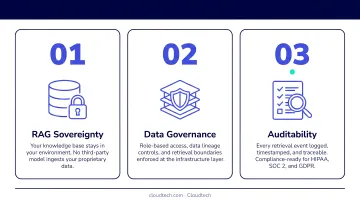
1. RAG Architecture Retrieval-Augmented Generation grounds every response in verified internal documentation. Per NIST's definition, RAG pairs the LLM with a retrieval system that pulls relevant content before generating an answer. The model cites its source, creating an auditable record of what was said and why.
2. Data Sovereignty Sensitive PHI and financial records must stay within a controlled network perimeter. Public cloud deployments that route data through shared infrastructure are not appropriate for most regulated use cases.
3. Full Auditability Every AI-generated response must be logged, traceable, and retrievable. FINRA Rule 4511 requires records to be preserved for at least six years. HIPAA requires access logs and audit controls for all systems handling ePHI.
Best Enterprise AI Chatbots for Finance & Healthcare
The five platforms below were evaluated against five criteria:
- Compliance certifications — HIPAA, SOC 2, GDPR, and equivalent
- RAG and source attribution — grounded answers with traceable references
- Deployment flexibility — cloud, private VPC, on-premise, and hybrid options
- Auditability — logging, access controls, and audit trail depth
- Document ingestion — handling complex policy, clinical, and regulatory content
Amazon Lex + Amazon Bedrock
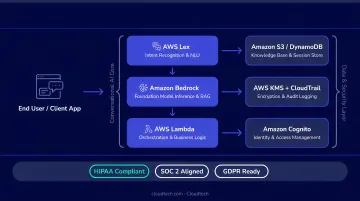
Amazon Lex is AWS's managed conversational AI service; Amazon Bedrock is the foundation model layer that powers it with enterprise-grade LLM capabilities. Together, they form a fully AWS-native chatbot infrastructure purpose-built for regulated enterprise deployments.
Compliance is built into the underlying infrastructure, not layered on afterward. Bedrock is HIPAA-eligible and in-scope for SOC and ISO programs. Models can be fine-tuned on proprietary data without that data leaving the customer's AWS environment.
AWS HealthLake enables FHIR R4-compliant healthcare data workflows, while AWS KMS provides FIPS 140-3 validated encryption for keys protecting PHI and financial records.
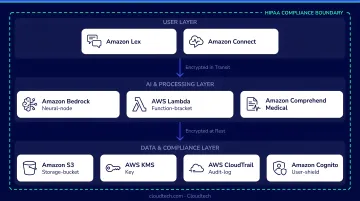
Cloudtech, as an AWS Advanced Tier Partner, specializes in implementing this stack for healthcare and financial services clients — with AWS CloudTrail audit logging, KMS encryption, IAM least-privilege controls, and encrypted S3 storage built into every deployment.
| Feature | Detail |
|---|---|
| Key Compliance | HIPAA-eligible, SOC 2, GDPR; AWS KMS encryption; CloudTrail audit logging |
| Deployment Options | AWS Cloud; private VPC; AWS Outposts (on-premises AWS infrastructure) |
| Best For | Organizations on AWS seeking a fully managed, compliant, and deeply customizable chatbot stack |
IBM Watson Assistant (watsonx Assistant)
IBM Watson Assistant — now branded watsonx Assistant — is a veteran enterprise NLP platform with a strong track record in regulated industries. It supports both cloud and on-premise deployment via IBM Cloud Pak for Data.
HIPAA support is available on Enterprise plans hosted in Washington, DC or Dallas. SOC 2 Type 2 compliance is confirmed. IBM's RAG-style grounded answer generation is available but requires significant configuration effort — teams without dedicated AI engineering resources should budget extra implementation time before go-live.
| Feature | Detail |
|---|---|
| Key Compliance | HIPAA-eligible (Enterprise), SOC 2 Type 2; role-based access controls; audit logging |
| Deployment Options | IBM Cloud; on-premise (IBM Cloud Pak for Data); hybrid |
| Best For | Large enterprises with existing IBM infrastructure and dedicated AI engineering teams |
Microsoft Azure AI Bot Service
Azure AI Bot Service is an enterprise chatbot framework built on Azure's compliance infrastructure, with native integration across Microsoft 365, Teams, and Dynamics 365. It holds HIPAA BAA coverage and SOC 1, 2, and 3 certifications, with GDPR supported through Microsoft's broader cloud commitments.
The Microsoft ecosystem integration is strong — if your organization already runs on Azure Active Directory (Entra ID), Teams, and Dynamics, this is a natural fit. RAG and source attribution, however, require custom engineering effort. Azure Government Cloud deployment is available for public sector and defense-adjacent use cases.
| Feature | Detail |
|---|---|
| Key Compliance | HIPAA BAA, SOC 1/2/3; Azure Entra ID integration; full audit trails |
| Deployment Options | Azure Cloud; Azure Government Cloud |
| Best For | Organizations deeply embedded in the Microsoft ecosystem needing compliant chatbots within Teams or Dynamics |
Google Dialogflow CX
Dialogflow CX is Google Cloud's developer-grade conversational AI framework, offering powerful NLU and highly flexible multi-turn workflow design. It is HIPAA-eligible and covered under Google Cloud's BAA, with VPC Service Controls available to create a perimeter that mitigates data exfiltration risk.
Regional data residency is supported — data at rest stays within the specified GCP region. Source attribution and audit-ready logging require custom implementation, which adds meaningful time-to-value for teams without strong in-house engineering resources.
| Feature | Detail |
|---|---|
| Key Compliance | HIPAA-eligible, SOC 1/2/3, GDPR via GCP; VPC Service Controls; encryption at rest and in transit |
| Deployment Options | Google Cloud; private VPC (VPC Service Controls) |
| Best For | Engineering-led teams on GCP building custom multi-turn conversational workflows |
Salesforce Einstein Bots
Salesforce Einstein Bots are natively embedded within Salesforce's Financial Services Cloud and Health Cloud, making them a strong fit for organizations already running Salesforce CRM.
Health Cloud carries HIPAA compliance certification and supports HITRUST and HL7 FHIR standards. Salesforce Shield adds Platform Encryption, Field Audit Trail, and Event Monitoring on top of the base platform. Out-of-the-box workflows for appointment scheduling, account inquiries, and claims routing reduce configuration time significantly — but flexibility outside the Salesforce ecosystem is limited.
| Feature | Detail |
|---|---|
| Key Compliance | HIPAA (Health Cloud), SOC 2, ISO; Salesforce Shield for enhanced encryption and audit |
| Deployment Options | Salesforce Cloud; limited on-premise support |
| Best For | Healthcare providers and financial services firms already running Salesforce CRM |
Key Features to Evaluate Before Choosing an Enterprise AI Chatbot
Compliance Certifications Are Non-Negotiable
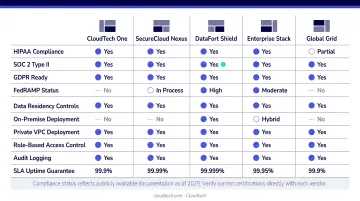
Ask vendors for documented proof — not promises. There is a meaningful difference between "we can help you get compliant" and "we hold SOC 2 Type II today and will sign a BAA." Operating without certified compliance during a build-out phase creates regulatory exposure that no timeline pressure justifies.
Minimum requirements for regulated industries:
- HIPAA eligibility with a signed Business Associate Agreement
- SOC 2 Type II attestation for security controls
- GDPR contractual and technical support for cross-border data handling
RAG and Source Attribution
Every customer-facing or employee-facing response must cite its source document. Without source attribution, a hallucinated answer about drug interactions or loan eligibility becomes a liability with no paper trail to defend against. Source attribution is the architectural requirement that makes AI defensible in regulated environments.
Data Sovereignty and Deployment Flexibility
Verify that private VPC or on-premise deployment is available now, not planned for a future release. Key requirements vary by industry:
- Healthcare: PHI must remain within a controlled network perimeter
- Finance: GDPR data residency rules may restrict where data is processed or stored
- Both: SEC and HIPAA rules can prohibit data crossing jurisdictional boundaries
Auditability and Logging Requirements
Every AI conversation should be logged with full context:
- The source document cited
- The exact response generated
- Any escalation to a human agent
- Timestamps and user identifiers
FINRA Rule 4511 requires six-year record retention. HIPAA's Security Rule requires audit controls for all systems handling ePHI. Verify that the platform meets these standards natively. A compliance feature bolted on through a third-party add-on introduces configuration risk and gaps in the audit trail.
Integration Depth and Document Ingestion
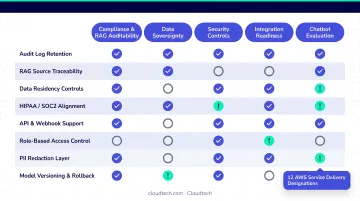
The chatbot must handle dense, multi-page policy documents, clinical protocols, and regulatory filings. FAQ-only pipelines will not hold up under real-world use. Run a pilot with your most complex internal documentation before committing to any platform.
System integration is equally critical. Confirm the platform connects with your existing infrastructure: EHR platforms (Epic, Cerner) via HL7 FHIR for healthcare, and CRM or financial compliance systems for regulated finance environments.
How Cloudtech Helps Deploy Compliant AI Chatbots on AWS
Configuring Amazon Bedrock to meet HIPAA, SOC 2, and financial services security requirements takes more than following AWS documentation. Most internal IT teams don't have the compliance architecture experience to get it right the first time — and in regulated industries, that gap carries real risk.
Cloudtech's team of AWS-certified architects — including former AWS professionals — designs and deploys Amazon Bedrock-based chatbot solutions for healthcare and financial services clients with compliance architecture built in from day one.
Documented production deployments include:
- A HIPAA-compliant AI voice agent for Ascend BPO handling 2,500–5,000 monthly appointment scheduling calls — built on an 8-node architecture with full PHI encryption and warm transfers to human agents in under 2 seconds
- A RAG-powered care navigation solution using Amazon Bedrock Agents for a healthcare SaaS platform, achieving a 45% reduction in support tickets within two months — with responses grounded in indexed S3 content and Redshift datasets, and full HIPAA compliance maintained throughout
Every deployment is backed by a consistent security stack designed specifically for regulated environments:
Standard security components include:
- AWS KMS encryption for data at rest across databases and S3 buckets
- AWS CloudTrail for immutable audit logging of all API calls and user activities
- IAM least-privilege access controls
- AWS Config for continuous compliance monitoring
- Amazon GuardDuty for proactive threat detection
- AWS Security Hub for consolidated security alerts
Cloudtech's AWS Advanced Tier Partner status also provides access to AWS Partner Funding programs that can reduce out-of-pocket implementation costs for qualifying businesses — worth asking about before finalizing your budget.
Conclusion
Regulated industries cannot afford AI chatbots that can't explain their outputs. The right platform must combine RAG-based source attribution, certified compliance, data sovereignty controls, and full auditability. All five platforms reviewed here meet that baseline — but the right choice depends on your existing tech stack, regulatory obligations, and deployment requirements.
If you're evaluating a compliant AI chatbot deployment for healthcare or financial services, contact Cloudtech for a consultation. Our AWS-certified team will assess your environment, recommend the right architecture, and deploy a solution built for compliance from day one.
Frequently Asked Questions
Which private AI chatbot is best suited for regulated industries like finance and healthcare?
Amazon Bedrock, deployed within a private AWS VPC, is a strong fit for organizations requiring full data sovereignty. All data stays within the client's own AWS environment — supporting HIPAA-eligible configurations without routing through public endpoints — and Cloudtech deploys this architecture for healthcare and financial services clients.
What compliance certifications should an enterprise AI chatbot have for healthcare?
The minimum bar is HIPAA eligibility with a signed BAA from the vendor, SOC 2 Type II for security controls, and GDPR support for any cross-border data handling. Note that "HIPAA-eligible" means the vendor supports a compliant configuration — the healthcare organization remains responsible for correct implementation.
How does RAG architecture make AI chatbots safer for regulated industries?
RAG grounds every AI response in verified internal documents rather than free-form generation. The model retrieves the relevant source passage first, then generates an answer anchored to that content with a citation — reducing hallucination risk and creating an auditable record of what the AI said and why.
What is the difference between HIPAA-eligible and HIPAA-compliant for AI chatbots?
"HIPAA-eligible" means the vendor's platform supports the technical safeguards required by HIPAA and will sign a BAA. HHS does not certify any product as HIPAA-compliant. Compliance is a shared responsibility — the healthcare organization must still configure the system correctly and implement administrative and physical safeguards.
Can enterprise AI chatbots in finance help with KYC and AML compliance?
Yes. Properly configured enterprise chatbots can automate KYC document intake, surface AML-related queries for human review, and give compliance officers on-demand access to policy documentation. However, they must be deployed with full audit logging and source attribution to satisfy FINRA and SEC recordkeeping requirements.
How long does it take to deploy a compliant AI chatbot for a regulated industry?
Timelines depend on platform and approach. Developer frameworks like Dialogflow CX or Azure AI Bot Service typically take three to six months to reach compliance standards. Pre-configured AWS deployments through an implementation partner like Cloudtech can move faster — with compliance architecture built in from day one, not retrofitted later.