Introduction
Businesses are deploying conversational AI faster than ever — but many can't answer a simple question: is it actually working?
The problem isn't a lack of data. Most platforms generate plenty of it. The real issue is tracking the wrong data — mistaking technical scores for business outcomes and calling a high containment rate a win when customers are silently abandoning conversations in frustration.
Gartner's 2024 survey of customer service leaders found that while 85% of service leaders planned to explore or pilot conversational GenAI in 2025, the gap between adoption intent and demonstrated ROI remains a persistent challenge — with Gartner explicitly warning that applying traditional IVR and chat metrics to conversational AI produces "unreliable, unhelpful insights."
This guide delivers a practical measurement framework covering which KPIs actually matter, how to tie them to business objectives, and what to do when the numbers reveal a gap between what your AI is doing and what your customers need.
Key Takeaways
- Conversational AI metrics span three layers: AI performance, operational efficiency, and business outcomes — each answering to a different stakeholder.
- Technical scores like intent accuracy must be paired with customer-facing metrics; neither tells the full story alone.
- Track 6–8 well-chosen KPIs against a pre-launch baseline — not dozens of metrics scattered across reports.
- Metrics must trigger action, not just generate reports.
- Build your monitoring infrastructure before launch; retrofitting it afterward costs time and accuracy.
What Is Conversational AI Metrics Analysis?
Conversational AI metrics analysis is the practice of selecting, tracking, and interpreting KPIs that reveal whether your AI system is achieving real business outcomes — not just running without errors.
This applies across any interface where AI handles human-like interactions:
- Customer service chatbots on web or mobile
- Voice AI in contact centers
- Internal helpdesk virtual assistants
- Lead qualification and outbound sales bots
Regardless of the channel, the same measurement problem applies: teams tend to track what's easy to measure rather than what actually matters. That's where a structured framework helps.
The Three Metric Layers
Every complete measurement framework covers three categories:
| Layer | Examples | Primary Audience |
|---|---|---|
| Technical | Intent accuracy, latency, escalation rate | Engineering team |
| Operational | Containment rate, handle time, deflection rate | Operations, Finance |
| Business Outcomes | CSAT, NPS, ROI | Leadership, Board |
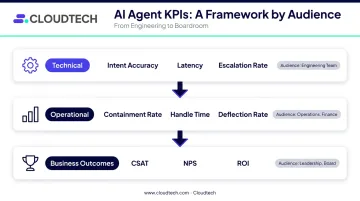
Most teams focus almost exclusively on technical metrics. A bot can hit 95% intent accuracy and still frustrate customers, erode trust, and underdeliver on ROI. Without visibility into all three layers, you're measuring the engine while ignoring whether the car is going anywhere useful.
Why Standard Technical Metrics Fall Short
A conversational AI system with 99% intent recognition accuracy that nobody uses — or that frustrates users into abandoning — delivers zero business value. Technical metrics measure what the system can do, not what it actually achieves for the customer or the company.
The Vanity Metric Trap
Containment rate is a common culprit. A high containment rate sounds like success: conversations are staying within the AI system. But if users are abandoning those conversations rather than being resolved, the metric is masking a failure.
That distinction has practical consequences. Microsoft's Copilot Studio analytics framework explicitly separates engaged sessions into three outcomes: resolved, escalated, and abandoned. A session that doesn't escalate is not automatically resolved. Without pairing containment rate with CSAT and resolution rate, you end up optimizing for the wrong goal.
The Case for Stakeholder-Aligned Measurement
Different stakeholders need different metrics — and they need them connected:
- Engineering teams track latency, error rates, and intent accuracy — early signals before problems surface in user complaints
- Operations and finance need throughput and deflection rates converted into actual cost-per-interaction figures
- Leadership needs resolution rates and CSAT trends tied directly to ROI, not just uptime percentages
When these layers connect, a drop in CSAT triggers an engineering investigation rather than a board-level guess. That's the difference between a dashboard and an operating system for your AI.
The Three Core Categories of Conversational AI KPIs
A complete KPI framework organizes metrics by who needs them and what decisions they inform. All three categories below should be tracked simultaneously from day one.
Category 1 — AI Performance Metrics
These are your leading indicators. They surface issues before they compound into customer satisfaction problems — and they predict downstream outcomes before those outcomes become expensive.
The three essential technical KPIs:
- Resolution Rate — the percentage of conversations fully handled by the AI without human transfer. This is a more meaningful baseline than containment rate because it requires the customer's issue to be actually resolved, not just contained.
- Intent Accuracy — how correctly the system identifies what the user is asking. Tracked using precision, recall, and F1 scores across your intent model.
- Transfer/Escalation Rate — the percentage of conversations handed off to a human agent. Google's Dialogflow CX analytics tracks this as "Live Agent Handoff" — conversations where escalation was explicitly requested.
Review these weekly. A spike in escalation rate on a specific intent signals a training gap before it becomes a CSAT problem.
Category 2 — Operational Impact Metrics
Operations leaders and CFOs don't speak intent accuracy — they speak cost and throughput. These metrics bridge that gap.
Key metrics and what they reveal:
- Average Handle Time (AHT) — time to complete a conversation, for both AI and human-assisted interactions
- Cost Per Resolution — the fully-loaded cost of resolving one customer inquiry via AI vs. human agent
- First-Contact Resolution (FCR) — whether the customer's issue was resolved in a single interaction
- Deflection Rate — the volume of interactions the AI handles that would otherwise require a human
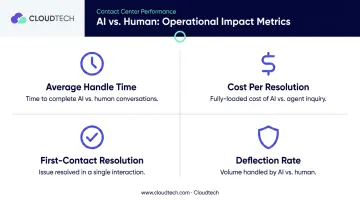
One critical framing note: don't compare AI AHT directly with human agent AHT. As Microsoft's contact center research explains, automation removes simpler contacts from the human queue — leaving agents with harder, longer cases. This can make human AHT increase post-deployment, even as total costs fall. The right comparison uses a combined bot-plus-agent measure and accounts for the changed case mix.
Category 3 — Customer and Business Outcome Metrics
These are lagging indicators — they confirm whether the investment is paying off. They're also what executives scrutinize most closely when evaluating whether to expand or cut the program.
Core metrics:
- CSAT (Customer Satisfaction Score) — direct customer feedback on the AI interaction
- NPS (Net Promoter Score) — longer-term loyalty signal, tracked at relationship level
- Bot-Assisted Conversion Rate — for sales or lead-gen deployments, the percentage of AI-handled conversations that advance to a conversion
- Overall ROI — cost savings plus revenue impact minus implementation and operating costs
Measure all four before launch. Without a pre-deployment baseline on CSAT, FCR, and cost per resolution, you won't be able to prove ROI to leadership — even when the numbers clearly improve.
How to Build Your Conversational AI Metrics Framework
The most common failure mode: deploying first and measuring second. By the time you realize the system isn't performing, you have no baseline to measure against.
Here's a five-step process that starts before launch and evolves with the system.
Step 1 — Define the Business Objective First
KPI selection must flow from the primary objective of the deployment. A cost-reduction initiative needs different leading metrics than a CX improvement program or a lead qualification bot.
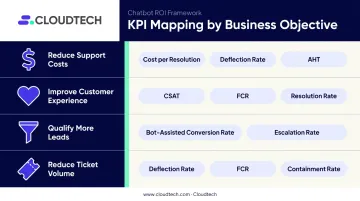
Common objectives and their KPI implications:
| Objective | Priority Metrics |
|---|---|
| Reduce support costs | Cost per resolution, deflection rate, AHT |
| Improve customer experience | CSAT, FCR, resolution rate |
| Qualify more leads | Bot-assisted conversion rate, escalation rate |
| Reduce ticket volume | Deflection rate, FCR, containment rate |
Step 2 — Establish Pre-Launch Baselines
Document current-state performance on your critical metrics in the weeks before go-live. Minimum baseline set:
- Average Handle Time (current human-only AHT)
- CSAT scores from existing channels
- Cost per interaction
- Escalation/transfer rate (if you have an existing bot or IVR)
- First-Contact Resolution rate
Step 3 — Build a Lean Starting Dashboard
Select 2–3 KPIs from each category, prioritized by your Step 1 objective. That gives you 6–8 metrics total, which is enough to tell a coherent story without overwhelming stakeholders.
Add metrics only after the core set is understood and being acted on consistently. More metrics rarely improve decisions; they usually slow them down.
Step 4 — Assign Ownership and Set a Review Cadence
Every KPI needs a named owner and a review rhythm:
- Weekly — technical performance metrics (intent accuracy, escalation rate, resolution rate)
- Monthly — operational metrics (AHT, cost per resolution, deflection rate)
- Quarterly — business outcome metrics and full framework reassessment
Step 5 — Close the Loop with Action
Metrics must trigger specific decisions:
- High drop-off in a specific conversation flow → redesign that flow
- Low accuracy on a particular intent → schedule retraining
- CSAT declining despite stable resolution rate → audit conversation quality, not just completion
Measurement without a feedback loop creates the illusion of improvement without the reality.
A Real-World Metrics Walkthrough
Consider an SMB deploying a conversational AI chatbot to handle customer support inquiries. The 90-day measurement arc below shows how the focus shifts as the system stabilizes.
Days 1–30: Establish AI Performance Baselines
The first month is diagnostic. You're not optimizing yet — you're learning.
- Track resolution rate, intent accuracy, and transfer/escalation rate daily
- Identify which intents are performing well and which are generating unexpected escalations
- Flag conversation flows with high abandonment before they affect CSAT
At this stage, a resolution rate lower than expected is not a crisis — it's data. The question is why.
Days 30–60: Shift to Operational Impact
Once the system is stable enough to benchmark, broaden the view:
- Compare AHT for bot-handled contacts against the pre-launch human baseline (using matched contact types, not raw averages)
- Calculate emerging cost per resolution using actual volume and handle time data
- Track deflection rate against the projected volume in your business case
This is the phase where operations leaders start to see the financial story taking shape.
Days 60–90: Evaluate Business Outcomes
Two months of operational data is enough to move from observation to outcome assessment:
- Compare CSAT scores against the pre-launch baseline
- Calculate an early ROI estimate: cost savings from deflection and AHT reduction, offset against implementation costs
- Review FCR rates to assess whether customers are returning for the same issues
Two warning signals to watch for:
- High containment rate + declining CSAT — the AI is technically handling conversations but not resolving them. This usually means the AI is trapping users in loops rather than solving their problems.
- Strong overall resolution rate + high escalation on one specific intent — a targeted training gap. That intent needs immediate attention.
In practice, a 90-day review triggers at least one concrete improvement action — redesigning a high-drop-off conversation flow or adding a missing intent category. The gains in resolution rate and CSAT are directly measurable against the baselines set in the first 30 days.
How Cloudtech Can Help
Knowing whether your conversational AI is working — and improving it continuously — requires the right measurement infrastructure built in from day one. That's where Cloudtech's AWS-native architecture approach makes a direct difference.
Cloudtech has designed and deployed AWS-based voice automation solutions across healthcare and other industries, with observability baked into the architecture rather than added after the fact. Two examples illustrate what measurable deployments look like in practice:
- Healthcare appointment scheduling: A HIPAA-compliant AI voice agent handling 2,500–5,000 monthly calls with 24/7 availability, full EHR integration, and warm transfers to human agents completed in under two seconds
- Lead qualification for Monster Reservations Group: Replaced an underperforming AI agent with an Amazon Bedrock + Amazon Connect solution that achieved 95%+ accuracy in customer preference gathering, cut response latency from 1,500ms to 500ms, and delivered a 67% projected reduction in cost-per-call
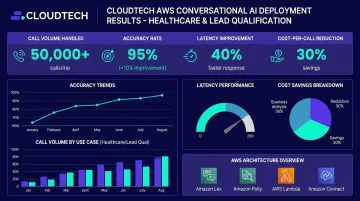
What makes these deployments measurable is that observability is built into the architecture from the start, not retrofitted after complaints surface. Cloudtech's AWS-native approach means monitoring infrastructure is configured as part of the solution — so you're tracking the right signals from day one.
For SMBs, that matters because you don't have the luxury of a large analytics team or months to troubleshoot a measurement gap post-launch. Cloudtech's engagements are designed to deliver speed-to-value — and to right-size the solution and its measurement framework to your actual goals and budget.
Ready to implement conversational AI with built-in KPI tracking? Connect with the Cloudtech team at connect@cloudtech.com or call (332) 222-7090 to discuss what a measurement-first conversational AI engagement looks like for your organization.
Frequently Asked Questions
What are the most important KPIs to track for conversational AI success?
Resolution rate, CSAT, and cost per resolution cover all three metric layers — technical, operational, and business. Which matters most depends on your objective: cost reduction favors deflection rate and cost per resolution, while CX improvement centers on CSAT and FCR.
What is the difference between containment rate and resolution rate?
Containment rate measures whether a conversation stayed within the AI system without escalating to a human. Resolution rate measures whether the customer's issue was actually resolved. A conversation can be contained but unresolved — which is why resolution rate is the more meaningful performance indicator of the two.
How do I establish a baseline before launching a conversational AI system?
Before go-live, document at least four metrics: average handle time, CSAT, cost per interaction, and escalation rate. Without these figures, post-launch improvement claims are unverifiable and your ROI case loses credibility with stakeholders.
How often should I review and update my conversational AI metrics?
Use a tiered cadence: weekly for technical performance metrics (intent accuracy, escalation rate, resolution rate), monthly for operational metrics (AHT, cost per resolution, deflection rate), and a full quarterly reassessment of the KPI framework itself to confirm it still aligns with your current business objectives.
Can SMBs implement a conversational AI measurement framework without a large analytics team?
Yes. Start with a lean 6–8 KPI dashboard using AWS-native monitoring tools or built-in analytics from your conversational AI platform. Working with an experienced implementation partner cuts setup complexity — and means the measurement infrastructure is designed into the architecture before launch, not added after the fact.
What is a realistic resolution rate benchmark for a conversational AI system?
Benchmarks vary: a Gartner-documented retail deployment reached 75% resolution (up from 40%), while IBM's cross-industry survey reported 64% average containment across 12 industries. Rather than chasing an external number, focus on improving your own pre-launch baseline — that's the figure that drives your ROI case.