Introduction
According to a KFF tracking poll, roughly 29% of U.S. adults now use AI for health information at least monthly. Most of them assume these tools carry the same privacy protections as their doctor's office. They don't — and for healthcare organizations recommending or integrating these tools, that gap isn't just a patient problem.
HIPAA, the regulatory framework governing health data, was built for hospitals, insurers, and their vendors. Consumer AI health apps operate outside that framework entirely. That creates real legal and reputational exposure: for patients sharing sensitive disclosures with chatbots, and for the organizations that deploy or endorse those tools.
This article covers what the HIPAA gap actually means in practice, the specific privacy risks AI health chatbots carry, how regulators are beginning to respond, and what healthcare organizations should evaluate before deploying any AI chatbot that touches health data.
Key Takeaways
- Most AI medical chatbots are not subject to HIPAA, even when handling sensitive health information
- "HIPAA-ready" and "HIPAA-compliant" are marketing terms — neither guarantees legal obligations or HHS enforcement authority
- Health data shared with non-HIPAA AI tools can be sold to third parties — no federal law prevents it
- Regulatory oversight is fragmented across the FTC, FDA, and select states — no comprehensive federal framework yet exists
- Before deploying any AI chatbot, verify BAA availability, cloud infrastructure, and independent security certifications
Why AI Medical Chatbots Are Entering Healthcare So Quickly
The demand side of this equation is straightforward. 43% of insured adults with fair or poor mental health reported needing but not receiving mental health services or medication in the prior year, according to KFF research. Cost barriers, long wait times, and stigma around seeking care are pushing patients toward whatever is available. AI chatbots are available immediately, at no cost.
Vendor capabilities have accelerated to meet that demand. Recent benchmarking found GPT-4o mini scoring 87%, 85%, and 80% on USMLE Steps 1, 2 CK, and 3 respectively — above the estimated human benchmarks for those exams.
The same study documented confident factual errors and multimodal reasoning failures, which matters enormously in clinical contexts. Exam performance and clinical reliability are not the same thing.
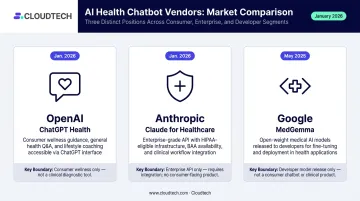
Major players have all launched dedicated health products in the last 18 months:
| Vendor | Product | Launch | Key Boundary |
|---|---|---|---|
| OpenAI | ChatGPT Health | Jan. 2026 | Consumer wellness; not presented as diagnostic |
| Anthropic | Claude for Healthcare | Jan. 2026 | Enterprise product with "HIPAA-ready infrastructure" |
| MedGemma / Health AI Developer Foundations | May 2025 | Open models for developers, not a consumer chatbot |
Healthcare organizations that haven't yet developed a policy on AI chatbot use almost certainly have staff — or patients — already using them. The policy gap is the real risk.
The HIPAA Gap: Why Most AI Health Apps Aren't Covered
Who HIPAA Actually Covers
HIPAA applies to covered entities — health plans, healthcare clearinghouses, and providers that transmit health information electronically — and their business associates: vendors contracted to handle Protected Health Information (PHI) on their behalf.
Consumer AI health apps almost certainly don't qualify. HHS guidance is explicit: an app developer doesn't become a business associate simply because a patient chooses to use the app. The business associate relationship only exists when a covered entity contracts with the vendor to create, receive, maintain, or transmit PHI on the covered entity's behalf.
What the Gap Means Practically
When HIPAA doesn't apply, there are no federal mandates requiring the company to:
- Protect health data from being sold to third parties or data brokers
- Notify users of a breach within any specified timeframe
- Submit to HHS audits or enforcement
Users are left with whatever the company's terms of service promise — and those can change.
The 23andMe Cautionary Case
This isn't a theoretical risk. When 23andMe filed Chapter 11 bankruptcy in March 2025, the genetic data millions of users had shared in good faith became a business asset subject to transfer. Twenty-seven states and Washington D.C. sued to block the sale without affirmative customer consent. A court ultimately allowed the $305M sale to proceed in July 2025.
The FTC issued warnings, but the regulatory machinery couldn't unwind what had already happened. Health data held by unregulated entities can — and does — end up somewhere users never anticipated.
Voluntary Commitments vs. Legal Rights
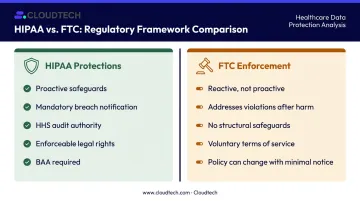
When an AI health app promises encryption, 30-day data deletion, or opt-outs from AI training, those are company policies. Not enforceable legal rights. A policy can be updated in a terms-of-service revision with minimal notice. A HIPAA obligation cannot.
The FTC can investigate unfair or deceptive data practices under Section 5 of the FTC Act, and its 2024 Health Breach Notification Rule update expressly covers health apps outside HIPAA. But FTC enforcement is reactive, not proactive — it addresses violations after harm occurs, rather than establishing the structural safeguards HIPAA requires of covered entities.
Key Privacy Risks When Using AI Medical Chatbots
Data Leakage and Third-Party Sharing
AI health chatbots frequently integrate with wellness apps, wearables, and external platforms. Each integration creates an additional data-sharing relationship with its own terms. Granting one app access to health data can create a chain of downstream access that users don't fully understand at the point of consent.
Conversation logs containing sensitive health disclosures can also be retained, analyzed, or used to train future models, with that fact buried in fine print most users never read.
Hallucination in Clinical Contexts
A 2025 JAMA Network Open review of 137 health-advice chatbot studies identified confidently incorrect results as a distinct and documented risk. Wrong dosage guidance, missed symptom flags, or a dangerously confident misdiagnosis aren't just clinical safety concerns. They also create liability exposure for any healthcare organization that recommended or integrated the tool.
Prompt Injection Attacks
NIST defines prompt injection as manipulating AI inputs to cause unintended behavior. Research testing Claude 3 Opus, Claude 3.5 Sonnet, Reka Core, and GPT-4o found all four susceptible to subvisual prompt-injection attacks embedded in medical images. In healthcare contexts, this vulnerability can expose other users' data or produce harmful outputs.
The Black-Box Problem
Even developers can't always fully explain how their models reach conclusions. JAMA Internal Medicine has called for model inputs and derivation to be made as transparent as possible, yet opacity remains standard practice. That lack of transparency creates three concrete problems for healthcare organizations:
- Auditing for bias becomes guesswork without insight into model logic
- Privacy commitments can't be verified at the model level
- Behavioral drift after deployment often goes undetected until harm occurs
The Regulatory Landscape: FDA, FTC, and State-Level Efforts
FDA's Current Position
The FDA's Digital Health Advisory Committee met in November 2025 specifically on generative AI digital mental health devices. Key recommendations included:
- Clearer labels on what tools can and cannot do
- Transparency about training data
- Stronger pre- and post-market safety requirements
- Validation across diverse patient populations
The FDA has authorized more than 1,200 AI-enabled medical devices. Fewer than 20 are authorized digital mental health devices — and as of that meeting, none were GenAI-enabled. Most AI chatbots sidestep FDA oversight entirely by marketing themselves as "general wellness" tools rather than diagnostic or treatment tools.
FTC Enforcement
The FTC has pursued health data privacy under its Section 5 authority over unfair and deceptive practices — and its Health Breach Notification Rule, expanded in 2024, now explicitly covers health apps and AI tools that handle personal health information outside of HIPAA. The agency has fined several digital health companies for sharing sensitive user data with advertisers without meaningful consent. For AI health chatbots, the FTC's position is clear: vague privacy disclosures buried in terms of service don't meet the bar for informed consent.
The State-Level Patchwork
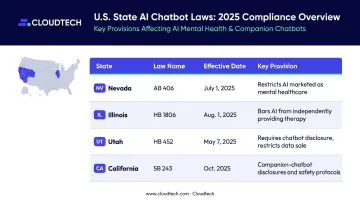
Several states have moved faster than federal regulators:
| State | Law | Status | Key Provision |
|---|---|---|---|
| Nevada | AB 406 | Effective July 1, 2025 | Restricts AI from being marketed as professional mental/behavioral healthcare |
| Illinois | HB 1806 | Signed Aug. 1, 2025 | Bars AI from independently providing therapy; allows limited administrative use |
| Utah | HB 452 | Effective May 7, 2025 | Requires chatbot disclosure; restricts use/sale of user information |
| California | SB 243 | Chaptered Oct. 2025 | Regulates companion-chatbot disclosures and safety protocols |
At the federal level, S.3097 (Health Information Privacy Reform Act) and H.R.8413 (SECURE Data Act) have been introduced but remain in committee. No comprehensive federal framework yet governs consumer-facing AI health tools.
That gap has real consequences. A healthcare organization operating in Nevada, Illinois, and California simultaneously faces three different chatbot disclosure regimes, three sets of restrictions on AI-provided care, and no unified standard for what "adequate consent" looks like — requiring separate legal review for each state of operation.
Decoding "HIPAA-Ready" vs. "HIPAA-Compliant"
This distinction matters more than most healthcare organizations realize.
These two terms are often used interchangeably — but they carry very different legal weight.
"HIPAA-ready" means a vendor's infrastructure is built to support HIPAA-eligible use cases: encryption at rest and in transit, access controls, audit logging. Anthropic's January 2026 announcement for Claude for Healthcare uses this language precisely — "HIPAA-ready infrastructure." That's not an accident. It signals capability, not legal obligation.
"HIPAA-compliant" implies the organization has undertaken all required administrative, physical, and technical safeguards under the law. But neither term tells you whether the vendor will sign a Business Associate Agreement, which is the actual legal mechanism that extends HIPAA obligations to a vendor.
Business Associate Agreements: The Actual Test
A BAA is required for any covered entity to legally share PHI with a vendor. Without one, using a vendor's AI tool with Protected Health Information puts the covered entity in violation of HIPAA — no matter of how the vendor describes their infrastructure.
BAA availability varies significantly by product and configuration:
- OpenAI: API customers may request a BAA; only sales-managed Enterprise or Edu customers are eligible for ChatGPT; Consumer ChatGPT Health is not identified as BAA-eligible
- Anthropic: BAA available for specified HIPAA-ready services and enterprise configurations — coverage is agreement-specific
- Google: Google Cloud offers a BAA; coverage of enterprise Gemini depends on the specific Cloud or Workspace service listed, not the Gemini name alone
The direct question every healthcare organization should ask: will you sign a BAA with us? If the answer is no, stop there — no amount of "HIPAA-ready" marketing language changes the legal exposure.
What Healthcare Organizations Should Evaluate Before Deploying AI Chatbots
Vendor Due Diligence Checklist
Before deploying any AI chatbot that could touch health data, verify:
- Will the vendor sign a Business Associate Agreement?
- What data does the tool collect, and how long is it retained?
- Who does the vendor share data with, including subcontractors?
- Has the vendor undergone independent security audits (HITRUST, SOC 2 Type II, NIST CSF)?
- Does the vendor have a documented breach notification process that meets HIPAA timelines?
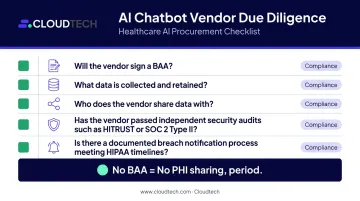
Security certifications like HITRUST and SOC 2 Type II don't substitute for HIPAA compliance — but they signal a notably higher baseline of security rigor than uncertified vendors.
Infrastructure and Cloud Architecture
The underlying cloud environment matters. AI chatbots built on HIPAA-eligible cloud infrastructure provide a more defensible security foundation than consumer-grade deployments.
AWS maintains a specific list of HIPAA-eligible services — including Amazon Bedrock, AWS HealthLake, Amazon Comprehend Medical, and Amazon SageMaker AI — that can be used to create, receive, process, or transmit PHI under an active AWS BAA. Configuration remains the customer's responsibility: being on a HIPAA-eligible service doesn't automatically mean a deployment is HIPAA-compliant.
Cloudtech has helped organizations like Klamath Health Partnership build HIPAA-compliant infrastructure on AWS from the ground up. That work spans secure data lakes for EHR storage, encryption via AWS KMS, and continuous monitoring through AWS Security Hub and CloudTrail.
Governance through AWS Control Tower ties it together — giving compliance teams the visibility and control they need before PHI ever touches the system.
Data Minimization and Retention
Architecture sets the foundation, but what data the tool collects — and how long it keeps it — determines your actual exposure. Evaluate whether the AI tool:
- Collects only the minimum data necessary for the stated function
- Allows users to delete their conversation data on request
- Uses patient interactions to train future models (high-risk for healthcare contexts)
- Has configurable retention policies aligned with HIPAA's minimum necessary standard
Staff Training and Policy Alignment
Deploying a technically compliant tool is only part of the equation. Healthcare organizations also need to:
- Train staff on what health information may and may not be entered into AI tools
- Update internal data handling policies to reflect AI usage
- Establish a process for monitoring vendor compliance over time — including reviewing any changes to the vendor's privacy policy or data handling practices
Start with Lower-Risk Use Cases
A phased approach reduces exposure. Begin with non-PHI workflows — administrative scheduling, general wellness Q&A, benefit navigation — before expanding AI chatbot use to clinical or sensitive data workflows. This allows organizations to assess real-world security performance, identify unexpected data flows, and build internal governance competency before the stakes are highest.
Frequently Asked Questions
Are AI medical chatbots HIPAA compliant?
Most are not. Unless a vendor has been contracted by a covered entity to handle PHI and has signed a Business Associate Agreement, the chatbot falls outside HIPAA's scope entirely. Any "HIPAA-compliant" claim in that context refers to infrastructure choices, not a legal obligation under federal law.
What is the difference between "HIPAA-ready" and "HIPAA-compliant"?
"HIPAA-ready" means the vendor's infrastructure supports HIPAA-eligible use cases. "HIPAA-compliant" implies all required administrative, physical, and technical safeguards are in place — but neither term guarantees the vendor is a regulated HIPAA entity or that they will sign a BAA.
Can AI health chatbots sell my health data to third parties?
If the chatbot is not a HIPAA-covered entity, no federal law prevents it from sharing health data with third parties or data brokers. Users should read each app's privacy policy — those voluntary commitments are not legally enforceable the way HIPAA protections are.
What happens to my health data if an AI health app shuts down or goes bankrupt?
Without HIPAA protections, health data held by an AI company can become a business asset transferred or sold during bankruptcy proceedings. The 23andMe case — where a court approved the $305M sale of genetic data despite widespread objections — illustrates exactly how this plays out.
What regulations apply to AI medical chatbots if HIPAA doesn't?
The FTC can act against unfair or deceptive data practices under Section 5 of the FTC Act, and its updated Health Breach Notification Rule covers qualifying health apps. Nevada, Illinois, and Utah have enacted AI-specific mental health laws, with other states advancing similar proposals. No comprehensive federal framework yet exists.
How should healthcare organizations assess an AI chatbot vendor's security?
Ask directly whether the vendor will sign a BAA. Look for independent security certifications (HITRUST, SOC 2 Type II) and confirm the tool runs on HIPAA-eligible cloud infrastructure. Verify the vendor's data retention and breach notification policies before any deployment involving patient data.