Why Business Leaders Are Investing in Conversational AI Now
Picture your customer support queue on a Monday morning: 400 tickets, 80% of them asking about order status, password resets, or account balances. Your team spends the first three hours of the week on interactions that follow identical patterns — every single week. That's not a staffing problem. That's an automation opportunity.
Conversational AI has moved well past the experimental phase. According to MarketsandMarkets, the global conversational AI market is projected to grow from $17.05 billion in 2025 to $49.80 billion by 2031. Salesforce reports that 75% of SMBs are already experimenting with AI — with adoption rates climbing fastest among growing businesses.
Companies sitting on the sidelines aren't just missing efficiency gains. They're watching competitors shorten response times, reduce support costs, and improve customer satisfaction — while their own teams still manually answer the same questions every Monday morning.
This guide is written for business leaders — not developers. It explains what conversational AI consulting actually covers, how a real implementation works from discovery to post-launch, and what it takes to build a system that delivers measurable ROI from day one.
Key Takeaways
- Conversational AI consulting covers the full lifecycle (strategy, architecture, integration, deployment, and optimization) — not just bot setup
- Architecture decisions made before development begins determine whether a system performs or plateaus
- SMBs in healthcare, financial services, manufacturing, and retail are well-positioned to capture high ROI from conversational AI
- A qualified partner designs for context retention, escalation paths, live data integration, and compliance from day one
- Track these four metrics to measure success: containment rate, cost-per-interaction, ticket deflection, and CSAT
What Conversational AI Consulting Actually Covers
Conversational AI consulting is the strategic and technical discipline of designing, building, and deploying AI systems that engage in natural language — including intelligent chatbots, voice agents, and LLM-powered virtual assistants — to automate customer interactions and internal workflows.
Rule-Based Chatbots vs. True Conversational AI
The distinction matters more than most business leaders realize.
| Capability | Rule-Based Chatbot | Conversational AI System |
|---|---|---|
| Input handling | Scripted keywords only | Natural language, varied phrasing |
| Context memory | None (each message is isolated) | Multi-turn dialogue with memory |
| Data access | Static responses | Live CRM, ERP, knowledge base |
| Escalation | Abrupt handoff | Graceful transfer with full context |
| Unrecognized inputs | Fails or loops | Manages gracefully, routes to human |
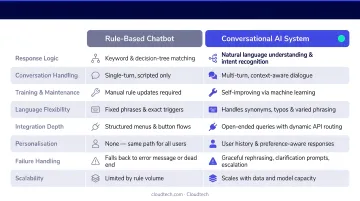
The table above makes the gap concrete. Rule-based systems handle only what they were explicitly programmed for — they fail visibly the moment a user deviates from the expected script. Modern conversational AI, built on NLP, large language models, and retrieval-augmented generation, understands intent and maintains context across a full conversation. It also pulls live data to personalize responses, something a scripted bot simply cannot do.
What a Consulting Engagement Covers
A complete engagement addresses each of these layers:
- Use case discovery and ROI mapping to identify which conversation types to automate first
- NLP and dialogue architecture design covering intent taxonomy, entity extraction, and fallback logic
- LLM selection and integration to connect the right models for reasoning and retrieval
- CRM, ERP, and helpdesk connectivity — what separates accurate responses from generic ones
- Omnichannel deployment across web, voice, Slack, SMS, or existing platforms
- Compliance architecture (HIPAA, SOC 2, GLBA) built in from day one, not retrofitted
- Post-deployment optimization using real conversation data to continuously improve performance
Gaps in any phase show up quickly in production — as high fallback rates, escalation spikes, or compliance exposure. The compliance architecture layer is the most expensive to retrofit: adding HIPAA or SOC 2 controls after launch typically requires rebuilding core data flows from scratch.
High-Impact Use Cases: Where Conversational AI Delivers Measurable Value
Customer Support and Ticket Deflection
Repetitive, high-volume queries — order status, account inquiries, password resets, FAQs — are structurally ideal for automation. The AI authenticates the user, pulls live account data, resolves the issue, and closes the interaction. No human required.
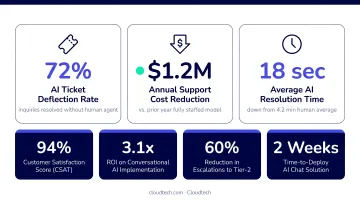
IBM research associates conversational AI with a 23.5% reduction in cost per contact when deployed for direct customer interactions. The Salesforce 2025 State of Service report finds AI currently handles 30% of service cases, with that figure expected to reach 50% by 2027. Service employees using AI also report spending 20% less time on routine tasks — recovering roughly four hours per week.
Healthcare and Life Sciences
Healthcare providers deploy conversational AI for appointment scheduling, pre-visit intake, medication reminders, and post-visit follow-up across web, voice, and SMS channels.
Critical architecture requirement: HIPAA compliance must be designed in from the start, not added after. This means controlling which data flows reach the AI model, encrypting PHI at rest and in transit, maintaining audit logs, and ensuring Business Associate Agreements are in place before any patient data touches the system.
Cloudtech's healthcare AI deployments — including a HIPAA-compliant voice agent handling appointment scheduling and a RAG-based care navigation assistant — are built on Amazon Bedrock, Amazon Connect, and Amazon Transcribe, with PHI handled through encrypted S3 storage and role-based access controls enforced throughout. In one documented healthcare SaaS engagement, the AI assistant reduced support tickets by 45% within two months while improving member satisfaction scores.
Financial Services and Insurance
Financial services firms deploy conversational AI across several high-value functions:
- 24/7 account inquiry handling — balance checks, transaction history, account status
- Loan and application updates — real-time status without routing to a human agent
- Fraud alert communication — proactive outreach and customer confirmation workflows
- Client onboarding — document collection, eligibility checks, guided intake
The differentiator in this sector is live data access. A system that cannot pull actual account records in real time produces generic answers that customers immediately distrust.
Compliance is non-negotiable here. The GLBA Safeguards Rule requires covered financial institutions to protect customer information through a documented security program — a requirement that shapes every data routing decision in a conversational AI architecture, which is why it must be addressed at the design stage, not retrofitted later.
Manufacturing, Logistics, and Internal Operations
Conversational AI value extends well beyond customer-facing applications:
- IT helpdesk automation — password resets, access requests, ticket status
- HR self-service — leave balances, onboarding FAQs, policy queries
- Supply chain inquiries — order status, delivery updates, inventory questions
ServiceNow's ASML deployment connected 6,000 employees in the first few weeks, with 80% user satisfaction and 90% response predictability. Internal deployments frequently deliver the fastest ROI in the portfolio — query volume is high, and response patterns are predictable enough to govern tightly.
Cloudtech's internal chat agents — built on AWS Bedrock and deployable in Slack, Microsoft Teams, or existing enterprise platforms — are trained on each client's own knowledge base and run within the client's own AWS environment, keeping sensitive operational data where it belongs.
The Strategic Roadmap: How Conversational AI Consulting Works
Phase 1 — Discovery and Conversation Audit
The most successful deployments start by analyzing actual business conversations — support tickets, call transcripts, chat logs — to produce an objective map of intent volume, query complexity, and resolution patterns. This data, not stakeholder assumptions, defines what gets automated first.
Gartner reports that more than 50% of GenAI projects are abandoned after proof of concept, with poor use-case selection as a leading cause. Skipping the audit phase means building for the conversations leaders think customers have — not the ones they actually have.
Phase 2 — Architecture and Dialogue Design
Before any development begins, a qualified consultant defines:
- Intent taxonomy and training phrases
- Dialogue flow logic and entity extraction
- Escalation trigger design and fallback strategy
- Compliance data routing requirements
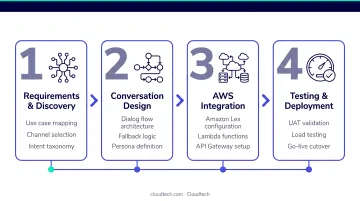
Time invested here reduces development cycles, QA effort, and post-launch remediation significantly. Get this phase right, and the rest of the build follows a clear path. Skip it, and you'll spend the budget fixing problems that were preventable.
Phase 3 — Technology Selection and Integration
Modern conversational AI systems are multi-model. A single conversation may route through an LLM for open-domain reasoning, a RAG layer for live knowledge base retrieval, and a classifier for intent routing — all within one interaction.
Cloudtech builds these systems on Amazon Bedrock as the LLM layer, using Amazon OpenSearch for near-real-time content indexing and AWS Step Functions for secure query orchestration. Deep integration with CRM, ERP, and helpdesk systems is what separates personalized, accurate responses from generic answers that erode user trust.
Phase 4 — Development, Testing, and Deployment
Development follows a milestone-based sequence:
- Core dialogue engine — intent recognition, entity extraction, conversation flow
- Integration layer — live data connections to CRM, ERP, knowledge base
- Channel deployment — web, voice, Slack, or SMS as defined in discovery
Before any user touches the live system, adversarial QA testing is essential — deliberate attempts to confuse the system with off-topic, ambiguous, or edge-case inputs. Cloudtech's voice agent deployments require warm transfer to a human agent in under two seconds, with full conversation context preserved, making escalation path testing a non-negotiable pre-launch milestone.
Phase 5 — Post-Deployment Optimization
Conversational AI does not reach peak performance on launch day. Organizations that treat launch as the finish line plateau within 60 days. Those that build optimization cycles into the engagement see compounding improvement over time.
Cloudtech's post-deployment service delivers:
- Real-time monitoring of conversation quality and system health
- Weekly tuning cycles driven by live conversation data
- Ongoing dialogue refinement as query patterns evolve
Latency and accuracy baselines established before launch become the benchmarks for every post-launch tuning cycle.
How to Choose the Right Conversational AI Consulting Partner
Before any demo, the right consulting partner will ask about your workflows, your compliance requirements, and what outcomes actually matter to your business.
Evaluate partners on these criteria:
- Ask for measurable outcomes — ticket deflection rates, cost-per-contact reductions — from real client engagements, not polished demos
- Verify industry experience, including familiarity with applicable compliance frameworks (HIPAA, GLBA, SOC 2)
- Confirm engagements are scoped around defined deliverables, not open-ended hourly billing
- Check whether they conduct a conversation audit before recommending any platform
Infrastructure credentials matter here too. An AWS-certified partner brings native access to Amazon Lex, Amazon Connect, and Amazon Bedrock — the core building blocks for enterprise-grade conversational AI — along with potential AWS Partner Funding that can reduce or eliminate out-of-pocket implementation costs for qualifying SMBs.
Cloudtech, for example, holds AWS Advanced Tier Partner status and is among a small group of partners selected for AWS's Small Business Acceleration Initiative, which focuses on making AWS-powered solutions accessible to SMBs. Both chat and voice conversational AI solutions are built entirely within the client's own AWS environment, ensuring full data ownership and compliance control from day one.
A partner who recommends a platform before understanding your workflows is optimizing for their sale, not your outcomes.
How to Measure ROI: Key Metrics for Business Leaders
Containment Rate
Containment rate — the percentage of conversations fully resolved by the AI without human escalation — is the foundational metric. Everything else compounds from it. A system handling 60% of interactions at $0.50 per contact versus $8.00 for a live agent makes the cost case straightforward to model.
Gartner predicts agentic AI will autonomously resolve 80% of common customer service issues without human intervention by 2029. Current benchmarks vary significantly by system maturity, integration depth, and conversation complexity — which is why establishing a baseline before deployment is essential for accurate ROI attribution.
Operational Efficiency Metrics
Track these together rather than in isolation:
- Support ticket volume reduction
- Average handle time for escalated interactions
- Call volume to live agents
- Time-to-resolution for automated vs. human-handled queries
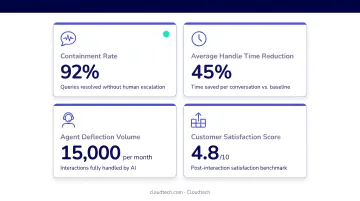
These metrics connect directly to headcount requirements and operational cost — making the ROI case clear to any stakeholder without requiring technical translation.
Customer Experience and Revenue Metrics
Three additional metrics complete the picture:
- CSAT scores — track satisfaction before and after deployment to validate experience improvements
- Customer retention rates — measure whether AI-assisted service reduces churn
- Conversion rates — for sales-oriented deployments, tie interactions directly to pipeline outcomes
Establish baselines before launch. Without pre-deployment benchmarks, there is no clean before-and-after comparison — and leadership deserves a measurable outcome, not a gut feeling.
Frequently Asked Questions
What does a conversational AI consultant actually do?
A conversational AI consultant guides the full project lifecycle — from auditing existing business conversations and mapping use cases to ROI, through dialogue architecture design, LLM selection, system integration, channel deployment, and ongoing post-launch optimization. The role spans strategy and technical execution, not just technology selection.
How is conversational AI different from a regular chatbot?
Rule-based chatbots follow scripted decision trees and break on any input they weren't programmed to handle. Conversational AI uses NLP and large language models to understand intent, maintain context across multi-turn dialogue, and pull live business data — delivering higher resolution rates and a significantly better user experience.
Is conversational AI only for large enterprises, or can SMBs benefit too?
SMBs are well-positioned to benefit — often more so than large enterprises, because the gap between current manual workload and what automation can handle is larger. AWS-native tools like Amazon Lex and Amazon Connect accelerate deployment, and AWS Partner Funding can reduce out-of-pocket implementation costs for qualifying organizations.
How long does a conversational AI implementation take?
Scope and compliance requirements drive the timeline. Focused single-channel deployments can move quickly, while multi-channel builds with live CRM connectivity and HIPAA or SOC 2 architecture take longer. Partners who invest in discovery and architecture phases consistently deliver on schedule.
What industries benefit most from conversational AI?
Healthcare, financial services, manufacturing, retail, and SaaS are the highest-ROI verticals. Healthcare and financial services lead because of high query volume, strict compliance requirements, and clear cost-per-interaction savings that make the business case straightforward to measure.
How do you measure whether a conversational AI deployment is successful?
Start with containment rate, then track support ticket volume reduction, CSAT, time-to-resolution, and cost-per-contact. For revenue-oriented use cases, add conversion rates. Establish baselines before deployment — without them, ROI attribution is guesswork rather than evidence.