Generative AI is different from conventional rule-based automation. Where legacy systems match patterns, large language models (LLMs) read context. They interpret clinical documentation, generate written outputs, and adapt to nuanced payer requirements — capabilities that legacy automation simply cannot replicate.
What was once experimental is now operational. 63% of healthcare organizations have integrated AI-powered automation into their revenue cycle, and the global AI in revenue cycle management market was valued at $20.63 billion in 2024, projected to reach $70.12 billion by 2030. Organizations that understand where GenAI applies — and where it requires oversight — are better positioned to compete on cost and performance.
Key Takeaways
- GenAI automates complex billing tasks — coding, claim submission, denial management, and prior authorization — tasks that once consumed hours of manual work.
- AI-powered coding systems can achieve accuracy above 95%, reducing billing error rates from 15–20% to under 3%.
- Initial claim denials climbed to nearly 12% in 2024; predictive AI tools are demonstrating 40–60% reductions in denial rates.
- AI-assisted upcoding has been linked to billions in excess spending; human oversight and audit frameworks remain essential.
- Any GenAI billing deployment requires HIPAA-compliant cloud infrastructure as its foundation.
Current Applications of Generative AI in Healthcare Billing
Generative AI is not one monolithic tool — it's a set of capabilities applied across multiple stages of the billing workflow. LLMs, NLP, and predictive analytics each play a role, often working together within a single revenue cycle platform.
Automated Medical Coding
Traditional coding depends on human coders manually reviewing physician documentation and assigning ICD-10, CPT, and HCPCS codes, a process prone to inconsistency as code sets grow more complex. The AMA's CPT 2025 update alone included 270 new codes, 112 deletions, and 38 revisions.
GenAI systems trained on medical records interpret clinical language contextually, not just by keyword. The results are measurable:
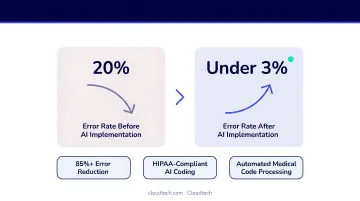
- AI-powered coding can achieve accuracy rates exceeding 95%, reducing error rates from 15–20% to less than 3%
- A 2024 peer-reviewed nephrology study found ChatGPT-4 achieved 99% accuracy assigning ICD-10 diagnosis codes in tested scenarios
- This represents an error reduction of up to 85%, according to CareCloud
Claims Generation and Submission
GenAI can auto-populate claim forms by extracting structured data from clinical documentation, eliminating redundant manual entry across EHR and billing systems. It also flags potential errors before submission, catching issues that trigger denials downstream.
The processing speed difference is substantial. AI-assisted claim processing compresses average timelines from 30–45 days to 2–7 working days, while cutting initial denial rates by 40–60% (vendor-reported, CareCloud). Third-party data reinforces this: Experian Health reports that OhioHealth achieved a 42% reduction in denials using AI-powered patient access tools, and that 69% of providers using AI reported measurable denial reductions.
Denial Management and Predictive Analytics
With HFMA reporting denial rates at nearly 12% in 2024 (a 2.4% year-over-year increase), predictive denial management has become essential for most revenue cycle teams.
GenAI systems analyze historical claims data to flag high-risk claims before submission and automatically generate draft appeal letters with contextual justifications. Vendor-reported outcomes include:
- 90% average denials overturn rate with AI-driven workflows (R1 RCM, vendor-reported)
- Montage Health achieved a 13% decrease in A/R days and saved 300 staff hours per month through AI-assisted authorization-status automation (AKASA case study)
- HFMA estimates denial rework administrative costs have reached nearly $20 billion annually
Prior Authorization Automation
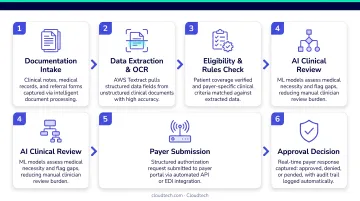
Physicians and their staff spend an average of 13 hours per week completing approximately 40 prior authorizations per physician — and 95% of physicians say those delays directly harm patient care.
GenAI streamlines this by automatically drafting authorization requests, pulling relevant clinical evidence from patient records, and aligning documentation with payer-specific requirements. The cost savings are concrete:
- Manual prior authorization transactions cost providers roughly $12 each (CAQH)
- Switching to electronic, AI-assisted workflows saves specialists up to $8.51 per transaction
Patient-Facing Billing Explanation Generation
Research published in PMC found that 87% of consumers were surprised by a medical bill, nearly 40% found bills confusing, and only 2 in 10 patients knew what they would owe after an appointment. That confusion drives billing disputes, delayed payments, and inbound call volume that strains staff.
GenAI addresses this by generating plain-language explanations of medical bills, EOBs, and coverage details tailored to each patient's situation. Cedar's AI billing agent shows what's possible:
- Fully resolves 15% of calls without human involvement
- Reduces live-agent handle time by up to 25% (vendor-reported)
What's Driving GenAI Adoption in Healthcare Billing
Multiple converging pressures — operational, technological, and financial — are accelerating adoption, particularly among small to mid-sized healthcare organizations operating under margin pressure.
Administrative cost burden: Health Affairs research confirms administrative costs consume 25–31% of total U.S. healthcare spending, with 82% of those administrative costs linked to billing and insurance-related tasks. A U.S. inpatient surgical bill costs $215.10 and 100 minutes to process — compared with $6 for a comparable Canadian bill. GenAI automation is a direct lever on that gap.
Labor shortages: AHIMA reports that 66% of health information professionals experienced persistent staffing shortages over the prior two years, and the AMA has identified a 30% shortage in medical coders. AI tools that scale throughput without proportional headcount growth are a practical response, not just a strategic aspiration.
Regulatory complexity: The FY 2025 ICD-10-CM update included 252 new codes, 36 deletions, and 13 revisions — effective October 2024. Payer-specific rules add another layer. GenAI systems that learn from updated data are better positioned to keep pace with this complexity than static rule sets.
Cloud infrastructure maturation: Scalable, secure cloud platforms now make deploying GenAI billing tools viable for organizations of all sizes. AWS provides the data processing capacity and security architecture these workloads require. AWS-certified partners like Cloudtech help healthcare organizations build HIPAA-compliant infrastructure that supports AI without requiring an enterprise budget.
How GenAI Is Impacting the Healthcare Billing Industry
GenAI is reshaping healthcare billing from multiple angles simultaneously — and the changes are measurable, not theoretical.
Operational Impact
The most immediate changes are in processing efficiency and error rates:
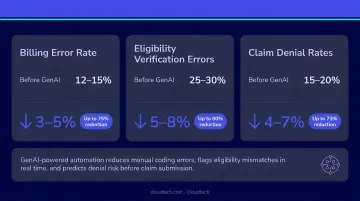
- AI reduces billing error rates from 15–20% to less than 3% — an 85% improvement
- Automated eligibility verification cuts denials related to patient coverage by up to 70% (CareCloud, vendor-reported)
- Experian Health data shows 43% of providers say incomplete eligibility checks add at least 10 minutes of work per check — automation eliminates this friction entirely
- Providence saved $18 million in potential denials through automated coverage discovery (Experian, vendor-reported)
EHR-to-billing integration is also eliminating data silos that have historically caused duplicate entry and eligibility-related denials — one of the top three denial drivers for 15% of providers.
Business Impact
Revenue cycle metrics are improving for early adopters:
- HFMA reports 22% of healthcare leaders lose at least $500,000 annually to denials; 10% lose more than $2 million
- R1 RCM reports full-cycle AI orchestration can produce a 5–7% net revenue gain, 50% reduction in cost to collect, and 60% operational throughput improvement (vendor-reported)
- For growing practices, AI handles volume fluctuations without proportional staff increases — a meaningful scalability advantage as patient volumes rise
Workforce Impact
Billing and coding roles are evolving, not vanishing. The BLS projects medical records specialist employment will grow 7% from 2024 to 2034, faster than the average for all occupations.
What's shifting is the nature of the work:
- Routine data entry and code assignment are increasingly handled by AI
- Professionals are moving toward exception handling, complex appeals, compliance oversight, and AI output review
- New skills in demand include AI system management, data interpretation, and audit processes
Organizations that invest in reskilling alongside technology deployment tend to see faster adoption and fewer compliance gaps than those that treat AI as a drop-in replacement.
Risks and Compliance Considerations of GenAI in Billing
AI-Assisted Upcoding
The most significant documented risk is also the least discussed. Blue Cross Blue Shield's Blue Health Intelligence analysis found that AI-enabled hospital coding tools appear to be contributing to a pattern of upcoding — diagnoses coded without corresponding treatment evidence.
The scale is material:
- Coding acute posthemorrhagic anemia in maternity admissions added $22 million in costs in a single year
- Aggressive AI-assisted coding may be linked to $663 million in inpatient and $1.67 billion in outpatient spending
- HFMA summarized the combined figure as approximately $2.3 billion
Human oversight and structured audit processes are not optional add-ons when deploying GenAI billing tools — they're built into compliance requirements at every level.
HIPAA Compliance and Data Privacy
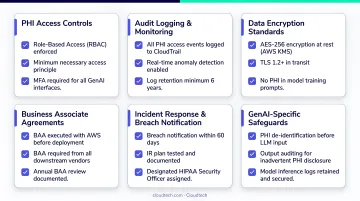
Any GenAI tool processing protected health information (PHI) must meet strict data governance standards. Under HHS guidance, any cloud service provider that creates, receives, maintains, or transmits ePHI qualifies as a business associate. That classification requires a HIPAA-compliant Business Associate Agreement (BAA) before deployment.
Key requirements include:
- Access controls, audit trails, and integrity controls under the HIPAA Security Rule
- Encryption at rest and in transit for all ePHI
- Vendor vetting for HIPAA certifications before deployment
- HIPAA-compliant underlying cloud infrastructure — not just the AI application layer
The 2024 HHS HIPAA Security Rule NPRM proposed strengthening ePHI cybersecurity requirements further — a signal that regulatory expectations are tightening, not loosening.
AI Bias and Clinical Context Gaps
GenAI models trained on historical billing data can perpetuate existing coding biases or misinterpret clinical nuance. A model that learned from a flawed training set will produce flawed outputs — and do so confidently, without flagging uncertainty.
This is why trained billing professionals must review AI-generated outputs before claim submission. Structured pre-submission audits, clear escalation paths for ambiguous cases, and periodic model revalidation are the controls that keep AI assistance from becoming a liability.
Future Signals for Generative AI in Healthcare Billing
CMS published a Real-Time Claims Processing Pilot document in July 2025, framing goals around reducing revenue cycle management burdens — including denials and appeals. Real-time adjudication, where claims are generated and submitted before a patient leaves the facility, is estimated to carry potential administrative savings of $45 billion annually if deployed at scale.
Several other signals point to where the industry is heading over the next 2-3 years:
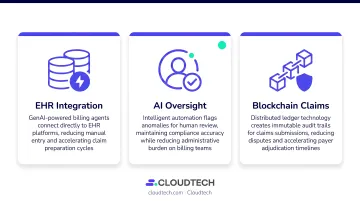
- EHR-to-billing integration is accelerating toward a seamless automation loop from clinical documentation to reimbursement, with minimal human intervention in routine cases
- AI coding oversight frameworks are coming — the BCBS/BHI upcoding analysis and HFMA's focus on denial metrics signal that federal and commercial payers are building formal governance requirements; organizations with audit protocols already in place will be ahead of those mandates
- Blockchain-integrated claims verification is an early-stage but active development area; a 2025 Frontiers systematic review found that smart contracts can automate adjudication and reduce administrative disputes
Taken together, these signals point to the same underlying requirement: healthcare organizations need compliant, scalable cloud infrastructure before they can act on any of them. Organizations that build that foundation now — HIPAA-compliant data environments, intelligent document processing pipelines, GenAI-ready architecture — are the ones that will execute quickly when these capabilities become standard. Cloudtech works with healthcare SMBs to build exactly that on AWS, without the overhead of an enterprise engagement.
Frequently Asked Questions
How is AI used in medical billing?
AI automates key billing workflow steps — including clinical documentation analysis, medical code assignment (ICD-10, CPT, HCPCS), claim submission, eligibility verification, and denial management. This reduces manual effort and improves accuracy across the revenue cycle.
What are the top 5 denials in medical billing?
The most common denial reasons are eligibility and coverage issues, missing or incorrect prior authorization, incorrect or unsupported coding, duplicate claim submissions, and missing documentation. Generative AI tools proactively flag many of these issues before a claim is ever submitted.
What is the difference between AI and generative AI in healthcare billing?
Traditional AI uses rule-based logic or machine learning to classify and match patterns. Generative AI uses LLMs to understand clinical language in context, generate content like appeal letters, and adapt to nuanced documentation — making it more capable for complex billing tasks.
Is generative AI HIPAA-compliant for use in medical billing?
Generative AI tools can be deployed in HIPAA-compliant ways, but compliance depends on the vendor's data governance practices, the security of the underlying cloud infrastructure, and contractual protections like Business Associate Agreements. Organizations must vet tools carefully before handling any PHI.
Can generative AI reduce claim denial rates?
Yes — by flagging errors before submission, running real-time eligibility checks, and applying predictive analytics to high-risk claims, GenAI has demonstrated real reductions in initial denial rates. CareCloud reports 40–60% reductions; OhioHealth achieved a 42% reduction using Experian's AI tool.
Will generative AI replace medical billing and coding professionals?
Generative AI is reshaping these roles rather than replacing them. Billing professionals are shifting from routine data entry toward oversight, exception handling, compliance auditing, and AI output review. The BLS projects 7% job growth for medical records specialists through 2034, with demand rising for professionals who can work alongside AI systems.