Introduction
Businesses across healthcare, financial services, and logistics are fielding more inbound calls than ever without the headcount to match. A front desk that misses calls after 5 PM loses patients. A lending firm that can't reach leads within minutes loses deals. A logistics dispatcher buried in routine status calls loses time that compounds across every shift.
Conversational voice AI has moved from interesting experiment to operational infrastructure in the last 18 months. A 2024 Gartner survey of 187 customer service leaders found 44% already exploring, 11% piloting, and 5% actively deploying GenAI voicebots. Gartner projected that figure would reach 85% exploring or piloting by 2025.
This guide covers what conversational voice AI is, where it delivers the clearest ROI, how AWS infrastructure makes it scalable for SMBs, and what to evaluate before committing to a platform.
Key Takeaways:
- Conversational voice AI uses LLMs, not rigid menus, to handle full phone conversations
- Healthcare, financial services, and logistics see the clearest ROI in 2026
- AWS-native services form the backbone of scalable voice AI deployments
- TCPA, FCC disclosure rules, and HIPAA compliance must be built in from day one
- Total cost of ownership matters far more than advertised per-minute rates
What Is Conversational Voice AI for Automated Phone Calls?
Beyond the Key-Press Menu
Conversational voice AI is an LLM-powered system that conducts full, natural-language phone conversations. Unlike legacy IVR menus, these systems understand what a caller means, remember what was said earlier in the call, and take action mid-conversation — all without forcing callers through a rigid key-press sequence.
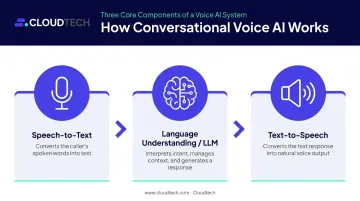
The core components working together in real time:
- Speech-to-text (STT): Converts the caller's spoken words into text the system can process
- Language understanding (LLM): Interprets intent, manages multi-turn context, and generates a response
- Text-to-speech (TTS): Converts the response back into natural-sounding voice output
Traditional IVR forces callers through rigid scripts. If a caller says "I need to move my Thursday appointment" instead of pressing the correct sequence of keys, IVR fails. A conversational AI system understands the intent, checks the calendar, confirms the change, and updates the record — all within the same call.
The Latency Problem That Got Solved
The technical shift that made this viable at scale was low-latency LLM inference. A 2024 University of Victoria/Northeastern paper found average human conversational response gaps of 239 milliseconds in English, while many automated systems were responding in 1,000–1,500ms — a gap callers noticed immediately.
By 2025, that gap had closed significantly. AWS introduced Amazon Nova Sonic in April 2025 as a unified speech-to-speech model with bidirectional streaming, eliminating the need to chain separate STT, LLM, and TTS models. The result: response latency approaching natural conversation speed.
With latency no longer a barrier to natural-feeling calls, the deployment question shifts from can it work to how should it be configured. Most production deployments combine both modes:
Inbound vs. Outbound Modes
- Inbound: The AI answers calls 24/7, resolving queries, booking appointments, and routing complex cases to human agents
- Outbound: The AI initiates calls at scale — payment reminders, lead qualification, appointment confirmations, follow-up surveys
Neither mode requires the other. That said, teams running both typically report the highest call deflection rates and the sharpest reductions in agent handle time.
Key Use Cases for Conversational Voice AI in 2026
Inbound Support and After-Hours Coverage
Every missed call is a missed opportunity. For a healthcare clinic, that might mean a patient who couldn't reach their provider after hours. Conversational voice AI answers instantly, resolves common queries (office hours, directions, insurance questions, prescription refill status), and logs structured data for human follow-up when needed.
For healthcare clinics, this means no voicemail drop-off after hours. For logistics dispatchers, it means drivers get routing updates without tying up a human. For financial services firms, it means leads don't go cold because nobody picked up.
Appointment Scheduling and Reminders
This is where the evidence is strongest. Zocdoc reported that early adopters of its voice AI agent resolved up to 70% of scheduling calls without staff intervention. That's a vendor-reported figure, but it's directionally consistent with what production deployments are showing.
Voice agents integrate directly with calendar systems to:
- Book and confirm appointments in real time
- Reschedule without requiring a human agent
- Send automated confirmation calls before the appointment date
Cloudtech's documented deployment for Ascend BPO, a healthcare BPO firm, handled 2,500–5,000 monthly appointment scheduling calls autonomously, completing identity and insurance verification in under 60 seconds per call.
Outbound Lead Qualification
Speed matters in lead response. An outbound voice agent can call a form submission within seconds, run a qualification script, update CRM fields, and route hot prospects to human reps without waiting on an available sales rep.
Cloudtech's work with Monster Reservations Group shows what that looks like in practice. Response latency dropped from 1.5 seconds to 500ms, and the deployment achieved a 67% reduction in cost-per-call, keeping conversations natural enough that callers stayed engaged through the full qualification flow.
Collections, Payment Reminders, and HR Applications
Beyond customer-facing calls, outbound voice AI has found traction in two operational areas that benefit from structured, repeatable phone contact.
Collections and billing teams use voice agents for payment reminder campaigns, partial payment acceptance via IVR integration, and flagging accounts that need human escalation. The compliance requirements here are significant (covered in detail below).
HR teams have found narrower but real applications: candidate pre-screening calls, onboarding check-ins, and employee survey calls. The AI handles scheduling and initial screening; humans handle everything that requires judgment.
Core Capabilities That Separate Modern Voice AI from Basic IVR
Natural Language Understanding and Off-Script Handling
The quality gap between platforms becomes obvious the moment a caller deviates from the expected flow. A caller partway through booking an appointment who suddenly asks "Wait, does my insurance cover this?" can derail a template-based system entirely. An LLM-native system handles the detour, answers the question using available information, and picks up the booking flow exactly where it left off.
This off-script handling is where most demo-to-production gaps appear. A polished vendor demo follows a perfect script — real callers rarely do.
Human Handoff and Warm Transfer Logic
A well-designed escalation path looks like this:
- The AI detects urgency, a topic it shouldn't automate (a patient describing symptoms, a caller expressing distress), or an explicit request for a human
- The AI tells the caller it's transferring them — and why
- The human agent receives a live summary of the conversation before picking up
- The caller doesn't repeat themselves
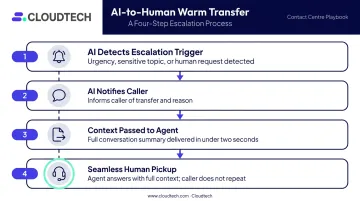
A cold transfer that drops the caller into a queue with zero context undoes any goodwill the AI interaction generated. The best deployments pass full conversational context to the agent before the call even connects — typically in under two seconds.
CRM Integration and Post-Call Analytics
The business value isn't just the call — it's what happens after. Structured outcomes need to flow back automatically:
- CRM fields updated with caller intent, qualification status, and next action
- Calendar systems reflecting confirmed or rescheduled appointments
- Post-call summaries generated without agent effort
Platforms with shallow integrations create manual reconciliation work that erases the efficiency gains the AI was supposed to deliver.
Those integrations also unlock a more valuable analytics layer. Automated call scoring and transcript review at 100% coverage is something manual QA simply can't match. NICE's Auto Score capability evaluates every interaction — compared to the traditional 1–2% sampling rate — which is a meaningful difference in compliance-heavy environments where gaps in coverage carry real risk.
How AWS Infrastructure Powers Scalable Voice AI
The four AWS services that form the backbone of a production voice pipeline:
| Service | Role in Voice Pipeline | Pricing Structure |
|---|---|---|
| Amazon Connect | Telephony, routing, contact flows, self-service orchestration | $0.038/voice minute + telephony |
| Amazon Lex | Speech recognition and natural language understanding | $0.004/speech request |
| Amazon Polly | Text-to-speech voice synthesis | $4/1M characters (standard); $16/1M (neural) |
| Amazon Transcribe | Streaming speech-to-text and call analytics | Pay-as-you-go, 1-second increments |
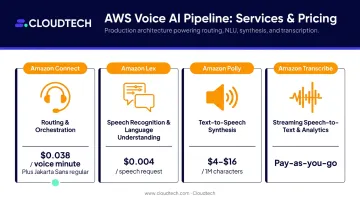
Each service uses a different billing unit — which is why a single advertised per-minute platform rate rarely reflects actual production costs.
Why This Matters for SMBs
Three specific advantages of AWS-native voice AI for smaller organizations:
- Absorbs call volume spikes — open enrollment periods, product launches, seasonal surges — without pre-provisioned capacity
- Eliminates the capital expenditure that enterprise CCaaS deployments historically required, with pay-as-you-go pricing across all four services
- Amazon Connect, Lex, Polly, and Transcribe are all HIPAA-eligible and in scope for AWS SOC compliance programs. Note: HIPAA eligibility at the service level still requires a Business Associate Agreement when a vendor handles PHI
That compliance architecture is only useful if it can be stood up quickly. For SMBs without internal cloud engineering teams, deployment timelines are the real constraint. Cloudtech's AWS-certified architects have built HIPAA-compliant voice AI infrastructure for healthcare clients — including the Ascend BPO deployment — compressing what would otherwise be multi-month builds into week-scale engagements.
What SMBs Should Look for When Evaluating a Voice AI Platform
Total Cost of Ownership, Not Headline Price
Advertised per-minute rates rarely include:
- LLM inference costs (often billed separately)
- Voice synthesis at neural quality
- Telephony charges on top of platform fees
- Compliance add-ons (HIPAA BAA, SOC 2 documentation access)
- Post-call analytics as a premium tier
Calculate cost per qualified conversation or cost per booked appointment instead. That metric accounts for call duration, resolution rate, and what the call actually produced.
Compliance Access and Coverage
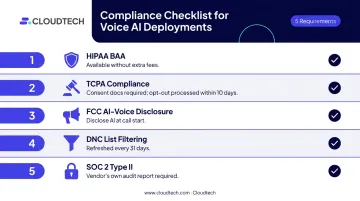
Non-negotiable requirements for regulated industries:
- HIPAA BAA: Available without additional sales engagement or fees
- TCPA compliance: Consent documentation, consent revocation honoring within 10 business days (per FCC 24-24), and opt-out mechanisms built into outbound workflows
- FCC AI-voice disclosure: The FCC classified AI-generated voices as "artificial voices" under TCPA in February 2024; a proposed rule (July 2024 NPRM, not yet final) would require disclosure at call start — build this in regardless of final rule status
- DNC list filtering: FTC rules require accessing the National DNC Registry at least every 31 days and honoring company-specific opt-outs
- SOC 2: Verify the vendor holds its own SOC 2 Type II report — AWS service eligibility doesn't automatically cover a third-party platform's complete call path
State-level requirements add another layer. California requires AI-voice disclosure for recorded messages (AB 2905). Florida and Texas each have separate statutory restrictions on automated outbound calling.
Workflow Ownership and Setup Complexity
Platforms fall into two broad categories — each with real tradeoffs for SMBs:
- No-code template platforms: Fast setup, lower engineering overhead, limited flexibility for complex workflows
- API/developer platforms: Maximum control and customization, but require dedicated engineering to build and maintain
For SMBs without a dedicated engineering team, the right question is: which platform can your operations team own, update, and QA without opening a support ticket? If every workflow change routes through vendor support or internal engineering, the maintenance burden quietly eats into the system's business value.
Challenges and Limitations to Plan For
Compliance Complexity in Outbound Deployments
TCPA, FCC AI-voice rules, and state-level calling regulations are actively evolving. Any outbound voice AI deployment needs these built in from the start:
- AI disclosure language at the start of every call
- DNC list filtering refreshed at least every 31 days
- An automated opt-out mechanism that immediately suppresses future outreach
- Consent documentation for wireless numbers and telemarketing calls
- Awareness that California, Florida, and Texas each impose additional requirements beyond federal rules
Bolt-on compliance after launch invites regulatory fines, forced campaign shutdowns, and brand damage that takes far longer to repair than building it in correctly from day one.
Off-Script Handling and Production Readiness
Compliance covers the legal perimeter — but technical resilience is what keeps a deployment running once real callers arrive. Demo quality and production quality are not the same thing. Common failure points in live deployments:
- Callers who provide information out of sequence
- Background noise (cars, children, office environments) that degrades STT accuracy
- Edge cases the conversation design didn't anticipate
- Escalation paths that weren't tested under realistic conditions
Before signing with any vendor, require them to demonstrate exception handling and fallback logic using realistic scenarios — not polished demo scripts with cooperative callers in quiet rooms.
Frequently Asked Questions
What is the difference between conversational voice AI and a traditional IVR system?
Traditional IVR routes callers through rigid touch-tone menus — if you don't press the right key, the system fails. Conversational voice AI understands natural language, manages multi-turn dialogue, and executes actions mid-call (scheduling, lookups, updates). The practical result is higher first-call resolution and fewer callers hanging up before they get help.
What industries benefit most from automated phone calls powered by voice AI?
Healthcare (scheduling, patient intake, after-hours coverage), financial services (payment reminders, lead qualification), logistics (dispatch coordination, status updates), and retail (order inquiries, after-hours support) see the clearest impact in 2026. All four verticals deal with high inbound volume, repetitive call types, and clear cost-per-call economics that make the ROI easy to quantify.
How does AWS support conversational voice AI deployments?
Amazon Connect handles telephony and routing, Lex manages natural language understanding, Polly delivers natural-sounding voice output, and Transcribe converts speech to text in real time. Together they offer pay-as-you-go pricing, built-in scalability, and native compliance controls (HIPAA eligibility, SOC scope) — making enterprise-level voice AI accessible to SMBs without the enterprise infrastructure cost.
What compliance requirements apply to AI-powered automated phone calls?
TCPA requires prior express consent for calls using artificial or prerecorded voice, and the FCC now classifies AI-generated voices under that definition — with a pending rule requiring AI disclosure at call start. FTC rules mandate DNC list filtering every 31 days, and healthcare deployments require a Business Associate Agreement from any vendor touching PHI. Build these requirements into the system architecture before launch, not after.
How long does it typically take to deploy a conversational voice AI system?
Template-based no-code platforms can be live in hours to days. Custom AWS deployments — covering HIPAA architecture, CRM integration, and multi-node conversation design — typically run several weeks. An AWS-certified partner like Cloudtech can cut that timeline compared to an internal team building from scratch.
What should SMBs prioritize when choosing a voice AI platform?
Total cost of ownership (not headline per-minute rates), compliance access without extra fees, CRM integration depth, and the ability for non-technical teams to manage workflows without engineering support. Prioritize vendors who can demonstrate off-script handling and escalation paths under realistic conditions before you commit.