Introduction
Sales teams are hemorrhaging time on leads that were never going to close. According to Salesforce research covering more than 7,700 sales professionals, reps spend only 28% of their week actually selling — down from 34% in 2018 — with manual tasks like lead management, data entry, and record-keeping consuming the rest. HubSpot puts it even more starkly: sales reps dedicate just two hours daily to active selling.
Those gaps add up. Slow follow-up, inconsistent qualification, and off-hours blind spots mean real buying intent slips away before a human ever responds.
In 2026, conversational AI has changed the equation. These systems engage leads through real-time, natural dialogue across chat, SMS, and voice channels, qualifying prospects around the clock before any SDR gets involved.
This article covers how the qualification process works step by step, what measurable gains teams are actually seeing, implementation best practices, and the failure points that trip up most deployments.
Key Takeaways
- Conversational AI qualifies leads through real-time dialogue, not static forms or passive scoring
- Speed-to-lead is now a critical competitive edge: AI responds within seconds of first contact
- Dynamic intent detection reads buying signals from language patterns and behavioral context, not just explicit answers
- Handoff design is as critical as qualification logic — a weak transition squanders momentum built during the conversation
- Clean CRM data, tight integrations, and human oversight for high-value leads determine real-world success
What Is Conversational AI Lead Qualification and Why It Matters in 2026
Beyond Passive Scoring
Traditional lead scoring analyzes static data — form submissions, job titles, company size — and assigns a number. Conversational AI initiates a two-way dialogue instead, asking context-aware follow-up questions in real time to determine fit, intent, budget, and timeline.
G2 defines conversational AI as technology using NLP, machine learning, and speech recognition to enable human-like interactions. The practical result for lead qualification is an AI that adapts its questioning based on what the lead just said — not a fixed decision tree.
What Makes 2026 Different
Three converging developments have made this practical for revenue teams:
- Large language models (LLMs) now generate responses indistinguishable from a knowledgeable human rep
- Low-latency voice AI has cleared the 800ms threshold — Telnyx benchmarks show latency above 1,500ms makes conversations feel broken
- Multi-channel messaging means leads can initiate contact via website chat, Instagram DMs, Facebook Messenger, SMS, or voice callbacks — and AI handles all of them
That last point matters. Many B2B buyers now initiate contact on messaging channels rather than filling out web forms. Meeting them there, instantly, is where speed-to-lead becomes a real differentiator.
How Modern AI Differs from Legacy Bots
Rule-based chatbots followed a script. If a lead's answer didn't match an expected pattern, the conversation stalled. Modern conversational AI:
- Adapts follow-up questions based on prior responses
- Detects emotional tone and urgency signals
- Escalates intelligently when the conversation exceeds its scope
- Maintains context across multi-turn conversations
These capabilities matter most when the AI knows where to stop. Compliance shapes that boundary directly: the FCC's February 2024 ruling (FCC 24-17) confirmed TCPA restrictions apply to AI-generated voices, requiring prior express written consent for outbound AI voice telemarketing calls. This has pushed most teams toward inbound qualification flows — where the lead initiates contact — rather than AI-driven cold outreach.
How Conversational AI Qualifies Leads: The Step-by-Step Process
Step 1: Instant Engagement and Intent Capture
When a lead submits a form, sends a DM, or clicks a chat widget, conversational AI responds within seconds. This matters more than most teams realize. InsideSales reported that conversion rates are 8x greater in the first five minutes of contact — yet only 0.1% of inbound leads are actually engaged that quickly.
Before asking a single qualifying question, the AI reads intent from the first message:
- Urgency words ("need this by," "ASAP," "comparing options now") signal high buying intent
- Pricing questions immediately indicate purchase consideration
- Feature exploration language suggests mid-funnel research
- Support-style phrasing flags existing customers who should be routed away from sales
This initial classification shapes everything that follows — tone, question sequence, routing priority.
Step 2: Dynamic Qualification and Scoring
Modern conversational AI applies a BANT+ framework during dialogue — but never by asking "What's your budget?" directly. It infers budget range from company size, role, and conversational context, then layers behavioral signals on top:
- How many questions the lead asks
- Whether they revisit the chat widget
- How deeply they engage with follow-up prompts
- Whether they volunteer information without being asked
NLP-driven intent classification then categorizes the lead in real time:
| Intent Level | Signals | Routing Action |
|---|---|---|
| High | Pricing requests, demo asks, urgency language | Immediate handoff or calendar booking |
| Medium | Feature questions, comparison shopping | MQL queue for rep follow-up |
| Low | Casual browsing, vague questions | Nurture sequence |
| Support | Existing customer phrasing | Customer success team |
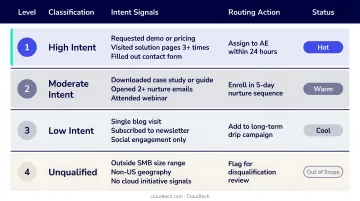
A 2025 peer-reviewed study of 23,154 B2B lead records found that behavioral signals — including number of responses and engagement depth — when layered into lead scoring models achieved 98.39% classification accuracy. The signal is there. AI reads it consistently; humans often don't.
Step 3: Intelligent Routing and Handoff
That scoring output drives an immediate decision: where does this lead go next, and how fast? Two handoff mechanisms handle different situations:
Immediate transfer — For high-intent leads showing strong buying signals. AI connects the lead to a rep in real time, briefing the rep on what was discussed.
Scheduled handoff — For MQL-threshold leads who need follow-up within a defined window. AI books the meeting or sets a rep task with full context attached.
Timing matters. Too early wastes sales capacity on leads that aren't ready. Too late, and buying intent fades faster than most teams expect.
A quality handoff includes:
- Full conversation transcript passed to the CRM-connected rep
- Lead score and qualification tags
- Flagged objections and points of interest
- Clear next-step expectation set with the lead
The rep picks up mid-conversation, not from scratch — which means faster closes and fewer leads lost to follow-up lag.
The Key Benefits of Conversational AI for Lead Qualification
24/7 Availability and Speed
AI doesn't take lunch, go offline at 5 PM, or miss leads submitted at 11 PM on a Saturday. Leads coming in across time zones get the same immediate, thorough engagement as a 9 AM inbound. The speed-to-lead advantage is real: InsideSales data shows only 0.1% of inbound leads are engaged within the five-minute window that produces 8x better conversion rates. AI closes that gap for every lead, every time.
Consistency and Bias Elimination
Human SDRs skip steps when rushed. They make judgment calls based on a lead's tone, job title, or company name rather than qualification criteria. Conversational AI applies identical logic across every single conversation — no favoritism, no shortcuts, no gut-feel overrides.
The result is a more reliable pipeline. Leads reaching sales reps have all cleared the same bar, making pipeline forecasting more accurate and reducing the friction of reps second-guessing scores.
Scalability Without Proportional Cost
That consistency becomes even more valuable at scale. A single conversational AI deployment handles hundreds of simultaneous conversations. Replicating that with SDRs means proportional headcount growth: more salaries, training, turnover, and management overhead. McKinsey estimated generative AI could raise productivity equivalent to 3–5% of global sales expenditures and reduce customer-care function costs by 30–45%. For SMBs, that math makes AI-handled volume work a straightforward business decision.
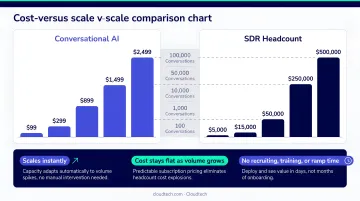
Cloudtech's conversational AI deployments, built on AWS infrastructure including Amazon Connect and Amazon Lex, are designed specifically so SMBs can scale lead volume without scaling headcount at the same rate.
Richer Lead Data for Sales
Forms capture what you asked. Conversational AI captures everything the lead volunteered. Reps receive leads with:
- Specific objections raised during qualification
- Features or use cases the lead found most relevant
- Urgency language that reveals actual timeline
- Questions that signal evaluation stage
That context produces more personalized first conversations, and measurably higher close rates.
2026 Best Practices and Implementation Considerations
Start with Your Highest-Volume Inbound Channel
Don't attempt to deploy across every touchpoint simultaneously. Identify the one or two channels generating the most inbound interest — typically website chat or SMS — and prove the speed-to-lead advantage there first.
Measure success by:
- Reduction in average response time from submission to first engagement
- Increase in qualified leads passed to sales per week
- Improvement in SDR close rates on AI-qualified leads
Once the model is validated, expanding to additional channels follows a repeatable playbook.
Integrate Deeply with Your CRM from Day One
Conversational AI only compounds in value when every piece of data syncs automatically. The core integration points:
- New contacts created instantly with qualification tags
- Lead scores updated to reflect conversational signals, not just form data
- MQLs advanced automatically when AI thresholds are met
- Rep alerts fired with full conversation context attached
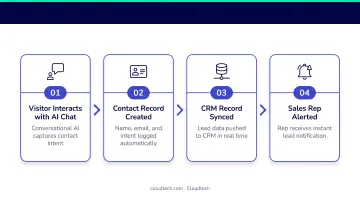
Amazon Connect (voice and contact routing) and Amazon Lex (natural language understanding) are purpose-built for this kind of integration — reliable uptime, strong data security, and native CRM connectivity. Cloudtech deploys these AWS-native conversational AI solutions for SMBs using pre-packaged architectures, typically getting teams live in two to four weeks.
Define Handoff Triggers Before Launch
Work backwards from your ideal qualified lead criteria. Define exactly when AI should escalate to a human, and build in edge-case escalation logic for:
- Explicit requests to speak with a person
- Pricing objections requiring negotiation
- Complex technical questions outside qualification scope
- Enterprise-level deal signals requiring senior rep involvement
No high-value lead should get stuck in an automated loop. Define the exits before you go live.
Common Challenges and How to Address Them
Data Quality and Incomplete Lead Records
Conversational AI is only as accurate as the data underpinning it. Incomplete CRM history produces miscalibrated lead scores and missed signals. Before deploying:
- Audit your CRM for completeness across key fields
- Use enrichment tools to fill firmographic gaps
- Establish baseline lead quality metrics you can compare post-deployment
Over-Reliance Without Human Oversight
Even sophisticated AI misinterprets ambiguous language. A lead who says "we're not ready to move forward right now" could mean this quarter or this decade — and the distinction matters. For high-value enterprise leads, a human review checkpoint remains essential.
The right model pairs AI for volume and speed with humans for judgment and relationship-building. These aren't competing functions — they work better together than either does alone.
Change Management and SDR Adoption
That human-AI balance only works if SDRs actually trust the system. Those who fear replacement will resist AI-sourced leads or second-guess AI scoring — which defeats the purpose.
Reframe the value proposition clearly: conversational AI removes the manual, early-stage qualification work so SDRs spend their time on conversations that are already warmed up and ready to close.
Support adoption with:
- Structured onboarding that walks SDRs through how AI scoring works
- Clear metrics showing how AI-qualified leads convert at higher rates
- Regular reviews where SDR feedback improves AI configuration over time
Frequently Asked Questions
What is conversational AI lead qualification?
Conversational AI lead qualification uses real-time, two-way dialogue — via chat, SMS, or voice — to assess whether a lead fits your ideal customer profile. Unlike passive scoring tools that analyze static form data, it actively asks adaptive questions and reads behavioral signals during the conversation itself.
How does conversational AI differ from traditional lead qualification chatbots?
Rule-based bots follow fixed scripts and rigid decision trees — if the lead's answer doesn't match an expected input, the conversation breaks down. Modern LLM-powered conversational AI uses natural language understanding to adapt its questioning in context, detect intent from language patterns, and handle unexpected responses naturally.
Can conversational AI qualify leads 24/7 without any human involvement?
Yes — AI can handle the full qualification dialogue autonomously, including scoring, tagging, and appointment booking. Human oversight for complex or high-value leads remains a best practice, however, to catch edge cases the AI may misclassify.
What data signals does conversational AI use to score and route leads?
Scoring combines explicit answers to qualification questions, behavioral signals (engagement depth, urgency language, return visits), CRM-enriched firmographic data, and NLP-based intent classification. Together, these inputs produce a richer, more reliable score than form data alone.
How does conversational AI integrate with CRM systems?
Well-implemented conversational AI syncs conversation transcripts, lead scores, qualification tags, and contact data directly into CRM platforms — triggering automated follow-up workflows, pipeline stage changes, and rep notifications without manual data entry.
What are the most important factors for successfully implementing conversational AI for lead qualification?
Three factors consistently determine success: clean CRM data before deployment, clearly defined qualification criteria and handoff triggers, and deep CRM integration so AI-captured insights drive action rather than sitting in a disconnected system.