Introduction
Skill gaps don't wait for hiring cycles. A project kicks off, a key team member leaves, or a new technology requirement emerges, and suddenly your internal team is stretched past capacity. Traditional recruiting for specialized roles like cloud architects or data scientists can take months, and by the time a full-time hire is onboarded, the window has often closed.
Staff augmentation addresses this directly. It gives businesses access to external professionals who work inside existing teams, under internal management, for a defined period or project — without the overhead of a permanent hire.
According to IDC, more than 90% of organizations worldwide are expected to feel the IT skills crisis by 2026, with potential losses of $5.5 trillion from project delays, quality issues, and revenue loss. The pressure to access specialized talent quickly has never been higher.
This guide covers:
- How staff augmentation differs from other flexible staffing models
- When it's the right fit — and when it isn't
- A step-by-step implementation framework
- The integration and governance steps most teams skip
Key Takeaways
- Staff augmentation embeds external professionals into your team temporarily, with your business retaining direct management control
- Use it to fill skill gaps, scale project capacity, or hit deadlines faster — without committing to permanent hires
- Unlike outsourcing, your internal team directs priorities, tasks, and outcomes directly
- Clear role definitions, structured onboarding, and the right vendor partnership determine whether it works
What Is Staff Augmentation?
Staff augmentation is a flexible workforce model where a company contracts external professionals to work alongside its internal team (for a specific project, skill gap, or time period) without making a permanent hire.
The model gives businesses access to specialized talent on demand. Rather than waiting months to recruit and onboard a full-time employee, a company can bring in an experienced professional within days or weeks. They integrate into existing workflows and scale back once the project wraps up.
How Staff Augmentation Differs From Outsourcing and Consulting
These three models are often confused, but they operate very differently in practice:
| Staff Augmentation | Outsourcing | Consulting | |
|---|---|---|---|
| Who manages the work | Client directs day-to-day | Vendor owns delivery | Consultant leads recommendations |
| Best use case | Filling specific skill gaps, scaling capacity | Non-core functions, full process delegation | Strategy, diagnosis, solution design |
| Level of integration | High — works inside your team | Low — separate team/process | Variable — advisory, not embedded |
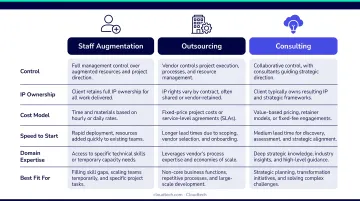
The practical implication: staff augmentation is the right fit when you need execution capacity inside your team, not a vendor running a separate workstream or an advisor handing over a report.
Why Businesses Choose Staff Augmentation in 2026
Three conditions are driving adoption right now: accelerating digital transformation, severe shortages of specialized technical talent, and growing acceptance of fractional or project-based workforce models.
The data backs this up. The global IT staffing market reached $123.30 billion in 2025, with software developers making up 37% of demand and generative AI roles projected to grow at an 11.75% CAGR through 2031. Temporary and contract engagements now account for 63% of IT staffing activity.
The Talent Shortage Is Real
The BLS projects job growth through 2034 across the roles businesses most often need to augment:
- Data scientists: 34% growth projected
- Information security analysts: 29% growth projected
- Software developers: 15% growth projected
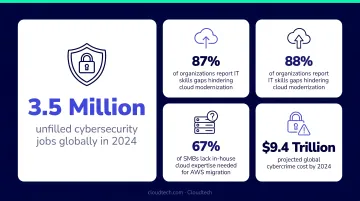
The cybersecurity gap alone reached 4.8 million unfilled positions globally in 2024, up 19% year over year. Cloud modernization compounds the pressure: 82% of cloud buyers said their infrastructure required modernization as of late 2024, and most lack the internal staff to execute it.
What Happens Without It
When businesses don't augment when they should, the consequences follow a familiar pattern:
- Projects stall while waiting for full-time hires to clear notice periods and onboarding
- Internal teams get stretched thin, leading to burnout and lower output quality
- Organizations either miss deadlines or pay premium rates for rushed recruitment under pressure
Staff augmentation doesn't solve every workforce challenge. For time-sensitive, skills-specific needs, though, it consistently outpaces full-time hiring on speed — and that gap only widens as demand for specialized talent grows.
How Staff Augmentation Works
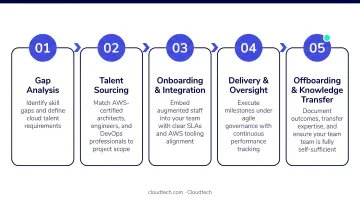
The end-to-end process moves through five distinct phases: identify the gap, select a partner, onboard the professional, manage performance, and close the engagement cleanly. Each step matters. Skipping any one of them is where most failures originate.
Step 1 — Define the Gap and Role Requirements
Before contacting a single vendor, conduct a skills gap analysis. Specifically:
- Identify what expertise is missing and why it's missing
- Define the deliverables and project timeline the role needs to support
- Determine whether the need is short-term, ongoing, or potentially permanent
- Clarify whether the role requires integration with specific internal tools or processes
This step also forces the most important decision: whether augmentation is actually the right model. If the gap requires long-term institutional ownership, permanent hiring may be more appropriate. Augmenting by default — rather than by deliberate analysis — is a primary cause of cost creep.
Step 2 — Select the Right Staffing Partner or Vendor
Not all vendors have the same depth. Evaluate potential partners on:
- Domain specialization — generalist staffing agencies often lack the ability to vet highly technical candidates accurately
- Candidate vetting rigor — how do they assess technical skills, not just certifications?
- Average time-to-fill — what's realistic for the role you need?
- Replacement policy — what happens if a placement doesn't work out?
- Compliance handling — NDAs, contracts, worker classification, data security agreements
- Pricing transparency — time-and-materials rates, any markups, total cost clarity
For technical roles like cloud architecture, working with a specialized partner matters. A generalist agency sourcing an AWS-certified solutions architect is unlikely to assess that candidate with the same rigor as a firm operating in that domain daily.
Cloudtech, for example, deploys AWS-certified specialists into client environments through project-based and embedded engagements. That means the vetting, compliance experience, and technical depth are built in — not improvised by a generalist vendor.
Step 3 — Onboard and Integrate Augmented Staff
Even experienced professionals need structured onboarding. Without it, the speed advantage of augmentation evaporates in the first week. A functional onboarding process includes:
- Access to internal tools, collaboration platforms, and relevant documentation
- Clear communication of project objectives and success criteria
- Team introductions and clarity on reporting lines
- A kickoff meeting covering project context, timelines, and communication norms
This applies even to short-term engagements. The assumption that a senior professional can "figure it out" costs more time than the onboarding would have taken.
Step 4 — Manage Performance and Maintain Oversight
Internal management remains the client's responsibility — this doesn't transfer to the vendor. Weak oversight is the most consistent reason augmentation engagements underdeliver.
Effective management involves:
- Setting clear KPIs and milestones from the start
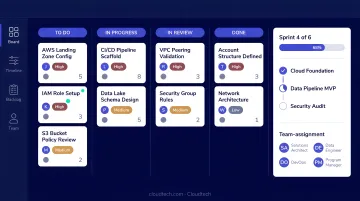
- Using project management tools (Jira, Linear, Asana) to track output against timeline
- Scheduling regular check-ins — weekly at minimum for active engagements
- Providing feedback tied to project goals, not vague impressions
The augmented professional is an extension of your team. Treat them accordingly.
Step 5 — Evaluate, Adjust, and Offboard Cleanly
Ongoing evaluation — not just a final review — keeps engagements on track. Monitor output quality, timeline adherence, and cost against expected ROI throughout the engagement, not only at the end.
Offboarding requires equal attention:
- Knowledge transfer documentation — configurations, architecture decisions, process notes
- Access revocation — system credentials, collaboration tools, any sensitive data access
- Post-engagement review — what worked, what didn't, what to do differently next time
NIST SP 800-53 PS-4 specifies that system access should be disabled within a defined period after termination and credentials revoked. This isn't just good practice for regulated industries — it's a baseline security requirement for any augmentation engagement.
Types of Staff Augmentation Models
By Skill Level
| Model | Description | Common Roles |
|---|---|---|
| Commodity-based | Routine tasks requiring speed over specialization | Data entry, QA testing, support |
| Skill-based | Defined functional expertise, minimal ramp-up needed | Software developers, analysts, project managers |
| Highly-skilled | Advanced technical or strategic roles, hardest to source | Cloud architects, data scientists, AI engineers, cybersecurity specialists |
Highly-skilled augmentation delivers the highest project impact but requires the most careful vendor selection. AWS-certified cloud architects sit firmly in this tier, and sourcing them has become one of the most common augmentation requests as cloud infrastructure work expands across industries.
By Duration
- Short-term (under 6 months): Project spikes, coverage gaps, defined deliverables
- Long-term (6+ months): Sustained specialized support, ongoing modernization programs
- On-demand: Reactive, variable scope — useful but requires flexible vendor arrangements
By Industry
IT and software development lead augmentation demand, followed by financial services (BFSI), healthcare, and manufacturing. The numbers reflect this: BFSI accounts for 24% of IT staffing demand, while healthcare IT is the fastest-growing vertical at a 10.25% CAGR.
The common thread across these sectors is compliance-driven technical work — HIPAA in healthcare, regulatory infrastructure in financial services — where the cost of getting it wrong is high and internal expertise is often thin.
Staff Augmentation Best Practices for 2026
Before Engagement
- Run a skills gap analysis first. Identify whether the gap is permanent or project-specific. Augmentation used as a reflex rather than a decision leads to cost creep and misaligned engagements.
- Define deliverables and timelines upfront. Augmented professionals perform best when expectations are explicit from day one. Scope drift traces back to ambiguity at kickoff more often than any other cause.
During Engagement
- Build a structured onboarding process. Even for 4-week engagements, include tool access, workflow documentation, team introductions, and a kickoff meeting with clear success criteria.
- Plan security and access control proactively. Require NDAs and security agreements before work begins, implement role-based access controls, and define an access revocation protocol before the engagement starts. Waiting until offboarding creates unnecessary risk.
- Require ongoing knowledge documentation. Decisions, configurations, and process notes should be documented throughout the engagement. Compressing this into a last-minute handoff is how institutional knowledge gets lost.
- Make communication norms explicit. Augmented staff, particularly remote hires or those from different professional backgrounds, perform better when feedback cadence, escalation paths, and collaboration expectations are stated directly rather than assumed.
Common Challenges and When Staff Augmentation Is Not the Right Fit
The Most Common Misconception
Even well-planned augmentation engagements fail when teams expect zero friction at the start. Augmented staff cannot be dropped into a team and immediately produce results without management overhead — augmentation reduces hiring time, not management time. Teams that skip the onboarding investment consistently underperform.
Common Failure Scenarios
- Over-relying on augmentation for roles that require continuity. Product ownership, architectural governance, and client relationships depend on long-term institutional knowledge — augmentation is a poor fit for these.
- Using it to sidestep a hiring decision. If the need is genuinely permanent, augmenting indefinitely costs more and delivers less than committing to a full-time hire early.
- Failing to plan knowledge transfer. When the engagement ends without documentation, the business loses both the contractor and any undocumented progress.
When Staff Augmentation Is Not the Right Model
These failure patterns share a common thread: augmentation was applied to a problem it wasn't designed to solve. Consider a different model entirely when:
- The role requires full-time presence and long-term ownership
- The internal team lacks the bandwidth to manage external professionals effectively
- The work involves highly sensitive IP without viable contractual protections
- The project scope is too undefined for a fixed staffing model — a managed services or consulting engagement is likely a better fit
Conclusion
Staff augmentation gives businesses a faster, lower-risk path to specialized talent — but only when used with intention. Clear role definitions, structured onboarding, active internal management, and a deliberate offboarding process are what separate engagements that deliver from those that don't.
Workforce models are shifting toward fractional and project-based structures, and access to specialized technical skills — cloud, AI, cybersecurity, data — is moving with them. The businesses that get the most out of staff augmentation won't necessarily use it the most. They'll use it with a clear plan, defined outcomes, and the internal discipline to make external talent actually work.
Frequently Asked Questions
What is staff augmentation?
Staff augmentation is the practice of adding external professionals to an existing team for a defined period or project, where the client company retains day-to-day management control. Unlike outsourcing — where a vendor owns the outcome — augmented staff execute work under the client's direct direction, fully embedded in your workflows.
Is staff augmentation cost-effective?
It reduces fixed costs like benefits, office space, and long-term salaries, and typically shortens time-to-hire compared to traditional recruitment. It's most cost-effective when the need is genuinely temporary or project-specific — when used as a default to avoid permanent hiring decisions, the costs can exceed what a full-time hire would have cost.
What is the difference between staff augmentation and consulting?
Consulting typically involves an external expert advising on strategy or diagnosing problems, with the consultant leading recommendations. Staff augmentation places external professionals under the client's direct management to execute work — the client sets direction, the augmented professional executes.
What is the difference between staff augmentation and a statement of work (SOW)?
An SOW holds a vendor accountable for delivering a defined outcome or deliverable on a fixed-price basis. Staff augmentation is time-and-materials — the client directs the work and retains responsibility for outcomes. In short, staff augmentation gives you more control over how work gets done, while an SOW holds the vendor accountable for the result.
When should a business use staff augmentation instead of hiring full-time?
Use staff augmentation when the need is project-based, time-limited, or requires a niche skill you won't need permanently. Hire full-time when the role demands long-term institutional knowledge or ongoing strategic ownership that a contractor relationship can't sustain.
What types of roles are most commonly filled through staff augmentation?
IT and software development roles dominate: software engineers, cloud architects, cybersecurity specialists, and data scientists are the most common. AWS-certified cloud architects are among the fastest-growing in demand, driven by cloud infrastructure modernization in healthcare, financial services, and other compliance-heavy industries.