That gap is expensive. Vendor lock-in, failed integrations, and stalled deployments don't just waste budget — they consume the internal goodwill needed to get AI initiatives approved in the first place.
The right vendor choice accelerates implementation, controls total cost of ownership, and actually reduces operational load. The wrong one creates a new category of complexity to manage. This guide gives SMB decision-makers a practical framework for evaluating vendors in 2026 — covering AI capability, integration architecture, compliance, and how to define ROI before signing anything.
Key Takeaways
- Evaluate vendors on intent recognition, context retention, and backend integration depth — not just chatbot features
- Six criteria matter most: AI capability, integration fit, cloud architecture, security/compliance, implementation support, and pricing transparency
- Define ROI baselines before go-live — measure cost-per-interaction, escalation rate, and average handling time upfront
- Start narrow: high-volume, low-complexity use cases deliver the fastest initial ROI
- Choose an AWS-certified implementation partner to reduce integration risk and speed up deployment
What Is Conversational AI?
Conversational AI refers to AI-powered systems that engage in natural dialogue using natural language processing (NLP) and machine learning. The critical distinction from traditional chatbots: rule-based bots follow fixed decision trees and fail the moment a user goes off-script. Conversational AI interprets varied language, maintains context across turns, and generates dynamic responses.
Three main types appear in business deployments today:
- Text-based virtual assistants — web chat, messaging apps, internal helpdesks
- Voice AI agents — phone-based automation for scheduling, support, and intake
- Agentic AI systems — autonomous platforms capable of multi-step decision-making and task execution
Core Components of a Conversational AI System
Production-grade systems have three interdependent layers:
- Language understanding — NLP and intent recognition that interprets what a user actually means, not just what they typed
- Dialogue management — context retention and conversation flow across multiple turns and channels
- Integration and action — real-time connections to CRMs, ERPs, ticketing systems, and knowledge bases
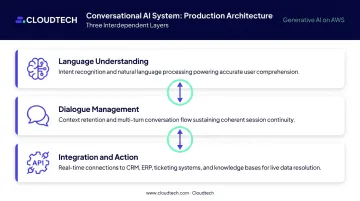
Failure at any single layer breaks the experience. A weak retrieval layer in a RAG-based system produces responses that sound confident but are wrong. Poor backend integration means the AI can't access the data it needs to give a useful answer.
Most modern platforms use LLMs, small language models (SLMs), or hybrid approaches. Gartner predicts organizations will use task-specific models three times more than general-purpose LLMs by 2027. That shift has direct implications for vendor selection: the model architecture powering a platform determines its latency, accuracy ceiling, and long-term cost structure. Those factors are worth pressure-testing before you sign a contract.
Why Businesses Are Adopting Conversational AI
Adoption is accelerating across SMBs and mid-market companies for a consistent set of reasons:
- 24/7 availability without proportional staffing increases
- Reduced average handling time on repetitive queries
- Self-service deflection of high-volume, low-complexity interactions
- Consistent responses across all channels
- Faster operational data for support team decisions
Key Criteria for Evaluating a Conversational AI Vendor in 2026
The vendor market in 2026 is saturated with platforms making nearly identical claims. The framework below is designed to cut through feature sheets and marketing demos to criteria that connect directly to deployment outcomes.
Selection weighting varies by industry — healthcare organizations must prioritize compliance, retail needs elastic scalability, financial services requires audit trails — but the following six factors apply universally.
AI Capability Depth and Accuracy
Surface-level demos are unreliable signals of real performance. Vendors rehearse their demos; your actual use cases are messier. Request testing against your own data, not curated scripts.
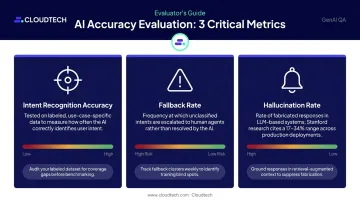
Key metrics to ask for:
- Intent recognition accuracy — measured on a labeled test set specific to your use cases
- Fallback rate — how often the system can't classify an intent and punts to a human
- Hallucination rate — for LLM-based systems, how often responses contain fabricated information
On hallucinations: a Stanford study of legal RAG systems found hallucination rates between 17% and 34% across three proprietary platforms — a meaningful risk when responses must be accurate. NIST does not endorse a universal "90% = production-ready" rule; accuracy thresholds should be set against your specific application context, not industry averages.
The distinction between systems that understand intent versus systems that pattern match becomes clear in edge cases. Test with ambiguous queries, multi-intent requests, and out-of-scope inputs to see where each vendor's system breaks.
Integration Architecture and Backend Connectivity
A conversational AI platform with weak integration is an expensive FAQ engine. Real utility comes from connecting in real time to CRMs, ERPs, ticketing systems, and knowledge bases — pulling personalized, current information and writing back to records after resolution.
Salesforce research found 44% of service leaders cite technology silos as a barrier to AI progress. Integration depth directly impacts:
- First-contact resolution rate
- Escalation rate to human agents
- Time-to-resolution
During vendor evaluation, run an integration proof: authenticate to your CRM, retrieve live customer context, write an approved transaction, create or update a ticket, and simulate an API failure. Platforms with native connectors or pre-built API ecosystems reduce integration overhead considerably.
Cloud Infrastructure and Scalability
Performance ceilings on on-premise and hybrid setups tend to surface at the worst possible moments: seasonal peaks, product launches, unplanned incidents. Cloud-native architecture is what separates platforms that absorb those spikes from ones that buckle under them.
Ask vendors for:
- Documented uptime history and load-testing results
- Service-level agreements with specific percentage commitments
- Regional failover and data residency options
- p95/p99 latency data under peak concurrency
For SMBs already operating on AWS, selecting a conversational AI solution architected for Amazon Lex, Amazon Connect, or AWS Bedrock simplifies integration and often reduces infrastructure overhead. The mismatch between a vendor's architecture and your existing AWS environment is a common and avoidable integration problem — one that Cloudtech, an AWS Advanced Tier Partner, works through with SMBs during the vendor selection phase.
Security, Compliance, and Data Governance
Requirements vary by industry, but all regulated businesses need to verify:
| Compliance Framework | What to Verify |
|---|---|
| HIPAA | BAA eligibility, ePHI handling, encryption in transit and at rest, audit logging |
| SOC 2 Type II | Report scope, exceptions, applicable trust service criteria, subprocessors |
| PCI DSS | Whether payment data is in scope; least privilege, lifecycle validation |
| GDPR / CCPA | Controller/processor roles, data subject rights, retention policies |
Request compliance documentation — not just a vendor's logo sheet. Verify whether the vendor can execute a Business Associate Agreement if your use case touches protected health information. Not all vendors are prepared for the legal obligations a BAA entails.
Vendor Track Record and Implementation Support
A vendor's feature list matters less than their track record deploying for companies at your scale and in your industry. A platform with enterprise case studies and no documented SMB deployments is a meaningfully different risk profile.
Request:
- Named references in your industry and size band
- Median pilot and production timelines
- Post-launch tuning cadence and optimization resources
- Renewal and expansion rates (a proxy for whether customers stay)
Renewal rates above 80% are a stronger signal than any case study — they indicate customers stayed after seeing actual results, not just a polished pilot.
Pricing Transparency and Total Cost of Ownership
Conversational AI pricing is notoriously opaque. Usage tiers, token-based billing, per-channel licensing, and API call fees compound rapidly at scale. Request a fully itemized cost model that includes:
- Setup and integration fees
- Licensing (per-user, per-conversation, or consumption-based)
- Training and onboarding
- Ongoing support and optimization
Common pricing structures from major platforms illustrate the complexity: Amazon Lex charges $0.00075 per text request and $0.004 per speech request — one conversation generates many requests. Salesforce Agentforce uses Flex Credits, per-conversation, or per-user models, each with different scaling behavior.
Gartner forecasts GenAI cost per resolution will exceed $3 by 2030 — above many offshore human agent costs. Model break-even in concrete terms: deflected support tickets, reduced agent hours, and cost-per-interaction improvement before signing anything.
Implementation and ROI Planning
Vendor selection is half the equation. Implementation planning determines whether the platform delivers value in weeks or stalls for months.
Organizations that achieve the fastest ROI start narrow: one high-volume, low-complexity use case — password resets, appointment scheduling, order status — before expanding scope. Starting small builds internal confidence and generates the baseline data needed to prove ROI to stakeholders.
Phased Deployment Model
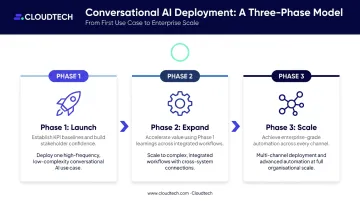
A three-phase approach reduces risk and accelerates initial time-to-value:
- Phase 1 — Deploy one high-frequency, low-complexity use case. Establish baseline KPIs. Build operational confidence.
- Phase 2 — Expand to more complex or integrated workflows using learnings from Phase 1.
- Phase 3 — Multi-channel deployment and advanced automation at scale.
Setting Pre-Launch KPI Baselines
Measure these metrics before go-live. Without a baseline, post-launch improvements are anecdotal:
| KPI | Why It Matters |
|---|---|
| Cost per interaction | Establishes the financial baseline for deflection ROI |
| Average handling time | Tracks efficiency gains for both AI and escalated interactions |
| Human escalation rate | Measures containment — declining rate indicates improving AI capability |
| First-contact resolution | Tracks whether issues are resolved without repeat contact |
| Customer satisfaction (CSAT) | Compares AI-handled, escalated, and human-handled cohorts separately |
Planning benchmarks exist: Salesforce respondents expected an average 20% reduction in resolution time from AI agents, while one Zendesk customer reported 44% automated resolution and 87% lower resolution times. Treat these as planning references, not guaranteed outcomes — require the vendor to reproduce results in a controlled pilot against your actual use cases.
Common Implementation Failure Modes
SMBs deploying conversational AI without an experienced implementation partner consistently encounter three failure patterns:
- Data readiness gaps — knowledge base holes and poor CRM data hygiene produce AI responses that are confidently wrong
- Skipped change management — support teams who weren't involved in deployment don't trust the AI and route around it
- Mismatched technical assumptions — vendor implementation timelines that assume dedicated internal engineering capacity the business doesn't have
Working with an AWS-certified partner — rather than handling deployment in-house — reduces time-to-value by ensuring the cloud infrastructure, API integrations, and data pipeline work are ready before the AI platform goes live. Cloudtech, for example, handles the AWS architecture layer that conversational AI deployments depend on: secure API connectivity, cloud infrastructure setup, and a structured discovery process that surfaces technical gaps before they become launch blockers.
How Cloudtech Can Help
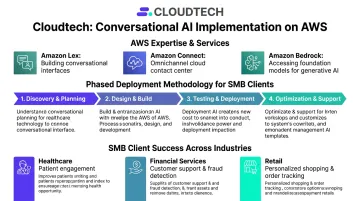
Cloudtech is a New York-based AWS Advanced Tier Partner with a team composed primarily of former AWS employees and AWS-certified architects. The firm specializes in helping SMBs evaluate, architect, and deploy AI solutions on AWS infrastructure — handling architecture, configuration, and deployment once a vendor is selected, not acting as a conversational AI vendor itself.
For SMBs navigating this decision, Cloudtech's positioning is straightforward:
- Pre-packaged AWS solutions delivered in weeks rather than months
- Transparent pricing without enterprise-level overhead
- A Human-First Consulting approach with named deliverables and defined milestones at each stage
Industries served include healthcare, financial services, manufacturing, SaaS, and retail — each with distinct compliance and integration requirements that shape how conversational AI gets built.
That industry depth informs every engagement. Cloudtech's relevant capabilities for conversational AI implementation include:
- AWS-certified cloud architects and data engineers with deep AWS product expertise across Amazon Lex, Amazon Connect, Amazon Bedrock, and related services
- HIPAA-compliant deployment experience, including a production AI voice agent (Amazon Bedrock, Transcribe, and Polly) for a healthcare BPO that completed appointment scheduling calls end-to-end in under 5 minutes with warm handoff in under 2 seconds
- Startup-friendly engagement model that is lean, transparent, and requires no retainer
- AWS Partner Funding access that can reduce or eliminate out-of-pocket implementation costs for eligible businesses
- Phased deployment methodology starting with discovery and workload mapping before any configuration begins
Conclusion
The right conversational AI vendor in 2026 is the one whose capability depth, integration architecture, compliance posture, and implementation support align with your specific operational priorities — not the one with the most features or the loudest marketing.
Vendor selection is also not a one-time event. Revisit platform performance against your KPIs every 6–12 months — what delivered results at launch may need recalibration as usage scales and business needs shift. Start with a narrow use case, measure rigorously, and let actual performance data — not vendor projections — drive your decision to expand.
Frequently Asked Questions
What is the difference between conversational AI and a traditional chatbot?
Traditional chatbots follow scripted decision trees and fail when users go off-script. Conversational AI uses NLP and machine learning to understand intent, retain context across turns, and generate dynamic responses — making it significantly more effective for complex or open-ended interactions where user language is unpredictable.
What are the most important criteria when selecting a conversational AI vendor?
The top criteria are AI accuracy and intent recognition depth, integration capability with your existing systems, security and compliance certifications, implementation support model, and pricing transparency. The right weighting depends on your industry — healthcare organizations should prioritize compliance, while high-volume retail deployments should focus on scalability and integration speed.
How long does a conversational AI implementation typically take?
Straightforward single-channel deployments can go live in 6–10 weeks with an experienced implementation partner. Complex multi-channel or deeply integrated deployments typically take 3–6 months. Phased approaches reduce risk and accelerate initial time-to-value by limiting Phase 1 scope to one well-defined use case.
What ROI metrics should businesses track after deploying conversational AI?
Track cost-per-interaction reduction, human escalation rate, average handling time, first-contact resolution rate, and CSAT scores. Baselines for each metric must be established before deployment — without pre-launch measurements, post-launch improvements can't be credibly attributed to the AI implementation.
How does cloud infrastructure affect conversational AI performance?
Cloud-native architecture delivers the scalability and uptime conversational AI demands. For businesses already on AWS, services like Amazon Lex, Amazon Connect, and Bedrock simplify integration and reduce latency — with costs that track actual usage rather than worst-case capacity projections.
Do SMBs need an implementation partner, or can they go directly to a vendor?
Some vendors offer self-serve onboarding, but SMBs without dedicated cloud engineering resources typically see faster deployment and better outcomes with a certified implementation partner. A partner handles infrastructure setup, API integrations, and data readiness in parallel — reducing the risk of stalled projects and underperforming deployments.