Introduction
Most websites still operate like digital brochures — static, silent, and completely passive while potential customers leave without ever getting the answer they needed. That's a real cost. Zendesk's 2026 CX Trends report found that 74% of consumers expect 24/7 service and 88% expect faster responses than a year earlier — expectations no human support team can meet alone.
Conversational AI changes that equation. By handling first-touch interactions automatically (qualifying leads, answering product questions, routing tickets), these tools keep websites working around the clock without adding headcount.
The market reflects this shift. MarketsandMarkets values the global conversational AI market at $13.77 billion in 2024, projecting it to reach $49.80 billion by 2031 at a 19.6% CAGR.
What follows is a breakdown of five tools that actually deliver on this promise — ranked on NLP quality, integration ease, automation depth, SMB pricing, and real-world reliability. Not all of them will fit every business, but at least one will.
Key Takeaways
- Conversational AI uses NLP and machine learning to handle queries, qualify leads, and trigger workflows without a live agent
- The best tool depends on your use case: support, lead gen, or custom workflows
- SMB-friendly options (Tidio, HubSpot) start free or under $30/month
- Amazon Lex offers the deepest customization but requires AWS familiarity to deploy well
- Match the tool to your existing stack and team's technical capacity to avoid costly switches later
What Is Conversational AI for Website Automation?
Google Cloud defines conversational AI as software that simulates human conversation using natural language processing, machine learning, and dialogue management. Deployed on a website, it replaces or supplements live agents — engaging visitors the moment they land, at any hour.
"Website automation" in this context covers far more than answering FAQs. Those capabilities include:
- Qualifying leads and routing high-intent visitors to sales reps
- Booking demos or scheduling calls without human involvement
- Updating CRM records based on conversation inputs
- Resolving support tickets by pulling from a connected knowledge base
- Triggering backend workflows — order lookups, status updates, escalations
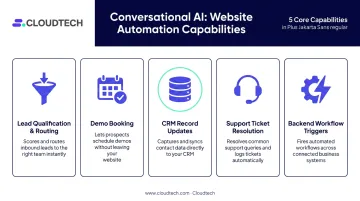
What makes these capabilities possible comes down to how the underlying technology works — and that's where conversational AI diverges sharply from older chatbot approaches.
How This Differs From Rule-Based Chatbots
Traditional chatbots follow fixed decision trees. Ask something outside the script, and they break. IBM distinguishes these from AI chatbots, which use NLP and machine learning to interpret less structured language, handle ambiguity, and improve with each interaction.
The practical difference: rule-based bots work for tightly scoped, predictable questions. Conversational AI handles the messy, unscripted exchanges that define most real visitor interactions — think a prospect asking three different questions in one message, or a support user describing a problem they can't quite name.
Best Conversational AI Tools for Website Automation in 2026
These five tools were evaluated on NLP quality, website integration ease, automation depth, SMB pricing accessibility, and deployment reliability across real use cases.
Intercom (Fin AI)
Fin, Intercom's generative AI agent, resolves customer queries directly from a connected knowledge base — across web chat, email, and in-app messaging — with clean handoff to live agents when needed.
What separates Fin from most AI chat tools is its ability to manage complex, multi-turn conversations without rigid scripting. It supports more than 45 languages and sits inside Intercom's full suite of ticketing, CRM, and analytics tools — making it the strongest option for SaaS and product teams scaling support without hiring.
| Feature | Details |
|---|---|
| Key Features | Generative AI chat, knowledge base training, live agent handoff, omnichannel inbox, proactive messaging, usage analytics |
| Pricing | Fin AI Agent at $0.99 per standard resolution; Essential seat plan at $39/month (month-to-month); 14-day free trial, no credit card required |
| Best For | SaaS companies and mid-to-large businesses needing enterprise-grade AI customer support on their website |
Tidio (Lyro AI)
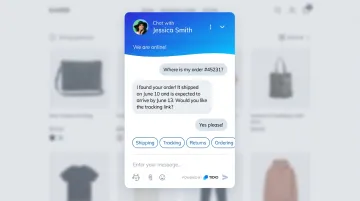
Tidio is built specifically for SMBs — combining live chat, AI chatbot flows, and automated sales triggers in a package deployable in minutes on Shopify or WordPress. Its conversational AI engine, Lyro, learns from your support content and handles queries in a conversational way, without requiring any engineering resources to set up.
Tidio's strength is speed-to-value. Pre-built ecommerce templates mean small teams can automate order status questions, return policies, and product recommendations without writing a single line of code.
| Feature | Details |
|---|---|
| Key Features | Lyro AI chatbot, chat flow builder, shared inbox, canned responses, ecommerce templates, customer segmentation, Shopify/WordPress integration |
| Pricing | Free plan available; Starter from $24.17/month (billed annually); Lyro add-on from $32.50/month for 50 conversations (first 50 free); 7-day free trial on paid tiers |
| Best For | Small and medium-sized ecommerce businesses needing fast, affordable website chat automation without developer support |
HubSpot Chatbot Builder
HubSpot's chatbot builder comes bundled inside its free CRM — no separate tool, no integration work. Businesses can build automated flows that qualify leads, book meetings, and route contacts, with everything syncing directly to HubSpot CRM records the moment a conversation ends.
The real differentiator here is native CRM data access. The bot can personalize responses based on a contact's existing history, segment leads mid-conversation, and trigger HubSpot workflows automatically. For teams already running HubSpot for sales or marketing, this is the lowest-friction path to website automation.
| Feature | Details |
|---|---|
| Key Features | No-code bot builder, CRM-native lead qualification, meeting booking, conversation branching, 2,000+ third-party integrations, AI content generation |
| Pricing | Free chatbot builder included; paid CRM plans from $15/month per seat |
| Best For | Marketing and sales teams running HubSpot who want CRM-connected website automation without a separate chatbot tool |
Amazon Lex
Built on the same technology as Alexa, Amazon Lex is AWS's fully managed conversational AI service for building custom chatbots and voice assistants. It connects directly to AWS Lambda, DynamoDB, S3, and other backend services — giving technical teams deep control over how conversations trigger real business logic.
Lex handles multi-turn dialogue natively, supports 65 locales for multilingual NLU, and performs sentiment analysis through Amazon Comprehend. Oklahoma State University–Oklahoma City deployed a Lex-based bot that handled 34,000+ conversations and saved 833 staff hours answering program and office information questions through web chat.
That depth comes with a tradeoff: Lex requires AWS familiarity to configure and deploy well. Businesses without in-house AWS expertise often benefit from working with a certified AWS partner — like Cloudtech — to architect the solution, connect it to the right backend services, and avoid over-provisioning costs from the start.
| Feature | Details |
|---|---|
| Key Features | Natural language understanding, multi-turn dialogue, AWS Lambda integration, voice + text support, sentiment analysis via Amazon Comprehend, enterprise security, 65 supported locales |
| Pricing | Pay-as-you-go: $0.00075 per text request, $0.004 per speech request; eligible new AWS customers receive up to $200 in Free Tier credits for six months |
| Best For | Businesses with development resources or an AWS consulting partner, needing fully custom, scalable, cloud-native conversational AI |
Botpress
For teams that need complete control over how their AI agent behaves, Botpress delivers. It combines a visual drag-and-drop flow builder with an LLM-powered generative AI layer, giving technical teams room to write custom code, custom integrations, and fine-tuned AI personas.
The hybrid approach is what makes Botpress worth considering: non-developers can build functional conversational flows using the visual builder and pre-built templates, while developers can go deeper when the use case demands it. Multi-channel deployment spans embedded webchat, WhatsApp (from Plus tier), and Microsoft Teams.
| Feature | Details |
|---|---|
| Key Features | Visual flow builder, LLM-powered AI, knowledge base Q&A, custom integrations, multi-channel deployment (web, WhatsApp, Teams), analytics dashboard |
| Pricing | Free plan (100 conversations/month); Plus at $150/month (250 conversations); Team at $750/month (1,500 conversations); Enterprise at custom pricing |
| Best For | Developer teams, agencies, and technical operators who need maximum customization and control over their website AI agent |
How We Chose These Tools
Tools were assessed against real SMB and mid-market use cases — not feature checklists or brand recognition. The most common mistake businesses make: picking the platform with the most capabilities rather than the one that fits their actual automation goal.
Five criteria drove the evaluation:
- NLP quality: Does it handle open-ended, unscripted inputs without failing or falling back to scripted defaults?
- Integration ease: How quickly can it be embedded and connected to your existing stack?
- Automation depth: Whether it can trigger backend actions, update CRM records, and escalate intelligently — not just respond.
- Pricing accessibility: Viable for SMBs without enterprise budgets.
- Scalability: Will it grow with the business without forcing a platform switch down the road?
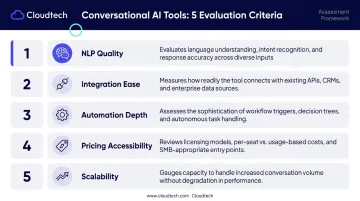
Each tool below was evaluated against all five criteria — so you can compare options based on what actually matters for your use case.
Conclusion
Choosing a conversational AI tool comes down to fit: your team's technical capacity, your existing stack, and the specific job you need done. Support automation, lead qualification, and custom backend workflows each point to different tools.
For businesses evaluating AWS-native options like Amazon Lex, the bigger challenge is often the surrounding architecture — IAM roles, Lambda integrations, backend data sources, and overall cloud readiness. Getting that foundation right before committing to a platform saves significant rework later.
Cloudtech, an AWS Advanced Tier Partner with SMB Competency, helps SMBs assess and build that foundation. Whether that means an AWS architecture review, a Well-Architected assessment, or scoping a migration before layering in automation, the implementation path is clearer with an experienced AWS partner involved early.
Start by identifying your highest-priority use case — support, lead gen, or custom workflows — then match it to the tool that fits. If you're exploring AWS-native options, book a free consultation with Cloudtech to scope the right architecture before committing to a platform.
Frequently Asked Questions
What is the difference between a chatbot and a conversational AI tool?
Traditional chatbots follow fixed decision trees and fail when users go off-script. Conversational AI uses NLP and machine learning to understand intent, handle ambiguous inputs, and improve with usage — making it far more effective for real-world website interactions.
Can small businesses afford conversational AI for their websites?
Yes — Tidio and HubSpot both offer free plans, and paid entry tiers start under $25/month. Costs scale with conversation volume and features, so SMBs should match the pricing model to their expected traffic rather than paying for enterprise capacity they won't use.
How do conversational AI tools improve website conversion rates?
By engaging visitors instantly, answering product questions, and routing high-intent leads to sales in real time, conversational AI reduces the friction that causes visitors to leave before converting.
What should I look for when choosing a conversational AI platform?
Prioritize these five factors:
- Integration with your existing CRM and tools
- NLP quality for handling unscripted conversations
- Ease of setup versus customization depth
- Pricing model (per seat, per resolution, or usage-based)
- Omnichannel reach beyond web chat
Is Amazon Lex a good option for businesses without AWS experience?
Lex is highly capable but requires AWS familiarity to deploy properly. Businesses without in-house AWS expertise should work with a certified AWS partner who can configure Lex, connect it to backend services, and ensure costs are sized correctly for the workload.
Which conversational AI tool is best for ecommerce websites?
Tidio is the most purpose-built option for ecommerce — with native Shopify and WordPress integrations, pre-built automation templates, and accessible pricing. Businesses with larger product catalogs or complex support needs will find Intercom's Fin AI better suited for advanced query resolution at scale.