Introduction
Voice AI handles routine calls well. The moment a call needs a human, most platforms reveal their weakest point.
That moment — the handoff — is where customer experience is actually won or lost. According to Zendesk CX Trends 2026, 74% of consumers find it frustrating to repeat their story to different agents. In voice, that frustration hits harder and faster than in any other channel.
Unlike chat or email escalations, voice operates in real time — there's no pause for an agent to scan a message thread. Silence is felt immediately. When a transferred caller hears dead air or gets asked to re-explain their issue, trust erodes fast.
This article covers what makes voice handoffs fail, the three trigger types that should drive escalation, how to choose between cold and warm transfer, five actionable best practices, and how to measure whether the system is working.
Key Takeaways:
- 74% of customers find repeating information frustrating — context transfer is non-negotiable
- Voice handoffs require three distinct trigger types, each serving a different escalation scenario
- Warm transfer with a whisper briefing outperforms cold transfer in high-stakes escalations
- Structured handoff cards give agents what they need to respond immediately — raw transcripts don't
- Post-handoff FCR and CSAT delta are more meaningful than handoff rate alone
Why AI-to-Human Handoffs Are Uniquely Challenging in Voice
The Real-Time Constraint
Chat escalations give agents a few seconds to scan context before responding. Voice gives them nothing. When a transferred call connects, the agent must understand the situation before speaking their first word — because that first word sets the tone for everything that follows.
This is why 70% of customers expect any representative to have the full context of their situation, regardless of how or where the conversation started. In voice, failing that expectation isn't just a bad experience — it's audible.
Why Most Platforms Default to Cold Transfer
Most voice AI platforms were originally built on chatbot architectures, where "escalation" meant routing a ticket to a queue. That same routing logic in voice produces a cold transfer: the caller is moved to a human with no context, no introduction, and no continuity.
The customer's experience resets at the exact moment it should accelerate.
The Emotional Dimension
Voice carries information that text does not. Tone, hesitation, pacing — these communicate frustration before a caller even finishes their sentence. A clumsy handoff in voice feels louder than the equivalent failure in chat.
The caller hears the dead air, the agent's uncertain opening, and questions they already answered.
AWS Contact Lens defines non-talk time as silence where neither participant speaks for more than 3 seconds — and flags it as a measurable signal worth monitoring.
The Root Problem: Context, Not Routing
Routing logic is not the issue. A system can route a call perfectly and still fail if the receiving agent picks up without knowing:
- Who they're speaking with
- Why the AI escalated
- What was already attempted
Solving handoff means solving context transfer — not just call transfer.
Three Types of Handoff Triggers in Voice Platforms
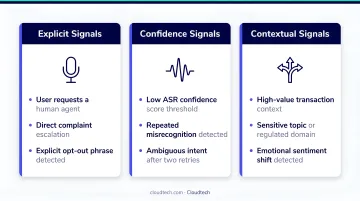
Effective voice platforms use three distinct trigger categories. A single catch-all escalation rule almost always produces either too many transfers or too few.
Explicit Triggers
When a caller directly requests a human agent, the system must escalate — without loops, retry prompts, or friction. Genesys Cloud automatically detects customer requests to speak to a human in voice bot flows without requiring a specific intent to be configured, logging the exit reason as AgentRequestedByUser.
Ignoring explicit requests is one of the fastest ways to damage trust in a voice AI deployment. Make a caller ask twice, and you've already lost them.
Confidence-Based Triggers
These fire when the AI's NLU confidence score drops below a defined threshold, or when the same issue has cycled without resolution after a set number of turns. Amazon Lex V2 supports confidence thresholds between 0.00 and 1.00 — when all intent scores fall below threshold, Lex returns AMAZON.FallbackIntent and the call can be routed to a human.
The calibration challenge is real. Thresholds set too aggressively flood agents with calls the AI could have handled; thresholds set too loosely trap customers in unproductive loops. The right threshold is deployment-specific and should be reviewed monthly — there's no universal number that works across all implementations.
Contextual Triggers
This trigger category catches what rules alone miss:
- Sentiment signals — detected frustration, elevated urgency, or negative sentiment trajectory
- Topic classification — billing disputes, account security issues, compliance-sensitive subjects
- Behavioral patterns — repeat callers, circular phrasing, or issues that have already been escalated once
Amazon Connect Contact Lens supports rules built on sentiment scores, keywords, customer attributes, loudness, and non-talk time. Genesys sentiment analysis scores overall customer sentiment from -100 to +100 and classifies phrases in real time. These signals catch edge cases that confidence thresholds and explicit requests cannot.
Cold vs. Warm Transfer: Choosing the Right Pattern
Cold Transfer
A cold transfer routes the caller directly to a human or queue with no context passed from the AI interaction. It is faster to implement, which is why it remains the default in most platforms — not because it performs better. The tradeoff is real: callers frequently have to repeat their issue from scratch.
It is appropriate in limited scenarios:
- Simple IVR routing where prior context is irrelevant to the receiving team
- Department changes where the new team starts fresh regardless
- Very high-volume, low-complexity call environments
Warm Transfer
Warm transfer briefs the receiving agent before or during the caller connection. There are two practical variants:
| Pattern | How It Works | Best For |
|---|---|---|
| Private warm transfer | AI dials the agent first, delivers a whisper briefing, then bridges the caller | Specialist escalations, regulated industries, high-stakes calls |
| Conferenced warm transfer | AI invites the human into the live call as a third participant, briefs them in real time | Cases where the AI can keep doing useful work (logging, scheduling) while the human handles conversation |
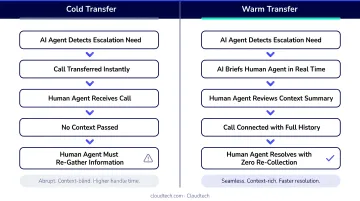
The whisper briefing is the defining feature. In Amazon Connect, a whisper flow triggers after the agent accepts the contact but before the customer is connected — giving the agent context before they speak a single word.
Decision Framework
- Use cold transfer when prior context does not affect resolution
- Use private warm transfer for specialist escalations, regulated interactions, or emotionally charged calls
- Use conferenced warm transfer when the AI adds value post-handoff (real-time note-taking, CRM updates, follow-up scheduling)
The pattern you choose shapes the caller's first impression of your human agent — get it wrong and you've already lost trust before the conversation begins.
Five Best Practices for Seamless AI-to-Human Voice Handoff
1. Pass Structured Context, Not Raw Transcripts
Handing off a full call transcript is not the same as handing off context. A 10-minute transcript requires scanning time an agent does not have.
The receiving agent needs a structured handoff card containing:
- Caller identity and account summary
- The issue as stated (not paraphrased)
- What resolution steps were already attempted
- Why the AI triggered escalation
- Recommended next action
Amazon Connect Customer Profiles combines data from Salesforce, Zendesk, ServiceNow, and Connect contact history to give agents a unified view — the raw material for a complete handoff card. With that in place, agents can open with context instead of questions.
2. Define Triggers Before Deployment, Not After
Escalation logic must be intentionally designed before a voice AI goes live. Teams that treat handoff as a fallback — rather than a designed workflow — end up in one of two failure modes:
- Customers trapped in AI loops on issues the system was never built to resolve
- Agents fielding calls the AI could have handled without any escalation
Document specific trigger conditions per use case and review them monthly. The data already exists inside your bot analytics — Amazon Lex's performance dashboard shows missed utterances, detected intents, and fulfillment outcomes by design.
3. Manage the Transition Moment Explicitly
The few seconds between the AI's final statement and the human's first word are where experience breaks down. Dead air in voice reads as a dropped call or a reset, not a transfer.
Before completing the transfer, the AI should:
- Acknowledge the escalation clearly ("I'm connecting you with a specialist now")
- Confirm the agent has full context ("They'll have everything we've discussed")
- Set realistic wait time expectations
This takes five seconds. It prevents the caller from assuming they are starting over.
4. Design Agent Interfaces Around the Handoff
Even with perfect context transfer, a disorganized agent screen undermines everything. At the moment of connection, the agent interface must surface three things immediately:
- What the caller wants
- What has already been tried
- What action is most likely needed
If agents have to search for this information, the handoff has already introduced friction. Amazon Connect supports real-time screen pop and step-by-step guided experiences in the agent workspace. AWS Lambda can package contact attributes and push them to CRM systems at the exact moment of transfer. Traeger reported roughly a 15% reduction in handle time using this Lambda-to-Salesforce pattern.
Cloudtech helps SMBs architect these AWS-based contact center environments so agents receive structured context at precisely the right moment, without requiring enterprise-scale infrastructure to do it.
5. Close the Loop with Continuous Learning
Every handoff is a training signal. Escalations where agents resolved the issue quickly suggest the AI correctly identified its limit. Escalations that required no additional agent effort suggest the AI could have handled the call without escalating.
Teams that review handoff data regularly can:
- Reduce unnecessary escalations
- Improve AI coverage over time
- Refine trigger calibration based on real outcomes
Amazon Lex conversation logs can be stored in CloudWatch and S3 for analysis. Genesys Intent Miner searches historical voice transcripts to surface real-world utterances the bot mishandled. Neither tool runs this analysis on its own. Assign a specific owner to the review cadence, set a monthly calendar reminder, and treat it as a product requirement — not an optional retrospective.
How to Measure Voice Handoff Quality
Handoff rate alone is a misleading metric. A low rate could mean strong automation or customers stuck in AI loops. A high rate could mean poor AI performance or a genuinely complex call mix. Neither tells you whether the handoff itself worked.
Metrics That Actually Matter
| Metric | What It Tells You |
|---|---|
| Post-handoff FCR | Whether the human resolved the issue without a follow-up contact |
| Repeat contact rate (24–48 hrs) | Whether the handoff left the issue unresolved |
| CSAT delta | Whether escalated calls score lower than automated ones — and by how much |
| Context completeness score | Whether agents confirm they had sufficient context to act without asking repeat questions |
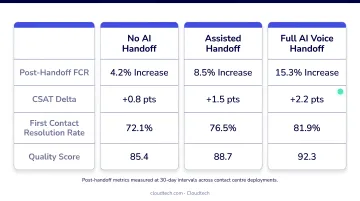
SQM's 2025 industry benchmark puts average FCR just under 70% across contact centers, with 80%+ considered top-performing. No AI-handoff-specific benchmark exists yet — but these general figures provide useful calibration.
Building a Review Cadence
- Weekly: Review escalation patterns and unresolved trigger types
- Monthly: Run retraining cycles based on handoff outcome data
- Quarterly: Tie handoff metrics to business outcomes — average handle time, cost-per-contact, customer retention
The CSAT Delta as the Honest Signal
If escalated interactions consistently score lower than fully automated ones, the issue is almost never the human agent. The breakdown happens earlier — in how context is transferred, how the transition is communicated, and whether the customer's expectations were set before the agent picked up.
A well-designed AI-to-human handoff should increase customer confidence, not reduce it. When the data shows the opposite, audit the moment of transfer first: what did the agent receive, and what did the customer hear before the agent said hello?
Frequently Asked Questions
What is the difference between a warm transfer and a cold transfer in voice AI?
A cold transfer routes the caller to a human with no context from the prior AI interaction — the agent picks up blind. A warm transfer briefs the agent before or during the connection via a whisper flow, so they pick up already informed and can address the caller's issue immediately without asking them to start over.
When should a voice AI agent escalate to a human?
Escalation should be triggered by three categories:
- Explicit requests: The caller directly asks for a human agent
- Confidence failures: The AI cannot determine intent or has looped without resolution
- Contextual signals: Detected frustration, sensitive topics (billing disputes, account security), or repeat contact patterns
How do you prevent customers from having to repeat themselves during a voice AI handoff?
Structured context transfer packages the caller's identity, stated issue, attempted resolutions, and escalation reason into a handoff card delivered to the agent at the moment of connection. A verbal whisper briefing adds a voice-specific layer, giving the agent spoken context before their first word.
What AWS services support AI-to-human handoff in voice platforms?
Four core services power the handoff stack:
- Amazon Connect: Cloud contact center foundation
- Amazon Lex: Conversational AI and intent recognition
- Amazon Bedrock: Generative AI-based post-contact summaries
- AWS Lambda: Packages real-time contact attributes and enables CRM integration at transfer
How do you measure whether a voice handoff is working?
Track post-handoff first contact resolution rate, repeat contact rate within 48 hours, CSAT delta between automated and escalated interactions, and agent-reported context completeness. Handoff rate alone tells you nothing meaningful without pairing it with these outcome metrics.
What makes voice handoff harder than chat or email escalation?
Voice is real time with no native transcript, so agents cannot scan context before responding. Silence is immediately felt by the caller, and emotional tone escalates faster than in text channels. Agents must be fully briefed before their first word, whereas chat agents can read the thread before replying.