Introduction
Most businesses aren't short on dashboards. They're short on people who can act on what those dashboards show.
The average BI setup produces charts that sit unread, reports that require an analyst to interpret, and KPIs that surface three days after the decision needed to be made. That's a workflow problem — and generative AI for business intelligence is built to solve it.
Forrester found in 2024 that self-service BI has helped only about 20% of non-IT professionals fulfill their own BI requirements. The other 80% still depend on analysts, pre-built reports, or intuition. GenAI BI closes that gap by letting any business user ask questions in plain language and receive data-backed answers — without writing a single line of SQL.
This guide covers what generative AI for BI actually is, where it creates measurable value, which risks to manage, and how SMBs can implement it using AWS-native tools without enterprise-level infrastructure.
Key Takeaways
- GenAI BI lets non-technical users query business data in plain language — no SQL or analyst required
- Gartner projects 75% of new analytics content will use GenAI for contextual intelligence by 2027
- Top use cases include conversational analytics, automated reporting, scenario forecasting, and anomaly detection
- SMBs can start with one high-friction workflow and AWS-native tools like Amazon Q in QuickSight
- The biggest risks (hallucinations, data quality gaps, access control failures) are manageable with proper governance
What Is Generative AI for Business Intelligence?
Generative AI for BI is the application of large language models to analytics workflows — enabling natural language querying, automated insight generation, and on-demand visualization without requiring SQL or data science expertise.
This is distinct from general-purpose tools like ChatGPT. Those tools generate content from the open web. GenAI BI generates insight tied directly to your business data, defined metrics, and access controls — so the outputs reflect your actual operations, not a publicly trained dataset.
Amazon Q in QuickSight is a concrete example: built on Amazon Bedrock, it supports natural language Q&A over curated datasets, executive summaries, and data stories — all tied to governed data sources, not open-ended generation.
Traditional BI vs. GenAI-Augmented BI
| Dimension | Traditional BI | GenAI-Augmented BI |
|---|---|---|
| Query type | Pre-defined dashboards | Ad hoc natural language |
| Report generation | Manual, analyst-built | Automated and on-demand |
| Visualization | Static, pre-configured | Dynamic, auto-generated |
| Anomaly detection | Analyst-dependent | AI-surfaced continuously |
| Scenario analysis | Resource-intensive | On-demand modeling |
That table points to a single structural shift: traditional BI puts an analyst between the data and the decision-maker. GenAI BI removes that bottleneck entirely. A business leader can ask "Why did Q3 margins drop?" at 6pm on a Friday and get a ranked, data-backed explanation — not a ticket in the analyst's queue.
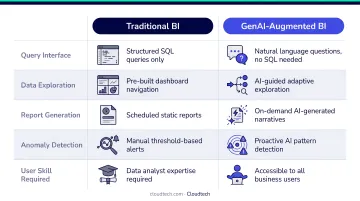
With only 20% of non-IT professionals currently able to meet their own BI needs, the bottleneck isn't the data. It's the access model.
Key Use Cases of Generative AI in Business Intelligence
Conversational Data Querying
Business users can ask plain-English questions — "Which customers have the highest churn risk?" or "Why did revenue drop in Q3?" — and receive ranked, data-backed explanations without writing SQL. QuickSight Topics allow teams to define subject-area datasets that users query conversationally, with the system maintaining an index of definitions to generate accurate answers.
When any manager can query data in real time, analytical work stops being gated by a specialist backlog.
Automated Reporting and Narrative Generation
GenAI translates KPIs, trend data, and analytical outputs into plain-language summaries and stakeholder-ready briefs automatically. What previously took an analyst hours to assemble — pulling numbers, structuring context, writing commentary — is generated on demand.
McKinsey's research found that GenAI and automation technologies could absorb 60–70% of the work activities currently consuming employee time — and reporting plus interpretation workflows sit squarely in that range.
AI-Driven Data Visualization
Rather than manually selecting chart types and configuring dashboards, GenAI selects the appropriate visualization, highlights anomalies, and adds contextual annotations automatically. The result is a dashboard that explains itself, rather than one that requires interpretation.
For SMBs without dedicated dashboard designers, this removes a recurring bottleneck from the analytics cycle entirely.
Predictive Analytics and Scenario Planning
GenAI enables "what-if" scenario modeling by feeding historical data, demand signals, and market variables through a model to simulate outcomes before resources are committed. Common applications include:
- Testing three pricing strategies against projected demand curves before a seasonal launch
- Modeling patient volume across staffing scenarios before scheduling decisions are locked in
- Projecting cash flow impact across supply chain disruptions before committing to contracts
McKinsey reports that AI-driven demand forecasting can reduce inventory levels by 20–30% — a benchmark that captures the planning advantage GenAI BI enables when connected to structured historical and operational data.
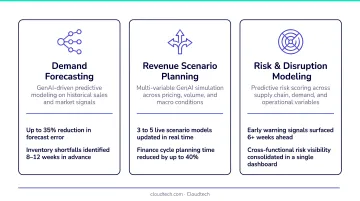
Anomaly Detection and Root Cause Analysis
GenAI continuously scans incoming data for deviations from expected patterns. When it detects one, it surfaces not just the anomaly but a ranked explanation of likely causes — flagging the drop in conversion rate alongside the campaign change, pricing update, and traffic source shift that correlate with it.
Unlike traditional alert systems that flag a number, GenAI BI surfaces the ranked causes behind it — cutting the time from detection to corrective action from days to hours.
Generative AI for BI Across Industries
GenAI BI delivers value across sectors, but the workflows it optimizes differ meaningfully by vertical.
Financial Services
Banks and financial teams use GenAI BI to interpret risk signals, summarize regulatory filings, detect fraud patterns, and sharpen customer segmentation. Mastercard's results demonstrate what's possible at scale: GenAI enhancements to its fraud detection technology boosted detection rates by 20% on average and as high as 300% in some cases.
For SMBs in financial services, the more immediate value is reducing the lag between data and action. Common use cases include:
- Surfacing credit risk signals before they escalate
- Flagging transaction anomalies in near real-time
- Identifying segmentation shifts without waiting for a scheduled analyst report
Healthcare
Healthcare organizations use GenAI BI to synthesize clinical, operational, and administrative data in one conversational interface. Non-technical staff — nurse managers, operations directors, clinic administrators — can explore patient flow, staffing trade-offs, and resource allocation questions without relying on disconnected departmental reports.
The value isn't just speed. It's the ability to ask questions that never made it onto a dashboard because no one anticipated them in advance.
Retail
GenAI BI connects sales data, supplier lead times, and customer behavior signals to enable real-time demand interpretation, inventory optimization, and personalized product recommendations. McKinsey estimates GenAI in retail could unlock up to $390 billion in value, with improved forecasting accuracy driving a significant portion of that opportunity.
Manufacturing
GenAI correlates IoT sensor readings, maintenance logs, and production data to shift maintenance from reactive response to planned intervention. Deloitte notes poor maintenance strategies can reduce an asset's productive capacity by 5–20% — a gap that predictive, data-driven approaches directly close.
Key Benefits for Businesses
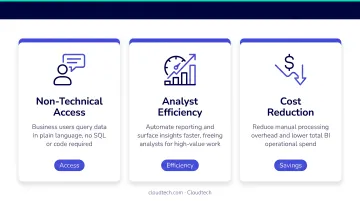
Lower the adoption barrier. When tools respond in natural language and explain why numbers changed, non-technical managers use them every day. GenAI BI doesn't require training on dashboard syntax or SQL conventions. That's the practical reason only 20% of non-IT professionals currently extract value from self-service BI — the other 80% need a different interface.
Address the data science skills shortage. U.S. data scientist employment is projected to grow 34% from 2024 to 2034, with roughly 23,400 new openings per year. That demand signals chronic scarcity, not an imminent supply solution. GenAI BI embeds analytical reasoning directly into business workflows, so teams can explore data and test assumptions without waiting in the analyst queue.
The result: data scientists stay focused on the complex modeling and governance work that actually requires their expertise.
Reduce cost and accelerate decision cycles. Automating data preparation, analysis, and reporting reduces both labor overhead and the time from question to insight. Cloudtech's generative AI implementations help SMBs reduce manual data processing time by 60% or more — by connecting governed data sources to natural language interfaces powered by Amazon Q, without requiring large internal analytics teams to sustain the operation.
Across these three advantages, the pattern is consistent:
- Non-technical teams get direct access to data insights without SQL or dashboard training
- Analyst bottlenecks shrink as GenAI handles routine exploration and reporting
- SMBs cut manual processing time significantly without expanding headcount
Risks and How to Address Them
AI Hallucinations and Unreliable Outputs
GenAI models can produce fluent but factually incorrect explanations. A well-written wrong answer is harder to catch than a wrong number in a chart — because it reads confidently. NIST's 2024 AI Risk Management Framework identifies confabulation as a core GenAI-specific risk.
Grounding addresses this directly: generation must be constrained by verified enterprise data, not open-ended model inference. Retrieval-augmented generation (RAG) through Amazon Bedrock Knowledge Bases is the primary technical control, supplemented by confidence indicators and human review gates for high-stakes decisions.
Data Quality as the Root Cause of Output Failure
GenAI BI amplifies whatever data foundation exists. Fragmented pipelines, inconsistent metric definitions, and stale data don't just limit insights. They produce misleading outputs faster than any previous analytics tool. Gartner research shows poor data quality costs organizations at least $12.9 million per year on average, and 59% of organizations don't measure data quality at all.
Stabilize the data layer before enabling a conversational interface. With GenAI in the mix, bad data doesn't just slow you down — it gets surfaced confidently and at scale.
Data Security, Privacy, and Access Control
A natural language interface can expose restricted data if access controls sit at the presentation layer rather than the retrieval layer. A user asking "What is the salary range for our VP of Sales?" shouldn't get an answer — but they will if permissions aren't enforced before the query reaches the data.
Enforcing controls at the data and identity layer — not the presentation layer — closes this gap. Key safeguards include:
- Role-based access controls scoped to individual users and groups
- Data masking for sensitive fields before they enter the retrieval pipeline
- Environment separation to isolate production data from development contexts
- IAM Identity Center integration (as used in Amazon Q Business) so access policies govern what the model can retrieve before generation begins
Addressing these risks early makes the difference between a GenAI BI deployment that earns trust and one that creates compliance exposure.
How to Implement Generative AI for BI on AWS
Step 1 — Identify the High-Friction Workflow First
Start with a specific, measurable analytical workflow where friction is costly and data is already structured. The weekly KPI pack that takes three hours to compile. The recurring leadership question that generates a data request every time it surfaces. These are concrete targets with clear baselines.
Define success metrics before implementation begins. Without them, "better insights" is unmeasurable and optimization has no direction.
Step 2 — Prepare Your Data Foundation Before Selecting a Model
GenAI BI is only as reliable as the data beneath it. Before enabling any generative features:
- Standardize key metric definitions across sources
- Clean and deduplicate critical datasets
- Establish role-based access controls at the data layer
- Enforce governance across pipelines
SMBs don't need a perfect data environment. They need a stable, well-governed one.
This is where working with an AWS partner like Cloudtech makes a tangible difference. Their team handles data readiness, architecture decisions, and compliance controls as part of the engagement — not as prerequisites the client must solve alone before work can begin.
Step 3 — Choose the Right AWS-Native Tools for Your BI Maturity
Two approaches, matched to different maturity levels:
Managed services approach (recommended starting point for most SMBs):
- Amazon Q in QuickSight — natural language querying over structured, curated datasets
- Amazon Q Business — unstructured document queries with IAM Identity Center access control
- Best for organizations with structured data already in AWS and limited internal ML expertise
Custom/embedded approach (for higher BI maturity or complex multi-source environments):
- Amazon Bedrock Knowledge Bases — RAG-grounded answers over governed enterprise data
- Bedrock Agents — multi-step task automation across BI workflows
- Amazon Redshift — central query engine for structured data, with Amazon Q generative SQL for analyst acceleration
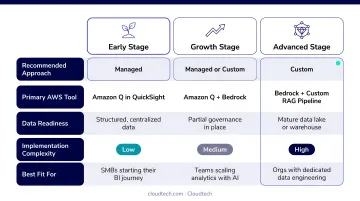
Match the approach to your current BI maturity. A common mistake: deploying Bedrock Agents before the underlying data is governed or centralized — which means the model answers quickly but answers wrong.
Step 4 — Build in Output Validation and Governance from Day One
Automated analysis and generated narratives require a validation layer before they reach decision-makers. Define:
- Who owns output quality and is accountable for errors
- How inaccuracies get caught at scale before they surface in leadership reviews
- What the review process looks like before AI-generated narratives inform decisions
Organizations that skip this step often discover it the hard way: one high-profile error erodes trust faster than a dozen successful outputs rebuild it.
A Forrester Consulting study commissioned by AWS found that composite organizations using GenAI solutions on AWS with AWS Partners moved from pilot to production within six months. That timeline holds when governance is built in from the start, not retrofitted after problems emerge.
Frequently Asked Questions
What does "generative" mean in generative AI for business intelligence?
"Generative" refers to the AI's ability to produce new outputs — explanations, summaries, visualizations, narratives — in response to a prompt, rather than retrieving a pre-built report. In BI, this means the system generates insights tailored to each specific question, grounded in the organization's data.
How is generative AI different from traditional business intelligence?
Traditional BI answers pre-defined questions through static dashboards built by analysts. GenAI BI lets any user ask ad hoc questions in plain language and receive dynamic, auto-generated insights — removing the analyst bottleneck from everyday decisions.
What AWS tools support generative AI for business intelligence?
The primary tools are Amazon Q in QuickSight (natural language querying over structured data), Amazon Bedrock Knowledge Bases (RAG-grounded answers over enterprise data), Bedrock Agents (workflow automation), and Amazon Redshift (central query engine for structured analytics, including generative SQL).
What are the biggest risks of using generative AI in business intelligence?
The three primary risks are AI hallucinations (confident but incorrect outputs), poor data quality amplifying errors at speed, and access control failures exposing restricted data. All three are manageable with proper data governance, RAG-based grounding, and identity-aware access controls at the data layer.
Can small and mid-sized businesses benefit from generative AI in business intelligence?
Yes. AWS-native managed services lower the infrastructure barrier, and pre-packaged deployments reduce time-to-value considerably. GenAI BI's self-service model means smaller teams can extract meaningful insights without a dedicated analytics staff.
How long does it take to implement generative AI for BI?
Teams can go live in weeks with a focused deployment targeting one high-friction workflow on a prepared data foundation — especially when using AWS managed services with an experienced consulting partner to handle data readiness and configuration.