Introduction
Loyalty programs have a membership problem, not a sign-up problem. Consumers join readily — Bond's 2024 U.S. Loyalty Report found the average American belongs to 19 programs but is actively engaged in only 9.3. That means roughly half of enrolled members are functionally invisible to the brands they signed up with.
The gap between enrollment and engagement is where loyalty programs lose members. Generic reward emails, slow response times, and points balances members don't even know they have — these aren't edge cases.
Bond's 2017 research found that 55% of loyalty members didn't know their points balance, and more than a quarter had never redeemed a reward.
AI chatbots address this gap directly — not as a futuristic feature, but as the always-on conversational layer that keeps members informed, engaged, and coming back. This article breaks down how they do it, what metrics shift when they're deployed, and what programs sacrifice by going without them.
Key Takeaways
- AI chatbots handle member questions, surface available rewards, and trigger re-engagement automatically — around the clock, without added headcount
- Personalized, timely interactions reduce the generic experience that drives program abandonment
- Proactive behavioral monitoring catches disengagement before members churn without warning
- Scalable AI handling of routine queries keeps support costs flat as membership grows
- Personalization improves as chatbots accumulate member data, so early adoption compounds into a meaningful long-term edge
What Are AI Chatbots in Loyalty Programs?
AI chatbots in loyalty programs are conversational systems that interact with members in real time, handling everything from reward lookups to re-engagement nudges across mobile apps, SMS, and messaging platforms.
In practice, they operate at every major member touchpoint:
- Post-enrollment onboarding — welcoming new members and explaining how to earn
- Points balance inquiries — instant answers without hold times or email delays
- Reward redemption — guiding members through redemption options based on their balance
- Re-engagement nudges — prompting inactive members before they drift away permanently
- Tier-status updates — notifying members how close they are to the next level
Rule-Based vs. AI-Powered Chatbots
The two main types behave very differently, and for loyalty programs, that gap has real consequences:
| Feature | Rule-Based Chatbot | AI-Powered Chatbot |
|---|---|---|
| Response logic | Fixed decision trees | Natural language processing (NLP) |
| Personalization | None | Based on member history and behavior |
| Handles unexpected queries | No | Yes |
| Improves over time | No | Yes, through machine learning |
| Scalability | Limited by script complexity | Scales with data, not scripts |
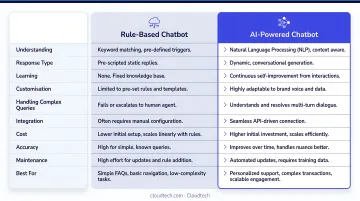
Rule-based chatbots can handle narrow, predictable queries. AI-powered chatbots go further — they read member intent, factor in past behavior, and sharpen their responses with each new interaction. For programs with diverse member bases or complex reward structures, that adaptability is the difference between a useful tool and a frustrating one.
Key Advantages of AI Chatbots in Loyalty Programs
The three advantages below are grounded in operational outcomes — not theoretical capabilities — and are measured against metrics loyalty program managers actually track.
Advantage 1: Personalized, Always-On Member Engagement
When a member has a question or redemption impulse and gets a slow or generic response, that's often the moment they disengage. AI chatbots remove that gap entirely.
In practice, the chatbot pulls from a member's purchase history, current tier, available points, and recent browsing behavior to deliver contextually relevant responses. Instead of "You have 1,200 points," the interaction becomes: "You're 200 points away from your next reward — here's a product you've browsed recently that would get you there."
That specificity matters. PwC's 2025 Customer Experience Survey found that 52% of consumers stopped using or buying from a brand after a bad experience. In loyalty programs, "bad experience" often means delayed, irrelevant, or impersonal communication.
The personalization gap is well documented. Bond's 2024 report found only 29% of Americans strongly agree that loyalty programs send relevant communications — and only 21% feel recognized by program representatives. AI chatbots close both gaps at scale.
Starbucks demonstrates the mechanism clearly. Microsoft documented how the brand uses reinforcement learning to generate order suggestions tailored to store inventory, customer preferences, time of day, and weather. Starbucks Rewards reached 34.3 million active 90-day members in Q1 FY2024, up 13% year over year — a result management directly attributed to AI-driven personalization efforts.
That level of personalization historically required enterprise-scale teams and platforms. AI chatbots bring that same capability within reach for SMBs.
KPIs impacted: Member engagement rate, reward redemption rate, CSAT, average response time, repeat purchase frequency
Highest impact when: Members span multiple time zones, the business lacks a large support team, or post-enrollment drop-off is a known problem
Advantage 2: Proactive Churn Prevention Through Behavioral Triggers
Most loyalty churn is invisible. Members don't cancel — they simply stop opening the app, stop making purchases, and let their points quietly expire. By the time a manual report surfaces the inactivity, the window for re-engagement has often closed.
AI chatbots are positioned to catch disengagement before it becomes permanent. The system monitors behavioral signals continuously:
- Declining purchase frequency
- Unclaimed rewards sitting idle
- Points approaching expiration
- Extended login inactivity
- Reward earning pace slowing below historical baseline
When a trigger fires, the chatbot automatically sends a personalized re-engagement message — no manual segment-pulling, no campaign scheduling delay. The response is immediate and contextual.
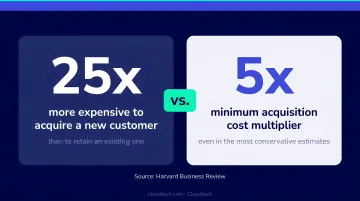
The financial logic for prioritizing retention is clear. Harvard Business Review cites Bain research showing that acquiring a new customer can cost 5 to 25 times more than retaining an existing one, and that increasing retention by just 5% can increase profits by 25% to 95%. For loyalty programs specifically, every member who drifts away represents not just a lost customer but a lost compounding asset — someone who was already enrolled, already earning, already close to a redemption moment.
Merkle's 2025 Loyalty Barometer Report, based on 2,000 consumer responses, found that 33% of customers who abandoned a loyalty program in the past year did so because rewards took too long to earn. An AI chatbot that proactively surfaces attainable milestones — "You're closer than you think to your next reward" — directly addresses this abandonment driver.
KPIs impacted: Churn rate, member retention rate, reactivation rate, customer lifetime value (CLV), points expiration/waste rate
Highest impact when: The program has a large passive member base, the 90-day post-enrollment window has passed, or competitors are actively targeting the same customer base with acquisition offers
Advantage 3: Scalable Program Operations Without Proportional Cost Growth
As loyalty programs grow, so does the volume of routine interactions — points balance checks, tier questions, redemption walkthroughs, complaint escalations. Without automation, support costs grow in proportion to membership, creating a cost structure that can erode program profitability over time.
AI chatbots resolve this by handling the high-frequency, lower-complexity interactions autonomously. Human agents focus on complex or emotionally sensitive cases. The chatbot scales to thousands of concurrent conversations without additional headcount.
Gartner predicts that by 2029, agentic AI will autonomously resolve 80% of common customer service issues without human intervention, contributing to a 30% reduction in operational costs. IBM cites a comparable 30% cost reduction potential for businesses that automate routine service tasks through chatbots.
Klarna's AI assistant handled 2.3 million conversations in its first month — equivalent to the work of 700 full-time agents — while cutting resolution time from 11 minutes to under 2 minutes and reducing repeat inquiries by 25%.
For SMBs, this changes the unit economics of running a loyalty program. What previously required a dedicated support function — or meant accepting slow, inconsistent member responses — can be handled by a well-configured AI chatbot on scalable cloud infrastructure. The program can expand its member base without expanding its support team proportionally.
KPIs impacted: Cost per interaction, support ticket volume, first-contact resolution rate, agent handle time, operational cost as a percentage of program revenue
Highest impact when: Membership is growing rapidly, peak shopping seasons create volume spikes, or the business wants to expand program reach without headcount growth
What Happens When AI Chatbots Are Missing from Loyalty Programs
Without AI chatbots, loyalty program disengagement tends to build undetected — members go dormant while the business assumes they're still active.
BCG's 2024 loyalty research found that while the average U.S. consumer now belongs to more than 15 programs, engagement is down 10% since 2022 and loyalty sentiment is down 20%. More memberships, less engagement — that's the trajectory programs without proactive AI intervention tend to follow.
The downstream consequences compound over time:
- High passive churn — members technically enrolled but generating no repeat purchase behavior, inflating program size while delivering no revenue signal
- Rising support costs — scaling linearly with membership rather than staying flat
- Missed re-engagement windows — by the time lapsed members are identified manually, they've often already accepted a competitor's offer
- Inconsistent member experiences — different answers via email vs. phone vs. in-app, eroding trust in the program itself
- Unredeemed points accumulating — Bond's 2017 data put the figure at $16 billion in unredeemed U.S. loyalty points, a baseline that has only grown as program enrollment has expanded since
None of these are edge cases. Each one reflects a structural gap that AI chatbots are specifically positioned to close — through real-time outreach, consistent responses, and automated re-engagement before a member is already gone.
How to Get the Most Value from AI Chatbots in Your Loyalty Program
AI chatbots deliver compounding value — their personalization improves as they accumulate more member interaction data. But that compounding only works when the underlying infrastructure supports it.
Three operational conditions determine whether an AI chatbot performs at its best:
Live data connectivity — the chatbot must access member purchase history, browsing behavior, points balance, tier status, and past interaction history in real time. Stale or siloed data produces generic responses, which defeats the purpose.
Regularly refined behavioral triggers — the signals that prompt re-engagement outreach should be reviewed and updated based on actual churn and reactivation data, not set-and-forgotten at launch.
Clearly defined escalation pathways — well-designed systems recognize when a query exceeds their resolution capability and hand off to a human agent with full conversation context, preventing friction at the moments that matter most.
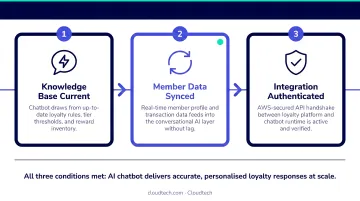
For SMBs deploying AI chatbots on AWS, the cloud backend architecture directly determines how responsive and accurate the chatbot experience is. Real-time loyalty interactions depend on low-latency data access, event-driven processing, and the ability to scale instantly during peak membership activity.
Businesses running these systems on fragmented or underpowered infrastructure see specific performance gaps — delayed responses, stale personalization, failed triggers — that erode member trust at the exact moments the chatbot was meant to strengthen it.
Cloudtech helps SMBs architect and deploy AI-ready cloud environments on AWS, including serverless event-driven workflows via Lambda, real-time data pipelines through Glue and Athena, and natural language interfaces powered by Amazon Q Business. These are purpose-built to support loyalty chatbot use cases where response speed and data accuracy directly affect whether members stay engaged or walk away.
Conclusion
AI chatbots have become the operational core of effective loyalty programs — directly affecting whether members stay engaged after enrollment, whether churn gets caught early, and whether program growth remains financially sustainable.
These advantages compound. Each interaction trains the model, each data point tightens the personalization, and each automated response handled without staff cost widens the efficiency gap between programs that adopted early and those still running manual workflows. SMBs that build this capability now don't just catch up — they set the baseline competitors have to match.
For SMBs, that means treating infrastructure as part of the chatbot decision — not a separate phase. The data pipelines, cloud environment, and integration layer determine how well any chatbot actually performs. Getting those foundations right is what makes the engagement gains stick.
Frequently Asked Questions
What are the 4 C's of customer loyalty?
Jennifer Rowley's 2005 framework defines four customer loyalty types: captive, convenience-seekers, contented, and committed — each distinguished by behavioral and attitudinal traits. Other "4 C's" lists circulate in marketing content, but none carry the same formal academic grounding.
How do AI chatbots improve customer retention in loyalty programs?
AI chatbots improve retention by monitoring behavioral signals — declining purchase frequency, unclaimed rewards, expiring points — and automatically triggering personalized re-engagement before the member fully disengages. This proactive approach catches churn early rather than waiting for members to reach out or disappear entirely.
What is the difference between a rule-based chatbot and an AI chatbot in a loyalty program?
Rule-based chatbots follow fixed decision trees and can only respond to pre-programmed queries. AI chatbots use NLP and machine learning to understand member intent, personalize responses based on purchase history, and improve with every interaction — making them far better suited to the demands of dynamic loyalty programs.
Can small businesses afford to implement AI chatbots in their loyalty programs?
Cloud-based platforms and pre-configured AWS solutions have made AI chatbot deployment accessible for SMBs at a fraction of the cost of custom builds. Automating routine member interactions reduces support overhead enough that most businesses recover the investment within their first year of deployment.
How do AI chatbots handle complex or escalated customer issues in loyalty programs?
Well-designed AI chatbots recognize when a query exceeds their resolution capability — due to complexity, emotional tone, or policy nuance — and escalate to a human agent with full conversation context attached. This ensures the handoff is seamless and the member doesn't have to repeat themselves.
What data do AI chatbots need to personalize loyalty program interactions effectively?
At minimum: member purchase history, points balance and expiration dates, tier status, browsing or engagement behavior, and past interaction history. All of this requires clean, connected data infrastructure to function in real time — fragmented data sources produce generic responses that undermine the personalization the chatbot was built to deliver.