Introduction
Customer service quality separates SMBs from their competitors — yet most hesitate to act, assuming enterprise-grade AI is priced for enterprises: too expensive, too complex, or too slow to justify. That's no longer true.
Cloud-native AI services have fundamentally changed the access equation. Gartner predicts that agentic AI will autonomously resolve 80% of common customer service issues by 2029, reducing operational costs by 30% — and the tools driving that shift are already accessible to businesses with 20 agents, not just 2,000.
This article breaks down how conversational AI generates measurable ROI through two distinct levers, which metrics actually prove it, and how to implement in a sequence that compounds returns over time.
Key Takeaways
- Conversational AI drives ROI through two levers: cost reduction and revenue generation
- Resolution rate — not deflection rate — is the single most important metric to track
- Amazon Connect and Amazon Bedrock give SMBs enterprise-scale AI on pay-as-you-go pricing
- Knowledge base quality before launch has more impact on outcomes than platform selection
- ROI compounds annually as the system learns; first-year returns are the floor, not the ceiling
What Is Conversational AI for Customer Service?
Conversational AI uses natural language processing (NLP) and machine learning (ML) to understand what customers are saying, respond appropriately, and improve with each interaction. It handles voice and digital channels — chat, SMS, phone — either autonomously or by assisting live agents in real time.
This is a key distinction from older rule-based chatbots. A traditional chatbot breaks when a customer phrases a question differently than the decision tree expects. Conversational AI understands intent, maintains context across a conversation, and handles requests that combine multiple needs in a single message.
Three Categories Worth Knowing
| Category | What It Does | Primary Benefit |
|---|---|---|
| Customer-facing AI agents | Automate interactions end-to-end | Reduces agent volume and extends hours |
| Agent assist tools | Support human agents in real time | Cuts handle time, improves accuracy |
| Conversation intelligence | Analyzes interactions at scale | Surfaces patterns, training gaps, and trends |
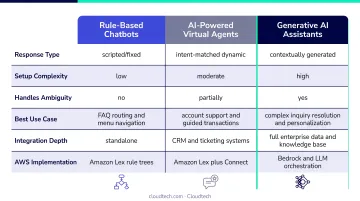
Most SMBs start with customer-facing automation and expand from there. That said, the entry point matters less than starting with a well-defined use case.
By 2028, Gartner projects that at least 70% of customers will use a conversational AI interface to begin their customer service journey — making implementation planning a near-term priority for SMBs that want to stay competitive.
The ROI Equation: Cost Reduction and Revenue Generation
Traditional ROI thinking for customer service treated it as a cost center: reduce headcount, reduce spend. Conversational AI changes that model because it operates on two sides of the equation simultaneously.
The Cost Reduction Side
The most direct impact is deflecting high-volume, low-complexity interactions — order status, FAQs, billing questions, appointment booking — away from human agents entirely.
According to Forrester, automated interactions cost roughly one-tenth of a human-handled conversation. IBM reports that conversational AI reduced cost per contact by 23.5% on average across external customer deployments. For handle time specifically, mature AI adopters reported 38% lower average inbound call handling time compared to non-adopters.
Cost reduction shows up in four places:
- Fewer agents needed for the same interaction volume
- Shorter handle times when agents do take calls (AI provides context and suggested responses)
- Reduced onboarding costs as AI-assisted training compresses ramp time
- Lower turnover pressure as agents handle fewer repetitive, frustrating interactions
One important caveat: Gartner warns that GenAI cost per resolution could exceed $3 by 2030 for poorly governed deployments. Cost reduction is real, but it depends on resolution quality.
The Revenue Generation Side
24/7 availability means inquiries that arrive at 11pm on a Saturday get handled, not lost. Leads captured outside business hours, issues resolved before a customer churns, upsell opportunities surfaced during routine interactions — these are revenue outcomes, not cost outcomes.
Forrester research found that customer-obsessed organizations — those investing in faster, lower-effort service — reported 41% faster revenue growth and 51% better customer retention compared to less mature peers. The link between resolution speed and loyalty is direct and measurable.
Why ROI Compounds Over Time
Conversational AI improves as it processes more interactions — a staffing hire doesn't. The system identifies gaps, refines responses, and handles increasingly complex scenarios as its training data grows. First-year returns reflect a partially trained system. Year two and three reflect a system that has seen your customers' actual questions at scale.
The Forrester Total Economic Impact study for Amazon Connect found a 342% ROI over three years, with AI-driven contact resolution generating over $51 million in present-value benefits across that period. These are enterprise-composite figures, but the compounding dynamic applies just as directly to SMBs — where each percentage point of cost reduction has proportionally larger impact on margins.
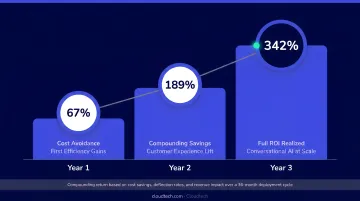
Resolution rate is the variable that determines how much of that ROI curve you actually capture — which is why it deserves its own examination.
Key Metrics to Track for Measuring Conversational AI ROI
Metrics matter most when they're baselined before deployment. Without a pre-launch snapshot, you're measuring change against nothing.
Operational Metrics
These tell you whether the system is working mechanically.
- Resolution rate / containment rate — The share of conversations the AI handles end-to-end without human escalation. This is the primary ROI driver — and the gap is significant. A Gartner survey of 5,728 customers found only 14% of issues are fully resolved in self-service, while Forrester's TEI for Amazon Connect found containment rates improving by 10% per year through AI-powered self-service.
- Average handle time (AHT) — Tracks efficiency gains for interactions that do reach human agents.
- Cost per interaction — Calculated across AI-handled and human-handled contacts to give you the weighted average as containment rates shift.
- Voice-to-digital deflection rate — Measures channel shift from higher-cost phone to lower-cost chat or self-service.
Customer Experience Metrics
Operational efficiency that damages customer satisfaction isn't ROI — it's a trade-off.
- CSAT — Captures immediate post-interaction sentiment
- CES (Customer Effort Score) — Lower effort correlates strongly with repurchase intent
- NPS — Tracks loyalty signals over time; useful for 6-12 month trend analysis
- First Contact Resolution (FCR) — Was the issue resolved in one interaction, regardless of channel?
Business Outcome Metrics
These take longer to attribute but represent the ultimate proof of ROI.
- Sales conversion rates on AI-assisted interactions with upsell opportunities
- Customer churn rate trends (6-12 months post-deployment)
- Customer Lifetime Value changes tied to retention improvements
Run a formal review at the 6-month and 12-month marks. Churn and CLTV move slowly — checking at 90 days will mislead you.
How to Implement Conversational AI for Maximum ROI
The implementation approach determines ROI as much as the platform. Most underperforming deployments break down in the planning phase, not the technical execution.
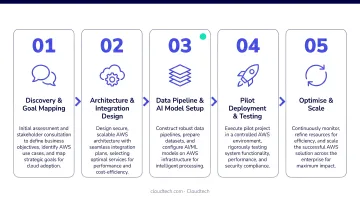
Step 1 — Audit Before You Build
Pull 3-6 months of customer interaction data. Identify the top 10-15 inquiry types by volume. The ones that are high-frequency, low-complexity, and procedurally predictable are your first automation targets.
Interview frontline agents too. They know which questions consume disproportionate time and which answers are buried in knowledge bases that no one maintains. That context shapes your use case prioritization and surfaces content gaps before you go live.
Step 2 — Start Narrow, Then Expand
Resist the temptation to automate everything at launch. Pick 2-3 well-defined use cases — FAQ automation, appointment scheduling, order status — and prove the system on those before expanding.
Channel selection matters too:
- Start where your customers already interact, not where deployment is easiest
- If your customers call, begin with voice; if they chat, start there
Step 3 — Design the Human-AI Handoff First
The moment a customer says "I want to speak to someone" is a make-or-break experience. If the AI transfers without passing conversation context, the customer repeats their entire problem to a live agent. That damages CSAT more than not having AI at all.
Design the handoff before you design anything else. The AI should pass the full conversation summary, detected intent, and relevant customer data to the receiving agent in real time. Cloudtech's voice deployments, for example, execute warm transfers in under two seconds with complete call context, so customers rarely notice the switch.
Step 4 — Fix the Knowledge Base Before Launch
The AI is only as good as the information it draws from. Structured, current, comprehensive support content produces strong resolution rates. Outdated or incomplete content produces escalations — and deflection numbers that mask the real problem.
This is the highest-leverage pre-launch activity. Allocate time for it before launch, not after.
Step 5 — Run Optimization as a Program
Organizations that see compounding ROI treat post-launch optimization as an ongoing discipline, not a one-time activity. That means:
- Weekly review of resolution rate trends and escalation patterns
- Monthly knowledge base updates based on gap signals (what the AI couldn't answer)
- Staged testing of changes before pushing to production
- Quarterly use case expansion as containment rates stabilize
If resolution rate trends are declining month-over-month and nobody is reviewing them, the problem compounds silently until customers notice.
Choosing the Right Infrastructure: AWS-Powered Conversational AI for SMBs
Platform choice determines how far you can scale without re-platforming — and for SMBs, the cost structure of that platform determines whether the math works at all.
Why AWS Works for SMBs
Amazon Connect (cloud contact center) and Amazon Bedrock (generative AI foundation models) operate on pay-as-you-go pricing with no upfront commitments and no minimum fees. There are no long-term contracts. An SMB handling 5,000 monthly interactions pays for 5,000 interactions — not an enterprise tier built for 500,000.
AWS-native conversational AI doesn't require a large upfront licensing commitment to get started. You can prove the model on a single use case, measure ROI, and expand based on results rather than locking into a multi-year contract.
How Cloudtech Builds on AWS
Cloudtech's conversational AI implementations are built directly inside the client's own AWS environment — meaning the client owns the infrastructure, the data, and the compliance configuration from day one.
For voice deployments, the standard stack includes:
- Amazon Bedrock for AI reasoning
- Amazon Connect for telephony and routing
- Amazon Transcribe for real-time speech-to-text
- Amazon Polly for natural voice output
- Amazon S3 for secure call recording storage with full audit trails — critical for HIPAA-compliant healthcare deployments
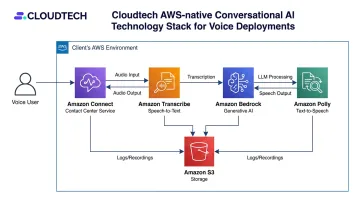
In practice, Cloudtech's voice agent for Ascend BPO — a healthcare BPO client — handled an 8-node conversational workflow: greeting, identity verification, insurance confirmation, slot availability, booking, and error recovery. The full appointment scheduling sequence completed in under five minutes per call, with warm handoff to a human agent in under two seconds when needed.
For chat deployments, Amazon Bedrock powers the reasoning layer with agents trained on company-specific knowledge bases, deployable across web chat, Slack, Microsoft Teams, or embedded directly in existing platforms.
AWS Partner Funding Reduces Entry Costs
As an AWS Advanced Tier Partner, Cloudtech can access AWS Partner Funding programs that may reduce or offset implementation costs for qualifying SMB clients. AWS Partner Funding includes mechanisms like Marketing Development Funds, Innovation Sandbox Credits, and the Migration Acceleration Program.
Beyond standard partner tiers, Cloudtech holds a Strategic Collaboration Agreement with AWS through the Small Business Acceleration Initiative — one of 26 global partners selected to specifically support SMB cloud adoption. That designation directly affects which funding mechanisms are available to the SMBs Cloudtech works with.
Common Mistakes That Erode Conversational AI ROI
Mistake 1 — Automating the Wrong Conversations First
Deploying AI on exception-heavy, complex interactions before proving the system on predictable, high-volume use cases burns budget and frustrates customers. The "quick wins first" sequencing from the implementation steps above serves two purposes: it builds organizational confidence in the system and generates clean performance data before you tackle harder problems.
Mistake 2 — Measuring Deflection Instead of Resolution
A customer who gives up is not a resolved customer. They're a churned inquiry waiting to become a churned customer. Deflection rate — interactions that didn't reach a human agent — counts both successful self-service and frustrated abandonment in the same column.
Resolution rate asks a harder question: did the customer's problem actually get solved? According to Gartner (2024), only 14% of customer service issues are fully resolved through self-service — meaning most deployments have a significant gap between what they're counting as deflection and what's actually being resolved.
Mistake 3 — Underestimating Total Cost of Ownership
Most ROI projections fail not because the platform underperforms, but because teams only account for licensing costs. The full cost picture includes:
- Platform consumption costs (scales with usage)
- Initial implementation and integration labor
- Knowledge base creation and ongoing maintenance
- Internal staff time for optimization and governance
- Integration costs for CRM, billing, or order management systems
- Compliance and security configuration (especially in regulated industries)
A Forrester Total Economic Impact study modeled $429,855 in consumption costs plus $134,158 in implementation and management over three years for an enterprise deployment. For SMBs, those figures scale down — but every cost category on the list above still applies. Build them into your projection from day one.
Frequently Asked Questions
What is conversational AI for customer service?
Conversational AI uses NLP and ML to automate customer interactions across voice and digital channels. Unlike rule-based chatbots that break on unexpected phrasing, it understands natural language, maintains conversation context, and improves over time through machine learning — handling complex, multi-step interactions without human intervention.
How does conversational AI reduce customer service costs?
It deflects high-volume, repetitive inquiries away from human agents, reducing cost per interaction. Agents who do take escalated contacts handle them faster with AI-provided context and suggested responses. The net effect is lower staffing pressure during volume spikes and a measurable reduction in cost per resolved interaction.
What metrics should I track to measure conversational AI ROI?
Resolution rate and containment rate are primary. Cost per interaction and average handle time track operational efficiency. CSAT and First Contact Resolution track customer outcomes. Baseline all of these before deployment — without a pre-launch snapshot, you can't quantify impact post-launch.
How long does it take to deploy conversational AI for customer service?
Simple FAQ automation on a well-prepared knowledge base can go live in weeks. Complex integrations with CRM, billing, or order management systems typically take two to four months, though AWS-native solutions with an experienced implementation partner compress timelines compared to custom-built alternatives.
Can small and mid-sized businesses afford conversational AI?
Yes. Amazon Connect and Amazon Bedrock operate on pay-as-you-go pricing with no minimums or long-term contracts. AWS Partner Funding programs can further reduce or eliminate upfront implementation costs for qualifying SMBs — making enterprise-grade conversational AI accessible without an enterprise budget.
What's the difference between a traditional chatbot and conversational AI?
Traditional chatbots follow rigid decision trees. They fail when customers phrase requests outside the expected pattern. Conversational AI understands natural language, handles multi-intent requests, and learns from every interaction — a difference that shows up directly in resolution rates and customer satisfaction scores.