Generative AI changes the math. Unlike rule-based automation that searches for predefined patterns, GenAI understands legal language contextually, generates new content, and surfaces insights buried in dense contract text. That makes it uniquely suited to every stage of the contract lifecycle.
This article covers how GenAI actually works in contract management, the key use cases driving adoption, measurable ROI, implementation challenges, the cloud infrastructure required, and what the next generation of AI agents will make possible.
Key Takeaways
- GenAI automates the most time-consuming contract tasks — drafting, review, summarization, and risk flagging — without replacing legal judgment- GenAI automates time-consuming contract tasks — drafting, review, summarization, and risk flagging — while keeping legal judgment in human hands
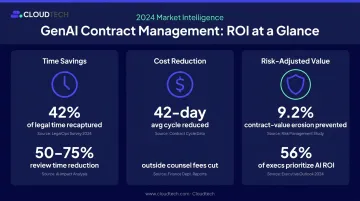
- Legal teams currently spend 42% of their time managing and maintaining contracts — time GenAI can redirect toward higher-value work
- Gartner predicts 50% of organizations will support supplier negotiations with AI-enabled contract tools by 2027
- Successful implementation requires clean data, strong governance, and the right cloud infrastructure alongside the software
- AI agents represent the next frontier: autonomous workflows that monitor obligations and trigger renewals in real time
What Generative AI Actually Does in Contract Management
Generative AI uses large language models (LLMs) and natural language processing (NLP) to understand, interpret, and generate human language — including the complex, nuanced language embedded in legal contracts. Traditional rule-based tools can only flag text that matches set patterns. GenAI understands context, infers meaning, and generates new language from scratch.
The Four-Step Process
When applied to contracts, GenAI typically follows this sequence:
- Document ingestion and parsing — contracts are uploaded and converted into structured, machine-readable content regardless of format
- Key term and clause extraction — LLMs identify obligations, dates, payment terms, indemnity clauses, and risk provisions
- Automated task execution — the model flags risks, drafts alternative language, or generates summaries based on extracted content
- Continuous learning and refinement — the system improves with new data and user feedback over time
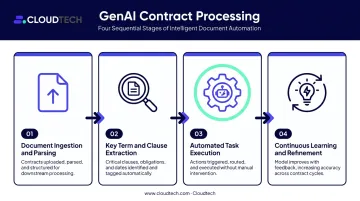
The system grows more accurate over time — each contract processed adds to its understanding of your organization's language, risk thresholds, and negotiating patterns.
Why Contracts Are an Ideal LLM Use Case
Contracts are text-heavy and structurally consistent, yet wildly variable in phrasing — exactly the conditions where LLMs outperform rules-based tools. A missed indemnity clause or misread payment term isn't an abstract error; it carries real financial exposure.
The human-AI dynamic here is worth naming clearly. GenAI takes on the high-volume, pattern-intensive work: clause extraction, risk flagging, draft generation. Legal professionals retain what machines can't replicate — judgment, accountability, and approval authority. This is augmentation, not replacement.
Gartner's 2024 forecast projects that 50% of organizations will use AI-enabled contract-risk analysis and editing tools by 2027 — a signal that early movers are already capturing the advantage.
Key Use Cases Transforming the Contract Lifecycle
Automated Contract Drafting and Customization
GenAI generates clause language from historical agreements, company playbooks, and industry standards — producing a first draft in minutes rather than days. More practically, it adapts contracts dynamically to specific counterparties, deal types, or regulatory contexts without starting from scratch.
The consistency benefit is underappreciated: AI-generated drafts apply standardized language across all contracts of the same type, eliminating the one-off clauses that quietly create compliance or liability exposure.
AI-Powered Contract Review and Redlining
GenAI scans submitted contracts against preferred terms, flagging:
- Non-compliant clauses
- Missing provisions (indemnity, limitation of liability, termination rights)
- Risky or ambiguous language
- Deviations from standard negotiation positions
Vendor data from Icertis suggests organizations report 50%–75% reductions in first-pass review time, with AI cutting the process from 2–4 attorney hours to 30–60 minutes per contract. Those figures are vendor-published without disclosed methodology, but the directional improvement is consistent across platforms.
Redlining assistance goes further: GenAI suggests specific edits and alternative clause language based on pre-approved standards and past negotiation outcomes — giving legal teams a data-backed starting position rather than a blank page.
Risk Detection and Compliance Monitoring
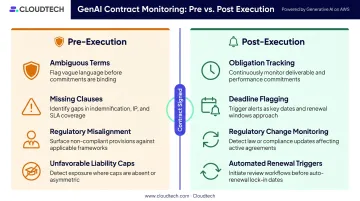
Pre-execution, GenAI analyzes contract language for:
- Ambiguous or undefined terms
- Missing indemnity or warranty clauses
- Regulatory misalignment
- Unfavorable liability caps or renewal conditions
Post-execution, the monitoring continues. GenAI keeps contracts working after signing by:
- Tracking performance against obligations
- Flagging approaching deadlines and renewal windows
- Monitoring regulatory changes that affect existing agreements
- Triggering automated renewal or renegotiation workflows
Contract Summarization and Clause Extraction
That post-execution visibility only matters if the right people can access it. A procurement manager shouldn't need to read a 300-page agreement to understand payment terms and termination rights. AI-generated summaries surface key obligations, expiry dates, penalties, and payment structures for stakeholders across finance, operations, and procurement — putting contract intelligence in front of the people who act on it, not just the legal team.
Measurable Business Benefits and ROI
The ROI of GenAI contract management spans several dimensions, and the numbers are specific enough to make the business case concrete.
Time and Labor Savings
Legal teams spend 42% of their time managing and maintaining contracts, according to the 2023 CLM benchmark study. That's nearly half the department's capacity absorbed by administrative contract work — drafting, reviewing, chasing signatures, tracking obligations.
GenAI recaptures a significant portion of that time. With 50%–75% reductions in first-pass review cycles, a team spending 20 hours per week on contract review could redirect 10–15 of those hours toward strategic legal work.
Cost Reduction
Those recovered hours translate directly into dollar savings — and cost reduction compounds across several areas:
- Reduced outside counsel fees — routine drafting and review handled internally by AI-assisted teams
- Faster time-to-signature — Ironclad's 2025 Contracting Benchmark Report documents an average 42-day creation-to-signature cycle; shorter cycles accelerate revenue recognition
- Fewer error-related costs — standardized AI drafting reduces the one-off clause mistakes that generate disputes
Risk-Adjusted Value
The WorldCC data on 9.2% contract-value erosion reflects the cumulative cost of missed obligations, poorly negotiated terms, and renewals that slip through without review. GenAI's continuous monitoring and risk flagging addresses each of those failure modes.
An Icertis survey of 500 senior executives found 56% prioritized AI use cases with immediate revenue or cost impact, and nearly half expected bottom-line effects in 2024. The contracting function — with its direct connection to deal velocity and obligation management — stands out as one of the most defensible places to deploy GenAI first.
Implementation Challenges and How to Overcome Them
Most GenAI contract implementations stall at the same point: not the model, but the underlying data, governance, and security infrastructure that surrounds it.
Data Quality and Readiness
GenAI models perform only as well as the contract data they're trained on. Inconsistent formatting, incomplete records, and siloed document repositories undermine model accuracy before a single clause gets analyzed.
What to do first:
- Audit existing contract repositories for completeness and format consistency
- Standardize naming conventions, metadata, and storage locations
- Establish a centralized contract repository before deploying any AI tooling
Security, Privacy, and Compliance Risk
Contracts contain some of the most commercially sensitive data in any organization. Thomson Reuters research found that 68% of legal-industry respondents cited data security as a barrier to GenAI adoption, with 62% citing privacy and confidentiality concerns.
Addressing these risks requires controls at the infrastructure level, not just the application layer:
- Role-based access controls (RBAC) enforced at the infrastructure level
- Encryption at rest and in transit (AES-256 and TLS 1.2 minimum)
- Alignment with SOC 2 and HIPAA frameworks for sensitive document environments
- Audit logging of every document access and modification event
Human Oversight and Governance
AI-generated contract outputs must be reviewed by qualified legal professionals — especially in high-stakes agreements where errors carry real legal weight. Governance frameworks should define:
- Who approves AI-generated drafts at each contract tier
- How errors or model failures are escalated
- How model performance is monitored and improved over time
Without clear accountability, AI-generated drafts can move forward without proper review — creating unsigned obligations, missed risk flags, and real legal exposure.
Building the Cloud Foundation for AI Contract Management
GenAI contract tools don't run in a vacuum. They require scalable compute, secure document storage, real-time processing, and clean integration with ERP, CRM, and document management systems. Without a well-architected cloud environment, even strong AI software underperforms.
The AWS Services That Power GenAI CLM
A production-grade GenAI contract management environment typically runs on a coordinated set of AWS services:
- Amazon Bedrock powers contract analysis, clause drafting, and Q&A through foundation models (Claude, Titan, Llama)
- Amazon S3 stores documents with encryption, version control, and lifecycle policies
- Amazon Textract extracts structured data from PDFs, scanned contracts, and forms with intelligent OCR
- AWS Lambda triggers automated workflows when documents are uploaded or contract milestones fire
- AWS IAM enforces least-privilege access controls across every role in the environment
- AWS CloudTrail logs every document access, edit, and deletion for a complete compliance audit trail
- Amazon OpenSearch handles vector indexing for semantic search and RAG pipelines
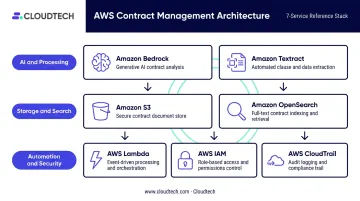
These components need to be configured correctly to deliver the performance and security GenAI promises. Misconfigured access controls or weak data isolation create exactly the compliance risks that make legal teams hesitant to adopt AI in the first place. That's where architecture expertise becomes the deciding factor.
Where Cloudtech Fits
For SMBs and mid-market companies building or modernizing AWS infrastructure for AI workloads, Cloudtech's AWS-certified architects design and deploy the environments that make GenAI contract tools actually work. That covers S3-based data lake architecture, Lambda and Glue pipelines, Textract document processing, and Bedrock RAG pipelines — all built with HIPAA and SOC 2-aligned controls from the start.
Cloudtech has deployed RAG pipelines on Bedrock for document-intensive healthcare workflows, achieving measurable outcomes: one engagement saw support tickets drop 45% within two months after deploying a Bedrock-powered document Q&A system. The underlying stack — Bedrock Agents, S3, OpenSearch, Lambda — maps directly to what contract management AI applications require.
For organizations that want to validate the use case first, Cloudtech offers a four-week GenAI POC engagement that produces a working AI prototype against your actual document datasets — before any full build commitment.
What's Next: AI Agents and the Future of Contract Intelligence
The current generation of GenAI contract tools is largely human-assisted: a legal professional initiates a review, the AI surfaces insights, and a human acts on them. The next generation is agentic — AI systems that autonomously execute specific contracting tasks within pre-approved guardrails.
An Icertis survey of 1,000 IT and business leaders found that 51% were already deploying AI agents in live workflows, with another 35% planning adoption within 12 months. That shift from human-initiated to autonomous execution is already underway.
What Agentic Contract Systems Look Like
Rather than a single AI doing everything, agentic architectures use specialized agents working in parallel:
- One agent monitors active obligations and flags approaching deadlines
- Another detects regulatory changes that affect existing agreements
- A third initiates renewal workflows based on contract terms and business rules
- A fourth generates negotiation position reports before a counterparty engagement
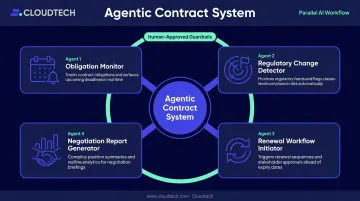
All of this happens within defined guardrails, without constant human prompting.
Emerging Capabilities Worth Watching
- Predictive risk scoring: historical contract data trains models to flag which agreements are likeliest to generate disputes or value leakage before they do
- Hyper-personalized drafting: counterparty-specific contracts built from past negotiation history, not generic templates
- Smart contract integration: blockchain-based self-executing agreements that cut manual enforcement on routine payment and performance terms
Getting there requires groundwork that most organizations underestimate. Clean contract data, defined governance policies, and cloud infrastructure that can support real-time agent orchestration are prerequisites — not afterthoughts. Teams that build those foundations now will deploy agentic systems faster and with far fewer governance failures than those retrofitting them later.
Frequently Asked Questions
What is generative AI in contract management?
Generative AI uses large language models and NLP to understand, analyze, and generate contract language. It automates tasks like drafting, clause extraction, risk flagging, and summarization that once took hours of manual legal effort, while keeping humans in the approval loop.
How much time can generative AI save in contract review?
Vendor data from platforms like Icertis suggests 50%–75% reductions in first-pass review time, compressing a 2–4 hour manual review to 30–60 minutes. The savings come from automated clause extraction, risk flagging, and comparison against preferred terms — rather than page-by-page reading.
What are the biggest risks of using AI for contract management?
The primary risks are data privacy exposure, acting on AI-generated outputs without qualified legal review, and inadequate governance frameworks. Mitigating these requires role-based access controls, encryption, audit logging, and clear escalation paths when AI outputs are flagged for human review.
Can small and mid-sized businesses benefit from AI-powered contract management?
Yes — SMBs often gain proportionally more, since they rarely have large legal teams to absorb contract volume manually. Faster deal cycles, reduced outside counsel spend, and better risk visibility are all accessible through cloud-based tools without requiring a large in-house legal or IT team.
What cloud infrastructure does an enterprise need to run generative AI contract management tools?
At minimum: scalable document storage (Amazon S3), LLM access (Amazon Bedrock), event-driven automation (AWS Lambda), identity and access control (AWS IAM), and audit logging (AWS CloudTrail). These components need to be correctly architected together — a task where experienced cloud architects ensure reliability, security, and cost efficiency from day one.
How do you measure the ROI of generative AI in contract management?
Focus on five metrics: manual review hours saved, outside counsel cost reduction, missed obligations avoided, time-to-signature, and contract-value erosion from unmonitored terms. Most organizations see measurable improvement across all five within their first year.