The challenge isn't access. It's clarity. Many SMBs find the AWS generative AI catalog genuinely confusing: dozens of services, overlapping capabilities, unclear starting points, and real questions about cost and data security.
This guide cuts through that noise. You'll learn what generative AI on AWS actually means, which services do what, where the real ROI lives across industries, and how to move from a proof of concept to a working production system, with security and compliance baked in from the start.
Key Takeaways
- AWS generative AI runs on foundation models (FMs) delivered through managed services, no infrastructure ownership required
- Amazon Bedrock is AWS's flagship GenAI platform, providing API access to models from Anthropic, Cohere, AI21 Labs, and Amazon's own Titan and Nova families
- RAG-powered chatbots, intelligent document processing, and code generation cut processing costs and accelerate workflows across regulated industries
- AWS maintains HIPAA eligibility, PCI DSS, SOC 2, and 140+ other compliance certifications that apply directly to GenAI workloads
- An AWS Advanced Tier Partner like Cloudtech can compress GenAI implementation from months to weeks using pre-built accelerators
What Is Generative AI on AWS?
Generative AI is the branch of AI that creates net-new content (text, images, code, audio) rather than just recognizing patterns in existing data. The distinction matters: a traditional ML model might classify a customer support ticket as "billing issue." A generative AI model reads that same ticket and drafts a personalized response.
The engine behind this capability is the foundation model (FM): a large neural network pre-trained on vast, diverse datasets. AWS describes FMs as deep learning models capable of language, image generation, and natural-language interaction out of the box, no task-specific training required. A single FM can handle tasks that once required separate, purpose-built models for each job.
Why Now?
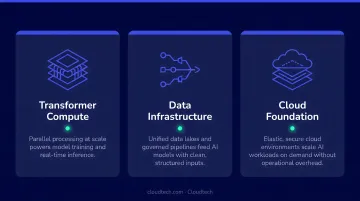
Generative AI scaled when it did because three infrastructure shifts happened at once:
- Transformer architecture: the 2017 "Attention Is All You Need" paper introduced the model structure underpinning virtually every modern LLM
- Scalable cloud compute: training and serving large models became economically viable on cloud infrastructure
- Data abundance: organizations now have enough structured and unstructured data to make grounded AI outputs genuinely useful
The adoption curve reflects this: McKinsey reported in 2025 that 71% of organizations regularly use generative AI in at least one business function, up from 65% the prior year.
AWS's Specific Approach
That adoption growth was largely enabled by cloud providers making FMs accessible without requiring organizations to build from scratch. AWS takes this further than most.
AWS provides managed access to FMs from multiple providers (Anthropic, Cohere, AI21 Labs, Stability AI, and Amazon's own Titan and Nova families) through a single, unified cloud infrastructure. No model hosting, no custom training pipeline required. The pricing is pay-as-you-go, it scales with demand, and it operates within your existing AWS security perimeter.
Key AWS Services for Generative AI
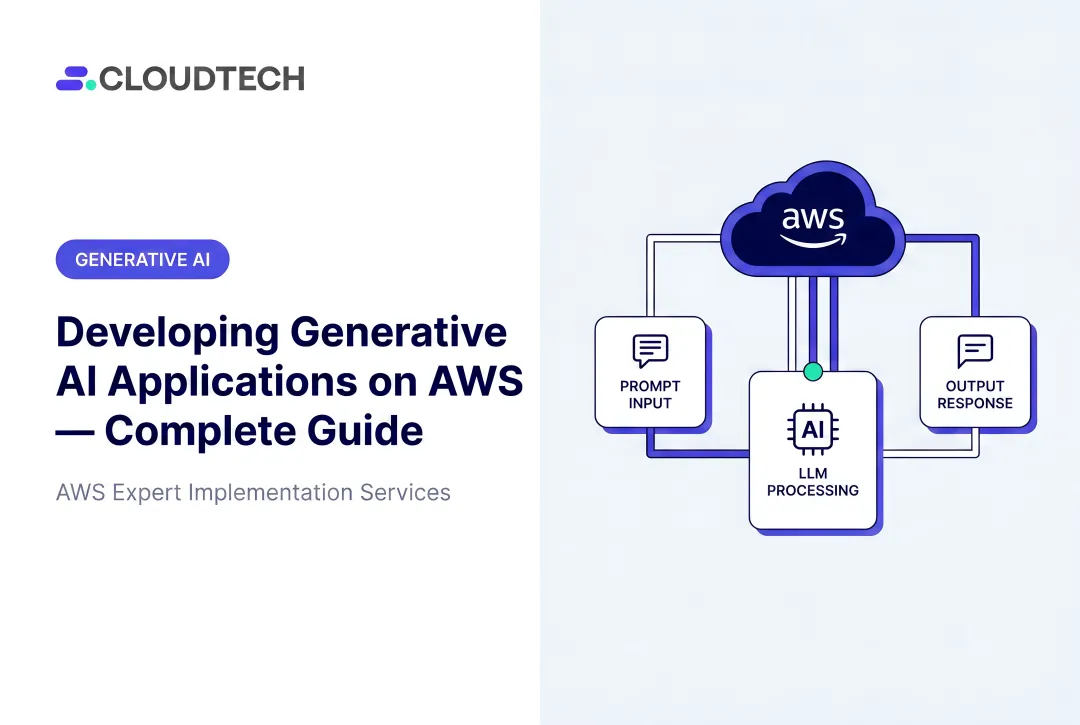
AWS covers the entire GenAI lifecycle through a layered set of services: accessing foundation models, building intelligent applications, and adding voice, vision, and document capabilities. Here's how the core services break down.
Amazon Bedrock
Bedrock is AWS's fully managed platform for generative AI. It provides a consistent API to access, evaluate, fine-tune, and deploy foundation models from multiple providers without managing any underlying infrastructure.
Two capabilities matter most for business builders:
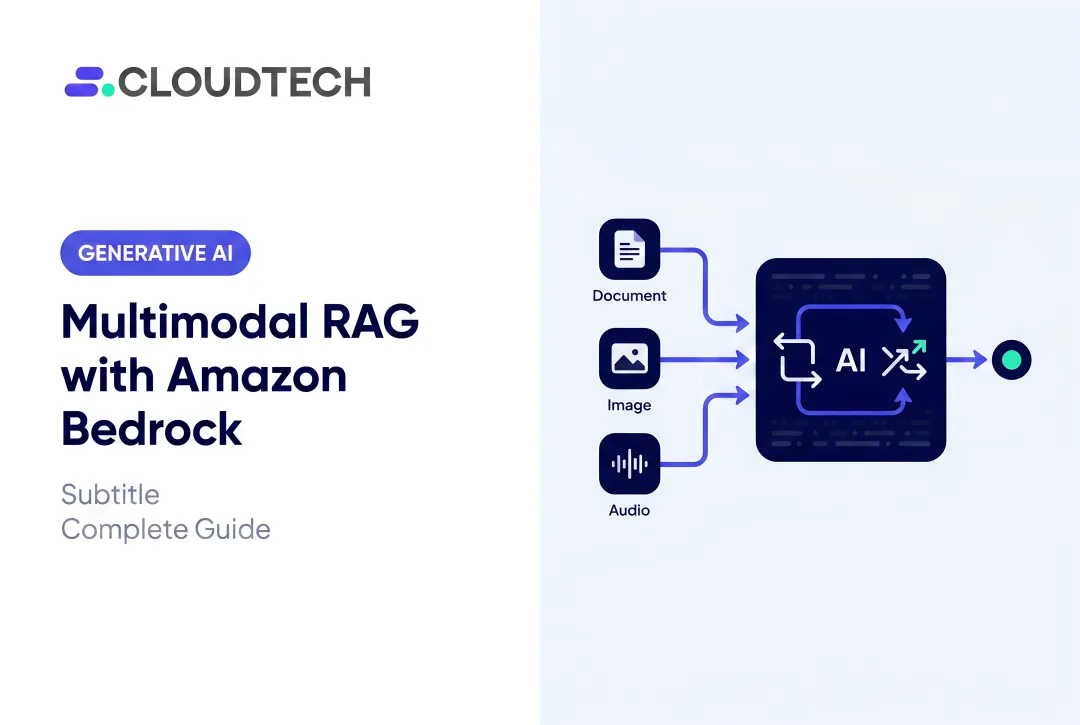
- Knowledge Bases for RAG: connects Bedrock to your private data sources (S3, databases, documents), retrieves relevant context before generating responses, and returns answers with citations. This reduces hallucinations and grounds outputs in your actual business data
- Bedrock Guardrails: configurable policy filters that block harmful content categories, denied topics, sensitive information exposure, and off-topic responses at both input and output
Amazon SageMaker
SageMaker is built for teams that need more control than pre-built models allow. It handles the complete model lifecycle: building, training, fine-tuning, and deploying custom models at scale.
Key capabilities include:
- JumpStart: a pre-built model hub with one-click deployment for open-source models
- Support for TensorFlow and PyTorch frameworks
- Tight integration with Bedrock for moving from prototype to production pipelines
Amazon Q
Amazon Q is AWS's managed AI assistant service with two distinct products:
- Amazon Q Business: a RAG-powered enterprise assistant that connects to internal data sources (Redshift, S3, SharePoint) and answers questions with cited references
- Amazon Q Developer: accelerates software development with inline code suggestions, code chat, and security scanning directly in IDEs. As of April 30, 2024, this service absorbed all of Amazon CodeWhisperer's capabilities
Supporting Services for Multimodal Pipelines
Beyond the core platforms, AWS offers a set of specialized services that plug into Bedrock and SageMaker pipelines to handle specific data types and interaction channels:
| Service | Core Function |
|---|---|
| Amazon Textract | Extracts text, forms, and tables from PDFs and scanned documents |
| Amazon Rekognition | Automates image and video analysis |
| Amazon Polly | Converts text to speech using deep learning |
| Amazon Lex | Builds conversational AI interfaces via voice or chat |
| Amazon Translate | Neural machine translation across languages |
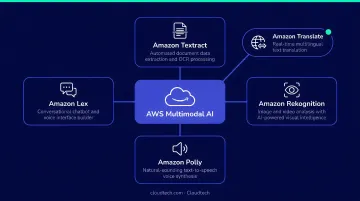
Cloudtech uses this stack directly in client engagements. One example: combining Amazon Textract with Amazon Q Business to build natural language interfaces over unstructured document repositories, so non-technical teams can query their data without writing a single SQL query.
Real-World AWS Generative AI Use Cases by Industry
Generative AI delivers measurable results in specific workflows. Here's where regulated and operational industries are already seeing those results.
Healthcare and Life Sciences
Clinical documentation is the highest-friction administrative task in healthcare, and AI is making a real dent. The American Medical Association reported that ambient AI scribes at The Permanente Medical Group saved physicians an estimated 15,791 documentation hours across 2.5 million patient encounters in a single year.
Practical AWS-based applications in this space include:
- Automated clinical documentation: transcription and summarization of patient encounters via Bedrock-connected audio pipelines
- Patient query chatbots: RAG-powered assistants that answer common questions grounded in approved clinical content
- Insurance claims automation: Textract extracts policy numbers, treatment codes, and billing amounts from scanned claims, cutting processing time from weeks to hours
- Synthetic data generation: creating research datasets without exposing real patient records
Both Amazon Bedrock and SageMaker are HIPAA-eligible services under the AWS BAA, so these architectures meet compliance requirements without requiring custom workarounds.
Financial Services
McKinsey estimates generative AI could add $200B to $340B in annual value to banking, roughly 2.8% to 4.7% of industry revenues, driven largely by productivity gains in document-heavy workflows.
AWS-based applications include:
- Intelligent document processing for mortgage underwriting, loan applications, and contract review: automated extraction with audit trails
- Compliance assistants: RAG-powered tools that surface cited regulatory passages from internal policy libraries
- Conversational analytics: natural language querying over sales and support data without analyst involvement
Bedrock's VPC isolation and CloudTrail integration handle both data sovereignty and audit logging, two requirements that financial services firms can't compromise on.
Operations and Content Automation
Across industries, three cross-functional use cases are delivering early, measurable returns:
- Automated content generation: product descriptions, internal reports, marketing copy at scale
- Code generation: GitHub's research found developers using AI coding assistants completed tasks 55% faster than those without
- Support automation: RAG-powered bots deflect routine inquiries, routing only complex cases to human agents
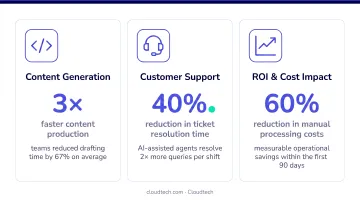
Cloudtech has hands-on experience deploying AWS GenAI and intelligent document processing solutions for healthcare and financial services clients, typically taking engagements from kickoff to working implementation in one to four weeks.
AWS Generative AI Best Practices
Start with RAG Before Fine-Tuning
Retrieval-Augmented Generation is the right starting point for most business applications. Instead of relying solely on a model's pre-trained knowledge, RAG retrieves relevant context from your private data before generating a response.
The practical impact: grounded outputs, fewer hallucinations, and answers that cite actual source documents your team trusts. AWS Bedrock Knowledge Bases handle the chunking, embedding, vector indexing, and retrieval pipeline; you connect your data sources and Bedrock handles the rest.
RAG should be your default architecture before considering fine-tuning, which requires significantly more data, time, and budget to execute well.
Prompt Engineering and Model Selection
Choosing the right foundation model matters as much as the application itself. Bedrock's model evaluation suite lets you run side-by-side comparisons before committing to production. Your prompt design shapes the output just as much as the model you choose.
Key principles:
- Match model to task: a lightweight Titan model handles classification efficiently; Claude handles complex reasoning; Stable Diffusion handles image generation
- Keep prompts concise because token count directly affects cost and latency. Every unnecessary sentence costs money at scale
- Test prompt variants systematically using Bedrock's built-in evaluation tools, no custom tooling required
- Guard against prompt injection: AWS Prescriptive Guidance recommends security guardrails and optimized prompt designs to mitigate injection risks
Use a Phased Implementation Approach
Don't attempt broad transformation in phase one. A reliable progression:
- PoC: one focused use case (a single RAG chatbot or document summarizer) with defined success criteria for accuracy, latency, and cost per request
- Foundation Build: validated architecture, CI/CD pipelines, model registry, and data governance in place
- Scale: multi-account AWS Control Tower structure, auto-scaling endpoints, and multi-AZ deployment
- Optimize: automated drift detection, cost tuning, and model evaluation on live traffic
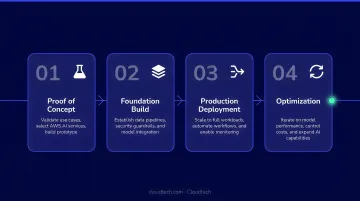
Each phase should produce a measurable business outcome before advancing to the next. Skipping that step is how pilots stall.
Security and Compliance for AWS Generative AI
Defense-in-Depth Architecture
AWS builds security directly into its GenAI services rather than treating it as an optional layer. Key controls include:
- Encryption at rest and in transit: Bedrock and SageMaker both encrypt data at rest by default; TLS 1.2 (with TLS 1.3 recommended) protects data in transit
- Customer-managed keys: AWS KMS integration lets you control your own encryption keys for Bedrock knowledge bases and SageMaker storage volumes
- VPC isolation via PrivateLink: Bedrock and SageMaker both support interface VPC endpoints, keeping all traffic off the public internet
- Audit logging: CloudTrail captures every API call; CloudWatch monitors inference and training jobs in real time
- Network isolation: SageMaker can run training and inference containers in internet-free mode, blocking all outbound network calls
Compliance Coverage
AWS maintains 143 security standards and compliance certifications, including HIPAA/HITECH, PCI DSS, SOC 1/2/3, ISO 27001, FedRAMP, and GDPR. Both Amazon Bedrock and SageMaker are explicitly listed as HIPAA-eligible services under the AWS BAA.
For SMBs in regulated industries, this matters: your GenAI workloads inherit AWS's compliance posture on day one, without the cost of building it from the ground up.
Responsible AI Controls
- Configurable content filters in Bedrock Guardrails block harmful outputs (hate speech, misinformation, and sensitive data exposure) at both input and output
- Pre-training bias detection via SageMaker Clarify surfaces data imbalances before models reach production
- In high-stakes domains (clinical decisions, financial approvals), route low-confidence outputs to human reviewers before any action is taken
Getting Started with AWS Generative AI
Practical First Steps
Don't start with a platform decision. Start with a problem.
- Identify a focused, high-ROI use case: a single document summarizer, a support chatbot, or an internal knowledge assistant. Narrow scope beats broad ambition in early-stage GenAI
- Audit your data sources: your proprietary data (S3 buckets, databases, document repositories) is the competitive differentiator. A RAG setup without quality data produces generic, low-value outputs
- Use Bedrock Playground: the Amazon Bedrock console provides playgrounds to test foundation models directly, no infrastructure setup required. Experiment with prompt variants and model outputs before committing to architecture
The Phased Roadmap
| Phase | Focus | Key Deliverable |
|---|---|---|
| PoC | Single use case, single data source | Working demo with defined accuracy/cost benchmarks |
| Foundation Build | Multi-source RAG, CI/CD, governance | Production-ready endpoint with monitoring |
| Scale | Multi-account structure, auto-scaling | Enterprise-grade deployment with SLA |
| Optimize | Drift detection, cost tuning | Continuous improvement pipeline |
Why an AWS Partner Accelerates This
Cloudtech is an AWS Advanced Tier Partner whose team includes former AWS professionals, including a VP of Engineering who spent years at AWS before joining Cloudtech. For SMBs, that means three concrete advantages: faster architecture decisions, access to AWS Partner Funding programs that can reduce out-of-pocket implementation costs, and implementation support from people who've shipped these systems before.
Most SMBs that go it alone spend four to six months validating architectural patterns that a seasoned partner already has documented. Working with the right partner compresses that to weeks.
Frequently Asked Questions
What is generative AI on AWS?
AWS generative AI refers to the suite of managed services and foundation models AWS provides for building applications that generate text, images, code, and other content. The primary services are Amazon Bedrock and SageMaker, both fully managed, meaning customers don't maintain the underlying infrastructure.
What is Amazon's version of ChatGPT?
Amazon Q is AWS's closest equivalent, a managed AI assistant that answers questions, generates code, and connects to enterprise data sources. Amazon Bedrock also gives you direct API access to ChatGPT-competing models like Anthropic's Claude, all through a single AWS interface.
What is the difference between Amazon Bedrock and Amazon SageMaker?
Bedrock is the API-driven platform for accessing and deploying pre-built foundation models with minimal setup. SageMaker is the full ML lifecycle platform for teams that need to build, train, and fine-tune custom models. Many organizations use both: Bedrock for application-layer AI, SageMaker for custom model development.
How much does AWS generative AI cost?
Bedrock charges per token for model inference; SageMaker bills by instance-hour. Costs vary widely by model and scale. Prompt engineering, multi-model endpoints, and AWS Inferentia chips are the primary levers for reducing spend. AWS Partner Funding may offset initial implementation costs for qualifying engagements.
Is AWS generative AI secure enough for healthcare or financial services?
Yes. AWS maintains HIPAA eligibility, PCI DSS, SOC 2, and 140+ compliance certifications covering Bedrock and SageMaker workloads. VPC isolation, customer-managed encryption keys, and full audit logging make both services appropriate for regulated industries, provided you configure them correctly under the shared responsibility model.
How long does it take to implement a generative AI solution on AWS?
A focused proof of concept (a RAG-powered chatbot or document summarizer, for example) can be operational within a few weeks. Enterprise-scale deployments typically follow a phased roadmap over several months. Working with an AWS Advanced Tier Partner like Cloudtech compresses both timelines by eliminating architectural trial and error.