Introduction
Healthcare providers are running lean. Staff shortages, rising patient volumes, and administrative backlogs have pushed organizations to find scalable solutions — and AI chatbots have moved from pilot programs into daily operations across scheduling desks, clinical documentation workflows, and billing departments.
The numbers reflect this shift. According to Precedence Research, the global healthcare chatbots market sits at $1.85 billion in 2026 and is projected to reach $11.99 billion by 2035 at a 23.19% CAGR — a trajectory that reflects sustained, structural adoption.
Deployment without governance, however, introduces serious risk. ECRI named AI chatbot misuse the #1 health technology hazard for 2026, and smaller providers often lack the infrastructure guardrails that enterprise health systems take for granted.
This guide covers the most impactful AI chatbot use cases in healthcare today, the measurable benefits, the real risks, and what healthcare organizations — especially SMBs — need to know before they deploy.
Key Takeaways
- AI chatbots now handle scheduling, triage, clinical documentation, billing inquiries, and chronic disease support across the full patient journey
- The clearest near-term ROI is in administrative and workflow automation, not autonomous clinical diagnosis
- ECRI's #1 health tech hazard for 2026: AI chatbot misuse — responsible deployment requires human oversight and HIPAA-compliant infrastructure
- Administrative costs consume 25–35% of U.S. healthcare spending — chatbots reduce this burden when scoped to defined administrative tasks
- SMB healthcare providers can deploy production-ready chatbots on AWS without large upfront infrastructure investment
What Are AI Chatbots in Healthcare and How Have They Evolved?
Healthcare chatbots are AI-powered conversational tools that interact with patients, clinicians, or administrative staff via text or voice to automate queries, workflows, and data lookups. They differ from broader AI agents, which autonomously execute multi-step actions across systems — though that boundary is narrowing fast.
The Technology Stack Behind Modern Healthcare Chatbots
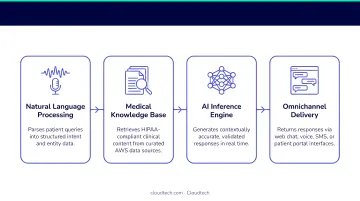
Modern deployments layer several capabilities:
- Natural language processing (NLP) — understands conversational input without requiring rigid commands
- Machine learning — personalizes responses and improves over time based on interaction data
- Speech recognition — enables voice-based interfaces for phone calls and ambient scribing
- Contextual awareness allows the chatbot to reference prior exchanges and, where integrated, pull relevant patient history
From Scripts to Generative AI
Those capabilities represent a significant leap from where healthcare chatbots started. Early systems were rule-based — scripted FAQ trees that broke the moment a patient asked something unexpected. Generative-AI-enhanced assistants now handle nuanced, multi-turn conversations far more naturally.
That shift is exactly why governance matters more now, not less. A rule-based bot that fails is obvious. An LLM that produces a confident but clinically incorrect recommendation creates a fundamentally different category of risk — one that requires active oversight, not just good architecture.
Top AI Chatbot Use Cases in Healthcare for 2026
Patient-Facing Use Cases
Appointment scheduling and reminders remain the clearest entry point for most organizations. A 2025 peer-reviewed survey of 3,661 U.S. adults found 72.1% used phone calls to schedule at least one medical appointment in the prior year, and 56.4% used phone as their primary scheduling method. Only 19.7% defaulted to online portals.
That phone dependency is a staffing problem. A March 2026 MGMA poll found scheduling was the second most time-consuming phone task for practice staff, accounting for 31% of inbound call volume. Chatbots handle the full scheduling workflow — checking availability, booking appointments, sending reminders via the patient's preferred channel, and collecting intake forms — without adding headcount.
No-show rates respond to automated outreach too. HIMSS data shows appointment notification systems generally reduce missed appointments by 5–10%, and a 2023 study at a Cleveland safety-net clinic found model-driven outreach reduced no-shows from 36.2% to 32.8% among high-risk patients.
Symptom checking and patient triage is higher stakes. Chatbots use guided questioning to assess symptom severity and route patients toward appropriate care — self-care, urgent care, or the ER.
A 2024 prospective evaluation of 2,543 emergency-care patients found a symptom checker avoided potentially hazardous undertriage under the study's consensus criterion. Accuracy across studies varies widely (49–90% depending on the symptom checker and methodology), which is why the framing matters: chatbot triage supports routing decisions, it does not replace clinician review.
Medication management and chronic disease support deliver measurable value for patients managing diabetes, hypertension, or other chronic conditions. Automated reminders and adherence check-ins improve follow-through between visits. When adherence drops, the chatbot surfaces an alert to the care team — converting a passive monitoring tool into a proactive clinical touchpoint.
Mental health and after-hours support fills a gap clinic hours simply can't. Woebot, the CBT-based mental health chatbot, showed meaningful depression symptom reduction in a 2-week RCT, with users engaging an average of 12 times over that period — available at 11 PM, no appointment required.
The limitations are documented: a 2025 study testing 29 mental health chatbot agents against simulated suicidal-risk scenarios found none met all expected crisis-response criteria. These tools support mental wellness; they do not manage mental health crises.
Clinical and Documentation Use Cases
Clinical documentation automation — ambient scribing — has the strongest published evidence for clinician impact. A JAMA Network Open study across 263 ambulatory clinicians at six healthcare systems found:
- Burnout declined from 51.9% to 38.8%
- Severe burnout fell from 18.4% to 12.2%
- After-hours documentation decreased 0.90 hours per week
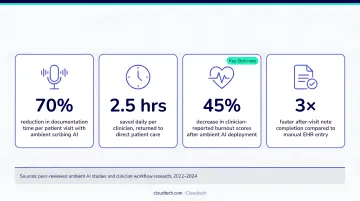
A vendor case study from Athenahealth found Suki reduced documentation time by approximately 40% and saved 45 minutes per clinician per day at an orthopedic practice — with encounter volume increasing 12% as a result. These are vendor-reported figures, but the direction aligns with peer-reviewed findings.
Ambient scribing tools listen to patient-clinician conversations (with consent), generate structured clinical notes, suggest billing codes, and flag incomplete documentation. That time recaptured from charting flows directly back into patient-facing care.
Clinical triage and decision support — hospital-facing AI assistants surface relevant patient history, flag high-risk indicators, and help clinicians prepare before walking into a visit. The practical value is reducing the time spent querying EHR systems mid-consultation, not replacing clinical judgment.
Administrative and Operations Use Cases
Billing inquiries, claims status, and financial assistance generate a disproportionate share of inbound call volume. Analysis of 4,000 hospital billing calls estimated AI could autonomously handle nearly one-third — that's a vendor estimate, not a peer-reviewed benchmark, but the category of question (balance inquiries, claim status, payment plan options) is genuinely well-suited to structured automation.
The context: administrative costs consume 25–35% of U.S. healthcare spending. Billing call deflection is one of the faster wins in that larger cost problem.
Insurance verification and prior authorization support is where delays compound into real care gaps. AI chatbots query payer systems, flag missing documentation, and route cases — reducing the manual back-and-forth that routinely delays treatment approvals by days or weeks.
Key Benefits of AI Chatbots for Healthcare Organizations
Operational Efficiency and Cost Reduction
The efficiency gains from chatbot deployment are measurable at the workflow level:
- Reduced inbound call volume for scheduling, billing, and routine inquiries
- Lower no-show rates through automated, personalized reminders
- Shorter administrative processing times for eligibility checks and prior authorizations
- Increased encounter capacity when documentation burden drops
The compound effect is significant for smaller practices where each staff member handles multiple roles — and it shows up directly in capacity and cost per encounter.
Improved Patient Engagement and Access
24/7 availability changes access dynamics, particularly for patients managing chronic conditions or those in underserved populations without easy access to regular clinic hours. A chatbot that answers medication questions at 9 PM or books a follow-up appointment on a Sunday reduces friction that often leads to missed care.
Staff Burnout Reduction
The burnout data emerging from healthcare AI deployments is among the more striking findings in recent research. One widely cited study found clinician burnout dropping from 51.9% to 38.8% within 30 days of AI-assisted workflow changes — that's not a marginal shift. When chatbots absorb the routine tasks (appointment confirmations, billing questions, medication reminders, documentation triage), clinical staff reclaim time for the work that actually requires their expertise.
Risks and Limitations to Address
Hallucination and Clinical Misinformation
ECRI named "Misuse of AI chatbots in healthcare" as the #1 health technology hazard for 2026. The specific concern: LLMs predict likely next words rather than verifying medical truth. They can sound authoritative while recommending unnecessary tests, generating incorrect diagnoses, or — in documented cases — inventing anatomical structures that don't exist.
This makes human-in-the-loop design essential for any clinical-adjacent deployment. The chatbot handles the volume; a clinician handles the judgment — catching errors before they reach patients.
Data Privacy, HIPAA Compliance, and Security Exposure
Using general-purpose AI tools — ChatGPT, Gemini, Copilot — in healthcare contexts where patients share protected health information (PHI) creates HIPAA liability. Three compliance requirements apply immediately:
- BAA required: HHS mandates a HIPAA-compliant Business Associate Agreement from any provider creating, receiving, maintaining, or transmitting ePHI
- Consumer tools excluded: ChatGPT, Gemini, and similar tools don't offer BAAs for standard usage
- Violation risk is real: Inputting PHI into public AI tools without a valid BAA constitutes a HIPAA violation under current guidance
AWS maintains a HIPAA Eligible Services program that identifies which services can be used with PHI under the AWS BAA — making it a foundational infrastructure choice for compliant healthcare chatbot deployments.
Bias, Generalizability, and Patient Trust
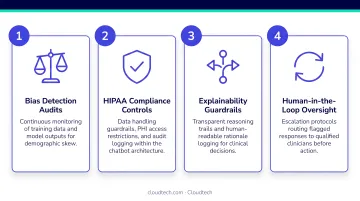
A 2023 JAMA Network Open study found AI chatbots gave different medical recommendations based on patient gender, race, ethnicity, and socioeconomic status across clinical vignettes. Models trained on non-representative data perform unevenly across patient populations — a problem that compounds when deployed at scale. Mitigating these risks requires structured governance at the deployment level:
- Clear scope limits (the chatbot does X, not Y)
- Regular model auditing against diverse patient populations
- Transparent patient communication about when they're interacting with AI
- Defined escalation paths to human staff
Implementing AI Healthcare Chatbots: What Healthcare Organizations Need to Know
Start With High-Value, Well-Defined Use Cases
Broad "AI everywhere" deployments fail more often than focused ones. Start with a specific, measurable workflow problem — appointment scheduling, billing inquiry deflection, medication reminders — where success criteria are clear and the chatbot operates within defined boundaries. Define what "working" looks like before you build anything.
Ensure HIPAA-Compliant Infrastructure From Day One
Healthcare chatbots handling patient information must run on HIPAA-eligible infrastructure with proper BAAs, encryption at rest and in transit, audit logging, and role-based access controls in place. This isn't a post-launch checklist item — it's a prerequisite.
AWS provides HIPAA-eligible services and BAA coverage that make it a natural foundation for compliant healthcare chatbot deployments. For SMB healthcare organizations without a dedicated compliance team, working with an AWS Advanced Tier Partner like Cloudtech means the infrastructure layer is built correctly from the start — using services like AWS Lambda, API Gateway, Amazon S3, AWS KMS, Amazon Macie for PHI detection, and CloudTrail for audit logging, all configured to healthcare standards.
That foundation only holds if compliance is treated as architecture, not afterthought. Cloudtech's healthcare deployments include dedicated HIPAA audit phases before production go-live and ongoing call log reviews post-launch — keeping clinical and compliance staff informed at every stage.
Integrate With Existing Systems
A chatbot that operates in isolation from your EHR, scheduling platform, and billing system will produce inaccurate, unhelpful responses. Chatbots need to read and write to the systems that matter — which requires secure API integrations and real-time data synchronization.
How complex that integration becomes depends heavily on scope. A focused scheduling chatbot with a single integration point can go live in weeks. A solution requiring deep EHR integration, billing system connectivity, and custom conversation flows takes longer and requires experienced engineering.
Design for Human Escalation and Oversight
Effective healthcare chatbots reduce the volume of routine interactions — they don't replace clinical judgment. Every deployment should include:
- Defined escalation triggers (keyword-based, sentiment-based, or topic-based)
- Clear handoff protocols with context passed to the receiving staff member
- Audit trails of AI-generated recommendations
- Regular review of escalated interactions to identify gaps
Measure, Monitor, and Iterate
Set KPIs before deployment, not after. Useful metrics include:
- Containment rate — percentage of interactions resolved without human escalation
- Patient satisfaction score — post-interaction feedback
- No-show rate — for scheduling chatbots
- Documentation time — for ambient scribing deployments
- Call volume deflection — for billing and scheduling use cases
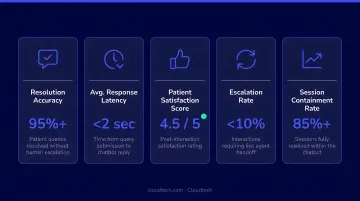
Build in a feedback loop to catch model drift, emerging edge cases, and user confusion patterns that signal the chatbot needs retraining or scope adjustment.
Frequently Asked Questions
What are the most common AI chatbot use cases in healthcare?
The primary categories are appointment scheduling and reminders, symptom triage, medication management, clinical documentation assistance, and billing inquiries. The highest near-term ROI typically comes from administrative use cases — scheduling and billing deflection — where success criteria are clear and clinical risk is low.
How do AI chatbots in healthcare stay HIPAA compliant?
HIPAA compliance requires a Business Associate Agreement with your cloud infrastructure provider, encryption at rest and in transit, role-based access controls, and audit logging. AWS provides HIPAA-eligible services with BAA coverage, making it an appropriate foundation for healthcare chatbot infrastructure. Consumer-grade AI tools are not suitable for conversations involving PHI.
What is the difference between a healthcare chatbot and an AI agent?
Chatbots respond to queries within a defined conversation flow. AI agents autonomously execute multi-step tasks across systems (booking an appointment, updating an EHR record, sending a reminder) without step-by-step prompting. The distinction is blurring as generative AI and agentic capabilities converge, but governance requirements scale with autonomy.
How much can AI chatbots reduce administrative costs in healthcare?
Results vary by deployment scope. Ambient scribing tools have cut documentation time by roughly 40% in vendor case studies, with peer-reviewed research showing measurable burnout reductions. MGMA data puts scheduling at 31% of phone-based staff workload, making it a high-value deflection target. Independent benchmarks for billing automation remain limited.
What are the biggest risks of using AI chatbots in healthcare?
ECRI's 2026 designation of AI chatbot misuse as the top health tech hazard points to core risks including hallucination and clinical misinformation, PHI exposure through non-compliant infrastructure, and over-reliance on AI for decisions that require clinical judgment. Human-in-the-loop design and purpose-built, HIPAA-compliant platforms are the practical mitigations.
How long does it take to implement an AI chatbot in a healthcare setting?
A focused chatbot for scheduling or billing inquiries — with a limited integration footprint — can go live in weeks when built on AWS-native pre-packaged solutions. Custom deployments requiring deep EHR integration, multi-system connectivity, and complex conversation flows typically take several months. Starting with a well-scoped use case and experienced implementation partners cuts timelines considerably.