Introduction
Generative AI is already inside most businesses — not always by IT's choice. Employees are using it to write, analyze, summarize, and decide. For SMBs and mid-market companies, that's often a net positive. But it also means sensitive data, compliance obligations, and brand reputation are now in the hands of tools that no one fully vetted.
According to Microsoft's 2024 Work Trend Index, 78% of AI users brought their own AI tools to work — a figure that climbs to 80% at SMBs. That's shadow AI at scale, operating outside any governance or security review.
This guide breaks down the five major risk categories GenAI introduces, how to build a governance framework, and the practical steps your team can take — without a dedicated security department or a Fortune 500 budget.
Key Takeaways
- GenAI introduces five major risk categories: cybersecurity, data privacy, compliance, operational reliability, and third-party/vendor risk
- GenAI is both a risk source and a powerful risk management tool — understanding that dual role shapes smarter strategy
- Effective governance requires a written AI risk appetite, clear ownership, and an up-to-date AI inventory
- SMBs face unique challenges: lean compliance teams and limited IT budgets make cloud-native controls especially critical
- Human-in-the-loop oversight and continuous monitoring are essential — not optional
What Is Generative AI and Why Does It Introduce New Risks?
Not all AI carries the same risk profile. Understanding the distinctions matters before you can govern any of them effectively.
| AI Type | What It Does | Primary Risk Profile |
|---|---|---|
| Generative AI | Creates novel outputs—text, images, code, summaries—from training data | Hallucination, privacy exposure, bias, information integrity |
| Predictive AI | Forecasts outcomes from historical data | Prediction drift, biased decisions |
| Agentic AI | Pursues goals and executes actions with limited supervision | Autonomy risk, compounded action errors |
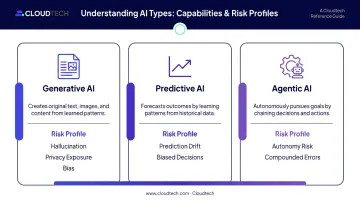
NIST defines generative AI as models that emulate characteristics of input data to generate derived synthetic content—and specifically calls out "confabulation" as a core risk: outputs that are confidently stated but factually wrong. Unlike traditional software, which fails visibly, GenAI produces plausible-sounding outputs that require human judgment to catch—making it fundamentally harder to audit.
That audit challenge extends beyond tools you build yourself. If your payroll vendor, CRM provider, or contract management platform has added AI features—you're already in scope. Indirect exposure through third-party tools is where many governance gaps live.
The Five Major Generative AI Risk Categories
Cybersecurity Risk
GenAI has lowered the barrier for attackers. What once required significant technical skill can now be done in minutes:
- Crafting a convincing phishing email or executive impersonation script
- Building targeted social engineering campaigns at scale
- Cloning voices for vishing attacks in real time
CrowdStrike reported a 442% increase in vishing (voice phishing) between H1 and H2 2024, fueled by AI-enabled impersonation. IBM's X-Force team produced an AI-generated phishing campaign in 5 minutes that achieved an 11% click rate—nearly matching a human-crafted campaign that took 16 hours to produce.
Beyond social engineering, GenAI models themselves are targets. Training data poisoning and adversarial attacks can corrupt model behavior at the source. The EchoLeak vulnerability (CVE-2025-32711) demonstrated that prompt injection attacks can cause data disclosure through AI tools like Microsoft 365 Copilot—meaning your AI tools are part of your security perimeter, not outside it.
Data Privacy Risk
When employees paste customer data, financial records, or patient information into a public AI tool, that data may be stored and potentially used to train future models. This is shadow AI in practice—and it creates serious exposure under GDPR, HIPAA, and CCPA.
The FTC has warned that breaking privacy or confidentiality commitments about customer data can constitute an FTC Act violation, with remedies including deletion of models built with unlawfully obtained data. Enterprise-tier offerings from major providers include data handling protections, but those protections typically don't extend to free consumer accounts—and most shadow AI usage involves exactly those accounts.
Compliance and Regulatory Risk
Existing law applies to AI systems—no exceptions. The FTC, DOJ, CFPB, and EEOC jointly confirmed that automated systems are not exempt from civil-rights, consumer-protection, and equal-opportunity laws. The EEOC's $365,000 settlement with iTutorGroup—over hiring software that allegedly discriminated by age—established enforcement precedent for automated decision-making.
The regulatory landscape is also accelerating. In 2025, all 50 states introduced AI legislation and 38 states enacted approximately 100 measures. The EU AI Act entered into force in August 2024, with obligations expanding through 2026. Organizations that assume "there's no AI law yet" are already behind.
Operational Risk: Hallucinations
GenAI produces confident, wrong answers—and has no mechanism to flag the difference. In a Stanford study of specialized legal AI tools, hallucination rates ranged from 17% to 33% depending on the platform, even with retrieval-augmented generation designed to reduce errors. In Mata v. Avianca, lawyers submitted six nonexistent judicial opinions generated by ChatGPT and received a $5,000 sanction.
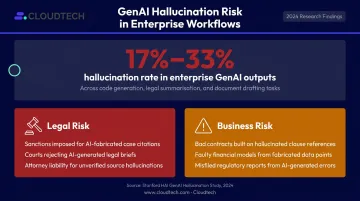
The business consequence isn't just embarrassment. It's decisions made on bad information—contracts signed, reports filed, financial models built—without anyone catching the error upstream.
Third-Party and Vendor Risk
Your organization is responsible for the AI your vendors use, not just your own internal deployments. NIST's GenAI Profile explicitly calls for supplier due diligence, third-party AI component assessment, provenance documentation, and incident reporting requirements.
The American Bar Association's AI contract guidance identifies specific provisions that vendor agreements should address:
- Training-data rights and provenance
- Use of customer prompts and outputs for model training
- Confidentiality obligations
- Audit rights
- Data return or deletion on termination
Most current vendor contracts address none of these.
How Generative AI Can Actually Help Manage Risk
The same technology that creates these risks can also help you manage them—faster and more accurately than manual methods alone.
Specific use cases where GenAI adds genuine risk management value:
- Regulatory change monitoring — Scans large volumes of regulatory updates, flags relevant changes, and summarizes their impact on existing controls
- Contract review — Surfaces risky clauses, non-standard terms, and missing provisions across large contract volumes
- Risk scoring and scenario modeling — Runs quantitative risk assessments faster than traditional methods allow
- Anomaly detection — Spots unusual patterns in financial transactions, access logs, or system behavior in real time
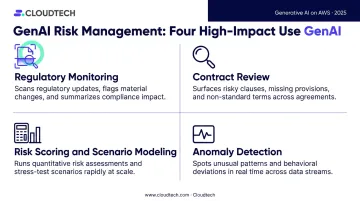
Amazon Finance Technology's implementation of a GenAI workflow for regulatory analysis reduced processing time by 92% while retaining human validation at key review points. The pattern is worth adopting directly: bounded, source-grounded GenAI handles the heavy lifting, while humans review outputs before any action is taken.
For SMBs with limited compliance staff, this matters practically. A two-person compliance function can't manually track 50 state AI laws, review every vendor contract, and run quarterly risk assessments. Purpose-built AI tools trained on curated regulatory or financial datasets can extend that team's capacity considerably.
One critical caveat: general-purpose models are not trained for regulatory accuracy. A Stanford legal research study found that even specialized retrieval systems hallucinated on 17–33% of queries. For compliance-sensitive work, domain-specific tools with verifiable, sourced outputs are the safer choice.
Building a GenAI Risk Governance Framework
Start with an AI Inventory
You can't govern what you can't see. An AI inventory is an organized record of every AI system in your environment—internal deployments and vendor-supplied tools alike.
NIST recommends documenting:
- System name, purpose, and use case
- Data inputs and their sensitivity classification
- Model type and provider
- Controls in place and gaps identified
- Associated vendor relationships and contract terms
- Incident history and monitoring status
This isn't a one-time exercise. The inventory requires updates whenever a new internal use case launches, a vendor changes its AI practices, or a regulatory update changes how a tool must be governed.
Define Risk Appetite and Ownership
Without named accountability, governance stalls. The board and executive team need to establish a written, explicit AI risk appetite—defining which GenAI use cases are permissible, how outputs are reviewed before action is taken, and who answers when something goes wrong.
For most organizations, this means role-specific ownership:
- CISO — Cybersecurity risk from AI-enabled threats and model vulnerabilities
- CDO or equivalent — Data privacy, shadow AI, and data handling policies
- CCO or General Counsel — Regulatory compliance and vendor AI disclosures
SMBs without dedicated C-suite roles can distribute these responsibilities to existing personnel. What matters is that accountability is named, documented, and reviewed regularly—not that it maps to a specific title.
Apply Standard Risk Treatment Approaches
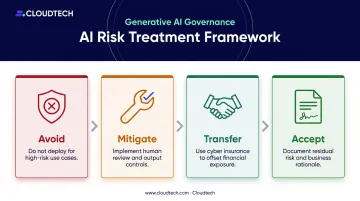
The four standard risk treatment options apply directly to GenAI:
- Avoid — Don't use GenAI for use cases where the risk exceeds acceptable limits (e.g., fully automated adverse credit decisions)
- Mitigate — Implement controls such as mandatory human review, output validation, or restricted data inputs
- Transfer — Use cyber insurance to offset financial exposure from AI-enabled attacks or privacy breaches
- Accept — Document the residual risk and the business rationale for accepting it
Apply AWS-Native Controls
For SMBs deploying GenAI on AWS, infrastructure-level governance controls reduce manual security overhead for internal teams. Three native services do most of the heavy lifting:
- Amazon Bedrock guardrails — Configurable controls for content filtering, PII detection and redaction, denied topics, and contextual grounding checks
- CloudTrail — Captures API calls with identity, action, time, and resource details for full auditability
- IAM policies — Enforce least-privilege access at the model and resource level
Cloudtech's work building HIPAA-compliant environments on AWS—using Control Tower, CloudTrail, AWS Config, Amazon Macie, and KMS—shows how these controls translate to regulated workloads. SMBs don't need to design governance architecture from scratch; the same patterns apply directly to compliant GenAI deployments on Bedrock.
Build in Continuous Monitoring
GenAI governance is not a project with a completion date. Models drift. Threat landscapes evolve. Vendors add AI capabilities without announcement. Regulatory requirements change quarterly.
Establish regular review cadences:
- Monthly — Monitor model output quality, usage anomalies, and vendor disclosures
- Quarterly — Review the AI inventory, update risk assessments, audit employee AI usage
- Annually — Full policy review against current regulatory landscape and business AI usage
Best Practices for Managing Generative AI Risks
Translating awareness into action requires discipline across five areas. Start with the basics.
Maintain a living AI inventory. Update it when new use cases are added, vendors change practices, or regulations shift. It's the foundation of defensible risk management.
Enforce human-in-the-loop oversight. Critical decisions—financial, legal, clinical, operational—should never be fully delegated to GenAI outputs. Define clear escalation thresholds: at what point does AI assistance end and human judgment take over?
Invest in employee education. Employees are both the primary source of shadow AI risk and the first line of defense against misuse. Training should cover:
- Recognizing AI hallucinations and understanding their business risk
- What data can and cannot be entered into AI tools
- Data handling policies for AI-generated outputs
- When and how to escalate concerns about AI-generated content
Require vendor AI disclosures. Audit existing vendor agreements for AI-related language. Add contract clauses covering notification requirements when AI practices change, data handling restrictions, model validation standards, and audit rights. Without these clauses, you have no contractual recourse if a vendor quietly changes how your data is processed.
Design for adaptability. Governance frameworks built today can be outdated within a year. Build modular policies with defined review cadences. Use scalable controls that can expand alongside your AI footprint. Rigid structures don't just slow you down—they create blind spots as capabilities evolve.
Frequently Asked Questions
How can generative AI help manage risk?
GenAI can automate risk identification tasks—scanning regulatory changes, analyzing contracts, running scenario models, and flagging anomalies in real time. For lean teams managing large risk surface areas, this means faster, more accurate risk coverage than manual methods can provide.
Which AI is best for risk management?
Purpose-built tools trained on curated, domain-specific data (regulatory content, compliance frameworks, financial data) are far more reliable than general-purpose models. They produce sourced, verifiable outputs rather than generalized text generation, which matters when decisions carry regulatory consequences.
What are the biggest risks of using generative AI in business?
The five core categories: cybersecurity threats enabled by AI-powered social engineering, data privacy exposure from shadow AI usage, regulatory compliance failures from biased or unexplainable outputs, operational reliability issues from hallucinations, and third-party vendor risk from undisclosed AI usage.
What is shadow AI and why should businesses be concerned?
Shadow AI refers to employee use of unsanctioned AI tools without IT or compliance oversight. When sensitive data enters these platforms, businesses lose control of it: no contractual protections, no audit trail, and no visibility into the exposure until damage is already done.
How do you create an AI inventory for your organization?
Document every internal GenAI use case (tool, purpose, data inputs, controls) and flag which vendors use AI and what contractual safeguards exist. Keep this inventory current. It should reflect your actual AI environment at all times, not just the moment it was first drafted.
What is an AI governance framework and where do I start?
An AI governance framework is the set of policies, roles, processes, and controls that define how your organization adopts and oversees AI responsibly. The practical starting point: establish a written AI risk appetite, appoint clear ownership for each risk category, and build your AI inventory before deploying any new GenAI tools.