Introduction
Businesses are deploying AI chatbots to handle customer queries at scale — and it's working, until it isn't. When a conversation exceeds what the bot can handle, customers expect a smooth transition to a human. What they often get instead is a cold transfer where they repeat everything from scratch.
According to Salesforce research covering 14,300 consumers and business buyers, 56% of customers say they often must repeat or re-explain information to different representatives. That friction adds up fast when it follows an already frustrating automated interaction.
This guide covers everything SMBs need to know in 2026:
- AI chatbot human handoff — what it is and why it matters
- Three trigger types that determine when to escalate
- Five elements that make handoffs seamless
- Building it on AWS using Lex, Connect, and Bedrock
- Metrics that actually tell you if it's working
- Common mistakes that undermine even well-designed systems
What Is an AI Chatbot with Human Handoff?
AI chatbot human handoff is the structured transfer of a customer conversation from an AI system to a live agent — with full conversation context preserved so the customer never has to repeat themselves. It's the point where automation ends and human judgment begins.
Getting that boundary right matters more than most teams realize.
Warm vs. Cold Handoffs
The type of handoff you use should match the stakes of the conversation:
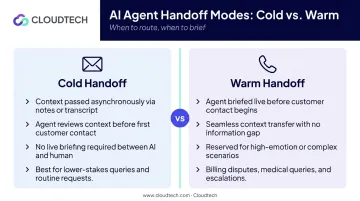
- Cold handoff: Context (transcript, intent, customer data) passes to an available agent asynchronously. The agent reviews and picks up the conversation without a real-time briefing. Suitable for lower-stakes queries.
- Warm handoff: The agent is briefed before engaging the customer directly. Used when emotion, urgency, or complexity is high — billing disputes, medical questions, or situations where the customer is already frustrated.
For SMBs, choosing the wrong type for a high-stakes situation isn't just an operational gap — it's a trust problem.
Why This Matters for SMBs in 2026
SMBs have historically relied on personal relationships to retain customers. A broken AI-to-human handoff directly erodes that trust — and unlike large enterprises, SMBs rarely get a second chance after a poor support experience.
The stakes are rising. Gartner predicts that by 2029, agentic AI will autonomously resolve 80% of common customer service issues without human intervention. That means the 20% of conversations that do reach a human will carry disproportionate weight. Poor handoff design in that 20% will define how customers remember you.
3 Types of Handoff Triggers
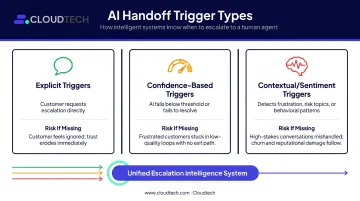
The most common mistake teams make is implementing only one trigger type — usually explicit requests — and leaving gaps that either trap customers in bot loops or flood agents with unnecessary escalations. High-performing systems use all three, layered together.
Explicit Triggers
The customer directly asks for a human: "Talk to an agent," "I need a person," "Let me speak to someone."
The rule here is absolute: escalate immediately, with no retries, no friction, and no loops. AWS documents this through a dedicated SpeakToAgent Lex intent that branches directly to a queue transfer in Amazon Connect. Ignoring an explicit request is the fastest way to destroy trust.
Confidence-Based Triggers
The AI drops below a defined confidence threshold, fails to resolve an issue after a set number of attempts, or reaches the edge of its knowledge base. In Amazon Lex V2, when every candidate intent falls below the nluIntentConfidenceThreshold, the system returns AMAZON.FallbackIntent — which can be configured to trigger handoff via Lambda.
Calibration requires ongoing attention. Set the threshold too aggressively and you overload your agents; set it too loose and customers get trapped. Tune continuously based on post-handoff outcome data, not just initial setup intuition.
Contextual / Sentiment Triggers
This is the most sophisticated type. The AI detects:
- Frustration signals or urgency cues in language
- High-risk topic categories (billing disputes, compliance questions, medical queries)
- Behavioral patterns like circular conversations or repeat contacts within a short window
Amazon Lex V2 integrates with Amazon Comprehend to analyze sentiment on each utterance, giving application logic a real-time signal to evaluate. These triggers catch edge cases that rules alone miss. They're especially valuable in healthcare and financial services, where emotional stakes and regulatory exposure are both high.
Combining All Three
Each trigger type covers a different failure mode. Layer them deliberately so no gap goes unaddressed:
| Trigger Type | Function | Risk If Missing |
|---|---|---|
| Explicit | Customer-controlled escalation | Customers feel trapped |
| Confidence-based | Safety floor for AI failures | Silent resolution failures |
| Contextual | Proactive detection | Frustrated customers not caught |
Revisit trigger thresholds on a set schedule — quarterly works well for most teams — using actual post-handoff outcomes to guide adjustments.
The 5 Elements of a Seamless AI-to-Human Handoff
Even with well-designed triggers, a handoff can fail at execution. Most teams over-optimize when to escalate and under-invest in how the escalation actually works. These five elements are interdependent — weakness in one degrades the others.
Full Context Transfer
Passing a raw transcript is not the same as passing context. A high-performing handoff delivers a structured package:
- Clear summary of the issue
- Identified customer intent
- Sentiment indicators
- Relevant account data
- Prior resolution attempts
The goal is not more information — it's the right information in a format the agent can act on immediately. Cloudtech's implementation for Monster Reservations Group demonstrated this directly: human agents received complete conversation context at the moment of transfer via Amazon Connect, eliminating the need for agents to ask customers to repeat themselves.
Intent-Aware Transfer Design
Not all escalations require the same approach. Match the handoff style to the situation:
- Low complexity, low emotion: Efficient context-structured cold transfer
- High emotion, urgency, or regulated topic: Warm transfer with agent briefing before engagement
Applying a uniform fallback regardless of context is a design failure. The escalation flow itself should adapt to complexity, emotion, and risk.
Agent-First Interface Design
At the moment of handoff, the agent interface must immediately surface three things:
- What the customer is trying to achieve
- What the AI already attempted
- What is most likely needed next
If this information is fragmented or buried, agents ask questions the customer has already answered. That's one of the most common and avoidable sources of escalation frustration — and it's a design problem, not an agent problem. Getting this right also directly shapes what the customer experiences next.
Customer Expectation Management
From the customer's perspective, escalation introduces uncertainty. The AI should actively manage the transition by:
- Confirming the next agent has full visibility into the conversation
- Setting realistic wait time expectations
- Maintaining a sense of momentum throughout
This matters most in high-stakes contexts (billing disputes, healthcare queries) where trust and reassurance directly determine satisfaction outcomes.
Closed-Loop Learning
Every escalation is a data signal. Was this issue automatable? Did the agent receive sufficient context? Was it resolved efficiently?
Without capturing and analyzing this data, the handoff process stays static. With it, every escalation becomes an input for refining AI behavior, refining trigger logic, and reducing unnecessary handoffs over time. Teams that review escalation data monthly — even at a basic level — consistently close gaps faster than those treating the handoff as a set-and-forget configuration.
How to Build AI Chatbot with Human Handoff on AWS
AWS provides the core building blocks for SMBs to handle this end-to-end without enterprise-scale infrastructure. Cloudtech, as an AWS Advanced Tier Partner and one of 26 partners selected globally for AWS's Small Business Acceleration Initiative, helps SMBs architect and deploy these systems — typically in weeks rather than months.
Amazon Lex and Amazon Connect
The core pairing works like this:
- Amazon Lex handles natural language understanding (NLU) — interpreting customer intent, detecting entities, managing conversation flow
- Amazon Connect serves as the cloud contact center that routes escalated conversations to live agents
The two services integrate natively. When Lex detects a confidence threshold breach (AMAZON.FallbackIntent) or an explicit escalation intent (SpeakToAgent), it branches the Connect flow to Set working queue and Transfer to queue. Conversation attributes — intent name, slot values, session data — pass through to the Connect agent workspace using the Set contact attributes block, referenceable via fields like $.Lex.IntentName.
Amazon Connect's step-by-step guides display these attributes as a screen pop the moment the interaction begins — the agent sees intent, slot values, and session history before saying a word.
Amazon Bedrock for Generative AI Responses
Amazon Bedrock lets SMBs layer foundation models — Claude, Titan, or others — into the chatbot for more natural, fluent responses. More relevant to handoffs: Bedrock can generate structured conversation summaries that give human agents immediate, organized context without reading raw transcripts.
Amazon Connect Contact Lens already uses Bedrock for post-contact summarization. That same capability applied at handoff produces a pre-formatted summary card in the agent workspace — covering intent, prior attempts, and sentiment — so agents start informed, not cold.
Key handoff benefits Bedrock adds:
- Generates plain-language summaries from raw conversation transcripts
- Surfaces structured context cards in the Connect agent workspace at transfer
- Reduces average handle time by cutting the agent's ramp-up on each interaction
Setting Up Handoff Workflows and Context Passing
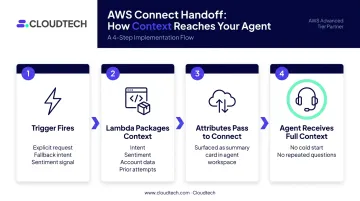
The key implementation pattern:
- Trigger fires — explicit request, fallback intent, or sentiment signal
- Lambda packages context — intent, sentiment, account data, prior attempts into structured contact attributes
- Attributes pass to Connect — surfaced as a summary card in the agent workspace
- Agent receives full context — no cold start, no repeated questions
Webhooks and API integrations extend this to CRMs and helpdesks. For reference architecture, AWS documents the Lex-to-Connect integration pattern and the Bedrock + Connect generative AI architecture.
How to Measure Handoff Quality
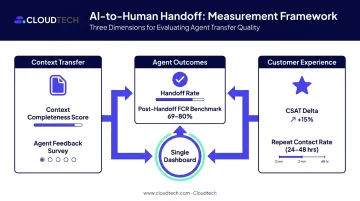
Most teams track escalation volume in isolation — which tells you almost nothing about quality. Evaluate handoffs as a system across three dimensions: context transfer, agent outcomes, and customer experience impact.
Handoff Rate and Post-Handoff First Contact Resolution (FCR)
Two metrics anchor this dimension:
- Handoff rate: Percentage of AI interactions that escalate to a human
- Post-handoff FCR: Whether the agent resolves the issue during that same escalated interaction
Neither metric is meaningful alone. SQM's 2024 benchmark puts aggregate inbound FCR at 69%, with world-class at 80%+. If escalated cases regularly require follow-up, either the wrong issues are escalating or agents aren't getting enough context. Track both together.
CSAT Delta and Repeat Contact Rate
- CSAT delta: Satisfaction difference between automated and escalated interactions. A well-designed handoff should increase customer confidence — when escalated scores run lower, the handoff experience is usually the culprit, not the agent.
- Repeat contact rate: Customers returning within 24–48 hours after escalation. High repeat contact signals hidden resolution failure — issues that appeared closed but weren't.
Context Completeness Score
Did the agent have everything they needed at the moment of connection? A consistently low score predicts poor downstream performance and points to gaps in what the bot passes to the agent.
Build a simple feedback loop to capture this:
- A brief post-handoff survey for agents (3–5 questions, 30 seconds to complete)
- Supervisor-scored QA rubric covering a sample of escalated interactions
- Monthly review of context scores alongside handoff rate and post-handoff FCR trends
Once you have all three in a single dashboard, gaps become obvious fast — and you can target fixes at the layer actually causing the problem, whether that's bot logic, context packaging, or agent training.
Common Mistakes to Avoid
Treating Handoff as a Routing Problem
Most teams invest heavily in trigger logic — when to escalate — and neglect context management: how the escalation actually works. If the agent doesn't inherit the full story, the system has failed regardless of routing accuracy. Handoff is a context problem. Routing precision means nothing if the receiving agent starts from scratch.
Over-Automating Without a Human Escape Valve
Designing bot flows that make it difficult for customers to reach a human destroys trust at the moment customers need it most. Always provide a clear, accessible path to a human.
Transparency about when they're talking to a bot versus a human is both an ethical requirement and a trust-building practice. Salesforce research finds that 72% of consumers say it's important to know whether they're communicating with an AI agent. Regulations are catching up: the EU AI Act (Article 50, effective August 2026) requires AI systems to disclose their nature to users, and Utah's SB 149 already mandates disclosure in covered commercial interactions.
Skipping the Feedback Loop
Treating the handoff as the end of the AI interaction — rather than the beginning of a learning cycle — is one of the most common optimization gaps. The minimum viable feedback loop:
- Post-handoff outcome tagging: Was the issue resolved? Did it require follow-up?
- Agent context-quality ratings: Did the agent have what they needed?
- Monthly review: Handoff rate vs. post-handoff FCR trends
Without this, teams cannot improve. With it, every escalation becomes an input for making the next one better.
Frequently Asked Questions
Are AI chatbots illegal?
AI chatbots are legal in most jurisdictions, though regulations are tightening. Core requirements: bot disclosure (mandatory under the EU AI Act from August 2026), GDPR/CCPA data privacy compliance, and sector-specific rules for healthcare (HIPAA) and financial services (CFPB oversight). Compliance hinges on deployment context and the data collected.
What triggers an AI chatbot to hand off to a human agent?
Handoffs are triggered by three signal categories:
- Explicit requests — the customer asks for a human directly
- Confidence thresholds — the AI fails to match intent or resolve the issue
- Contextual signals — detected frustration, high-risk topics (billing, medical), or repeated failed attempts
How do I prevent customers from having to repeat themselves during a handoff?
Full context transfer is the answer — passing a structured summary that includes intent, sentiment, account data, and prior resolution attempts ensures the receiving agent can act immediately. Raw transcript dumps don't solve this; structured, agent-ready context packages do.
What is the difference between a warm and cold handoff?
A cold handoff passes structured context to an agent asynchronously; they review it before engaging. A warm handoff means briefing the agent before they contact the customer — used in high-emotion or high-complexity scenarios where immediate continuity matters.
What metrics should I track to measure AI chatbot handoff quality?
Track these four:
- Handoff rate + post-handoff FCR — are escalations actually getting resolved?
- CSAT delta — how satisfaction shifts between automated and escalated interactions
- Repeat contact rate — customers recontacting within 24–48 hours signals failed handoffs
- Context completeness score — gathered via agent feedback or QA review
How long does it take to implement an AI chatbot with human handoff on AWS?
Using pre-built AWS services — Amazon Lex, Amazon Connect, and Bedrock — SMBs can deploy a functional chatbot-with-handoff system in weeks, not months. Timelines stretch when integration complexity is high or when HIPAA/SOC 2 compliance needs to be built in from day one.