Without analytics, you're flying blind. Without integrations, chatbot conversations stay siloed — invisible to your CRM, helpdesk, and sales pipeline.
This guide evaluates five leading AI chatbot services specifically on their analytics depth and integration ecosystems. Whether you're in healthcare, financial services, retail, or SaaS, the goal is the same: help you choose a platform that drives measurable outcomes, not just impressive demos.
Key Takeaways
- Analytics metrics — containment rate, CSAT, escalation rate — directly signal support cost savings and CX quality
- Integration breadth (CRM, helpdesk, e-commerce) determines whether chatbot data actually informs your business
- Top platforms covered: Intercom Fin AI, Zendesk AI, IBM watsonx Assistant, Salesforce Agentforce, and Tidio
- No single tool fits every business — team size, tech stack, and primary use case should drive your selection
- Before committing, run a free trial with real queries and evaluate analytics output — not just conversation quality
Why Analytics and Integrations Define the Best AI Chatbot Services
A chatbot without analytics is a black box. Conversations happen, but you can't tell which ones are working, which are failing, or where customers drop off. The metrics that matter most:
| Metric | What It Tells You |
|---|---|
| Containment rate | % of conversations resolved without human escalation |
| Escalation rate | How often the bot hands off to a human agent |
| Resolution rate | % of issues fully resolved by the AI end-to-end |
| CSAT | Whether AI responses actually meet customer expectations |
| Conversation volume | Total load handled, by channel and time period |
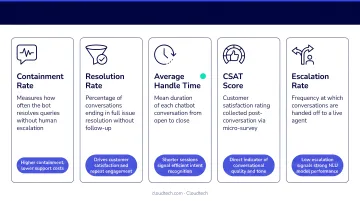
Each metric connects directly to business outcomes. A high containment rate means lower support costs. Low CSAT on AI interactions signals training or configuration gaps, while escalation rate reveals where your bot's knowledge runs thin.
Integrations are equally critical. According to Salesforce's State of Service report, 82% of high-performing organizations use the same CRM platform across their service operations.
When your chatbot operates in isolation — no CRM connection, no helpdesk sync — the data it generates never reaches the teams who need it:
- Support managers don't see resolution trends
- Sales teams miss qualified leads surfaced through chat
- Marketing can't act on intent signals
The five platforms below were selected because they lead on both dimensions: analytics depth and integration breadth. Conversational AI quality matters, but it's baseline — what separates genuinely useful platforms is whether they make their data actionable.
Top 5 AI Chatbot Services With Analytics & Integrations
These platforms were evaluated on analytics depth, integration breadth, deployment ease, and fit for SMBs and mid-market teams — not brand recognition alone.
Intercom (Fin AI)
Intercom is a customer communications platform, and Fin AI is its generative AI-powered chatbot built natively into that ecosystem. It's designed specifically for customer support teams that want to automate resolution without rebuilding their entire support stack.
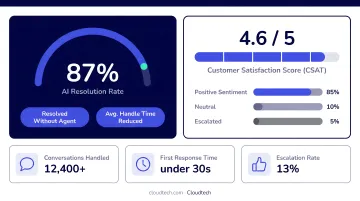
What sets Fin apart is how tightly analytics are woven into the core product. Key metrics include:
- Resolution rate: percentage of conversations Fin closes without human involvement
- Automation rate: a composite of involvement and resolution rates
- CSAT and topic-level performance via the Topic Explorer
- Escalation tracking: distinguishes procedural handoffs from default escalations, showing where the bot needs better guidance versus where it's routing intentionally
On integrations, Intercom connects natively with Salesforce, HubSpot, Slack, Stripe, Shopify, and Zendesk, with over 350 additional apps available through its app store. REST API and webhooks cover custom connections.
| Feature | Details |
|---|---|
| Key Analytics | Resolution rate, automation rate, CSAT, Topic Explorer (automation by topic), escalation tracking |
| Integration Ecosystem | Native: Salesforce, HubSpot, Slack, Stripe, Shopify, Zendesk; 350+ apps via app store; REST API + webhooks |
| Pricing | Fin AI Agent: $0.99/resolved outcome; platform seats from $29/seat/month (Essential) to $132/seat/month (Expert); 14-day free trial available |
Best for: Support-focused teams already using the Intercom ecosystem who want resolution and topic analytics out of the box.
Zendesk AI
Zendesk built its AI layer directly into the Zendesk Suite — including AI-powered bots, intelligent triage, and agent assist. For teams already running Zendesk for ticketing, this means AI analytics sit alongside human agent data in a single reporting environment.
The unified analytics view is Zendesk's clearest differentiator. Bot CSAT, deflection rate, resolution time, and ticket volume trends across both AI and human interactions all appear in one reporting environment.
Zendesk also separates ticket deflection from resolution — deflection means the customer didn't file a ticket, while resolution means the issue was actually solved. Both metrics appear in reporting, giving support managers a more complete picture.
The Zendesk Marketplace offers over 1,200 app integrations, including native connections to Salesforce, Shopify, Jira, Slack, and Microsoft Teams. For SMBs, published per-agent pricing makes budget planning straightforward; enterprise plans require a sales conversation.
| Feature | Details |
|---|---|
| Key Analytics | Bot + agent unified reporting; deflection rate, resolution rate, CSAT, resolution time, ticket volume by channel; Explore reporting suite |
| Integration Ecosystem | 1,200+ apps via Zendesk Marketplace; native: Salesforce, Shopify, Jira, Slack, Microsoft Teams |
| Pricing | Suite Team: $55/agent/month; Suite Professional: $115/agent/month; Copilot add-on: $50/agent/month; AI agents included in Suite plans, billed per Automated Resolution; Enterprise: contact sales |
Best for: Customer support teams wanting unified bot-and-human analytics and the largest third-party integration marketplace.
IBM watsonx Assistant
IBM watsonx Assistant is an enterprise-grade conversational AI platform designed with regulated industries in mind — healthcare, financial services, and similar environments where security and compliance aren't optional. It deploys on IBM Cloud or on-premises via IBM Cloud Pak for Data, and the watsonx platform is also available on Microsoft Azure.
The analytics module tracks intent confidence scores, containment rate, and conversation path visualization, showing exactly where users move through the dialog tree and where they drop off.
Integration coverage includes Salesforce, Zendesk, Slack, and Microsoft Teams, with custom REST APIs for other connections. GDPR and HIPAA compliance documentation makes it a credible option for healthcare and financial services organizations where data handling requirements are strict.
Pricing follows a monthly active user (MAU) model rather than per-conversation billing, which benefits teams with high but predictable conversation volumes.
| Feature | Details |
|---|---|
| Key Analytics | Intent confidence scores, containment rate, conversation path visualization, escalation tracking via live-agent transfer integrations |
| Integration Ecosystem | Salesforce, Zendesk, Slack, Microsoft Teams; custom REST APIs; IBM Cloud and on-premises deployment |
| Pricing | Lite: free; Plus: from $140/month (includes first 1,000 MAUs); Enterprise: contact IBM |
Best for: Regulated industries (healthcare, financial services) needing HIPAA/GDPR compliance and enterprise-grade security with flexible deployment options.
Salesforce Agentforce
Agentforce is Salesforce's AI chatbot and agent platform embedded directly within the Salesforce CRM. If your business already runs on Salesforce — Service Cloud, Sales Cloud, Marketing Cloud — it's the most integration-native option on this list, with native access to every Salesforce cloud product.
The analytics depth comes from CRM context that other platforms simply don't have. Standard Einstein Bot reports track bot metrics by hour and day, escalation transfers to service reps, and session-level data. The platform also surfaces lead conversion from chat, customer sentiment scoring via real-time analysis, and case deflection rates — all feeding back into the Salesforce data model. Advanced reporting runs through Tableau Next (formerly Einstein Analytics), giving teams powerful visualization without leaving the platform.
Pricing is consumption-based, which creates flexibility but also requires careful planning. For SMBs, Salesforce Starter Suite at $25/user/month includes built-in AI and prebuilt agents, offering a lower-cost entry point.
| Feature | Details |
|---|---|
| Key Analytics | Bot metrics (hourly/daily), escalation reports, case deflection, lead conversion from chat, customer sentiment, CSAT; advanced reporting via Tableau Next |
| Integration Ecosystem | Native across Salesforce clouds (Service, Sales, Marketing, Commerce); Slack, WhatsApp, SMS, web, mobile; REST APIs for external systems |
| Pricing | $2/conversation or $500 per 100,000 Flex Credits; add-ons from $125/user/month; Agentforce 1 Editions from $550/user/month; Starter Suite from $25/user/month |
Best for: Businesses already operating on Salesforce who want chatbot analytics fed directly into CRM-native pipelines and reporting.
Tidio
Tidio targets e-commerce SMBs specifically. Its Lyro AI generative chatbot combines live chat and built-in analytics in a package built for Shopify, WooCommerce, WordPress, and Wix stores.
The analytics dashboard tracks conversations handled by Lyro AI, CSAT score (available separately for both AI and human agents), first response time, conversation duration, visitor behavior, and "transferred to agent" as a proxy for escalation rate. Reports are exportable, and the live visitors list adds a layer of behavioral context most SMB tools skip.
Setup is no-code, which matters for small teams without dedicated technical resources. Zapier access extends the integration footprint significantly without requiring API development work.
| Feature | Details |
|---|---|
| Key Analytics | AI conversations handled, CSAT, response time, conversation duration, bot-to-agent handoff rate, visitor behavior; exportable reports |
| Integration Ecosystem | Native: Shopify, WooCommerce, WordPress, Wix, HubSpot, Mailchimp; Zapier for extended connections; API available |
| Pricing | Free plan: $0/month (50 billable conversations, 50 Lyro AI conversations); Starter: from $24.17/month; Growth: from $49.17/month; Lyro AI standalone add-on: from $32.50/month |
Best for: E-commerce SMBs on Shopify or WooCommerce that need a fast, no-code deployment with accessible analytics and e-commerce platform integrations.
How We Chose the Best AI Chatbot Services
Many businesses shortlist chatbot platforms based on demo quality or brand recognition. That's a mistake — because a chatbot that can't surface analytics and connect to your existing tools delivers very little measurable value, regardless of how well it handles test conversations.
The evaluation criteria used for this guide:
- Analytics dashboard depth — not just raw data exports, but structured dashboards tracking the KPIs that connect to business outcomes (containment rate, CSAT, resolution time, escalation patterns)
- Integration breadth and quality — native CRM, helpdesk, and e-commerce connections that allow chatbot data to inform sales, support, and marketing decisions
- Deployment ease — can a small or mid-sized team actually get this running without a months-long implementation project?
- Scalability — does the platform grow with the business, or does it hit limits as conversation volume increases?
- Industry fit — platforms with documented compliance or industry-specific capabilities for healthcare, financial services, manufacturing, retail, and SaaS were weighted accordingly
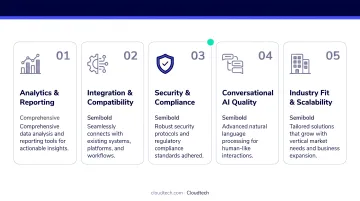
Each criterion ties back to business outcomes. Analytics that track containment rate reduce support staffing costs directly. CRM integrations make chatbot-generated leads visible to sales teams. Deployment speed determines how quickly a business starts seeing return on their investment.
That last point — deployment speed — becomes especially relevant when the underlying infrastructure is a factor. For businesses deploying these platforms on AWS, the chatbot's compatibility with services like Lambda, API Gateway, and Amazon Connect directly affects how quickly integration comes together. Cloudtech, an AWS Advanced Tier Partner, works with SMBs to evaluate, configure, and integrate conversational AI solutions within existing AWS environments, typically completing implementations in weeks rather than months.
Conclusion
The best AI chatbot service isn't the one with the most polished demo. It's the one that gives your team clear analytics and connects cleanly to the systems already running your business — your CRM, helpdesk, or e-commerce platform.
Shortlist two or three tools from this guide. Run a free trial using real business queries, not sample scripts. Evaluate analytics depth and integration reliability before committing. Conversational quality is easy to test; those two factors are what determine whether a tool earns its keep.
If you're deploying an AI chatbot on AWS and need help with integration or infrastructure, Cloudtech's AWS-certified team works directly with SMBs to get implementations right. Reach out at connect@cloudtech.com or call (332) 222 7090.
Frequently Asked Questions
What are the best AI chatbot services with analytics and integration features?
The strongest options are Intercom Fin AI, Zendesk AI, IBM watsonx Assistant, Salesforce Agentforce, and Tidio. The best fit depends on your business size, existing tech stack, and whether analytics depth or integration breadth is the higher priority for your team.
What are the four types of chatbots?
The four main types are rule-based, AI/NLP-based, generative AI (LLM-powered), and hybrid chatbots. According to IBM, most modern platforms with built-in analytics fall into the AI-based or hybrid category.
What analytics metrics should I track in an AI chatbot?
Focus on containment rate (conversations resolved without human escalation), CSAT score, resolution time, escalation rate, and conversation volume by intent. These metrics connect directly to support cost reduction and customer experience — containment rate alone tells you how much labor the bot is actually replacing.
How do AI chatbot integrations work with CRM systems?
CRM integrations let the chatbot pull customer data like purchase history, open tickets, and account status in real time to personalize responses. On the back end, they push conversation outcomes — resolved cases, qualified leads, sentiment scores — back into the CRM, making chatbot activity visible to sales and support teams.
Can AI chatbots be deployed on AWS infrastructure?
Yes. Several platforms support AWS-compatible deployment or integration. Custom-built chatbot solutions can be built natively on AWS using services like Amazon Connect, Lambda, API Gateway, and Amazon Lex. For teams wanting third-party chatbot services running alongside AWS infrastructure, an AWS consulting partner can help design and implement the integration securely.
What is the difference between a chatbot platform and a chatbot service?
A chatbot platform (such as Dialogflow or Amazon Lex) provides tools to build a chatbot from scratch. A chatbot service (such as Intercom Fin AI or Zendesk AI) is a ready-to-deploy product with pre-built analytics, integrations, and support workflows. For most businesses, services are faster to deploy and require less technical overhead to maintain.