Introduction
Voice AI crossed a meaningful threshold in 2026. The tools covered in this guide don't just read text aloud — they listen, interrupt, adapt tone, and respond in under half a second. That's a fundamentally different experience from the delayed, robotic text-to-speech bots that came before.
The problem is that "voice-enabled" means very different things depending on the platform. Many chatbots still run voice as an afterthought — converting text responses to audio after the full reply is generated, resulting in noticeable delays and robotic delivery. For customer support, healthcare intake, or any real conversation, that lag destroys the experience.
According to MarketsandMarkets, the conversational AI market is projected to grow from $17.05B in 2025 to $49.80B by 2031. That growth is driving real investment — but buyer confusion about what "real-time voice" actually means continues to produce costly, underperforming deployments.
This guide covers five platforms that genuinely support real-time, bidirectional voice — and explains who each one is built for.
TL;DR
- Real-time voice AI uses streaming audio, sub-second latency, and semantic turn detection — not just text-to-speech played over a chatbot response
- The five tools covered: ChatGPT (GPT-4o Voice), Gemini Live, Hume AI (EVI), Amazon Lex + Amazon Connect, and Claude Voice Mode
- What differentiates them: Conversational intelligence (ChatGPT), ecosystem depth (Gemini), emotional expressiveness (Hume AI), compliance and scalability (Amazon Lex), and structured reasoning (Claude)
- Best fits: Professionals (ChatGPT), Google Workspace users (Gemini), healthcare builders (Hume AI), regulated AWS deployments (Amazon Lex), legal/compliance teams (Claude)
- For regulated businesses, HIPAA-eligible voice AI on AWS via Amazon Lex and Connect offers the strongest compliance posture; AWS partners like Cloudtech can accelerate deployment
What Sets Real-Time Voice AI Chatbots Apart?
The Technical Definition of "Real-Time"
Not all voice AI is created equal. True real-time voice AI requires four things working together:
- Sub-second latency: time-to-first-byte under 500ms
- Semantic turn detection: understands when a user is done speaking, not just detecting silence
- Interruption handling: lets users cut in mid-response without breaking the conversation
- Bidirectional streaming audio: audio flows both directions simultaneously, not in alternating turns
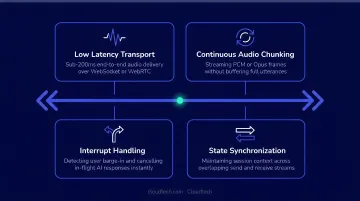
Basic voice-enabled chatbots, by contrast, generate a full text response, then convert it to speech. OpenAI's documentation describes true real-time as "bidirectional audio streaming" — an entirely different architecture.
The Pipeline Problem
Most production voice AI systems use a three-stage cascaded pipeline:
- Speech-to-Text (STT) — transcribes spoken audio
- LLM reasoning — generates the response
- Text-to-Speech (TTS) — converts response to audio
Each stage adds latency. LiveKit's turn detector documentation reports that standard silence-based endpointing waits 0.5–3.0 seconds before triggering a response — a gap users notice immediately.
Newer speech-to-speech models collapse these stages into a single pass. On the Artificial Analysis speech-to-speech leaderboard, Gemini 2.5 Flash Native Audio Dialog clocked 0.63s time-to-first-audio, while GPT-Realtime-2 High came in at 1.14s. Cascaded pipelines remain the production standard for regulated industries due to their reliability and compliance auditability, though that performance gap is closing fast.
Why This Matters in Practice
Those milliseconds carry real business risk. A 2024 Gartner survey found that 53% of customers would consider switching to a competitor if AI handled their service interaction poorly. A half-second delay or a robotic tone is enough to trigger that switch.
For real-world voice AI evaluation, look beyond headline latency numbers. Key criteria include:
- Backchanneling support — does the system acknowledge mid-sentence cues?
- Voice consistency across a full multi-turn session
- Function-calling reliability when the agent needs to retrieve data or trigger actions
- Turn detection quality under noisy or hesitant speech conditions
Best AI Chatbots with Real-Time Voice in 2026
These five tools were selected based on voice naturalness, real-time responsiveness, business integration potential, and overall accessibility for individual and SMB use. Each excels in a distinct scenario.
ChatGPT (GPT-4o Voice Mode)
GPT-4o's "omni" architecture is the most widely adopted real-time voice AI in 2026. Unlike earlier voice implementations that routed audio through separate systems, GPT-4o was trained end-to-end across text, audio, and image — so the model processes spoken input natively rather than as a conversion artifact.
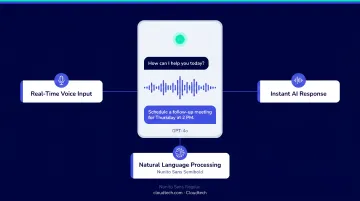
OpenAI reports GPT-4o can respond to audio in as little as 232ms, averaging 320ms — close to human conversational response time. Interruption handling is built into the Realtime API, which uses a persistent WebSocket connection for continuous audio streaming.
What keeps ChatGPT at the top of most comparisons is the combination of voice naturalness and general intelligence. The reasoning quality doesn't degrade in voice mode — it remains the same GPT-4o model handling complex questions, multi-step instructions, and nuanced follow-ups.
| Feature | Details |
|---|---|
| Key Voice Features | Real-time bidirectional voice, interruption support, multimodal (voice + image), natural pacing |
| Pricing | Free tier via GPT-4o mini (2hr/day limit); ChatGPT Plus at $20/month for full GPT-4o voice access |
| Best For | Professionals, students, and teams needing a versatile voice AI for everyday productivity |
Gemini Live
Google's Gemini Live is built for users already living in Google's ecosystem. Where ChatGPT prioritizes general intelligence, Gemini Live prioritizes integration — connecting directly with Gmail, Drive, Calendar, Tasks, Keep, Maps, and more depending on enabled extensions.
The voice experience supports natural interruptions and free-flowing multi-turn conversation. Gemini's updated audio models support live speech-to-speech translation across 70+ languages and 2,000+ language pairs, preserving intonation, pacing, and pitch — a capability that sets it apart for globally distributed teams.
Google made Gemini Live free on Android and iOS in 2025, with advanced features available under Google One AI Premium.
| Feature | Details |
|---|---|
| Key Voice Features | Real-time voice with natural pacing, interruption support, Android-native, Google Workspace integration, 70+ language support |
| Pricing | Free via Gemini app; advanced features in Google One AI Premium at ~$20/month |
| Best For | Android users, Google Workspace-dependent teams, and SMBs wanting voice AI built into existing tools |
Hume AI (EVI)
Hume AI's Empathic Voice Interface (EVI) occupies a category of its own. Every other platform on this list treats the voice layer primarily as input/output infrastructure. EVI treats it as emotionally meaningful data.
EVI analyzes prosody — the tune, rhythm, and timbre of speech — detecting 48+ core emotions and 600+ voice descriptors in real time. Responses are generated using Hume's Octave TTS model, which produces contextually adaptive, expressive speech rather than a flat synthetic voice. The result: a system that adjusts its own tone based on how the user sounds, not just what they say.
That's not a novelty feature. Zendesk's 2025 CX Trends Report found that 64% of consumers are more likely to trust AI agents that exhibit human-like traits such as empathy and friendliness.
In mental health, patient intake, and emotionally sensitive customer care, that distinction separates adoption from abandonment. A Hume case study involving a therapy support platform reported 40% reduction in administrative work and 2x engagement compared to text-based systems.
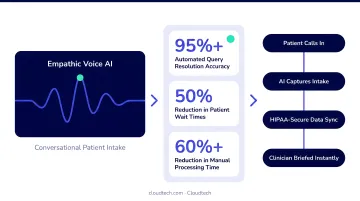
Developers access EVI through WebSocket and REST endpoints, with options to integrate external LLMs (including OpenAI or Anthropic) and build custom voice personas.
| Feature | Details |
|---|---|
| Key Voice Features | Real-time emotion detection, expressive TTS (Octave), WebSocket API, voice persona customization, 48+ emotion categories |
| Pricing | Free tier available; $0.072/minute usage-based API pricing; enterprise custom pricing |
| Best For | Developers and businesses building empathy-aware voice agents for healthcare, wellness, or sensitive customer support |
Amazon Lex with Amazon Connect
For businesses that need production-grade, compliant, customizable voice AI — not a consumer product adapted for enterprise — Amazon Lex with Amazon Connect is the serious option.
Amazon Lex handles the conversational AI layer (STT, NLU, response logic). Amazon Connect provides the telephony infrastructure: inbound and outbound call routing, queue management, and agent handoff. The same bot logic handles both voice and chat from a single configuration, which reduces maintenance overhead.
Compliance is where this stack stands out. Both services are covered under AWS's HIPAA BAA, making them eligible for healthcare deployments involving protected health information. The AWS ecosystem also supports Lambda-based integrations with:
- Salesforce and Zendesk for CRM data lookup mid-conversation
- Custom workflows triggered by call outcomes
- Amazon Connect agent handoff with full conversation context passed through
Pricing is pay-as-you-go: $0.004 per speech request for Lex, and $0.038/minute for Amazon Connect voice — no upfront commitment, which makes it genuinely accessible for SMBs. A Forrester TEI study commissioned by AWS found composite organizations achieved 342% ROI over three years using Amazon Connect.
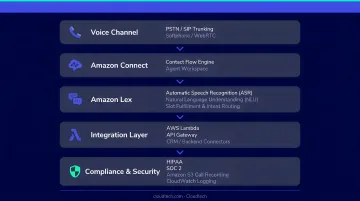
For SMBs in healthcare, financial services, or regulated industries, the configuration complexity is real. AWS partners like Cloudtech handle the architecture, compliance setup, and integration work, compressing a months-long project into weeks.
| Feature | Details |
|---|---|
| Key Voice Features | Real-time voice + chat from one bot config, AWS ecosystem integration, telephony via Amazon Connect, HIPAA-eligible |
| Pricing | $0.004/speech request (Lex) + $0.038/minute (Connect voice); limited free tier for new AWS accounts |
| Best For | SMBs and enterprises on AWS needing compliant, customizable real-time voice AI for customer service or internal support |
Claude (Voice Mode)
Anthropic's Claude brought voice interaction to a model already known for structured reasoning and low hallucination rates. The use case is more specific than ChatGPT's general-purpose voice mode — Claude Voice is strongest where precision matters more than personality.
For legal teams reviewing contracts, compliance officers working through regulatory questions, or healthcare administrators navigating complex documentation, Claude's long-context retention (up to 1M tokens on supported models) means it can hold extensive background information across a voice session without losing thread.
The Anthropic Trust Center lists SOC 2 Type 2, ISO 27001, HIPAA, and other certifications. Zero Data Retention arrangements are available for organizations that need assurance their voice session content isn't stored.
The tradeoff is conversational warmth — Claude's voice style is clear and precise, not casual. That's a feature for the right audience, not a limitation.
| Feature | Details |
|---|---|
| Key Voice Features | Voice interaction with long-context reasoning (up to 1M tokens), low hallucination rate, enterprise privacy controls (SOC 2, HIPAA) |
| Pricing | Free tier (limited); Claude Pro at $20/month; enterprise plans with custom pricing |
| Best For | Legal, compliance, and strategy teams needing a reliable, precise voice AI for structured professional conversations |
How We Chose These AI Voice Chatbots
The Evaluation Framework
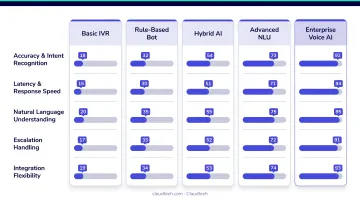
Tools were assessed across five dimensions:
- Real-time latency — time-to-first-byte and interruption handling under realistic conditions
- Voice naturalness — turn detection quality, emotional tone, and consistency across a 10+ minute conversation
- Integration flexibility — API access, business tool connectors, and AWS compatibility
- Privacy and compliance posture — HIPAA eligibility, data residency options, audit trail availability
- Total cost of ownership — pricing at SMB scale, not just per-request rates
A common mistake in voice AI evaluation is testing demos rather than extended conversations. A two-turn demo will almost always sound impressive. The quality gap between platforms surfaces in turn 8, when the conversation branches, a user interrupts, and the system needs to hold context across a topic change.
Why Compliance Was Weighted Heavily
For regulated industries — healthcare, financial services, manufacturing — compliance is a prerequisite, not an afterthought. A platform that can't sign a BAA or support data residency requirements isn't saving you money; it's creating liability.
Only platforms with streaming audio, sub-second response architecture, and bidirectional conversation support qualified for this list. Platforms that generate audio from text post-response were excluded regardless of brand recognition.
That exclusion criterion matters most for SMBs in regulated sectors, where implementation and compliance configuration need to be scoped together — not treated as separate workstreams. Cloudtech's AWS-certified architects specialize in configuring Amazon Lex and Connect environments for healthcare and financial services SMBs, building compliance requirements into the architecture from the start rather than retrofitting them after launch.
Conclusion
The five platforms in this guide differ in ways that matter — latency, emotional expressiveness, integration depth, and compliance readiness are not interchangeable features. Here's where each one stands:
- ChatGPT GPT-4o Voice delivers the broadest conversational intelligence
- Gemini Live wins on ecosystem integration
- Hume AI EVI is the only platform that actually listens to how you sound
- Amazon Lex with Amazon Connect offers the most defensible path to enterprise-grade, compliant voice AI
- Claude handles structured professional reasoning better than any other voice model available
Before committing to a platform, run extended multi-turn voice sessions — not quick demos. Audit your data governance requirements. Calculate costs at your actual call or session volume, not the lowest-tier rate.
If your business operates in a regulated industry and needs a compliant, customized AWS-based voice AI solution, Cloudtech's team of AWS-certified architects and former AWS professionals can design and implement the right setup — starting with a structured discovery session to map your requirements before any configuration begins. Reach out at connect@cloudtech.com or call (332) 222-7090 to start the conversation.
Frequently Asked Questions
What is the difference between a voice-enabled chatbot and a real-time voice AI chatbot?
A voice-enabled chatbot converts a fully generated text response into audio after the fact — adding latency and producing unnatural pacing. Real-time voice AI streams audio bidirectionally, uses semantic turn detection to know when you've finished speaking, and handles interruptions mid-sentence.
Which AI chatbot has the most natural-sounding real-time voice in 2026?
It depends on your use case. Hume AI (EVI) leads on emotional expressiveness, adapting tone based on how the caller sounds. ChatGPT (GPT-4o) is the most consistently natural across general conversations, while Gemini Live feels most fluid on Android with strong multilingual pacing.
Can real-time AI voice chatbots be integrated with business systems like CRMs or help desks?
Yes. Amazon Lex (via AWS Lambda and Amazon Connect) integrates with Salesforce, Zendesk, and other backend systems mid-conversation, while Claude and ChatGPT support API-based integrations. Integration depth varies by platform and almost always requires technical setup — for AWS-based deployments, working with an AWS partner typically accelerates the process considerably.
What is the typical latency for real-time AI voice chatbots in 2026?
Production-grade cascaded pipelines (STT + LLM + TTS) typically target time-to-first-byte under 500ms. Independent benchmarks show Gemini 2.5 Flash Native Audio at 0.63s and GPT-Realtime-2 at 1.14s time-to-first-audio. Latency varies based on model size, infrastructure region, and network conditions.
Do AI chatbots with real-time voice allow explicit or sexual content?
No. All five platforms covered — ChatGPT, Gemini Live, Hume AI, Amazon Lex, and Claude — enforce strict content moderation policies prohibiting explicit and sexual content. Enterprise deployments add additional governance controls and audit logging on top of platform-level restrictions.
How should SMBs evaluate AI voice chatbot options for customer-facing use?
Prioritize three factors: latency and voice naturalness in live multi-turn sessions (not demos), compliance readiness for your industry, and integration compatibility with your existing stack. For regulated sectors, a managed AWS-based deployment via Amazon Lex and Connect offers a faster, more defensible path to production than building custom infrastructure from scratch.