Introduction
When a customer contacts your support team, the clock starts immediately. According to Salesforce research on connected customer expectations, 83% of customers expect immediate engagement when they reach out — and 70% will choose not to buy from a company with long wait times. Long wait times aren't just a satisfaction issue — they're directly costing businesses sales.
Yet most businesses experiencing long queues treat it as a staffing problem, adding headcount to backlogs that smarter automation and better infrastructure could handle at a fraction of the cost.
This article breaks the problem into three layers — decisions made before deployment, management choices made during operations, and the infrastructure the whole system runs on. For each layer, you'll find concrete strategies using AI chatbots and virtual agents to reduce wait times at the source.
Key Takeaways
- 83% of customers expect immediate responses — long waits directly reduce purchase intent and increase churn risk
- Four cost drivers inflate wait times: repetitive queries, after-hours gaps, poor routing, and fragmented channel data
- AI reduces wait times through three mechanisms: deflection of Tier 1 volume, faster routing, and 24/7 coverage
- Effective deployment starts with scoping the right query types before rolling out broadly
- Cloud-native infrastructure — not just the chatbot — determines whether your AI support stack holds under demand spikes
How Wait Time Costs Build Up in Customer Support
Wait time costs don't appear as a single line item on a P&L. They build up across four interconnected drivers:
- Repetitive queries clog the same queue as urgent issues — Salesforce projects AI will resolve 30% of service cases by 2025 and 50% by 2027, yet most queues still process these manually
- After-hours gaps create predictable backlog spikes — Monday morning queues absorb everything that arrived over the weekend unanswered
- Unresolved first contacts generate repeat contacts — low first-contact resolution directly multiplies inbound volume
- Satisfaction erodes while customers wait — the CFI Group's 2022 Contact Center Satisfaction Index put overall satisfaction at just 69/100, down three points from 2020
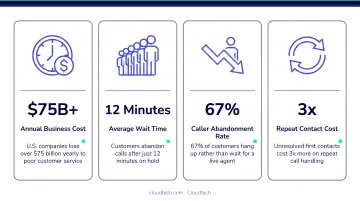
Each of these drivers is manageable in isolation. Together, they create a structural backlog that stays invisible until a stress event — a product launch, a service outage, peak season — exposes it all at once. When that happens, delays hit brand perception and retention across the board.
One number illustrates the structural depth of the problem: Gartner reports the average self-service support success rate is only 14%. That figure isn't primarily a technology problem. It points to poor knowledge base quality, unclear escalation paths, and self-service tools launched before the underlying content was ready.
Key Cost Drivers Behind Long Customer Support Wait Times
Three forces push wait times upward, and they interact in ways that make partial fixes ineffective.
Volume Mix Mismatch
High-volume, low-complexity queries — password resets, order status, basic FAQs — compete for attention in the same queue as urgent escalations. Simple issues create delays for complex ones, and agents spend the majority of their day on work that automation could handle.
Staffing Model Rigidity
Fixed headcount cannot flex during demand spikes without proportional cost increases. A business with ten support agents during normal periods needs a fundamentally different architecture — not ten more agents — to handle three times the volume during peak season.
Channel Fragmentation
Salesforce found 76% of customers expect consistent interactions across departments, yet 54% report that sales, service, and marketing generally don't share information. When customer history doesn't travel across channels, agents spend time reconstructing context. Customers repeat themselves. Resolution times stretch.
There's also the 24/7 coverage gap. Zendesk's CX Trends 2026 report found 74% of consumers now expect customer service to be available around the clock — a direct result of AI making that expectation feel reasonable. Businesses still operating on a 9-to-5 model are guaranteed to build backlog every night.
These drivers don't operate in isolation. Adding headcount without fixing routing inefficiency doesn't reduce average handle time. Deploying a chatbot without unified customer data forces more escalations, not fewer. The fix has to address all three layers.
Cost-Reduction Strategies for AI-Powered Customer Support
Deploying an AI chatbot is not the same as solving a wait time problem. The strategy behind the deployment — what gets automated, how handoffs work, and where the system runs — determines whether wait times actually fall.
Strategies That Change Implementation Decisions
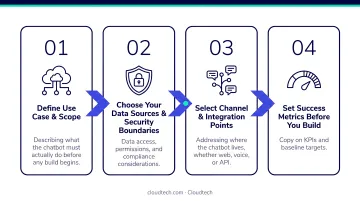
These decisions happen before go-live. Getting them right determines whether the chatbot reduces load or creates new frustration.
Automate the highest-volume, lowest-complexity query types first — order status, password resets, appointment confirmations, billing checks. Automating edge cases at launch produces poor deflection quality and increases escalations.
Consolidate and validate your knowledge base before any bot goes live. Inconsistent or outdated source material generates incorrect AI responses — which is why Gartner research on self-service success rates consistently points to knowledge base accuracy as the primary failure point.
Define escalation triggers upfront: low confidence scores, detected frustration, high-stakes categories like billing disputes or cancellations. Every handoff should pass full conversation context to the agent — no summaries, no starting over.
Choose an omnichannel-compatible platform from day one. A chatbot that only works on your website cannot reduce wait times across email, social media, and messaging apps — and inconsistent responses across channels undo whatever gains you've made.
Strategies That Change How Support Is Managed
Once the system is live, management discipline determines whether gains are sustained or gradually eroded.
Pair deflection rate with a 72-hour recontact rate. Deflection only measures whether a conversation ended without human involvement — not whether the issue was resolved. If customers contact you again within three days, the AI ended the conversation without actually solving anything.
Use intelligent routing to cut manual triage. AI that classifies tickets by intent, urgency, and topic before assignment eliminates the read-and-categorize step that adds minutes to every interaction. Zendesk's intelligent triage documentation shows automatic classification by topic, sentiment, and language as a standard capability.
Treat 24/7 AI coverage as a structural fix, not an add-on. After-hours gaps create predictable Monday backlog spikes. Closing those gaps with AI is the most direct way to reduce average first response time without changing daytime staffing.
Review escalated and unanswered conversations regularly. These are the clearest signal of knowledge gaps. If the same topics consistently escape the AI, fixing them reduces the volume requiring human intervention and shortens resolution times over time.
Strategies That Change the Infrastructure Underneath It
In many deployments, the bottleneck isn't the chatbot — it's what the chatbot runs on and connects to.
- Deploy on cloud-native infrastructure built for elastic scaling. AI support systems on under-provisioned infrastructure introduce new wait time problems at the exact moment demand spikes — the opposite of the outcome you need. AWS services like Amazon Lex and Amazon Connect handle thousands of simultaneous conversations without degradation.
Cloudtech, an AWS Advanced Tier Partner, helps SMBs architect and deploy these environments quickly, without the overhead typically associated with enterprise-scale implementations.
Integrate the AI directly with CRM and ticketing systems. Without live access to account data and order history, the chatbot cannot resolve transactional inquiries on its own — and every unnecessary escalation adds wait time. A chatbot that pulls order status from a live CRM record resolves in seconds; one that can't will escalate every time.
Pre-scale infrastructure before peak periods, not during them. AWS's Amazon Connect guidance on contact spikes makes this clear: reactive provisioning after Black Friday has already started arrives too late. Size for anticipated peak load in advance.
Conclusion
AI does reduce customer support wait times — when the deployment is treated as a system design problem, not a plug-and-play install. Businesses that see real, lasting results typically get four things right:
- Scope automation to the right query types from the start
- Build clean, well-structured knowledge sources
- Design escalation logic before launch, not after
- Run on infrastructure that absorbs demand without degrading
Businesses that deploy a chatbot and expect wait times to drop on their own usually find results plateau — or, in poorly scoped implementations, worsen for certain query types.
The gains are real when the approach is structured. Salesforce's 2025 State of Service survey found organizations using AI agents expect an average 20% decrease in customer wait times — a figure that reflects well-implemented deployments, not off-the-shelf tools dropped into unprepared environments.
If you're evaluating an AI-powered customer support environment built on AWS, Cloudtech works with SMBs to design, deploy, and train these systems from the ground up — including escalation logic, CRM integration, and elastic infrastructure. Reach out to start the conversation.
Frequently Asked Questions
What is the difference between an AI chatbot and a virtual agent?
Chatbots typically handle scripted, single-turn FAQ exchanges — they respond to a specific trigger with a pre-written answer. Virtual agents use natural language processing and contextual memory to hold multi-turn conversations and handle more complex requests. The line between them is blurring as conversational AI capabilities advance.
How much can AI chatbots realistically reduce customer support wait times?
A defensible planning range is 30%–65% of queries resolved without human involvement for well-scoped deployments, with Salesforce projecting an average 20% reduction in wait times from AI agent use. Results depend heavily on query scope, knowledge base quality, and system integration depth.
How do AI chatbots know when to escalate to a human agent?
Escalation triggers include low confidence scores, detected frustration, explicit customer requests, or pre-configured high-stakes topics like billing disputes or legal concerns. Every handoff should pass full conversation context to the receiving agent — no repeated intake, no lost history.
What metrics should I track after deploying an AI customer support chatbot?
Track first response time (FRT), ticket deflection rate, average resolution time, CSAT, and a 72-hour recontact rate. The recontact rate is the most important validation metric — it tells you whether deflected conversations were actually resolved or just ended.
Which industries see the greatest benefit from AI virtual agents in customer support?
Financial services, retail and e-commerce, SaaS, and healthcare consistently see the highest gains. What they share: large volumes of repetitive, structured inquiries — account lookups, order tracking, billing questions, appointment scheduling — that AI handles reliably at scale.
How long does it typically take to deploy an AI chatbot for customer support?
Timelines range from days for lightweight FAQ bots to several weeks or months for fully integrated, omnichannel deployments with CRM and ticketing system connections. Cloud-native platforms with pre-built connectors shorten time-to-value significantly compared to fully custom-built solutions.