Key Takeaways
- Drive-thrus account for roughly 70% of sales at top QSR brands, yet most still process orders manually
- Labor and food costs each consume up to 33% of QSR revenue, making automation a financial necessity
- Wendy's FreshAI handles 86% of orders without employee intervention; White Castle reports ~90% order completion
- AI upsell prompts achieve an 88% offer rate with over 46% customer acceptance (CKE/Presto pilot)
- Cloud-based AI deployments let QSR chains roll out voice ordering across hundreds of locations without rebuilding infrastructure from scratch
What Is Conversational AI for Quick Service Restaurants?
Conversational AI is software that uses Natural Language Processing (NLP) and Automatic Speech Recognition (ASR) to understand what someone actually means — not just detect keywords. That distinction matters in a QSR environment, where background fryer noise, regional accents, and compound orders like "a large combo, no pickles, swap the regular soda for diet" are everyday reality.
A basic rule-based chatbot would struggle with that order. Conversational AI parses the full sentence for intent, handles modifications, and confirms the result in real time.
Where It's Deployed in QSR Settings
| Channel | How It Works |
|---|---|
| Drive-thru voice | Greets customers, captures spoken orders, and routes confirmed items to the KDS |
| Phone ordering | Handles inbound calls end-to-end, from order capture to verbal read-back |
| Mobile app / chat | Text-based ordering with natural language input |
| Self-service kiosks | Interprets spoken or typed modifications, including substitutions and special requests |
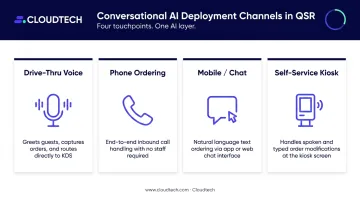
The same underlying NLP engine powers all four channels. What changes is the interface — voice or text — not the model doing the work. That distinction becomes relevant when evaluating vendors, since a strong platform should handle both without requiring separate systems.
Chatbot vs. Conversational AI: The Practical Difference
Rule-based bots follow scripts. If a customer says something the script doesn't anticipate, the interaction breaks. Conversational AI handles open-ended requests, remembers context within a session ("actually, make that two of those"), and gets better over time as it accumulates more interaction data — which means a system deployed in January is measurably more accurate by Q3.
Why QSRs Need Conversational AI Right Now
The economics are pressing. Labor and food expenses each consume up to 33% of QSR revenue, leaving operators with razor-thin margins on every transaction. Add rising minimum wages and persistent difficulty filling peak-hour shifts, and the staffing math gets harder every year.
The volume at stake makes even small efficiency gains significant. Drive-thrus historically generate about 70% of sales at top QSR brands. Marginal improvements in accuracy, speed, or upsell rate — multiplied across millions of transactions — translate directly to the bottom line.
What Customers Actually Expect
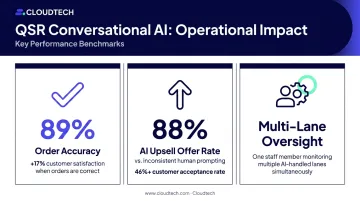
Those economic stakes connect directly to customer experience. Intouch Insight's 2024 mystery-shopping study found overall QSR order accuracy at 89% — up from 86% in 2023, but still meaning roughly 1 in 10 orders has an error. The same report found customer satisfaction 17% higher when an order was accurate.
Beyond accuracy, customers expect:
- Mobile payment capability at the window
- Nutritional information on demand
- Personalized recommendations based on past orders
- Consistent service quality regardless of time of day
Peak-hour staffing pressure makes delivering all four reliably difficult. Conversational AI addresses each one at the system level — not dependent on who's working the window that afternoon.
Key Use Cases of Conversational AI in QSRs
The most successful QSR deployments start with one high-impact channel and expand from there. Here's what that looks like in practice.
Automated Drive-Thru Voice Ordering
AI voice assistants take orders at the drive-thru without human involvement. The system greets customers, processes multi-item orders with modifications, confirms the order verbally, and passes a clean digital order directly to the kitchen display — no transcription errors, no "I'll need to repeat that."
Real deployments are proving this out:
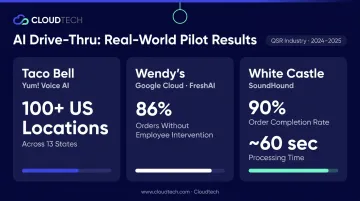
- Taco Bell (via Yum! Brands' proprietary Voice AI) was live at more than 100 US drive-thrus across 13 states by July 2024, targeting hundreds more by year-end
- Wendy's FreshAI (built on Google Cloud) handled an average of 86% of orders without employee intervention in early pilots
- White Castle (using SoundHound) reported approximately 90% order completion with orders processed in about 60 seconds
McDonald's ended its IBM-powered voice AI test in June 2024 after achieving roughly 85% accuracy — a reminder that the technology is still maturing, but also that major chains are actively learning from each iteration.
AI-Powered Phone Order Automation
Phone ordering is chronically understaffed. Calls go unanswered during rushes; staff who do answer are pulled away from other tasks. AI eliminates both problems: the system answers every call instantly, takes the full order in natural conversation, reads it back for confirmation, and routes it directly to the POS — handling unlimited concurrent calls simultaneously.
The scale of adoption tells its own story:
- SoundHound processed more than 100 million cumulative restaurant phone interactions by October 2024
- Chipotle expanded AI phone ordering to approximately 1,800 locations by mid-2019
That call-handling capacity also creates a reliable upsell window. Because the AI never skips its prompting logic — even during a rush — the "Would you like to add a dessert?" offer gets made on every single call, not just the ones staff have bandwidth for.
Personalization and AI-Driven Upselling
Conversational AI connected to a loyalty database can greet returning customers by name, suggest their usual order, and recommend relevant new items based on past behavior. The appetite for this among customers is real: survey data found 27% of consumers want an ordering system that remembers their order history.
The upsell results from CKE (Carl's Jr. and Hardee's) and Presto provide the clearest benchmark available:
- 88% upsell offer rate — the AI prompted an upsell in nearly every interaction
- More than 46% of customers accepted those offers
CKE reported increased check sizes and revenue as a result, though the exact ticket lift wasn't disclosed. Consistent AI prompting simply outperforms human staff who skip the upsell when slammed — which is most of the time.
Back-of-House and Operational AI
Conversational AI isn't limited to the customer-facing side. Staff can use an AI assistant to handle tasks that typically eat into manager time:
- Query current inventory levels in plain language, without pulling up a spreadsheet
- Receive automated reorder prompts when stock drops below set thresholds
- Get shift scheduling recommendations optimized around historical traffic patterns
These applications reduce managerial overhead and help operators staff smarter during peak periods.
Benefits of Conversational AI for QSR Operators
Lower Labor Costs Without Reducing Service Quality
One team member monitoring multiple AI-handled drive-thru lanes or phone lines simultaneously replaces the traditional one-person-per-lane model. Wendy's, CKE, and others have characterized this as labor redeployment rather than headcount reduction — freeing staff to focus on food prep and hospitality rather than order-taking.
No exact labor savings percentage has been publicly disclosed by QSR operators, but the operational logic is straightforward: fewer order-taking roles needed during peak hours means lower hourly labor spend per transaction.
Fewer Errors, Fewer Refunds
AI records exactly what the customer says, confirms it back, and sends a precise digital order to the kitchen. There's no mishearing "no onions" as "with onions" during a noisy rush. According to QSR industry benchmarks, satisfaction is 17% higher when orders are accurate — and current industry accuracy sits at 89% — so even closing half that gap represents meaningful improvement in customer retention.
24/7 Availability Across Locations
AI performs identically at 2 AM on a Tuesday as it does at noon on a Saturday. For franchise operators, the same AI model can deploy across hundreds of locations simultaneously with consistent quality — something human staffing struggles to replicate at scale. Late-night and early-morning shifts are frequently the hardest to fill. AI doesn't have that problem.
Richer Customer Data
Every AI-handled interaction generates structured data: what was ordered, when, which upsells were accepted, how long the interaction took. This feeds directly into:
- Menu optimization decisions
- Promotional targeting
- Staffing model refinements
- Loyalty program personalization
Manual operations capture fragments of this at best — and rarely in a format that connects across locations or time periods.
How to Implement Conversational AI in Your QSR
Step 1: Audit Your Current Tech Stack
Before selecting any AI solution, map your existing POS system, loyalty platform, kitchen display system, and drive-thru hardware. Conversational AI only delivers value when it connects cleanly to these systems — an isolated AI that can't push orders to the POS creates more problems than it solves.
Key questions to answer during this audit:
- Does your POS expose an API for third-party order injection?
- Is your loyalty platform capable of real-time data exchange?
- What's the latency tolerance of your kitchen display system?
This is also where AWS cloud architecture decisions matter. The right cloud foundation determines whether your AI system can scale across locations, integrate with your existing data layer, and update centrally — all without re-engineering each site individually.
Step 2: Select the Right Deployment Channel First
Pilot conversational AI on the highest-volume, most friction-prone channel — usually the drive-thru or phone line. Define clear KPIs before launch:
- Order accuracy rate
- Average handle time
- Upsell acceptance rate
- Concurrent call/lane capacity
A focused pilot with measurable proof of ROI is far easier to justify for franchise expansion than a broad multi-channel rollout from day one.
Step 3: Choose Cloud-Based AI Infrastructure Built to Scale
Cloud-based deployment beats on-premise hardware for most QSR operators because:
- AI model updates deploy centrally across all locations simultaneously
- Capacity scales elastically during lunch and dinner rushes
- Integration with analytics and CRM platforms is straightforward
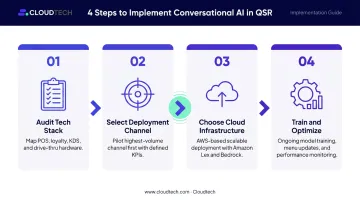
AWS services form a strong foundation here. Amazon Lex provides managed conversational interfaces with ASR and NLU; Amazon Bedrock supplies generative AI capabilities for more complex interactions. For operators who want to move quickly without deep in-house engineering, working with an AWS Advanced Tier Partner like Cloudtech can compress deployment timelines — Cloudtech's team helps QSR operators build the cloud infrastructure, data pipelines, and AWS service integrations that underpin these AI systems.
Step 4: Train, Monitor, and Continuously Optimize
AI maintenance is ongoing, not one-time. The model needs:
- Training on your specific menu, including seasonal items, modifiers, and local offerings
- Testing across accent variations and noisy environments
- Regular updates as the menu changes
AI performance improves as it accumulates real interaction data. A model that starts at 86% non-intervention — like Wendy's early drive-thru pilot — gets measurably better over time, not worse.
Common Challenges and How QSRs Overcome Them
Legacy POS Integration
Many QSRs run on older systems that weren't built with API connectivity in mind — making POS integration the most common deployment obstacle. Require proof of compatibility before committing to any AI vendor, and budget for middleware or custom integration work where needed. Most enterprise-grade platforms offer integrations with Oracle MICROS, PAR Technology's Brink, and Toast, but compatibility must be verified against your specific version.
AI-to-Human Handoff
AI will occasionally encounter an order too complex or ambiguous to handle alone. A well-designed system detects this and escalates to a human team member without the customer having to repeat themselves. That handoff doesn't happen by default — it requires intentional workflow design, not just AI capability.
Data Privacy and Compliance
Conversational AI systems that store customer order history and dietary preferences carry real compliance risk. They fall under state-level privacy laws and PCI requirements for payment data. Operators must ensure their chosen solution provides:
- Clear data governance controls
- Consent mechanisms for personalization features
- Role-based access controls on stored interaction data
Frequently Asked Questions
What is the difference between a chatbot and conversational AI for QSRs?
Chatbots follow pre-set scripts triggered by keywords — if the customer says something unexpected, the interaction fails. Conversational AI uses NLP to understand intent, handle complex modified orders naturally, and improve with experience. In QSR environments where every order varies, conversational AI handles that unpredictability; scripted chatbots cannot.
How does conversational AI handle customized or complex orders at drive-thrus?
Modern systems parse the full sentence for meaning rather than matching individual words. A request like "large combo, no pickles, add jalapeños, diet soda instead" is processed as a complete instruction set, confirmed back to the customer, and flagged for clarification if anything is ambiguous — rather than guessing and getting it wrong.
Can conversational AI integrate with existing QSR POS systems?
Most enterprise-grade platforms offer integrations with major providers including Oracle MICROS, PAR Technology's Brink, and Toast. Compatibility must be verified before deployment, and middleware may be needed for older systems. Requiring a working integration demo before contract signing is a reasonable standard.
How long does it take to implement conversational AI in a QSR?
A single-channel pilot — phone ordering is the most common starting point — typically goes live in 4–8 weeks. A full multi-channel rollout across franchise locations takes 3–6 months, depending on POS integration complexity and location count.
What are the ongoing costs of maintaining a conversational AI system?
Costs include platform licensing or usage-based compute fees, integration maintenance, and periodic model retraining for menu updates. Operators should weigh these against labor savings and upsell revenue — CKE's results (88% offer rate, 46%+ acceptance) indicate the revenue lift alone can justify the investment at scale.
Which QSR brands are already using conversational AI?
Several major chains are already live:
- Taco Bell — 100+ US drive-thrus via Yum!'s Voice AI
- Wendy's — FreshAI on Google Cloud
- White Castle — SoundHound Dynamic Drive-Thru
- Chipotle — AI phone ordering at scale
- Domino's — voice and text AI ordering
Adoption is accelerating across large chains and independent operators alike.